HOW TO BUILD BRICK CARS
DETAILED LEGO? DESIGNS FOR SPORTS CARS, RACE CARS, AND MUSCLE CARS PETER BLACKERT
Section 1: Foundation
1932 Ford V-8 Coupe & Roadster 10 Ferrari 488 GTB & 488 Spider 16 Citroën 2CV Charleston 30 Jaguar E-Type Coupe & Roadster 38

Section 2: Intermediate
2017 Ford F-150 Raptor 52
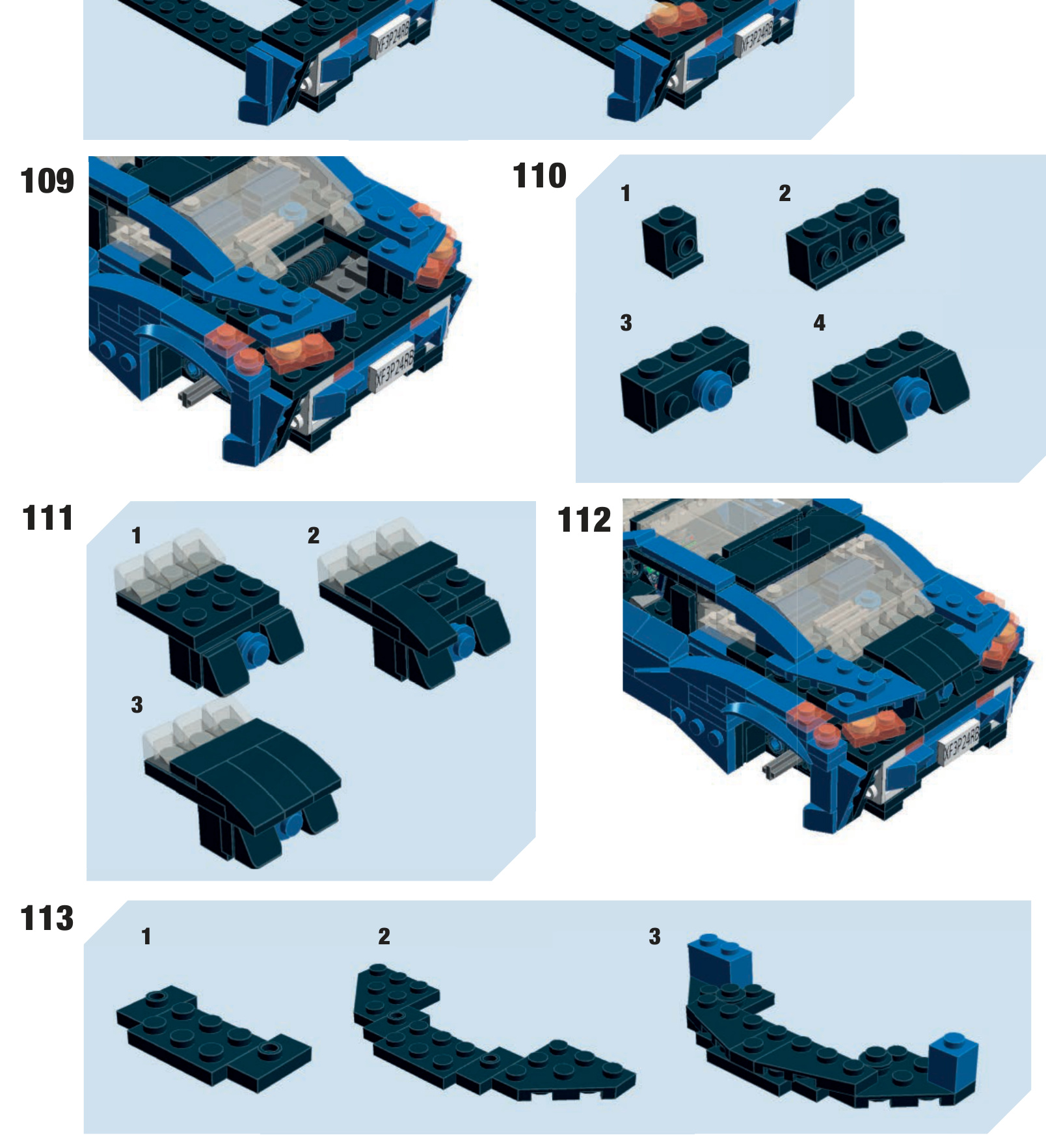
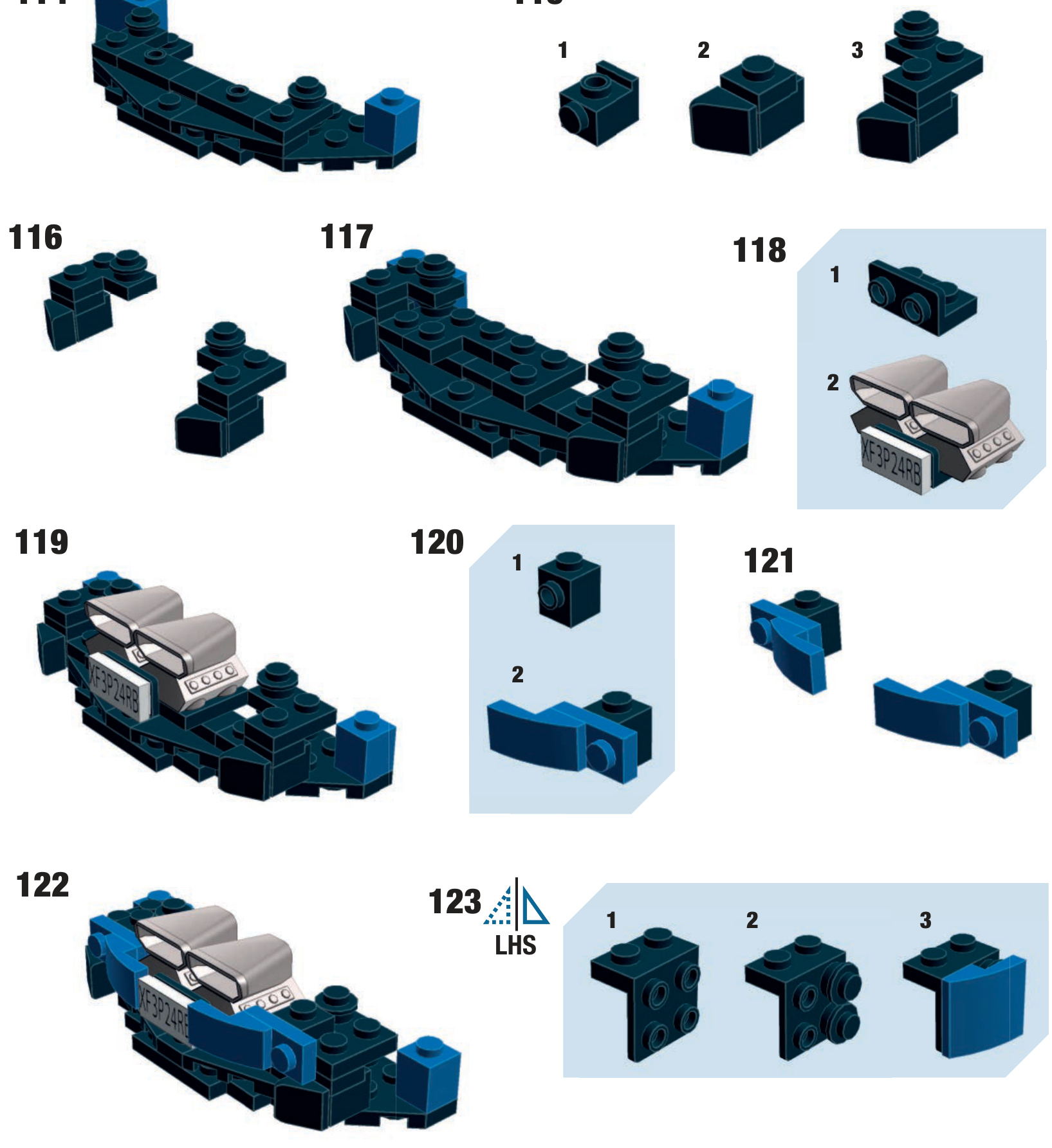
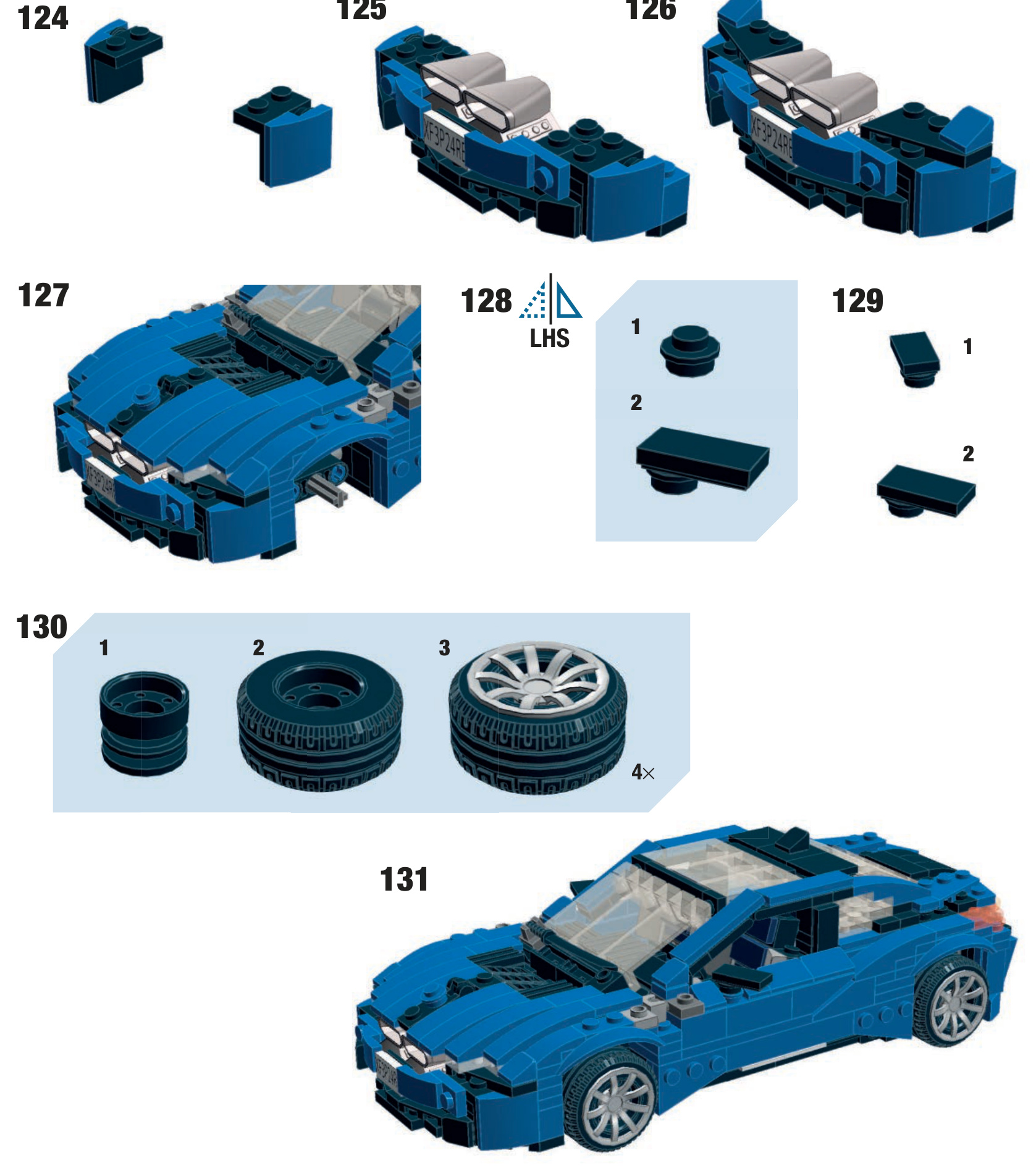
Datsun 240Z Coupe 70 Ferrari 250 GT SWB California Spyder 86 BMW i8 Hybrid Coupe 102 Porsche 911 Carrera 2.7 RS 122
Section 3: Advanced
1971 Plymouth HEMI ’Cuda 140 2016 Ford GT Le Mans Racer 158 Bugatti Veyron EB 16.4 176
Resources 191
About the Author 192
P R E FAC E
W thratnisfoitrtmhat vder tvecshanoflaosgciynoaft tohnettoweanrtdiectharcse?nFtuary.mTohre tcharnwjruasptsaumpetcwhoanciecnatluhrioers eo,ftahdevcaanrcehsasinbseceinenthce
The automobile is the driver of so many technological changes in our lives—we are more likely to have frst had a computer in our car than in our house. And unless you have fown to the moon, your car was probably the frst product you’ve been in that was designed on computer too.
Whole societies have been transformed by the automobile, which fueled the growth of cities, highways, shopping malls, and suburbs. From its origins in late-nineteenth-century Europe during the Industrial Revolution, the car has also come to represent our hopes and dreams. Postwar American optimism was refected in gleaming two-tone paint, rocket pods, towering fns, and chrome.
It is sports cars, muscle cars, and race cars, though, that feed high-octane excitement into our bloodstreams. Power, noise, speed, and fast, fast styling are mechanical interpretations of our fears of and appreciation for the animals that lurk, linger, and growl. Dangerous animals with claws, teeth, and talons. Animals we’re warned about and that haunt our dreams. Automotive history is flled with cars named after these animals—Pantera (panther), Bronco, Cobra, Stingray, and Viper. (Section 3 of this book includes the Plymouth Hemi ’Cuda—the wildest of the wild muscle cars from the early 1970s.)
The industry that creates these cars has drawn in passionate artists, stylists, engineers, marketers, and visionary dreamers. Men and women pour their sweat and tears in pursuit of a hero vehicle—cars that set our imaginations alight. These hero vehicles can be found on posters on teenagers’ bedroom walls, on the screensavers of coworkers, and polished to perfection in the garages of car enthusiasts the world over.
In How to Build Brick Cars, I hope to bring these cars to life in 3-D brick form: cars made from LE bricks. In creating the cars for this book, I have drawn on a small portion of the thousands of brick vehicles I have built over the years, married to more than a decade of automotive design engineering at the Ford Motor Company.
LEGO has been instrumental in developing the skills now termed STEM or STEAM—creative skills in science, technology, engineering, art, and mathematics—of people in diverse, exciting careers, including those who design and develop cars.
LEGO has been part of my own experience in developing these skills and applying them to my own specialist feld of advanced vehicle architecture.
These are some of the most signifcant sports cars, muscle cars, and race cars over the past one hundred years. I hope you enjoy building them as much as I have designing them.
Best Regards, Peter Blackert
W H Y B U I L D B R I C K C A R S ?
D eople often ask me what I do for a living—a normal question when you meet someone for the frst time. I respond in any number of ways: “I work for Ford,” or “I am a car design engineer,” or something similar. If I give them my real job title, they just stare at me blankly, sometimes even when the question is asked by one of the engineers who works in
the same building.
When it comes to discussing what I do for fun, the idea that an adult designs cars made from L bricks is perhaps a bit more unusual. Kids, of course, think this is a fantastic hobby.
The next question is, “Why?”
Again, there is always more than one answer.
I build cars from LEGO because it is a relaxing and enjoyable creative pastime.
But I also build cars from LEGO because it allows me to quickly solve problems that I encounter when I design real vehicles, in a way that’s much less expensive and time-consuming. It allows me to demonstrate the solutions in a 3-D interactive form that people can see and hold. LEGO is not a static object either. The suspension systems used in this book in the Intermediate and Advanced sections rely on the engineering properties of LEGO that are poorly understood and seldom exploited, properties that exist in all materials and that we rely on every day without appreciating their signifcance.
For further reading, I suggest researching “torsion bars”—the spring method used in this book—along with “elastic properties of materials.” These subjects are usually frst encountered at a college or university, but the opportunity to experience them in a LEGO-built model can provide invaluable insight.
It may come as a surprise, but the chief practice of engineering is to solve problems. If there are no problems to solve, I don’t have a job to do. Thankfully (I guess?) there seems to be an overabundance of problems to solve, even if we are challenged to make “minor” changes to a vehicle that we designed a couple of years earlier. Real vehicle engineering is like this—the various stakeholders (corporate, government, customer, and manufacturing) all move the goal posts forward in pursuit of a better car, whether it’s in regards to safety, environmental pollution, comfort, cost, convenience, or features. Cars are pretty complex, and understanding how everything works together is challenging—we create models in one form or another all the time to try to simplify the concepts and appreciate their interactions.
When you can build your world in LEGO, you can create models of your problems as well as models of your solutions.
This is also true of felds outside automotive engineering. LEGO has always had an architectural focus, and LEGO robotics sets have added problem-solving with software code, sensors, motors, and gears to the LEGO-based STEM toolkit. My involvement with Ford Motor Company includes mentoring programs with local schools using these tools.
And lastly, I build cars from LEGO because I love cars and I love LEGO.
H OW TO U S E T H I S B O O K
D esigning cars is a skill set that has taken me a great many pleasurable years of building to master. In writing this book, and through the detailed instructions, I have endeavored to provide inspirational material to aid builders, new and experienced alike, with design techniques and solutions that they can use to create their own model vehicles.
The selection of cars spans the 1930s to today and represents the evolution of a number of engineering technologies, including V engines, all-wheel drive, independent suspension, mid-engine layouts, and other real-life features, scaled down to model size.
On frst reading, a new builder may fnd some of the advanced designs beyond their LEGO parts collection, building experience, or comfort zone. I hope that a slow progression through the Beginner and Intermediate designs, and experimentation with some of the techniques introduced into your own builds, will give you the confdence to move to the more advanced designs when you are ready for those challenges.
For the advanced builder, I hope that the less-complex models are nonetheless a rewarding building exercise at a smaller scale and that the more-complex models reveal an advanced world of model building, one that more closely refects the challenges and rewards of designing and engineering real cars for the real world.
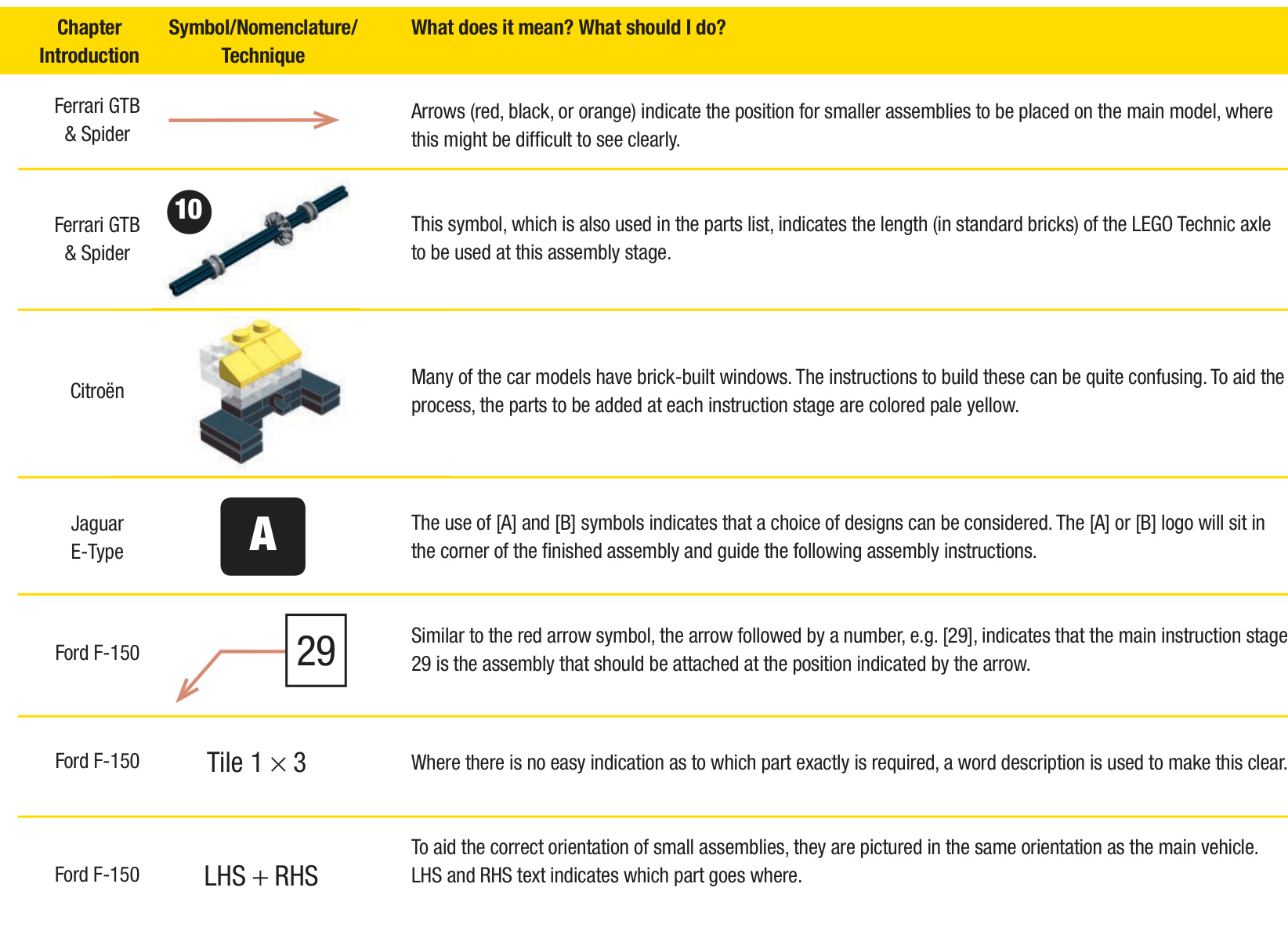
| Build Introduction | Symbol/Nomenclature/ Technique | What does it mean? What should I do? |
| '32 Ford | The instructions forthe1932Ford V-8 allow the builderto create either acoupe ora roadster version of the car. The instructions forboth are common for most of the construction,with unique instructions to build one or the other detailed at the end ofthe build.This technique is usedagain forthe Ferrari 488 andthe Jaguar E-Type. | |
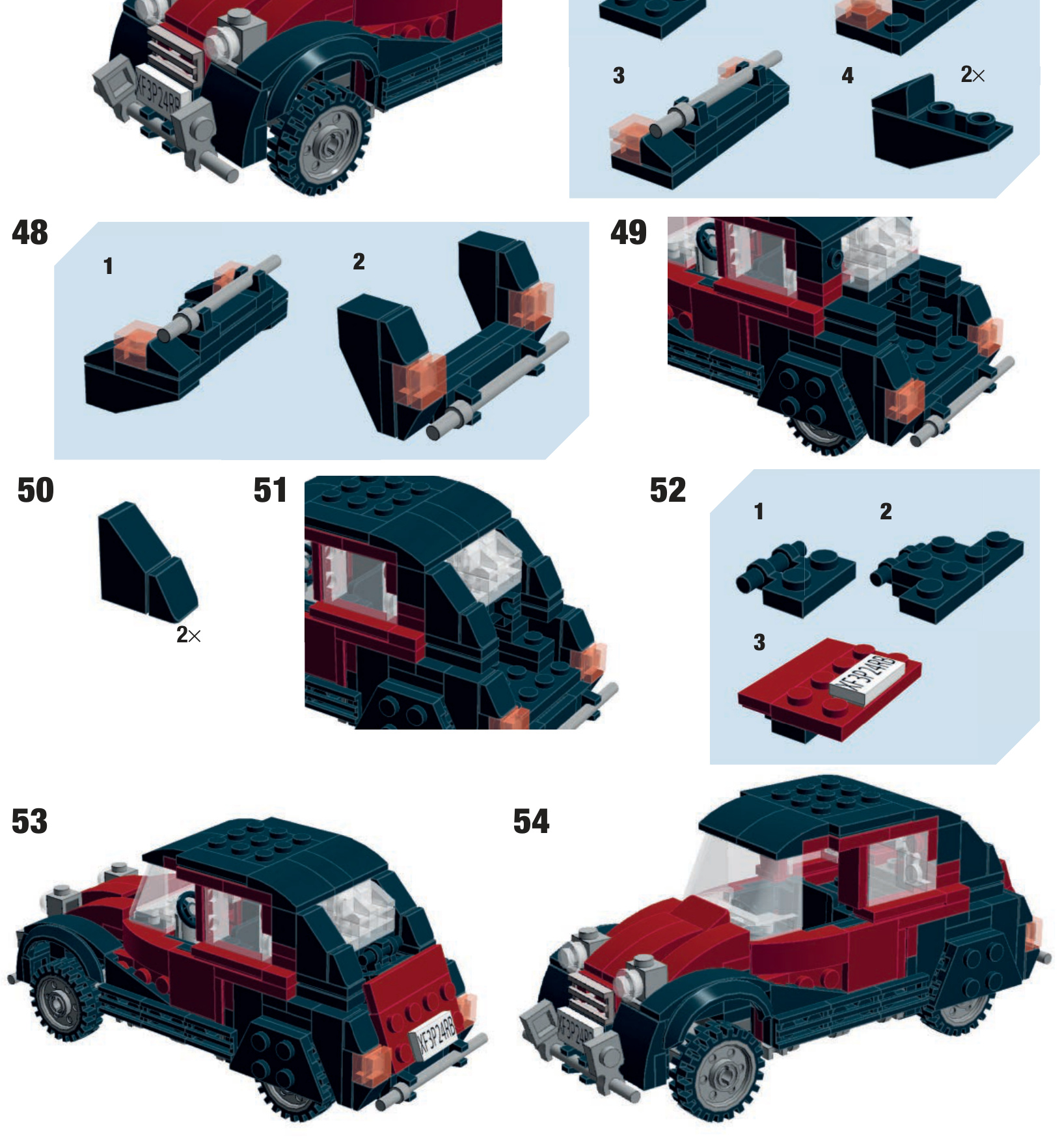
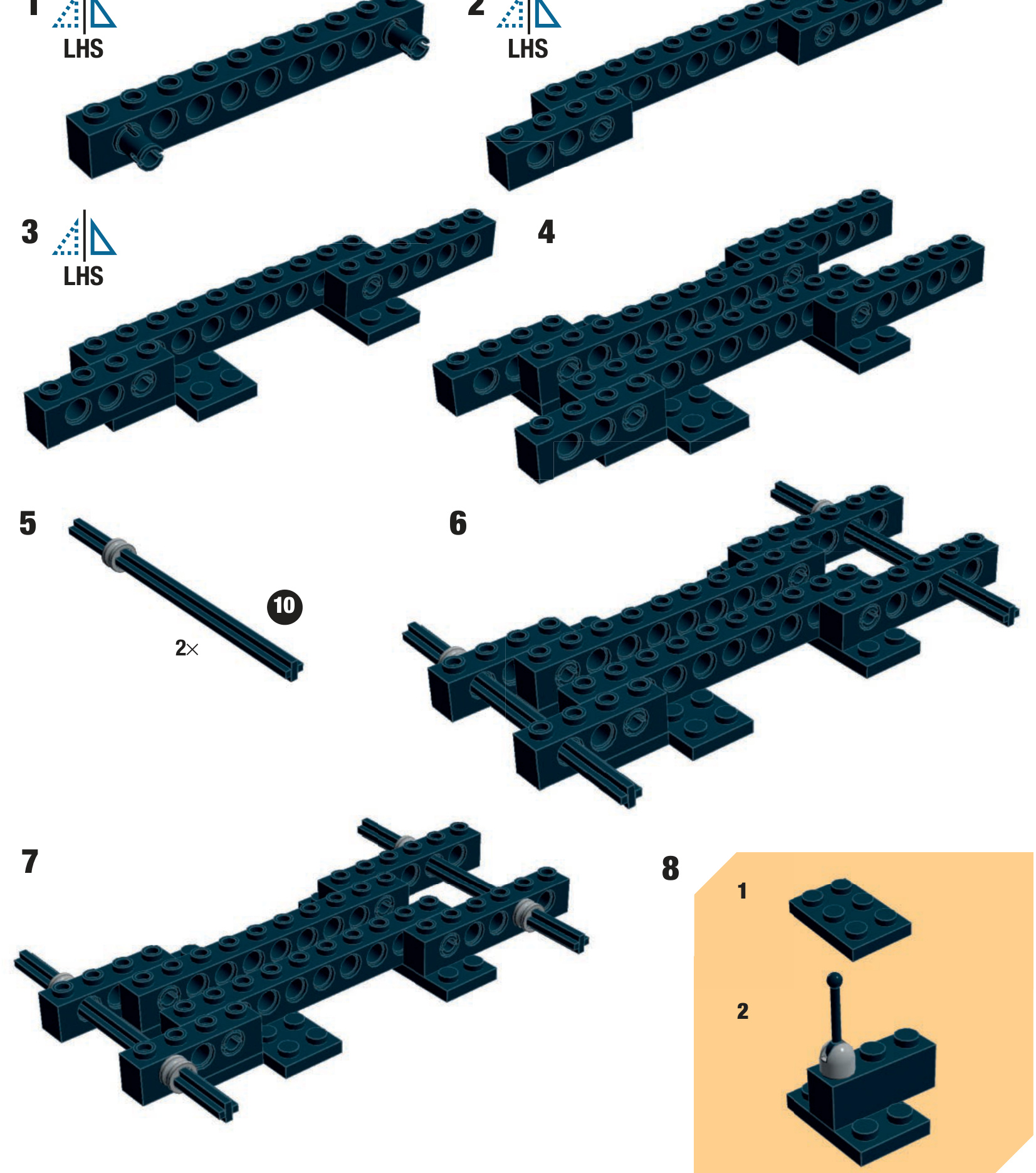
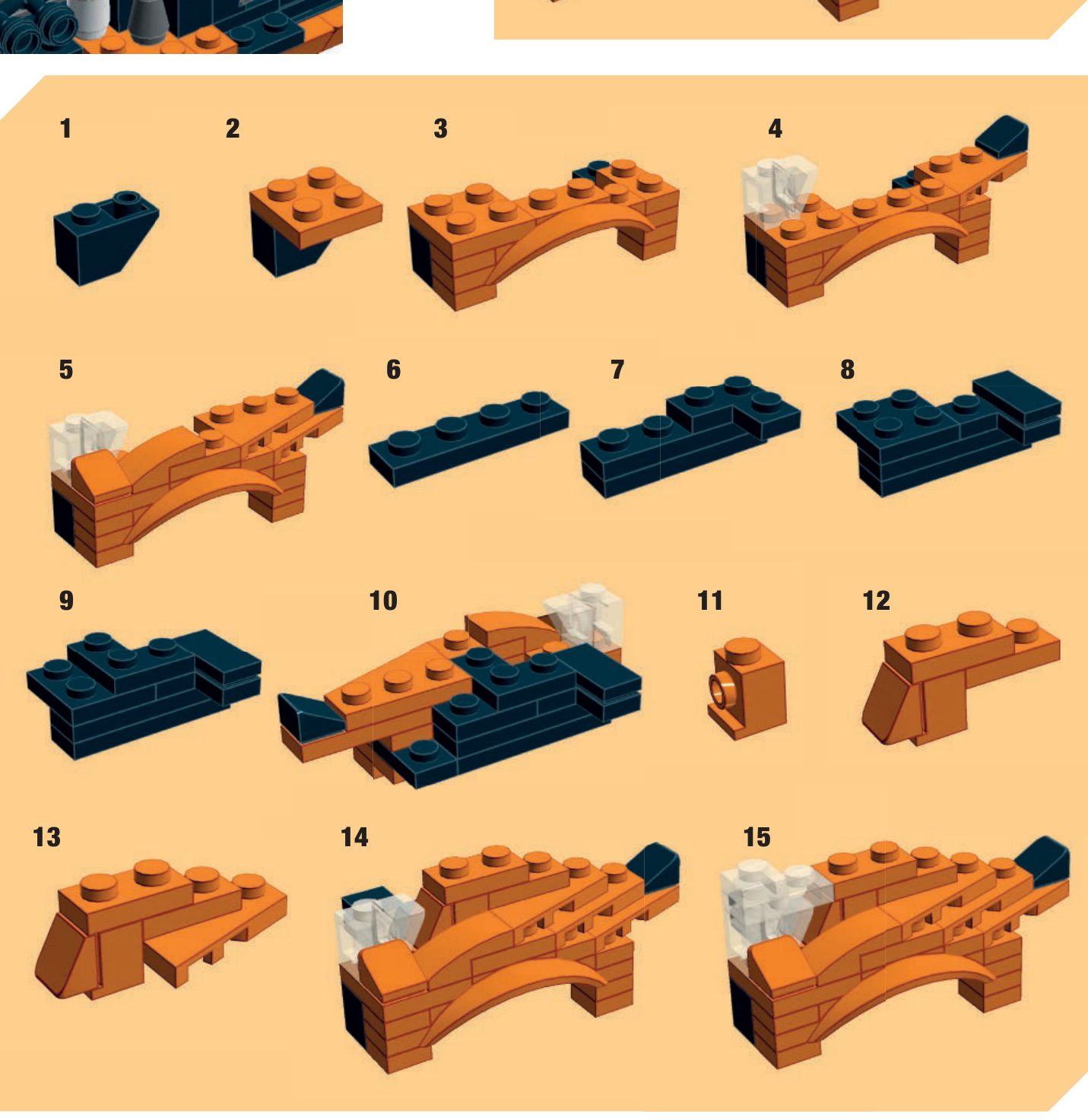
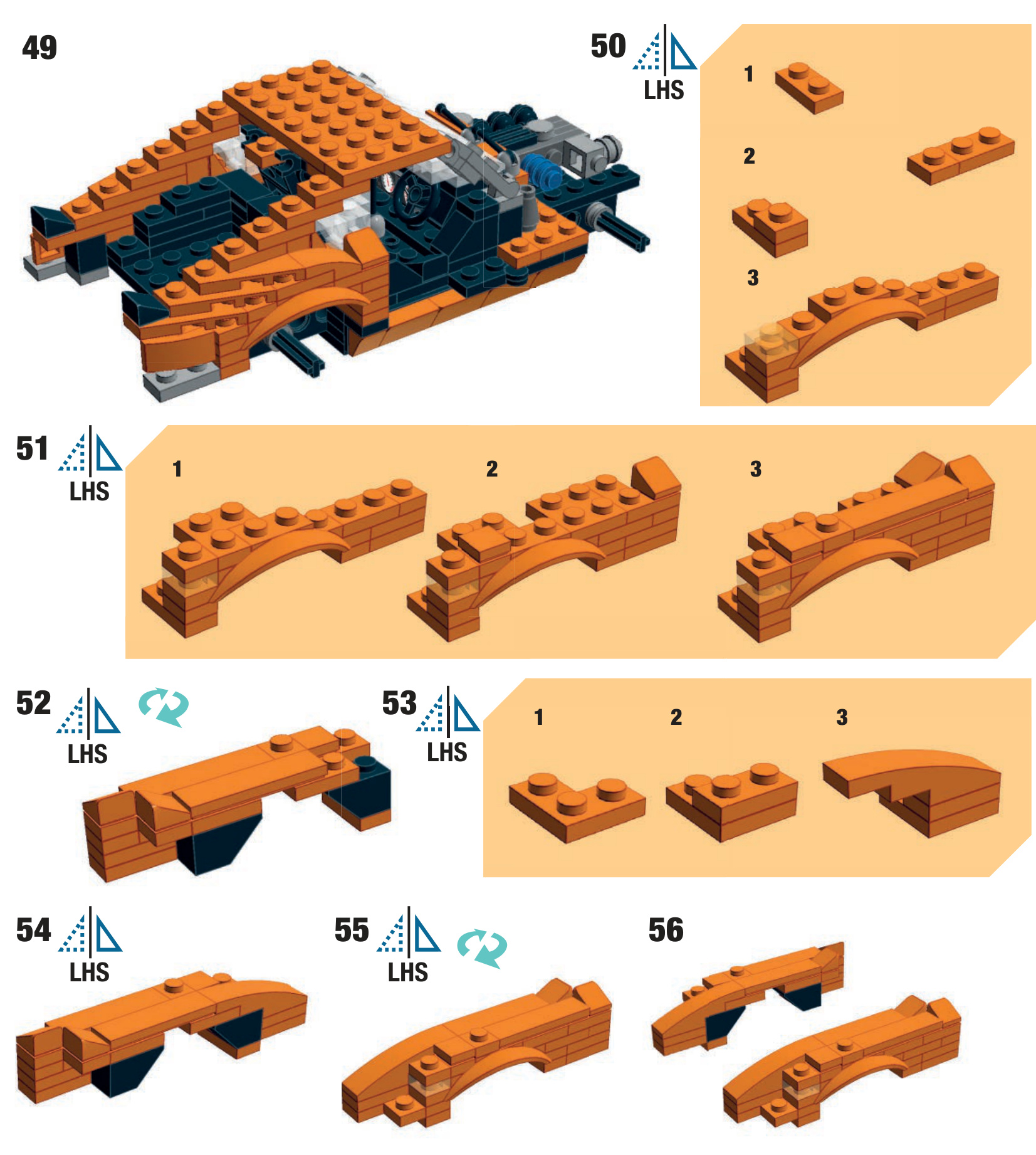
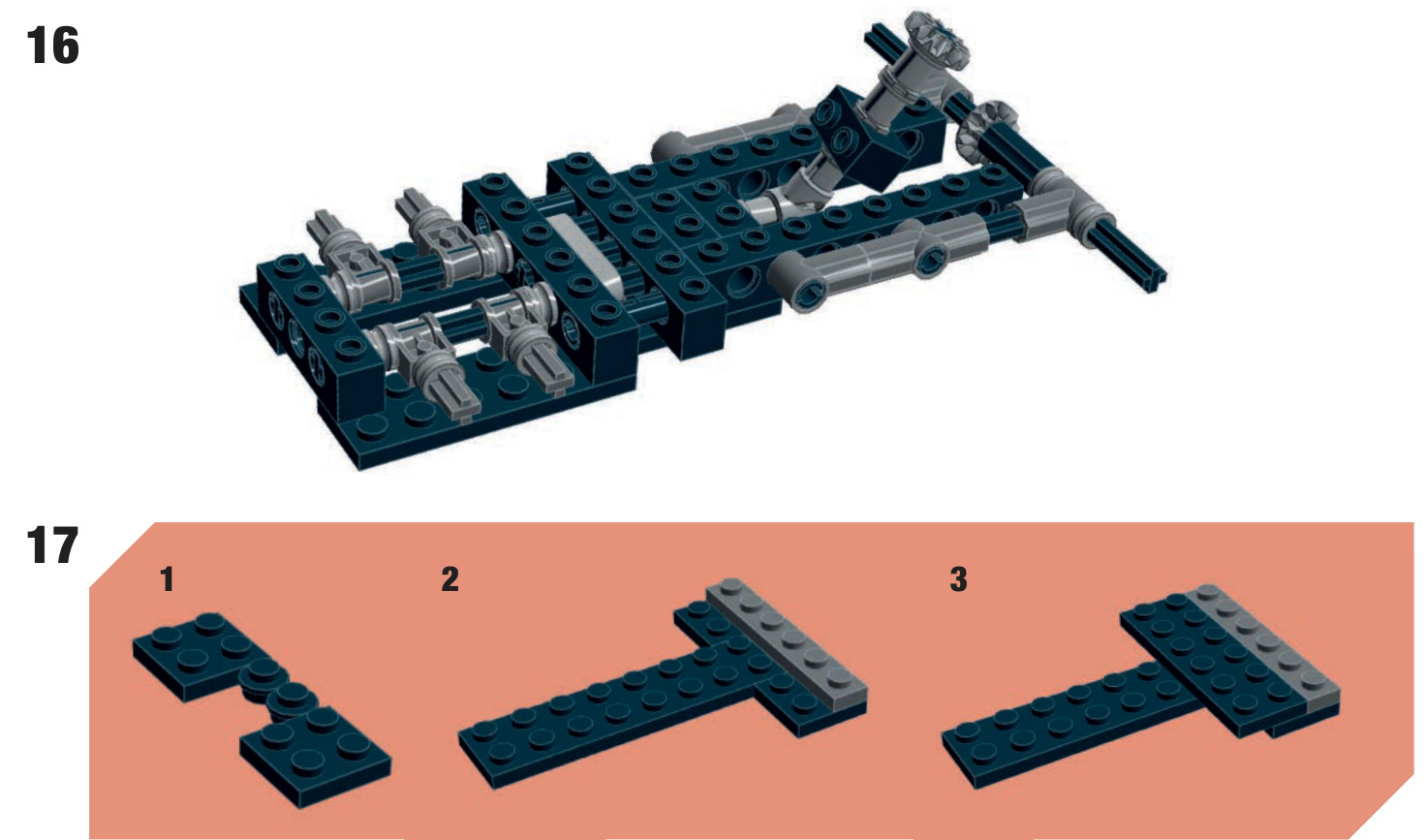
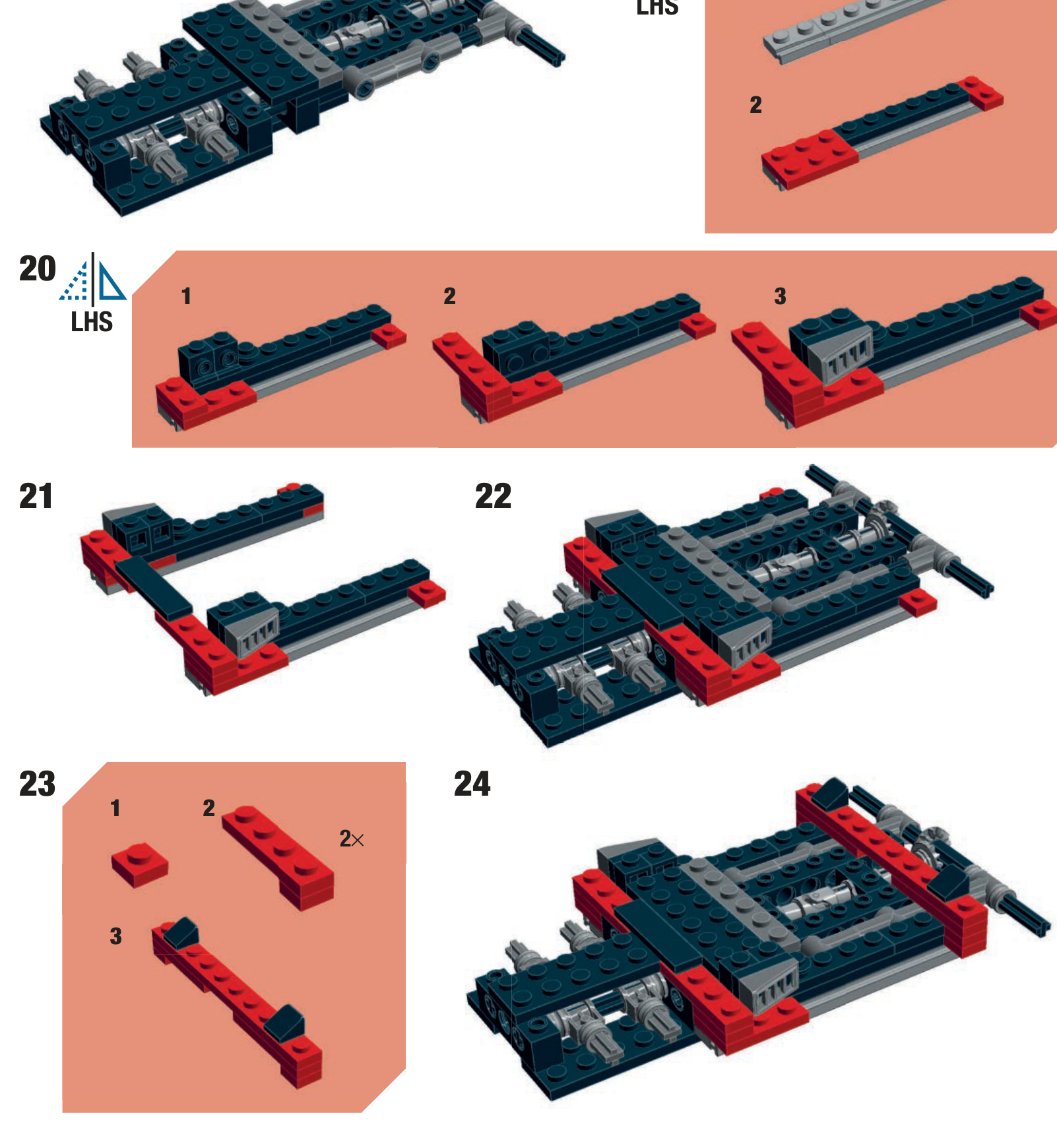
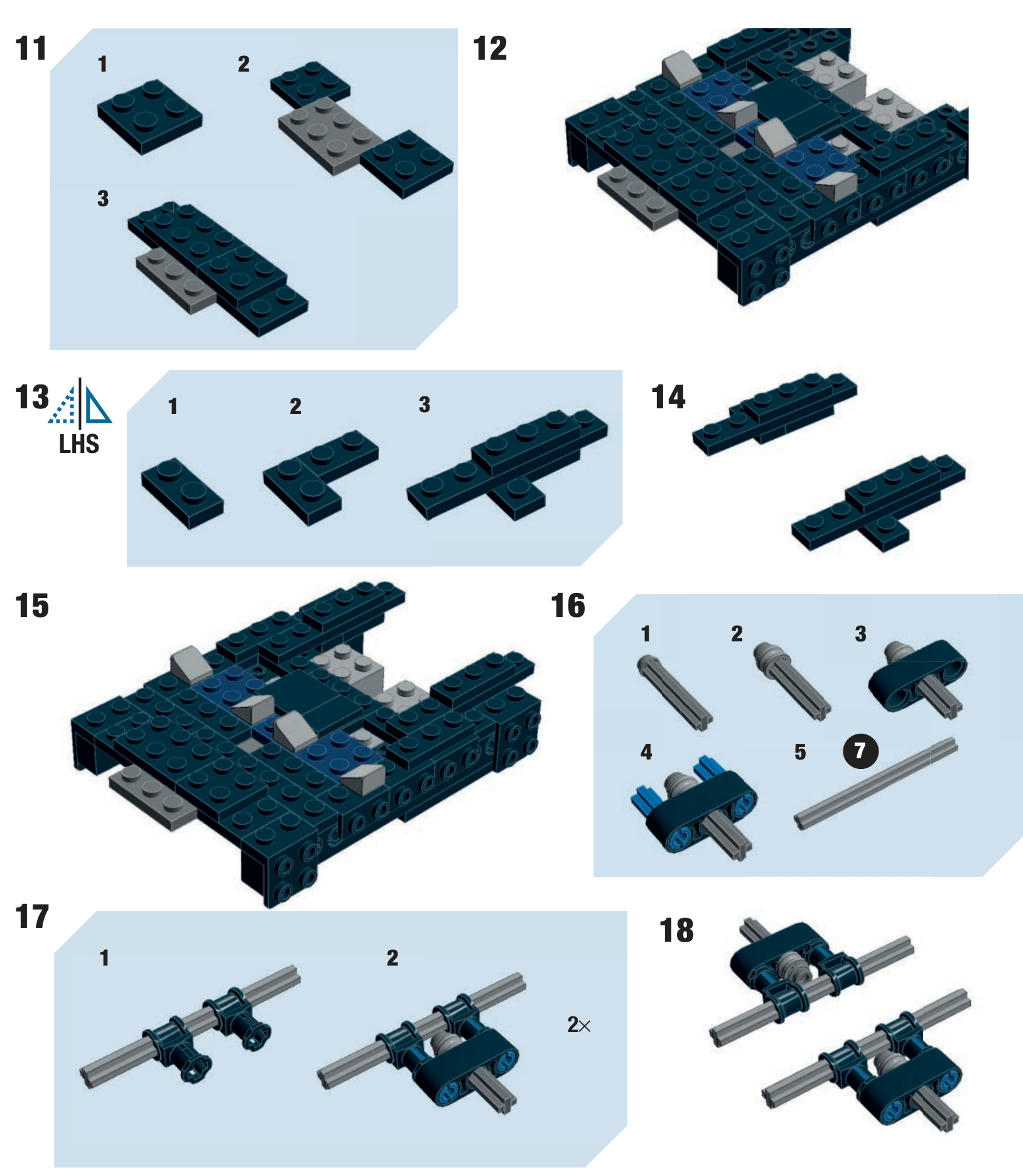
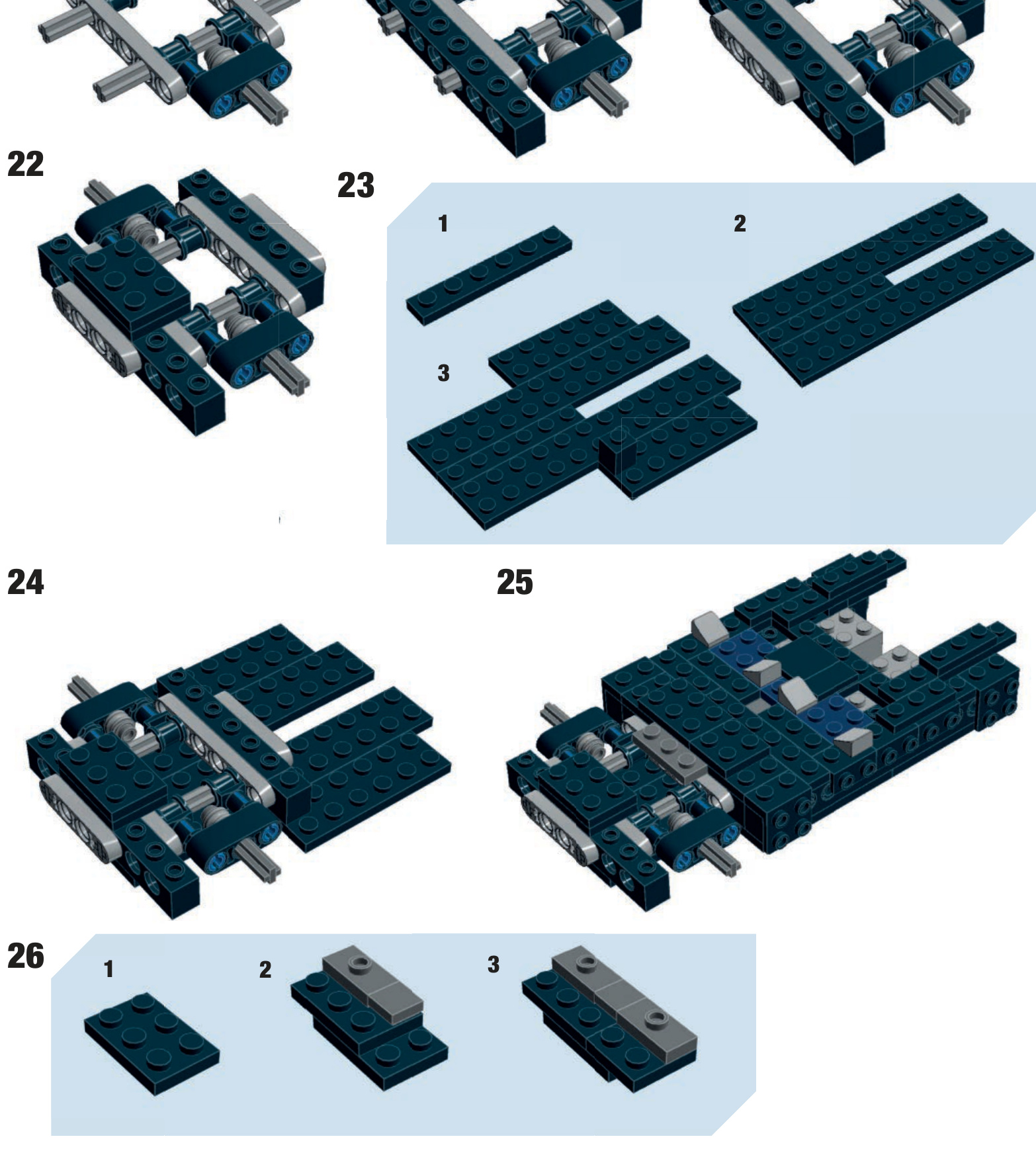
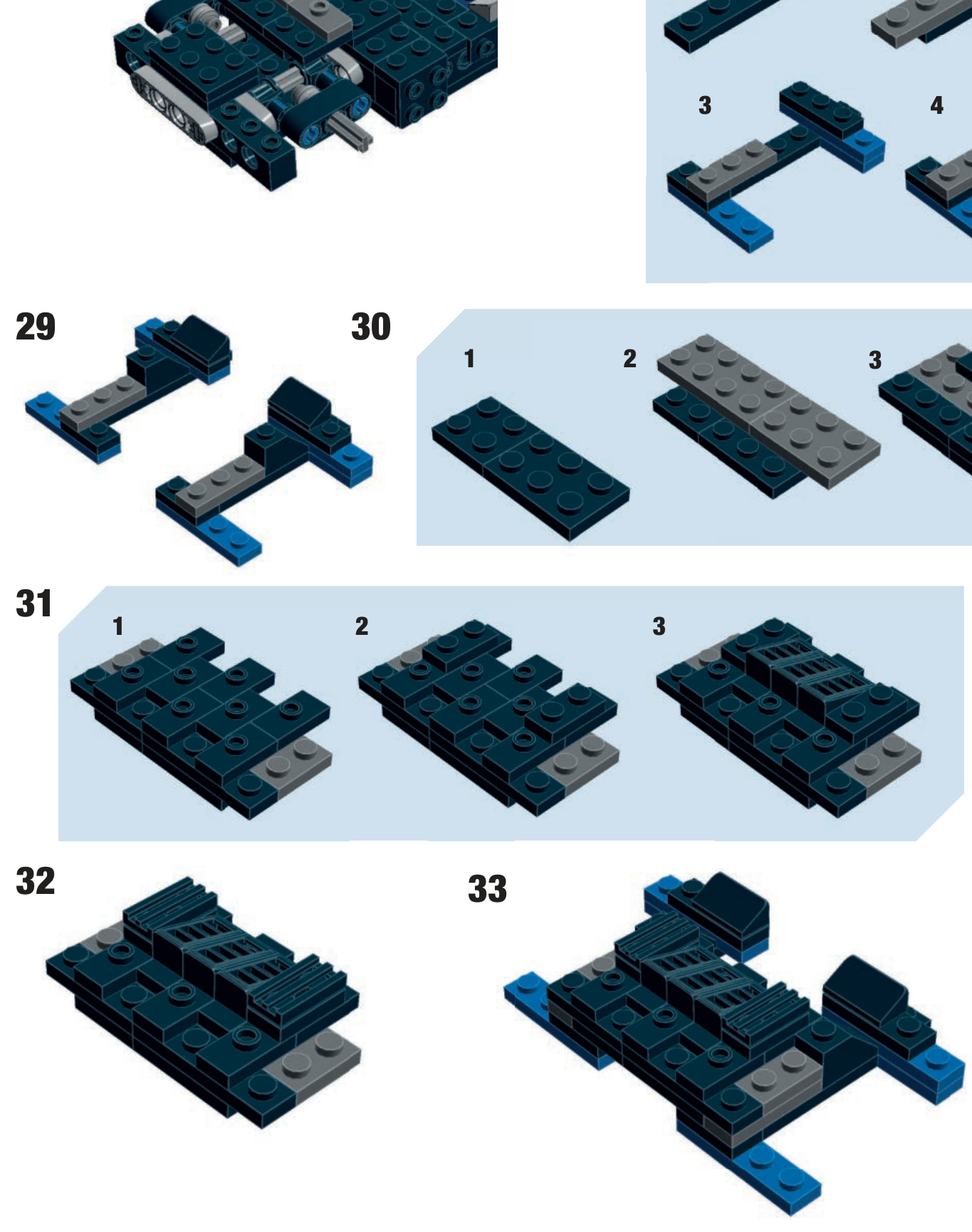
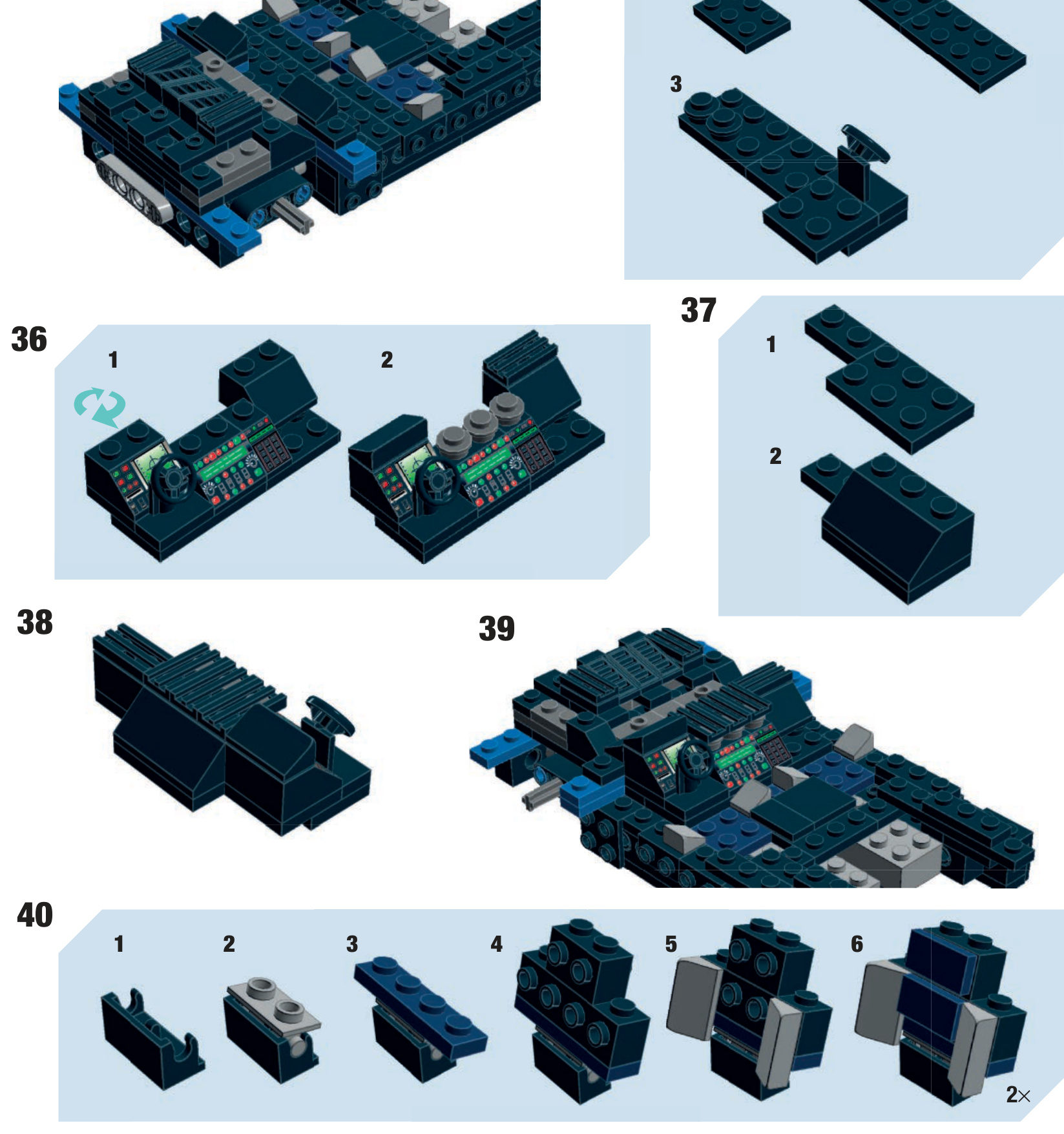
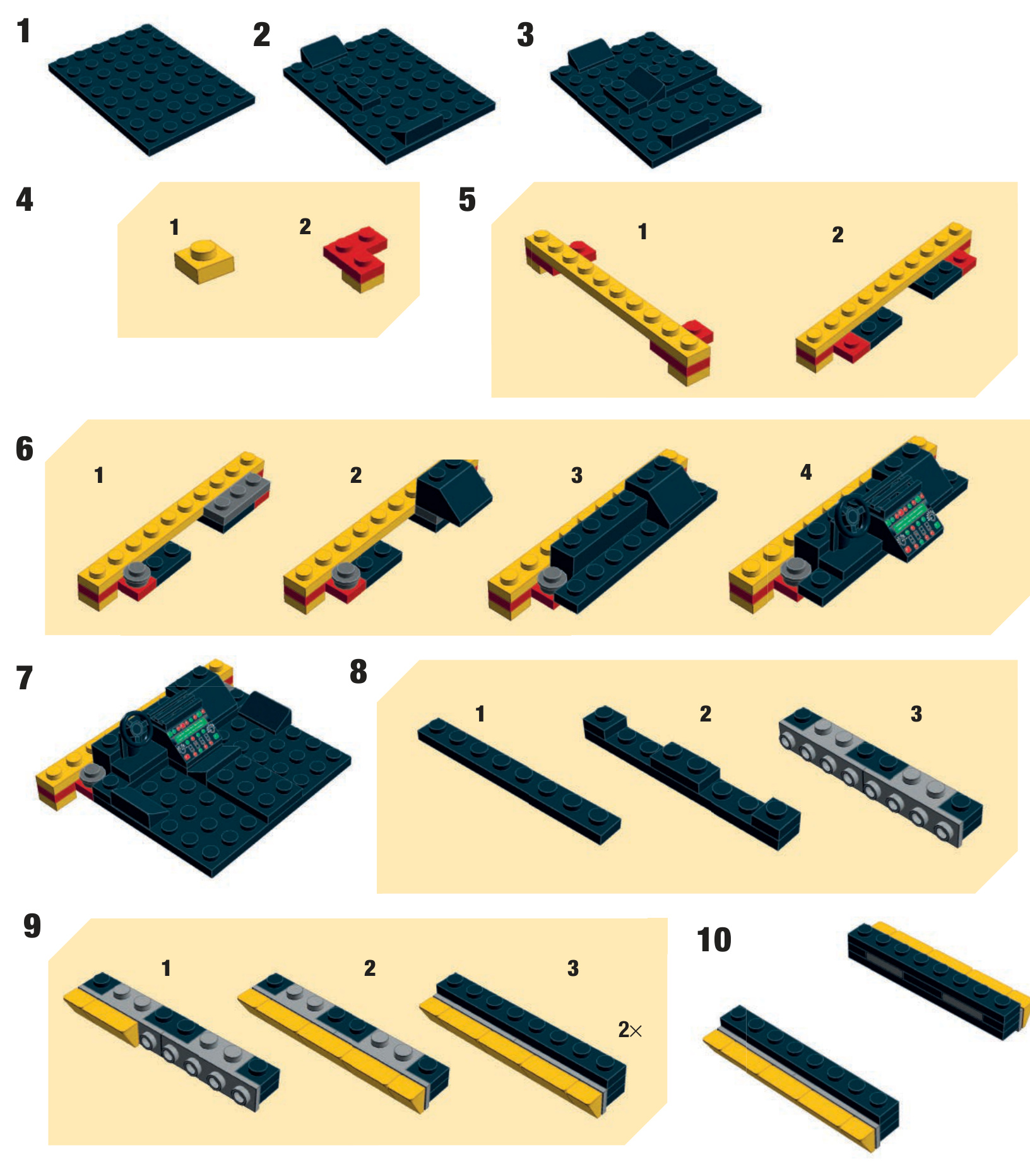
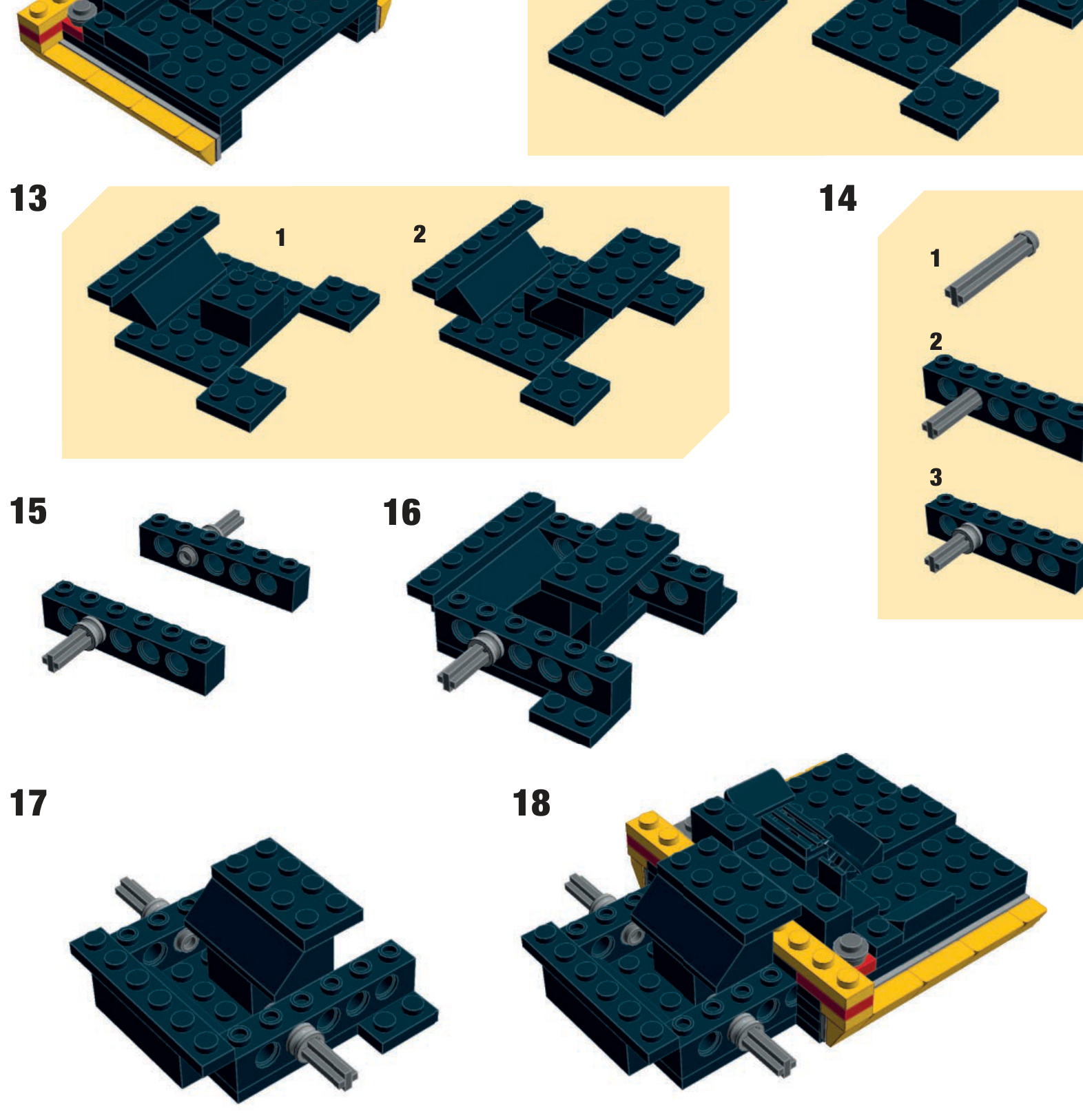
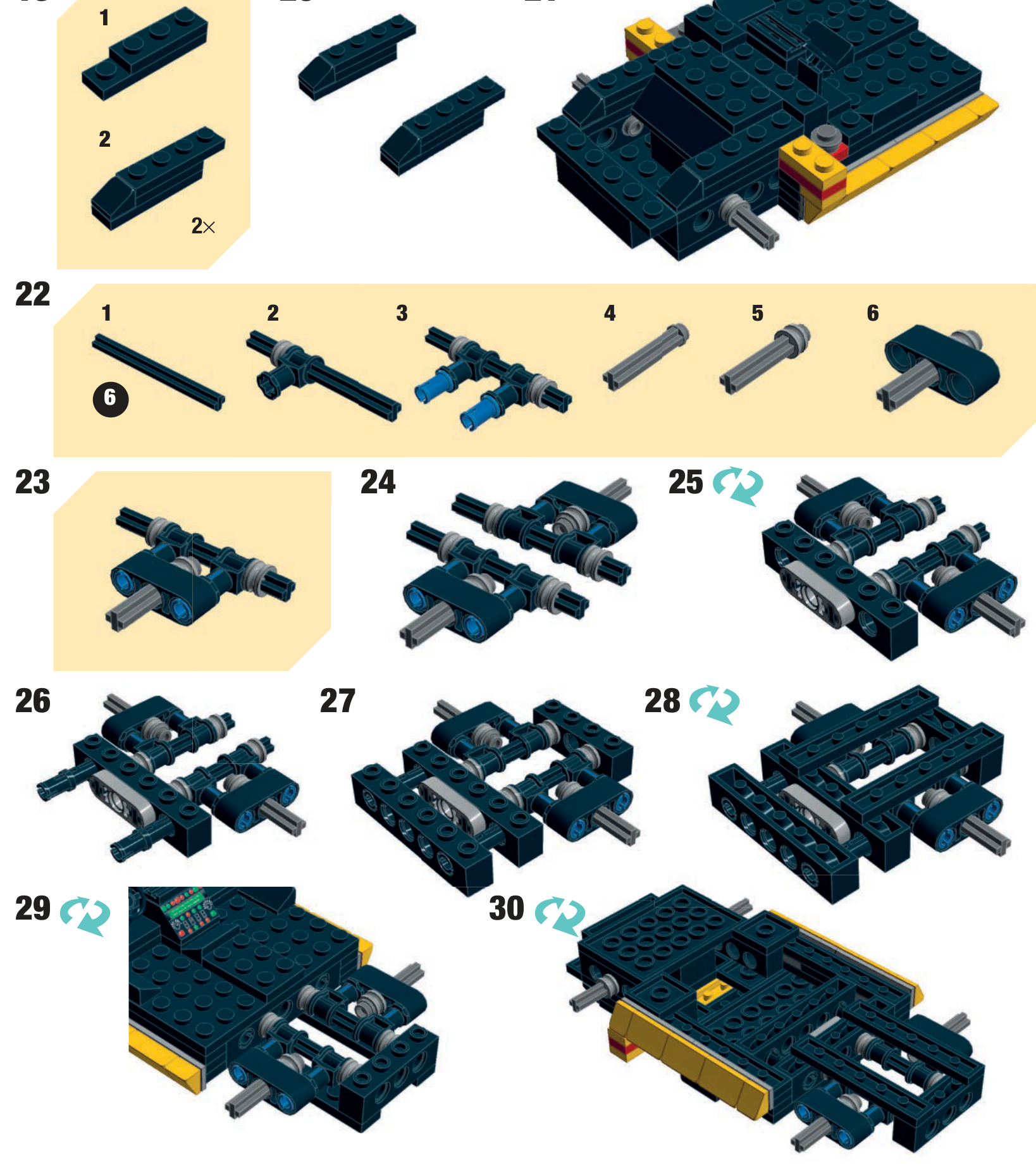
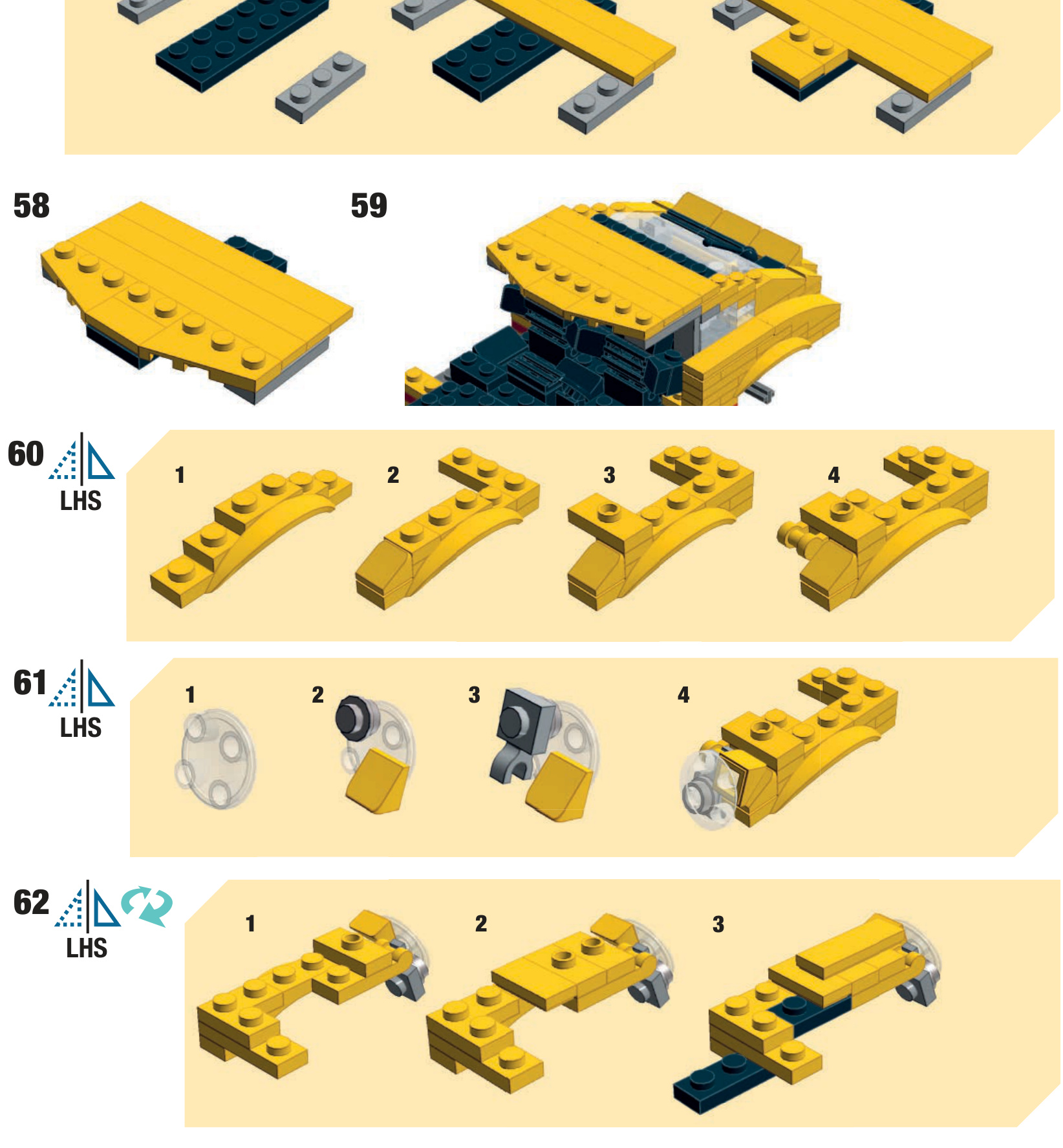
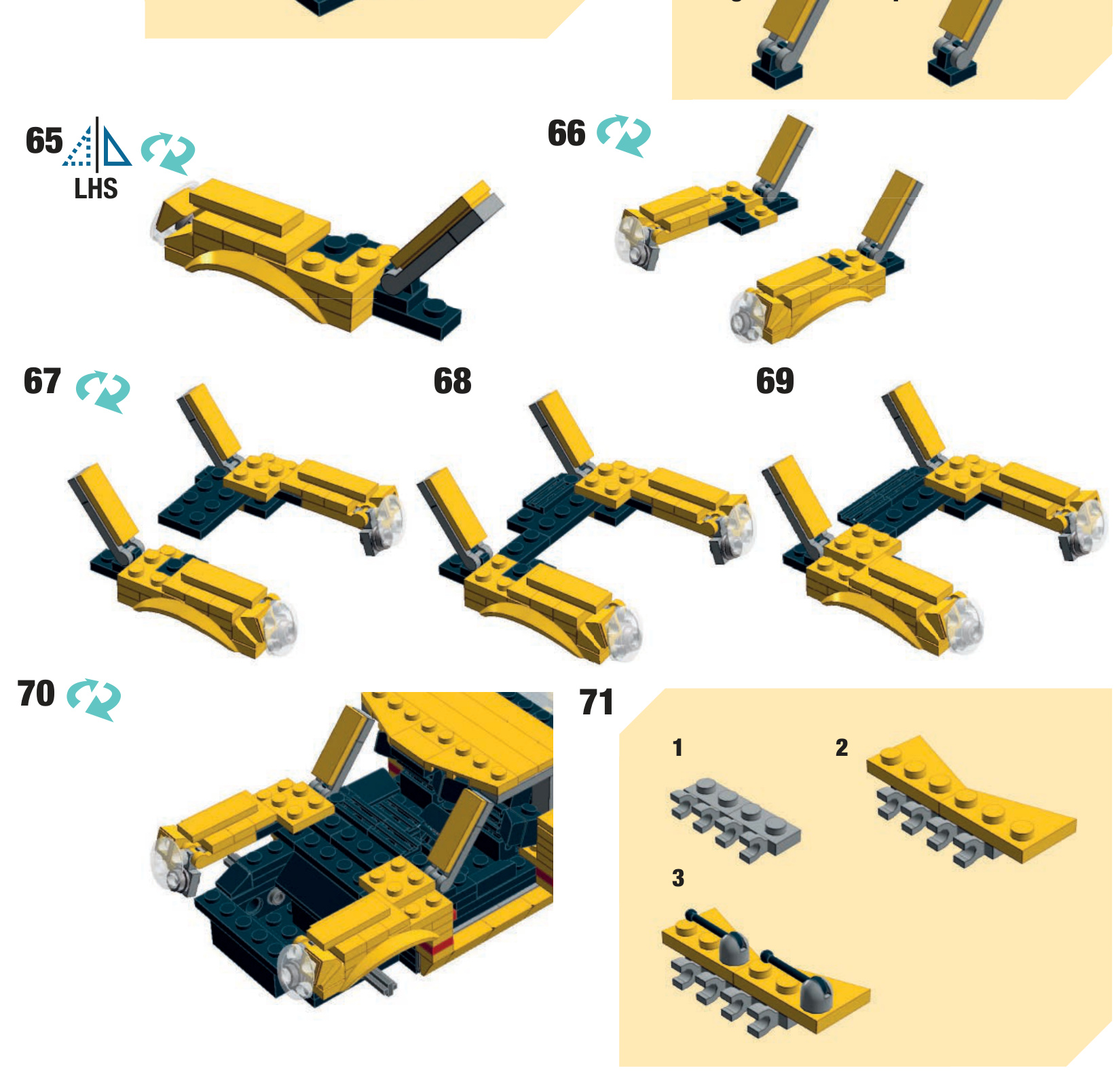
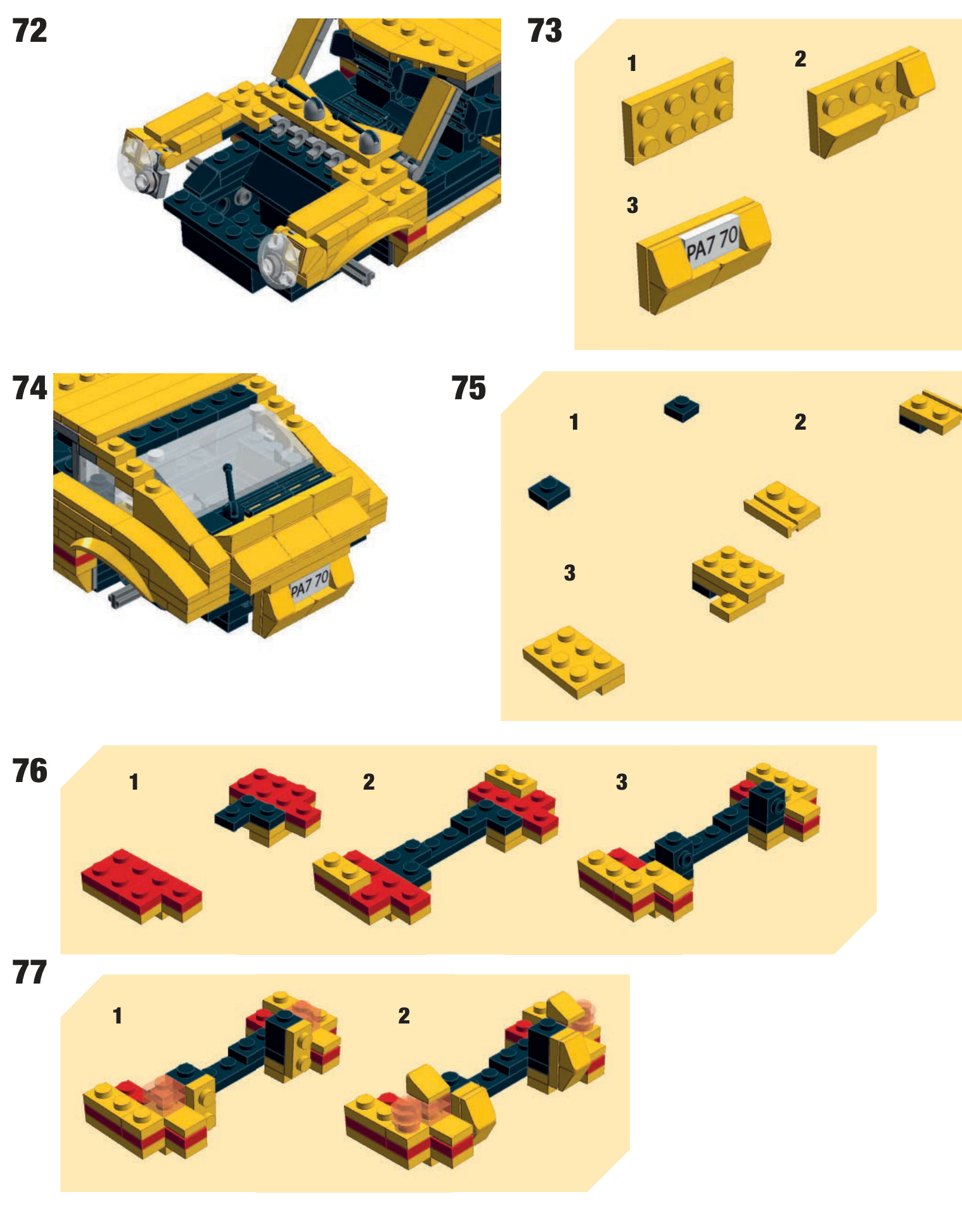
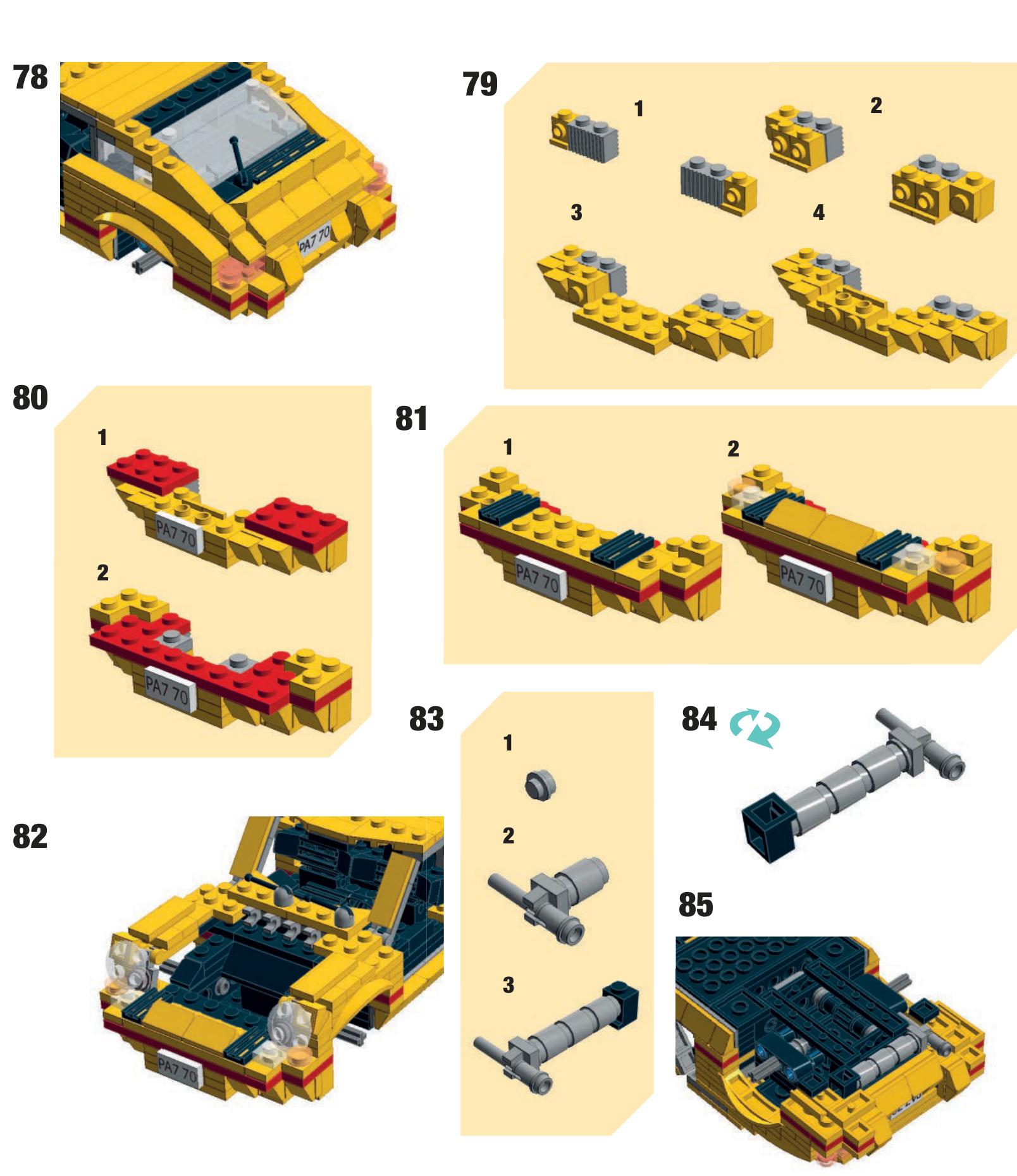
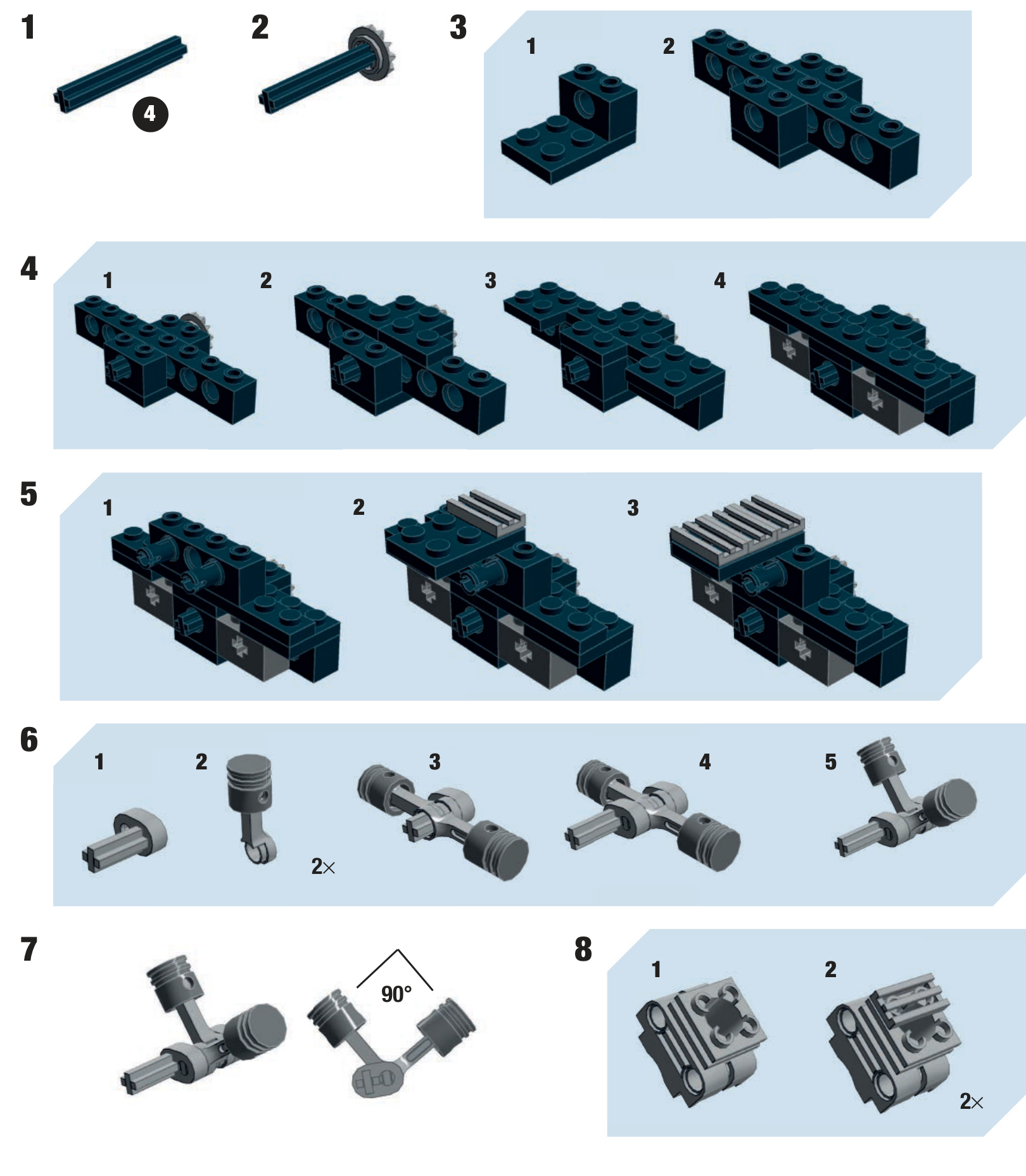
| '32 Ford | 1 29 | The large bold numbers for the instructions start at 1 and number progressively.This helps keep track of the stage that the build is in overalland provides some guidance to the next instruction step when alternative designs can be chosen. |
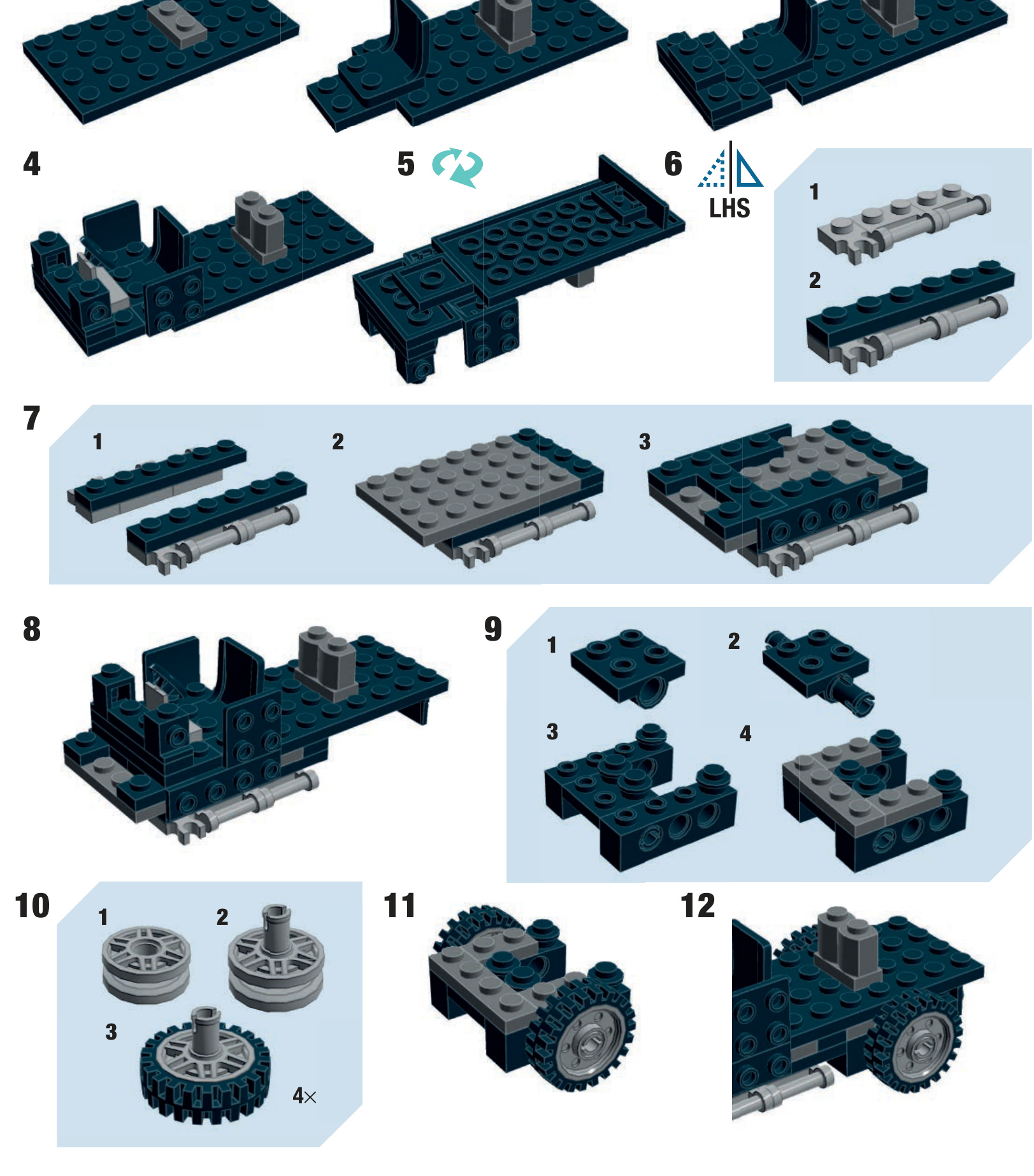
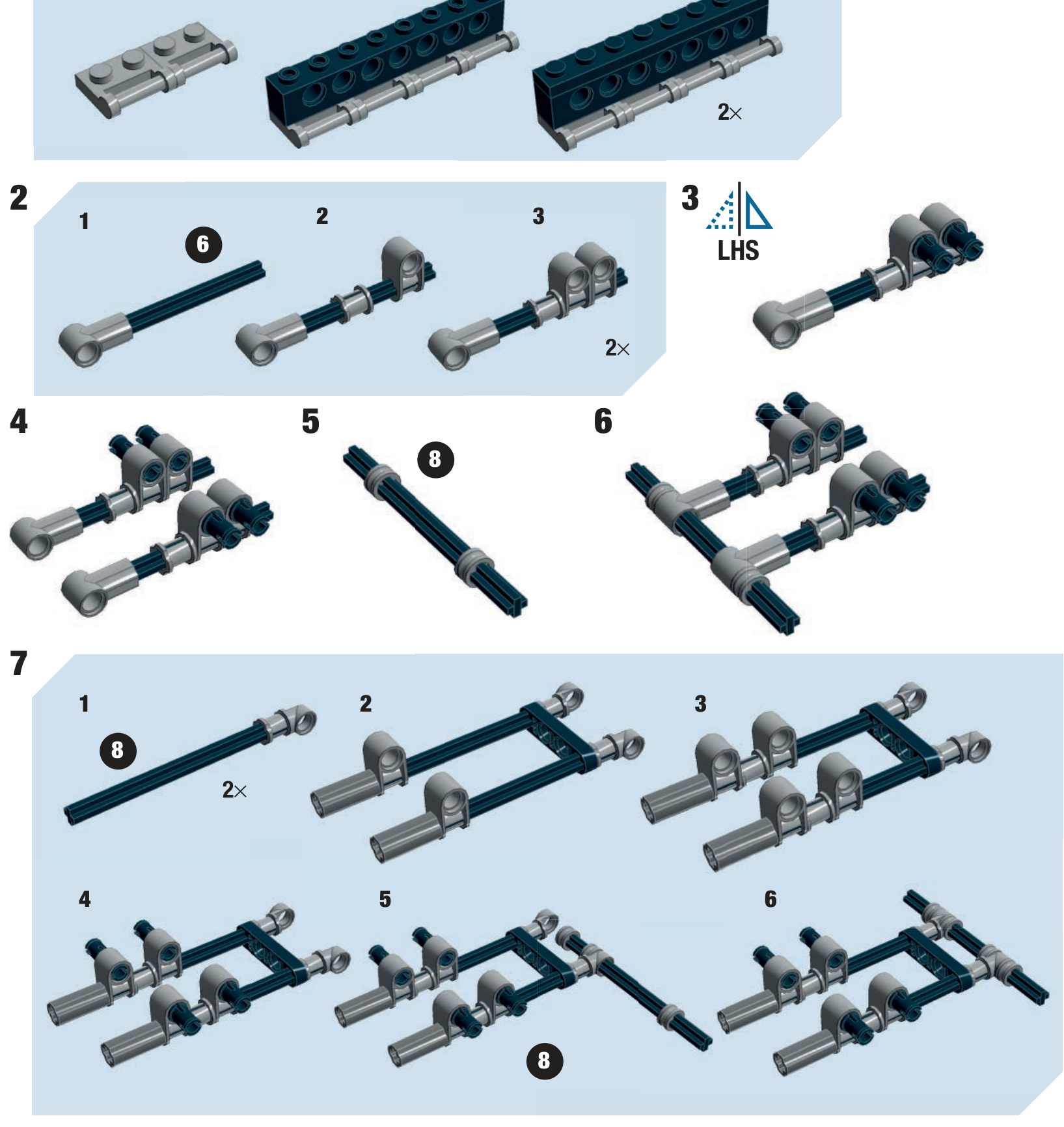
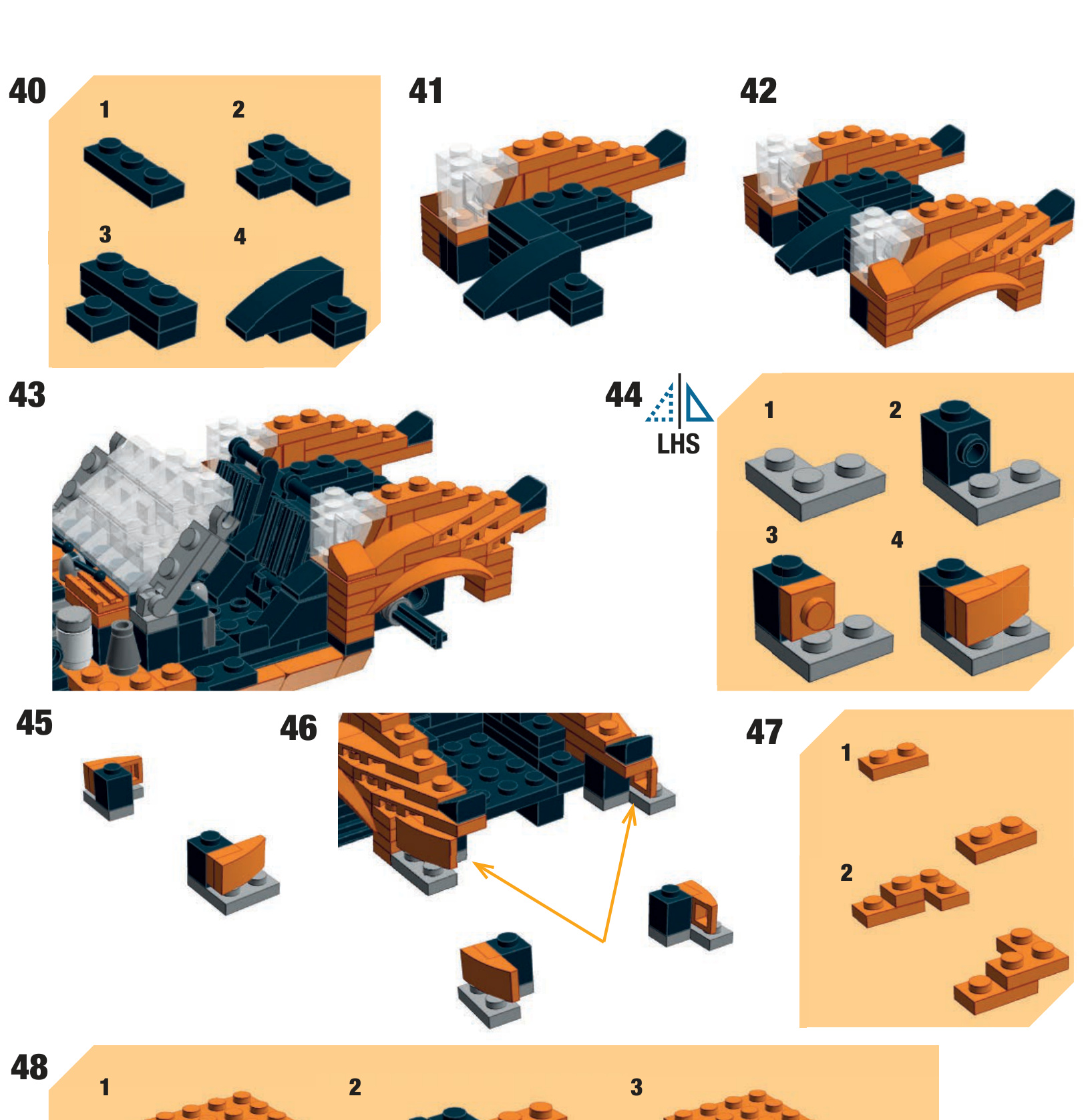
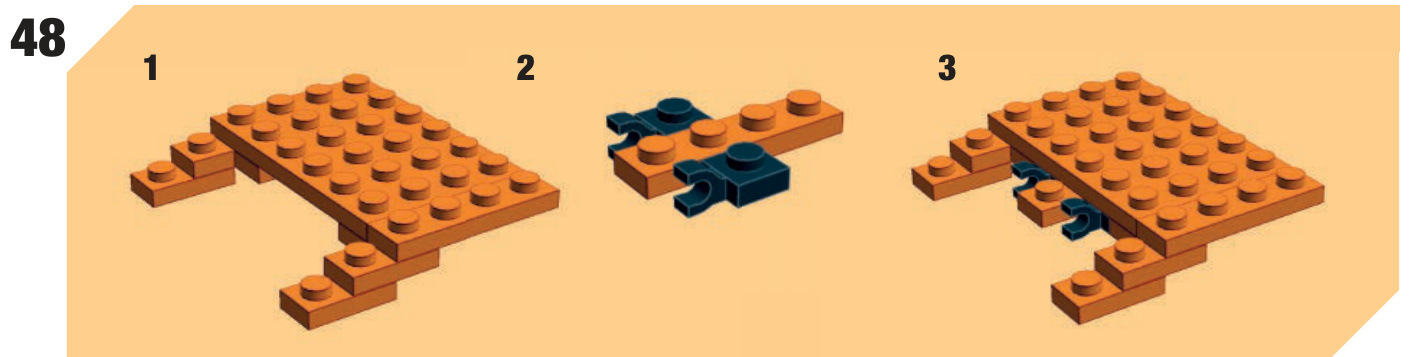
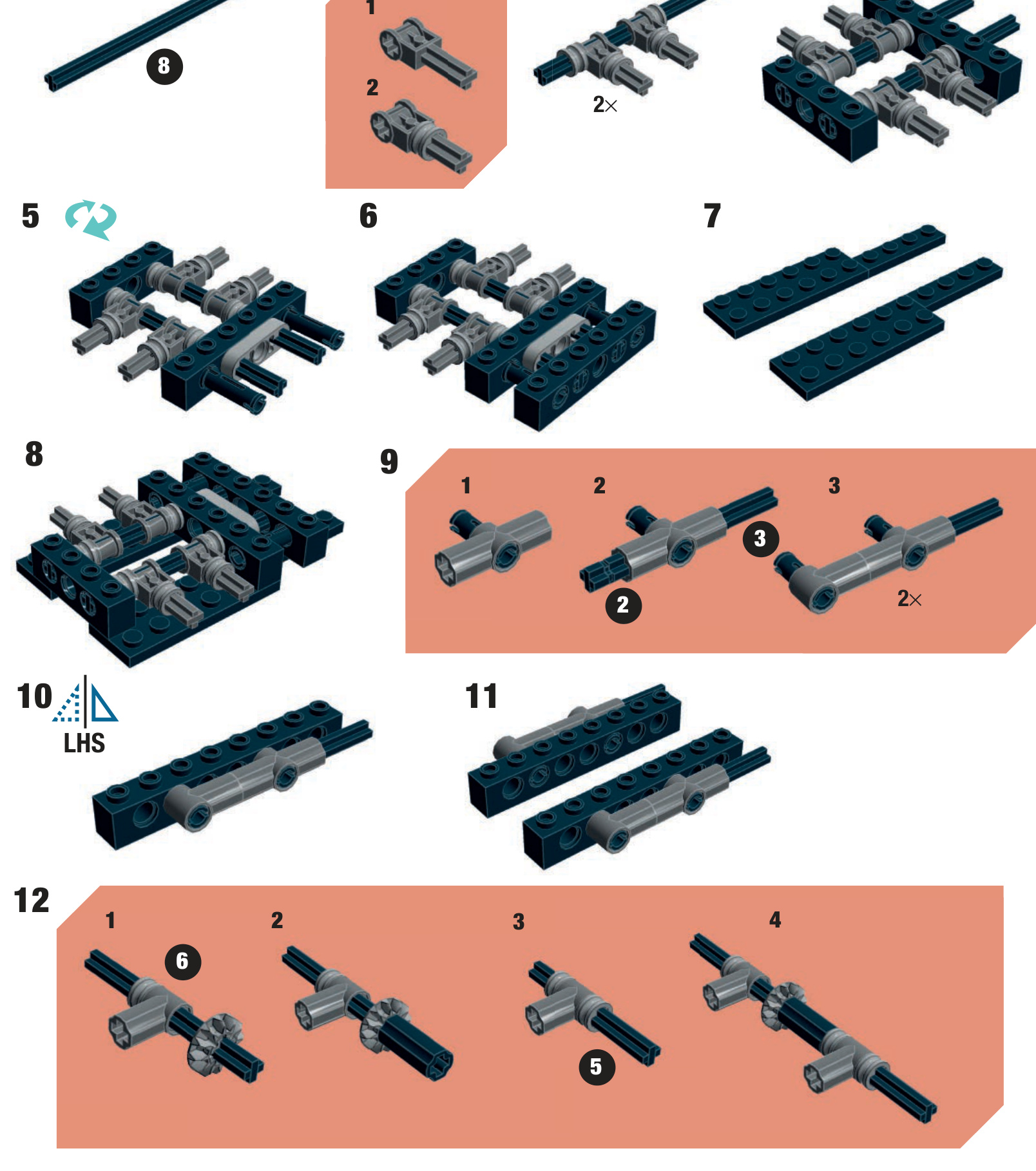
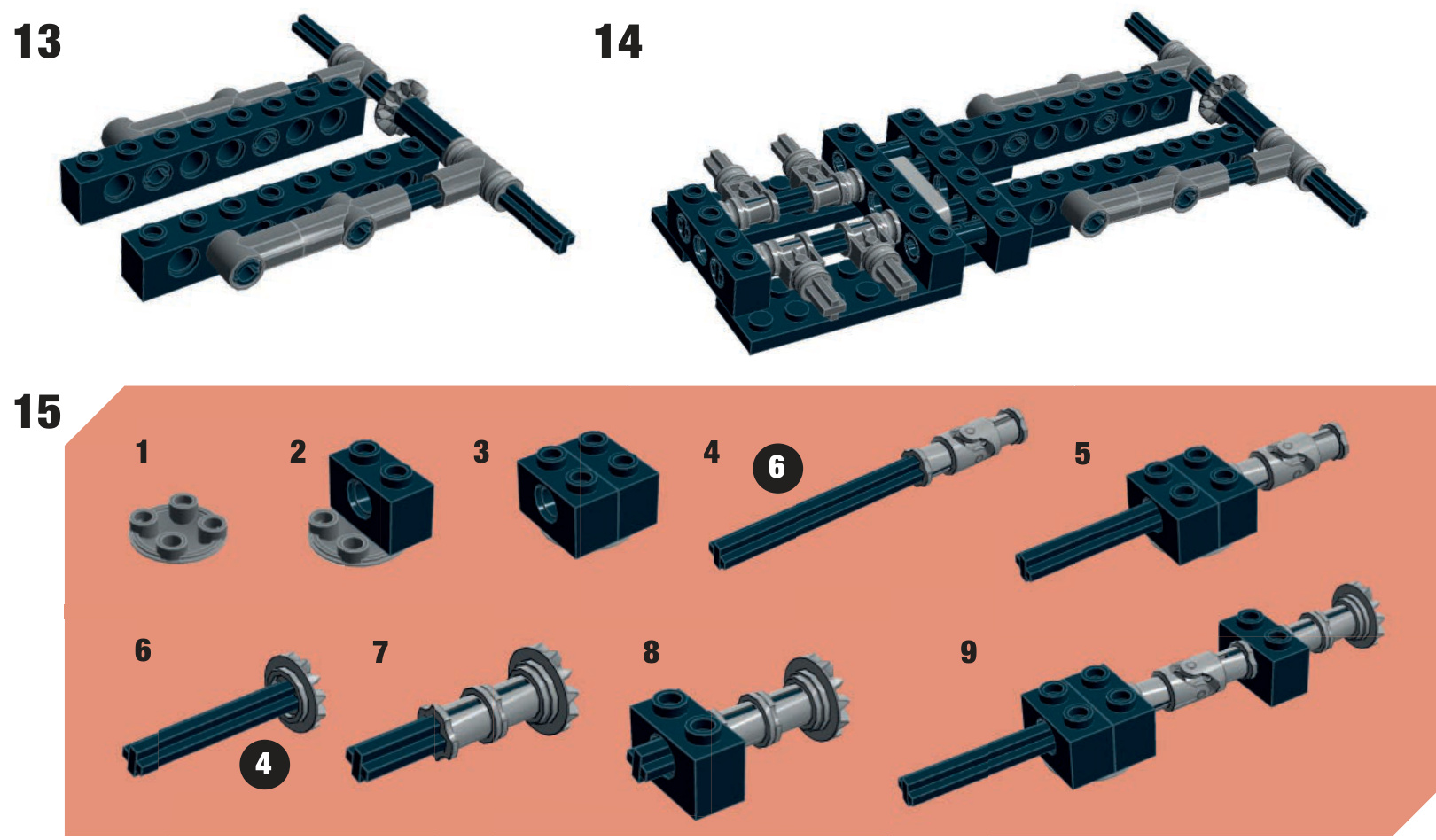
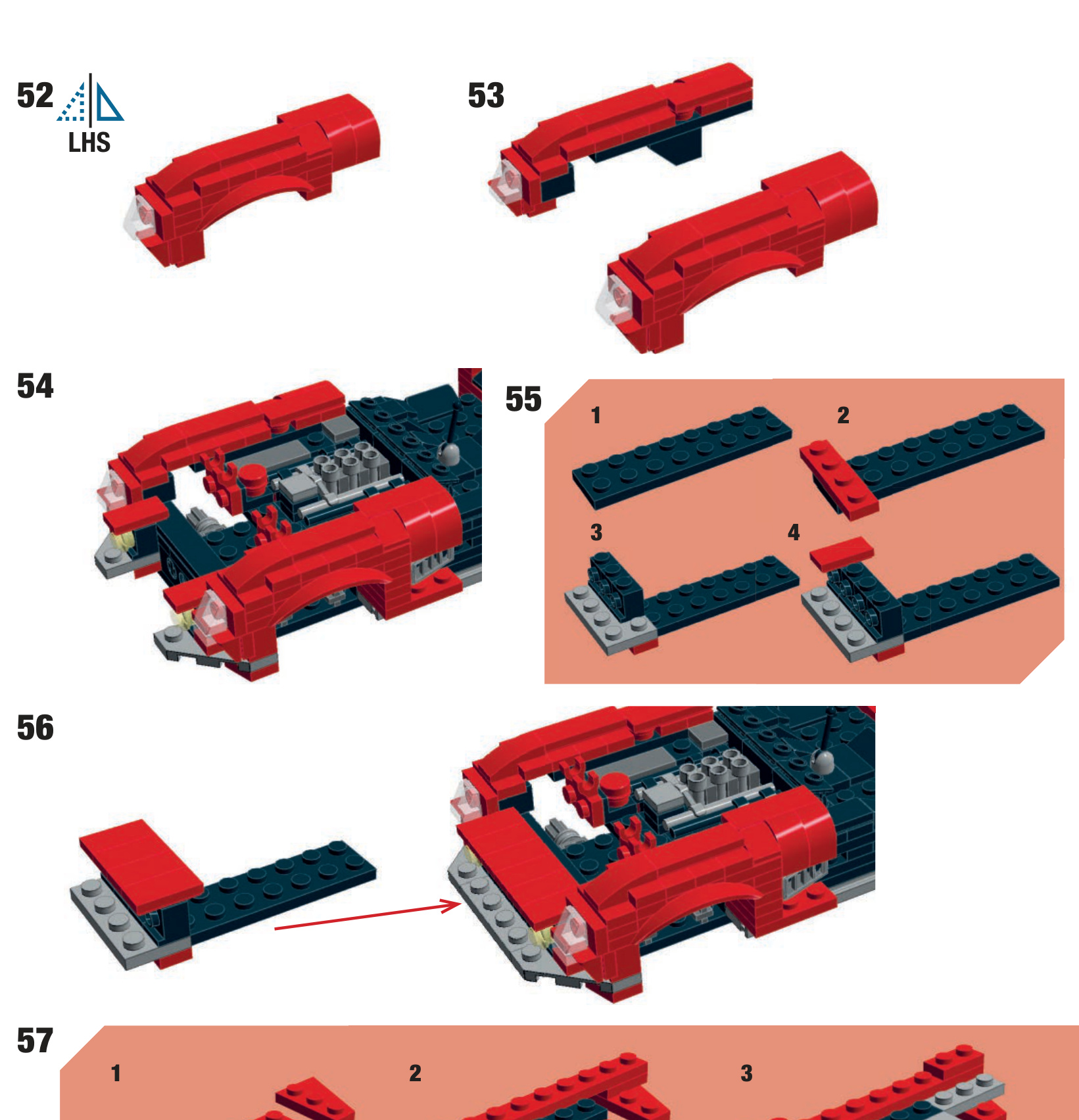
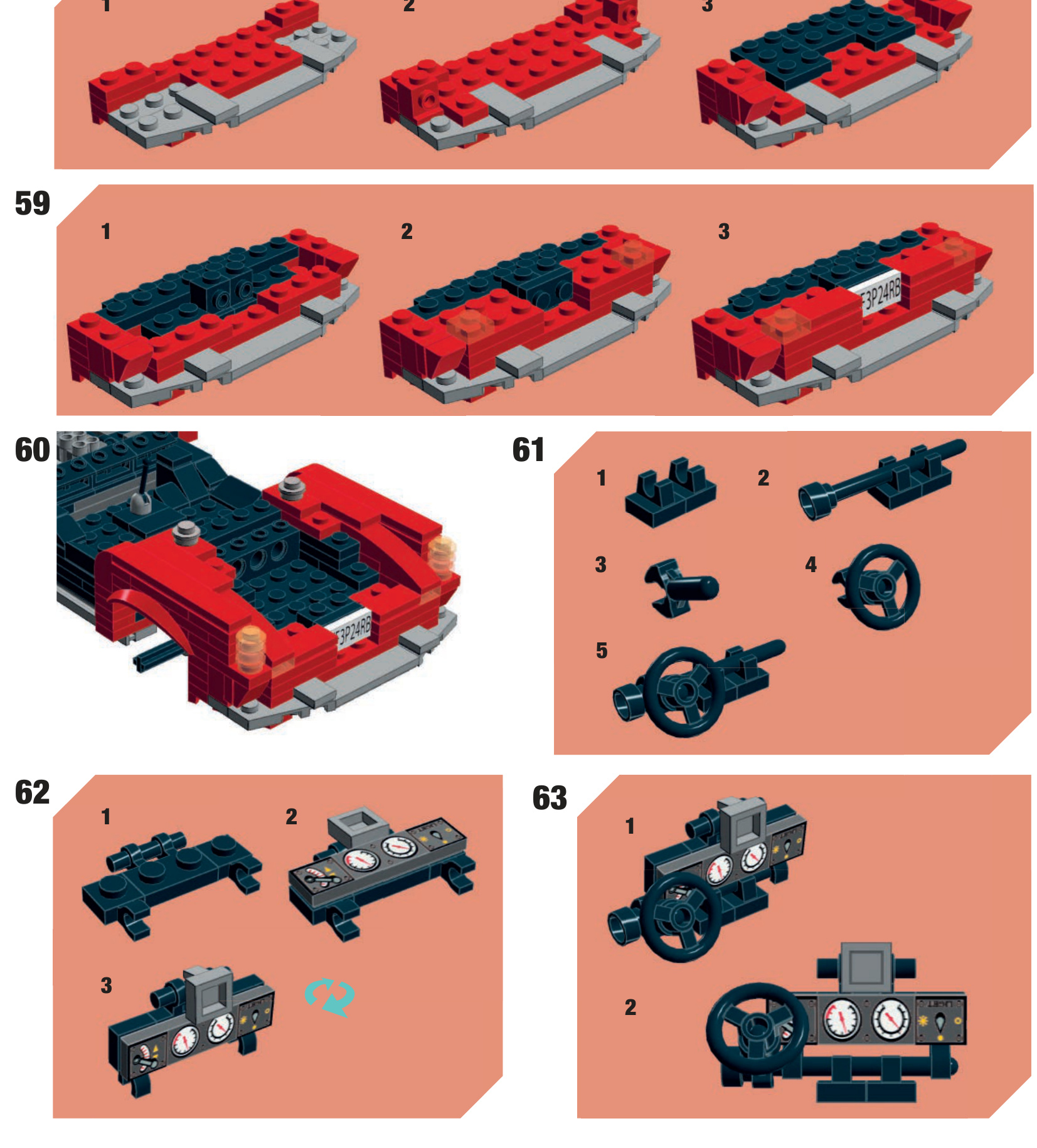
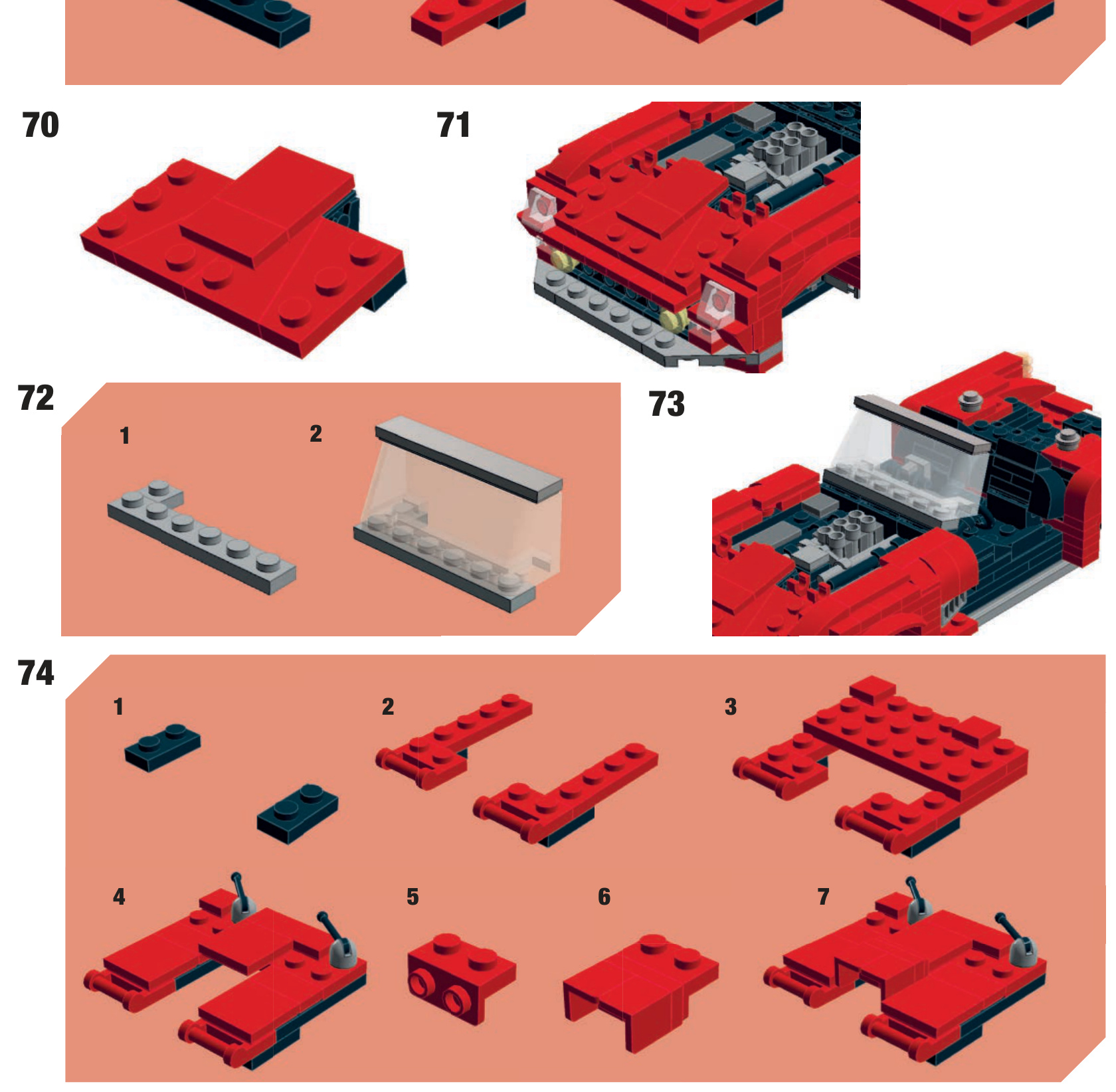
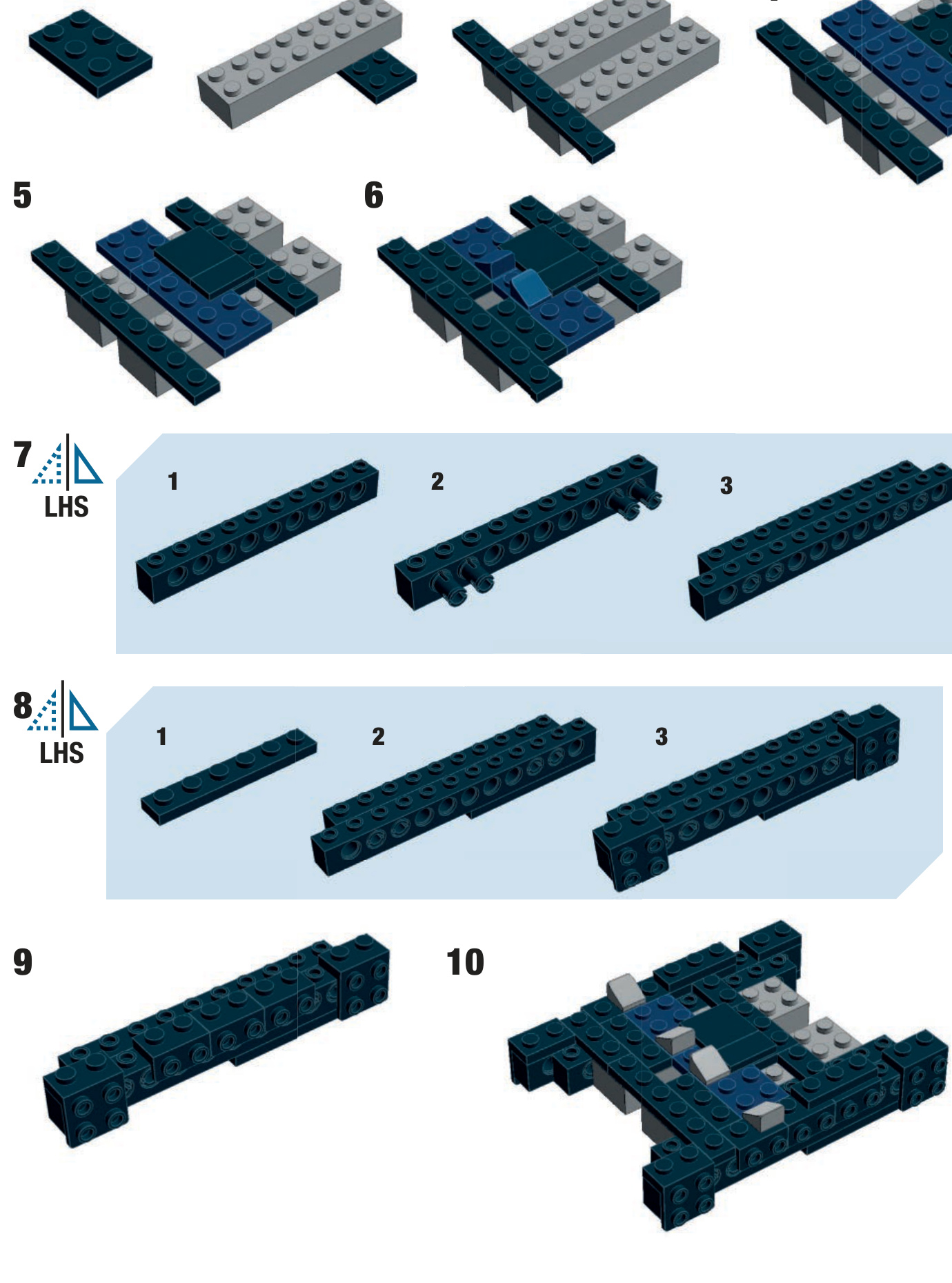
| '32 Ford | 1 4 | The smallbold numbers included in the colored box fields show the step level when creating an assembly.An assembly is a collction of parts that create a cohesive structure prior to being joined to the main model. |
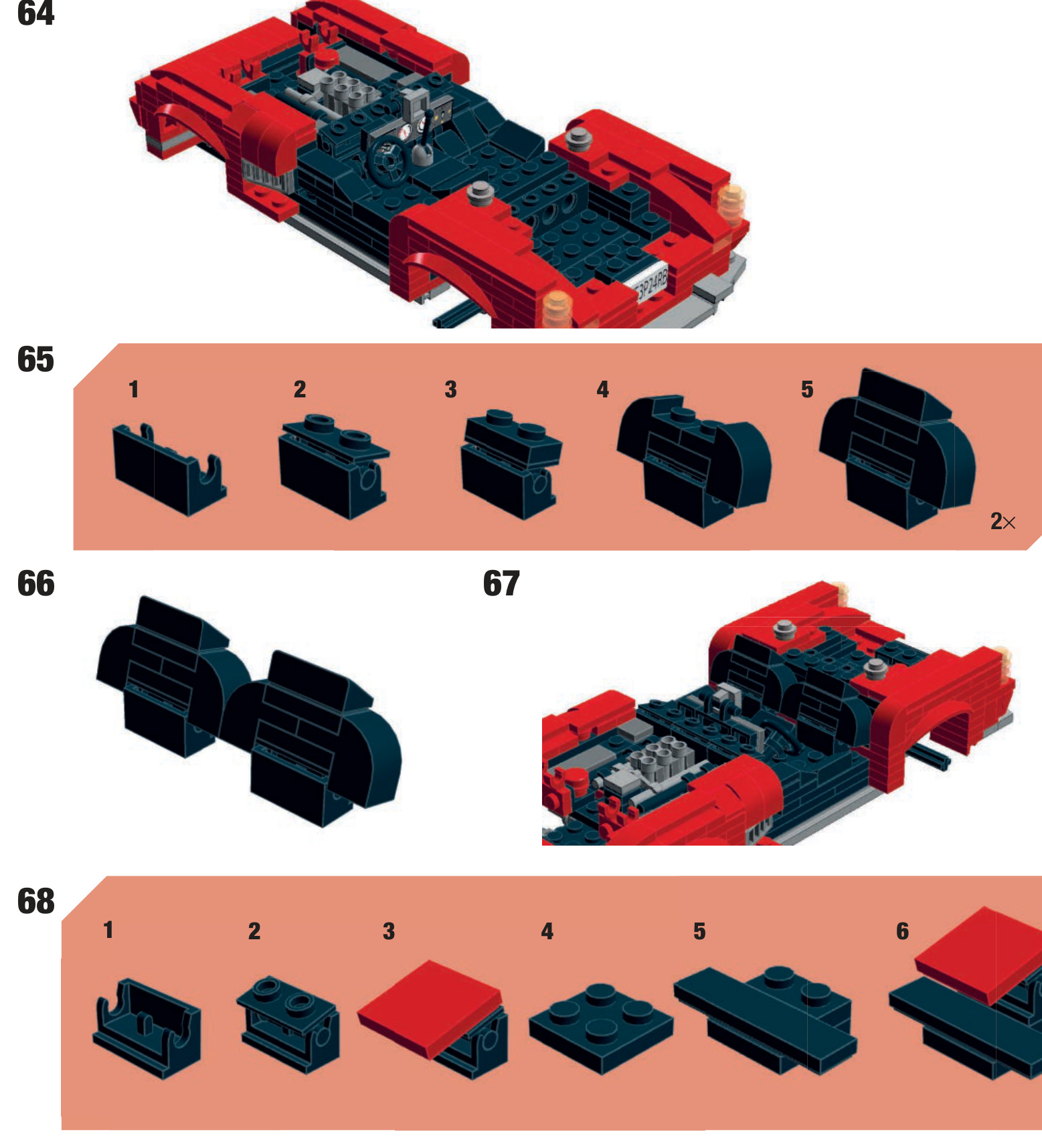
| '32 Ford | 2× | A number followed by×indicates that the builder should assemble that number of common assemblies.This is usually the case for wheels, seats, and engine parts. |
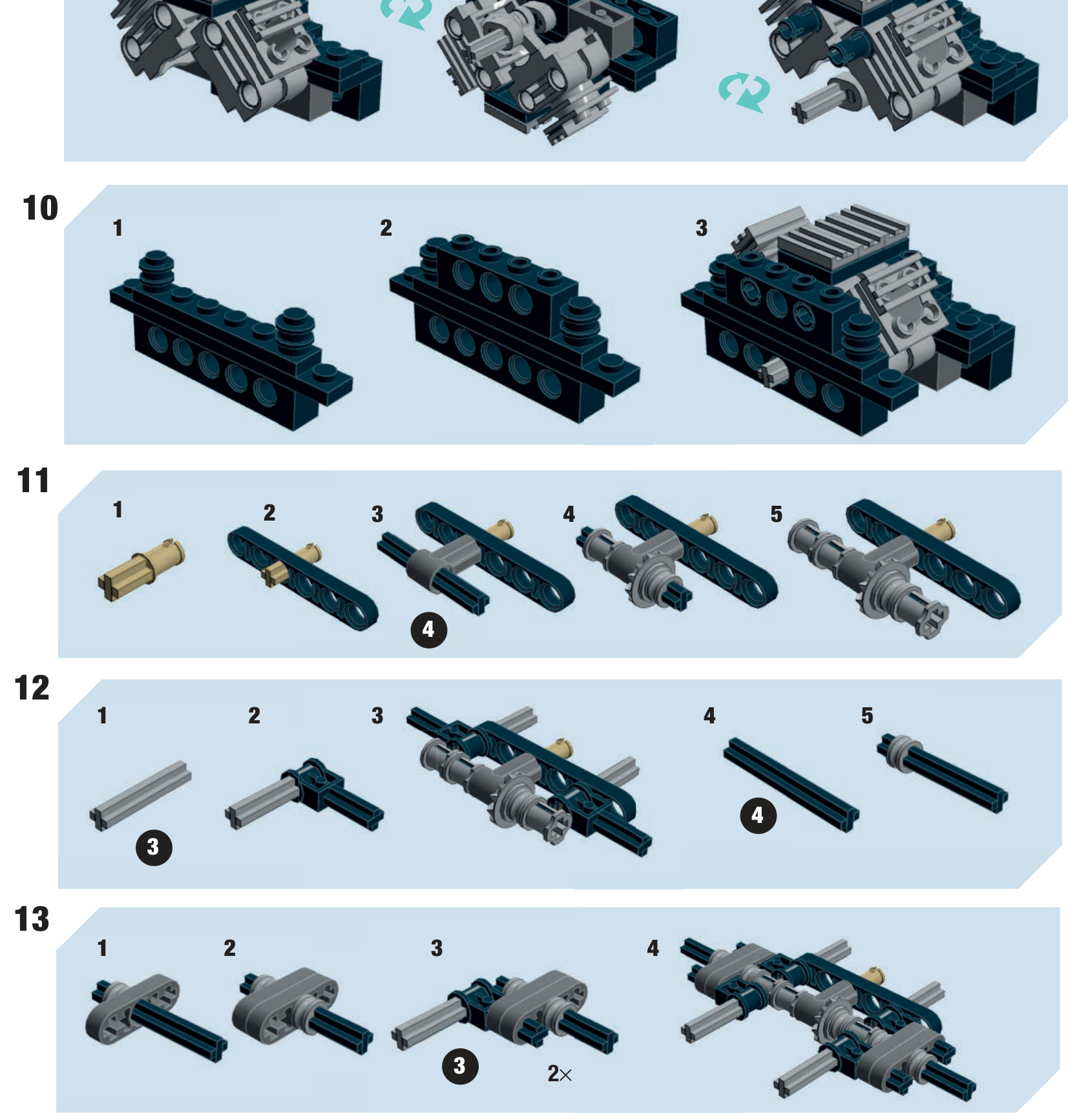
| '32 Ford | This symbolindicates thatthe assemblyor modelshould berotated to aid thenext steporto see whatit looks lik from the reverse side. | |
| '32 Ford | This symbol indicates that alternative assemblies can be chosen and points to the beginning of the first stepof building the assembly shown to the left of the arrow. | |
| '32 Ford | This symbol indicates the construction sequence to attach an assembly to the main structure of the model. | |
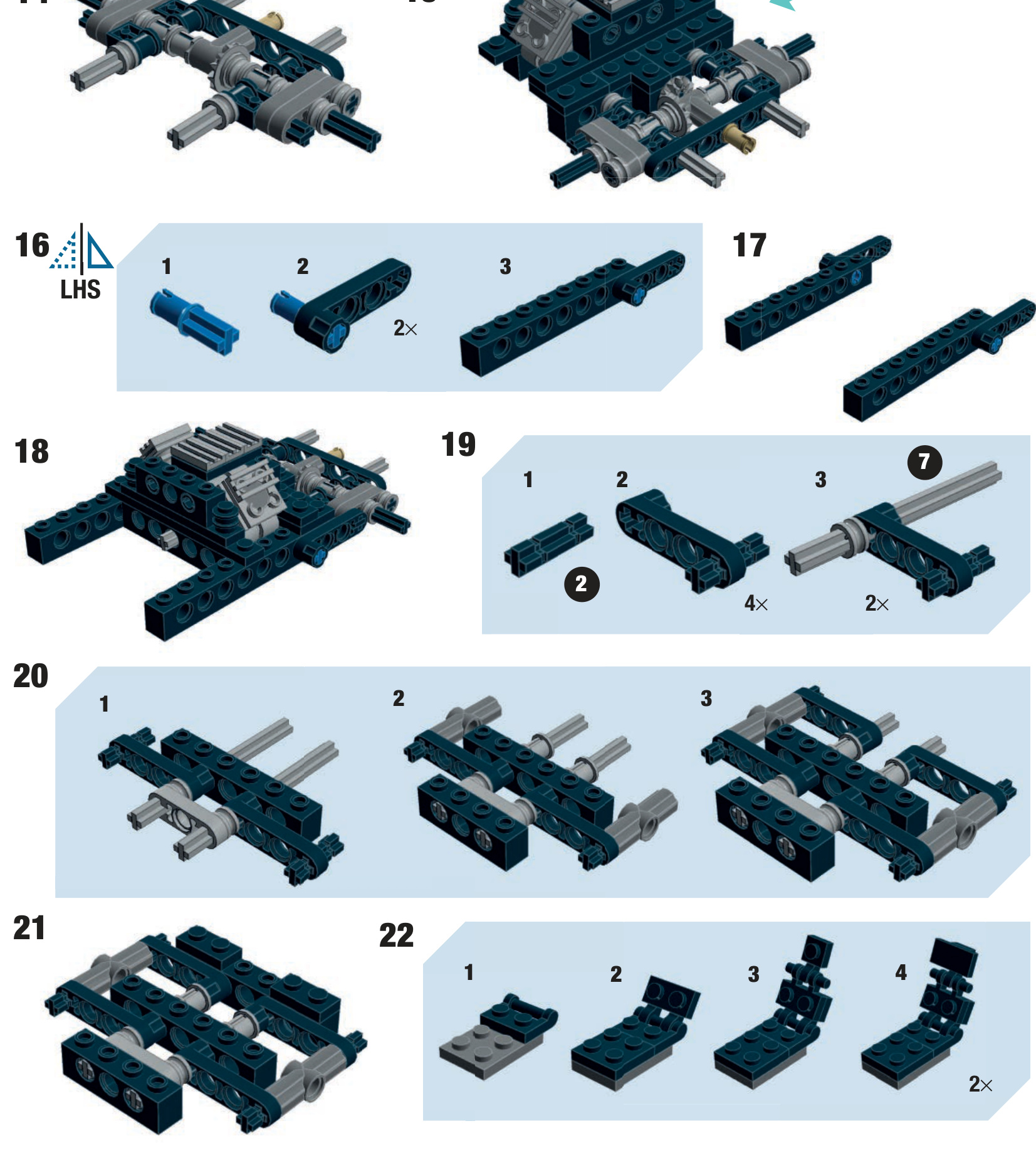
| Ferrari GTB & Spider | 5 LHS |
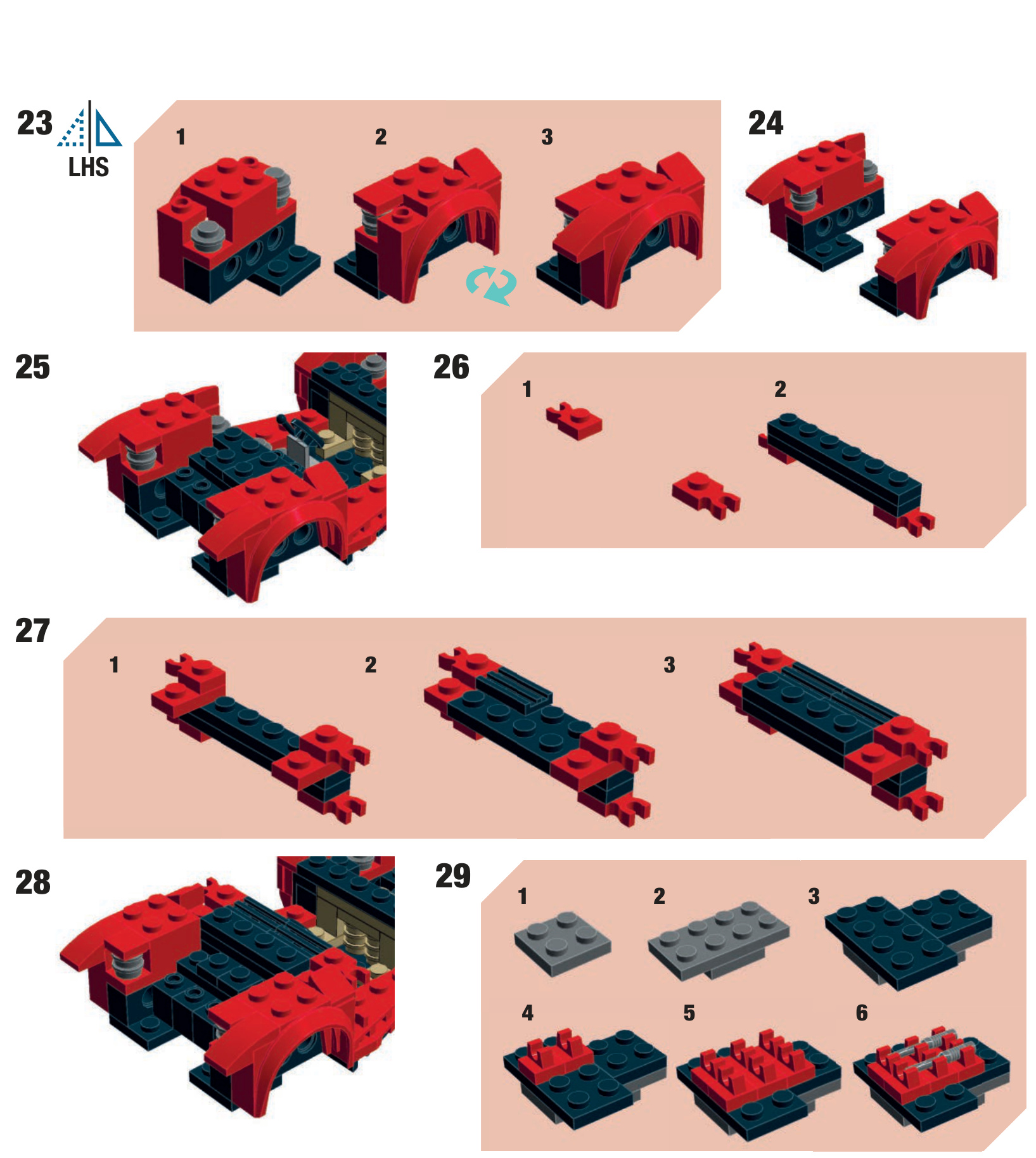
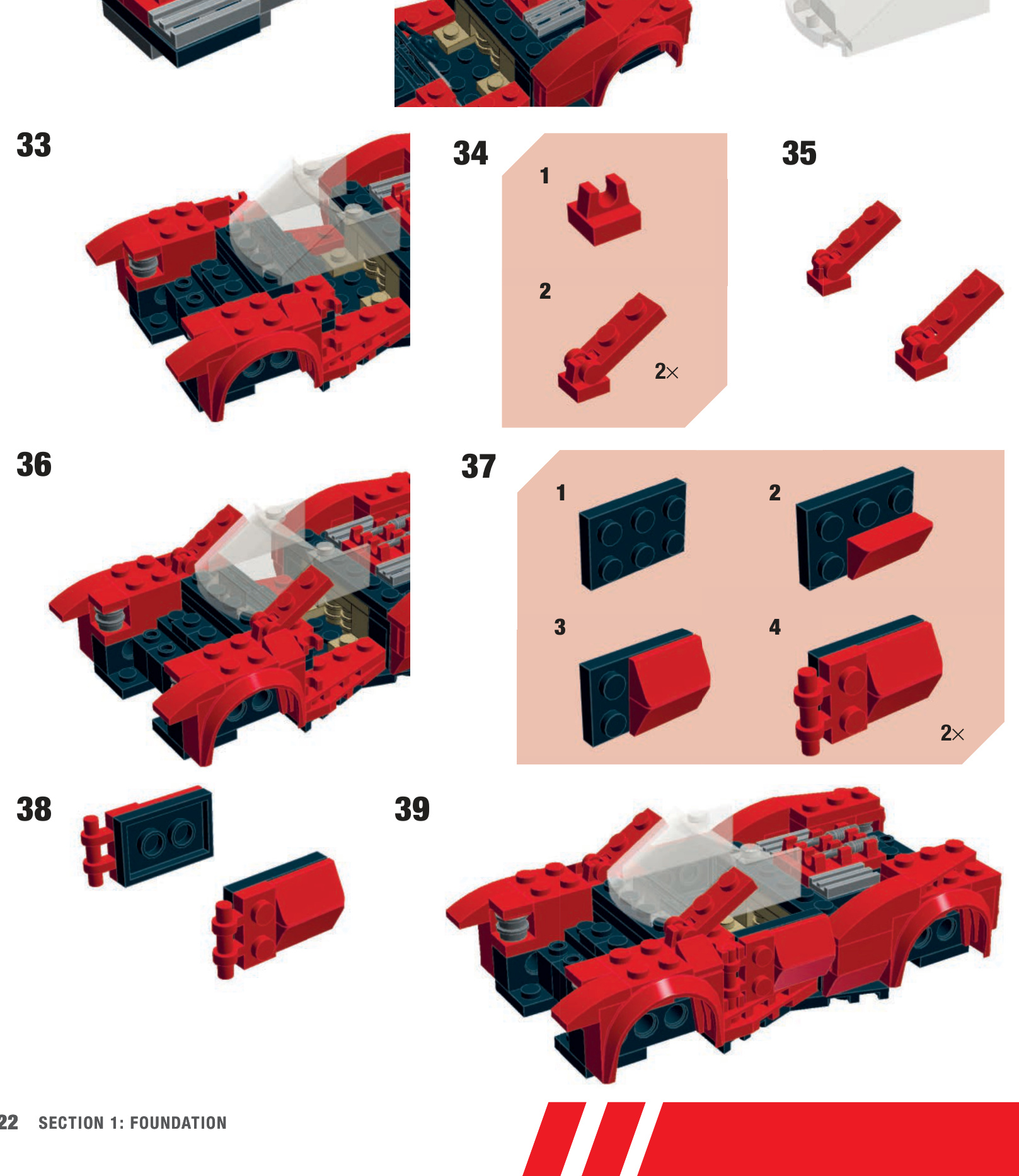
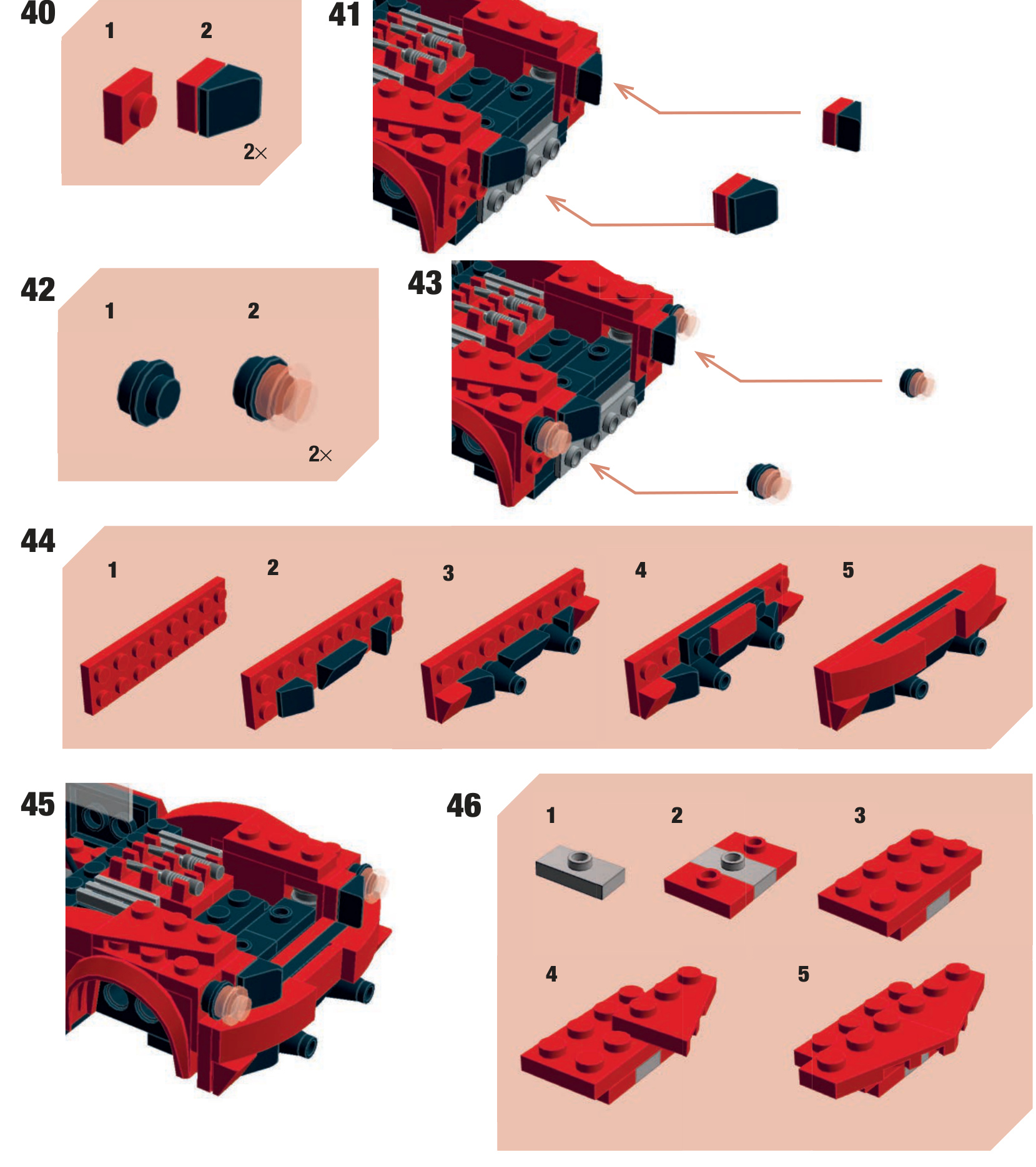
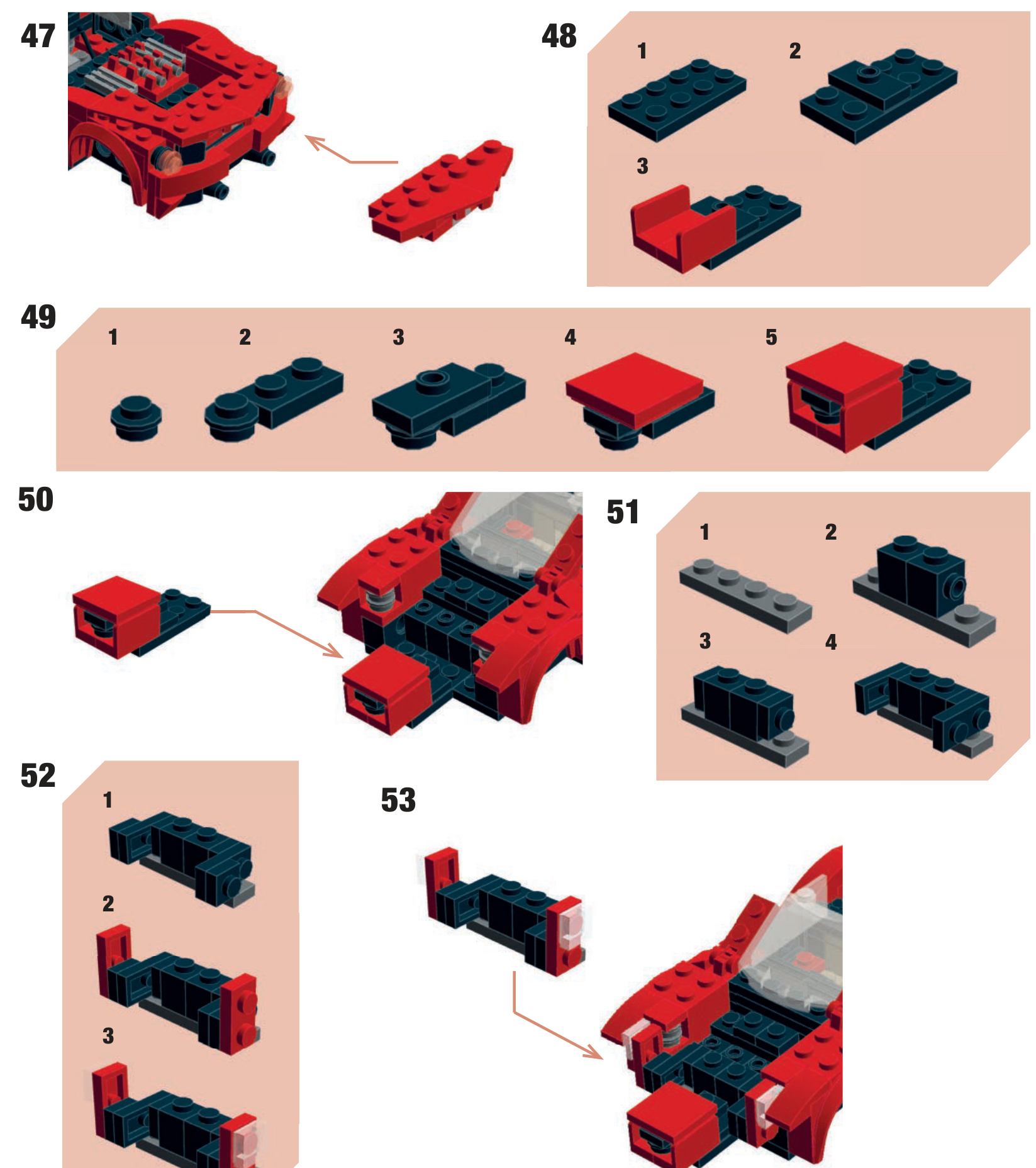
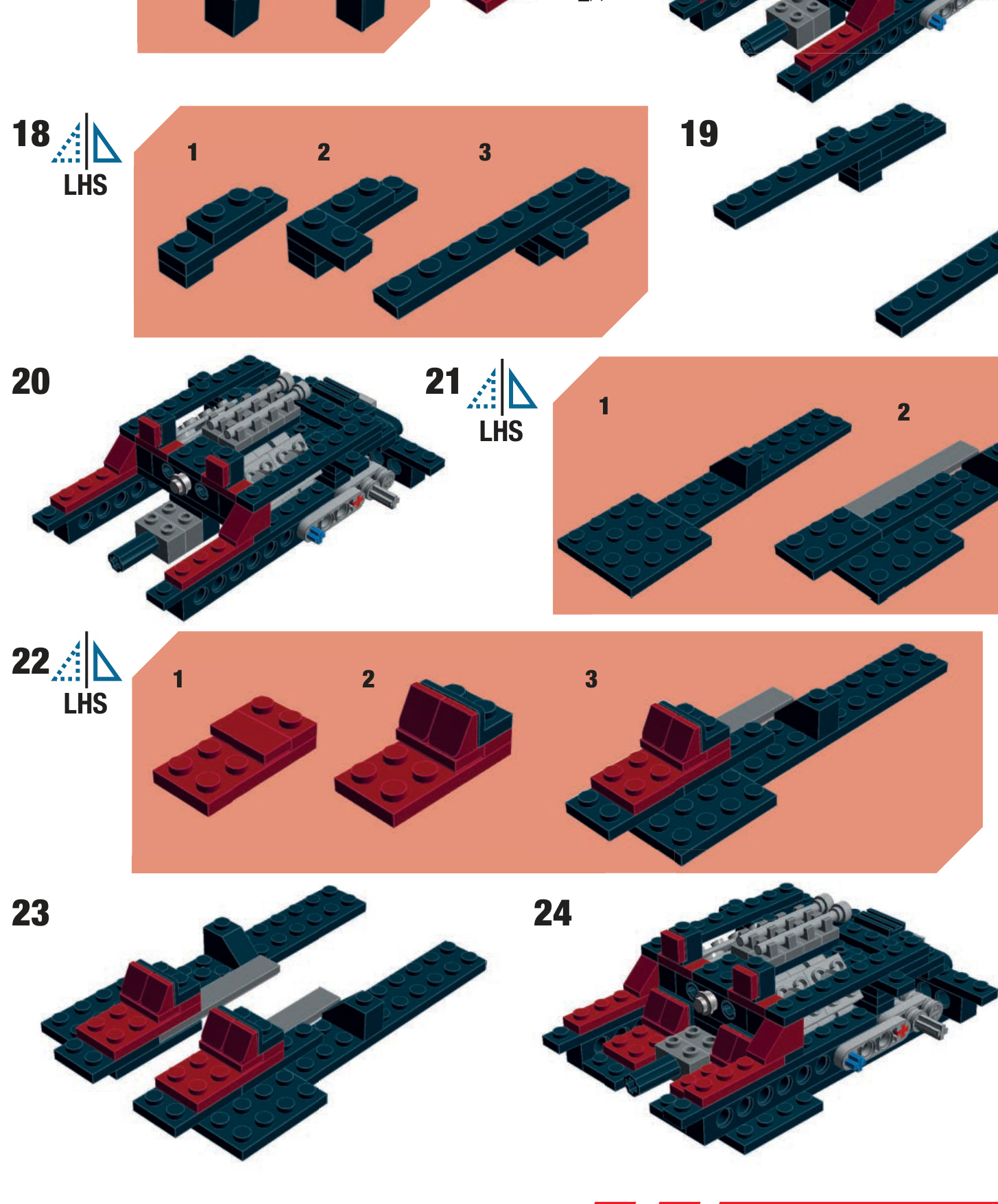
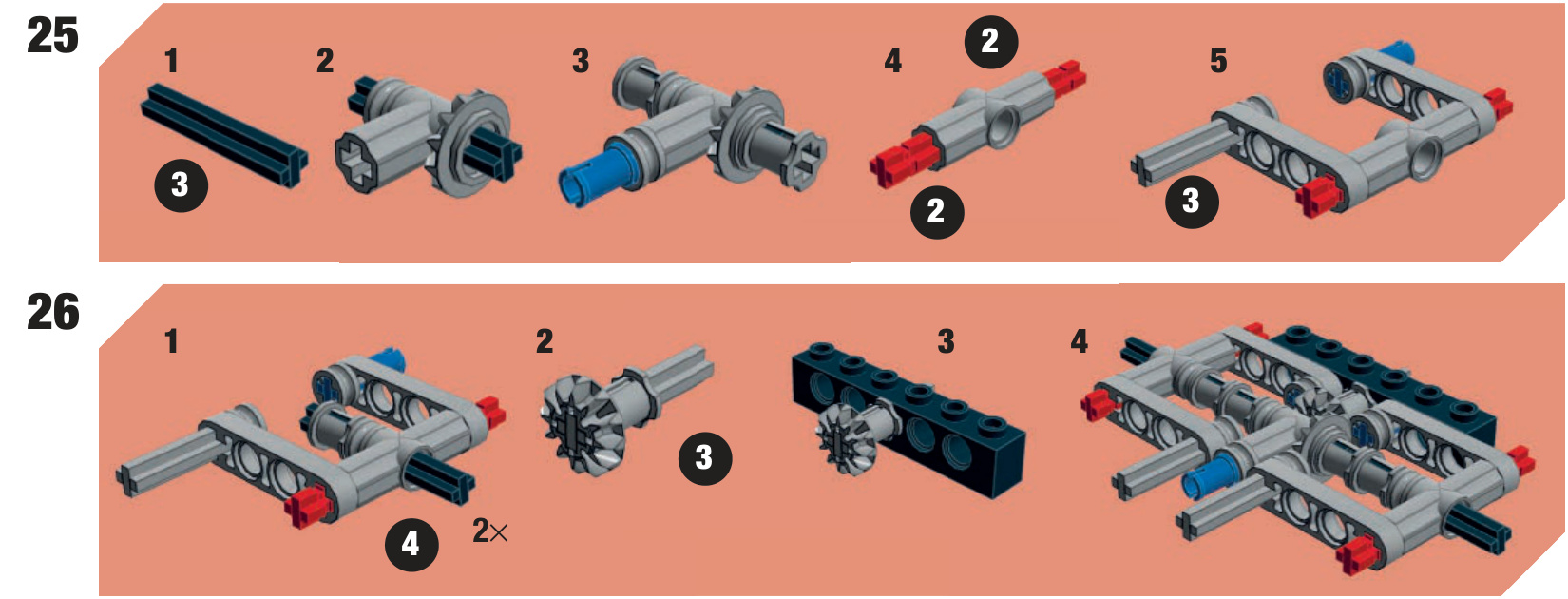
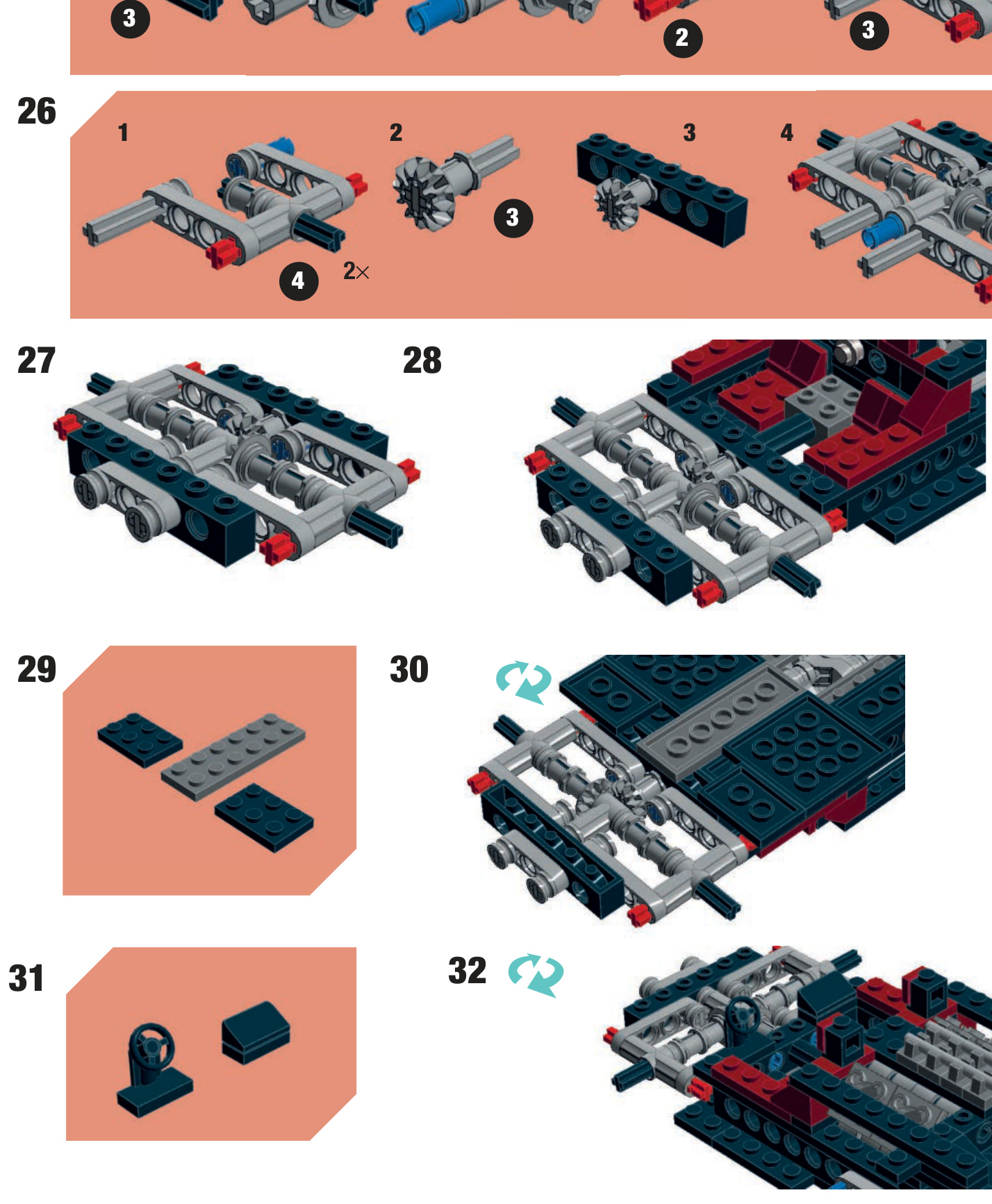
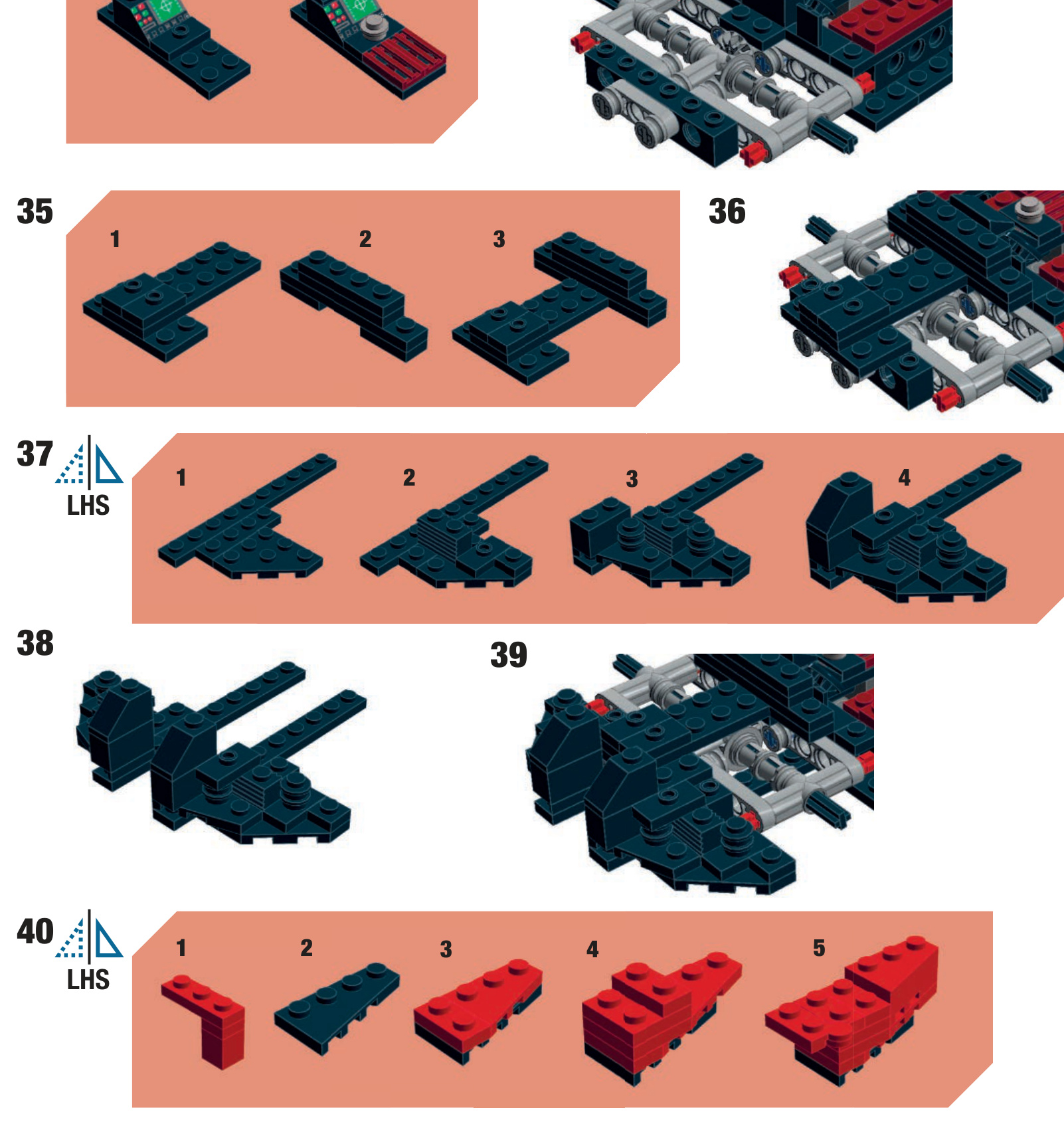
The building instructions introduce various symbols and nomenclature progressively through the chapters, allowing for the instruction set to be condensed while still maintaining instruction clarity. The following symbols and typography are there to aid the builder in selecting the correct parts at each building stage, preparing intermediate assemblies, and connecting them to the base model architecture.
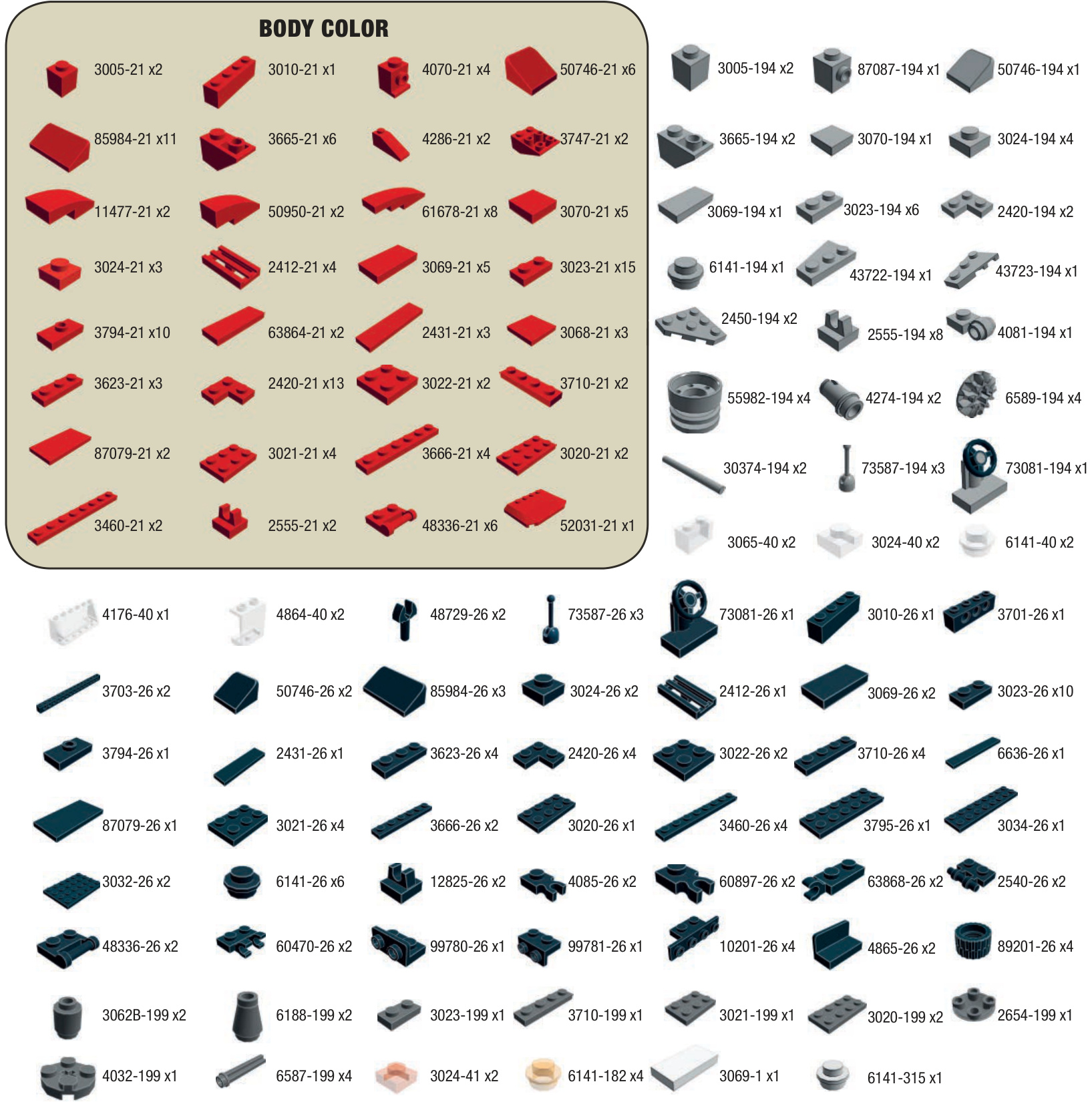
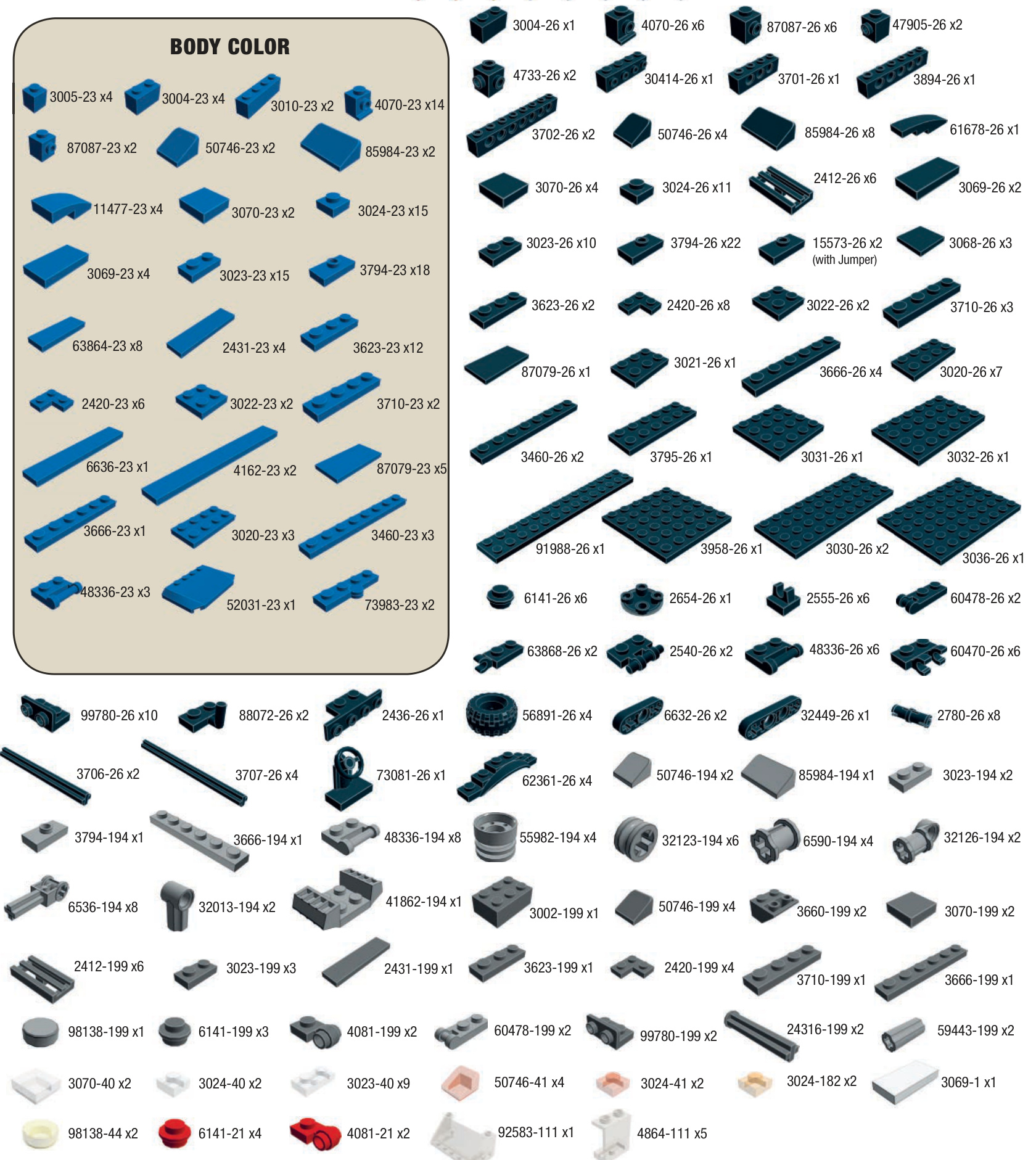
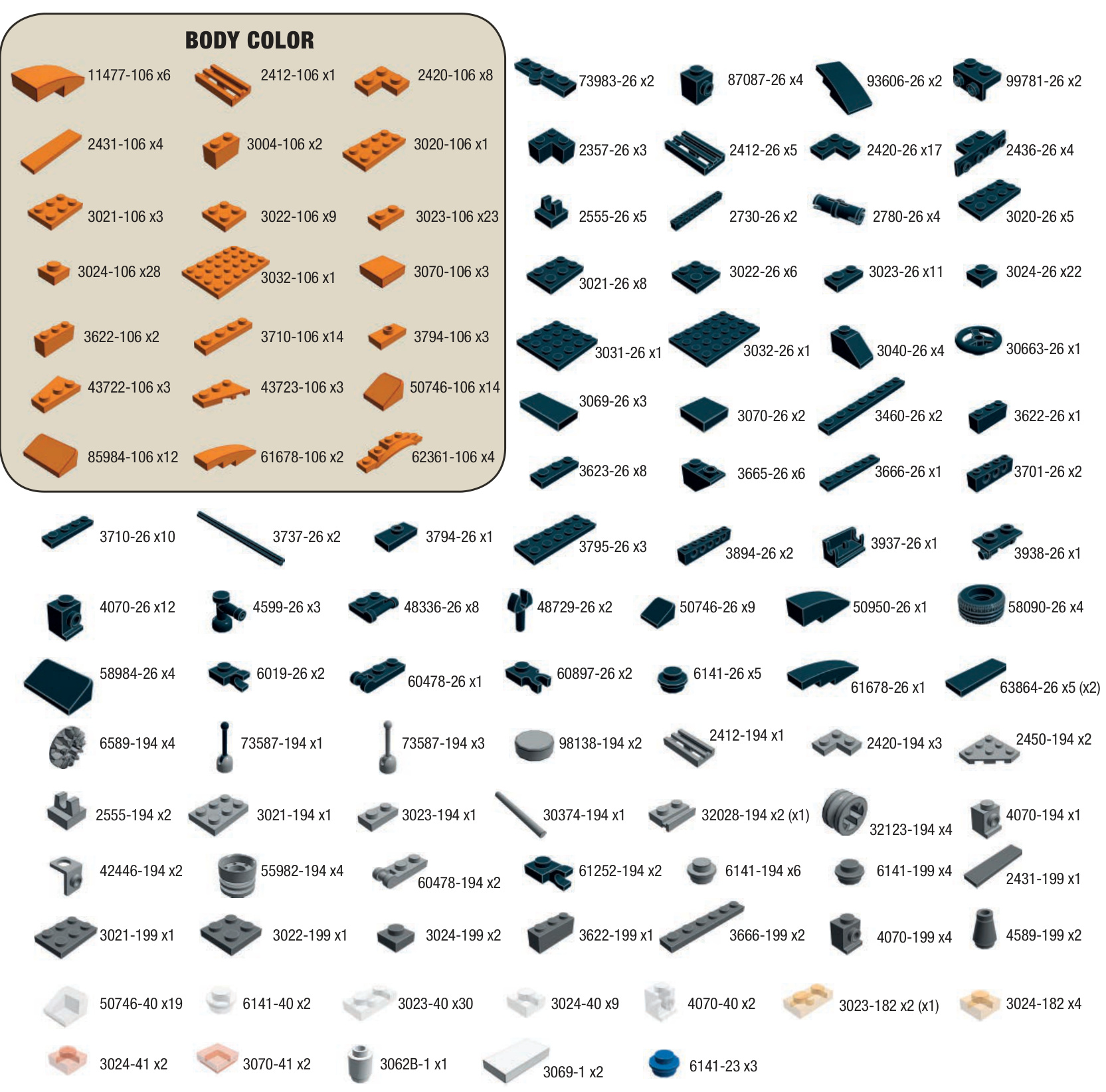
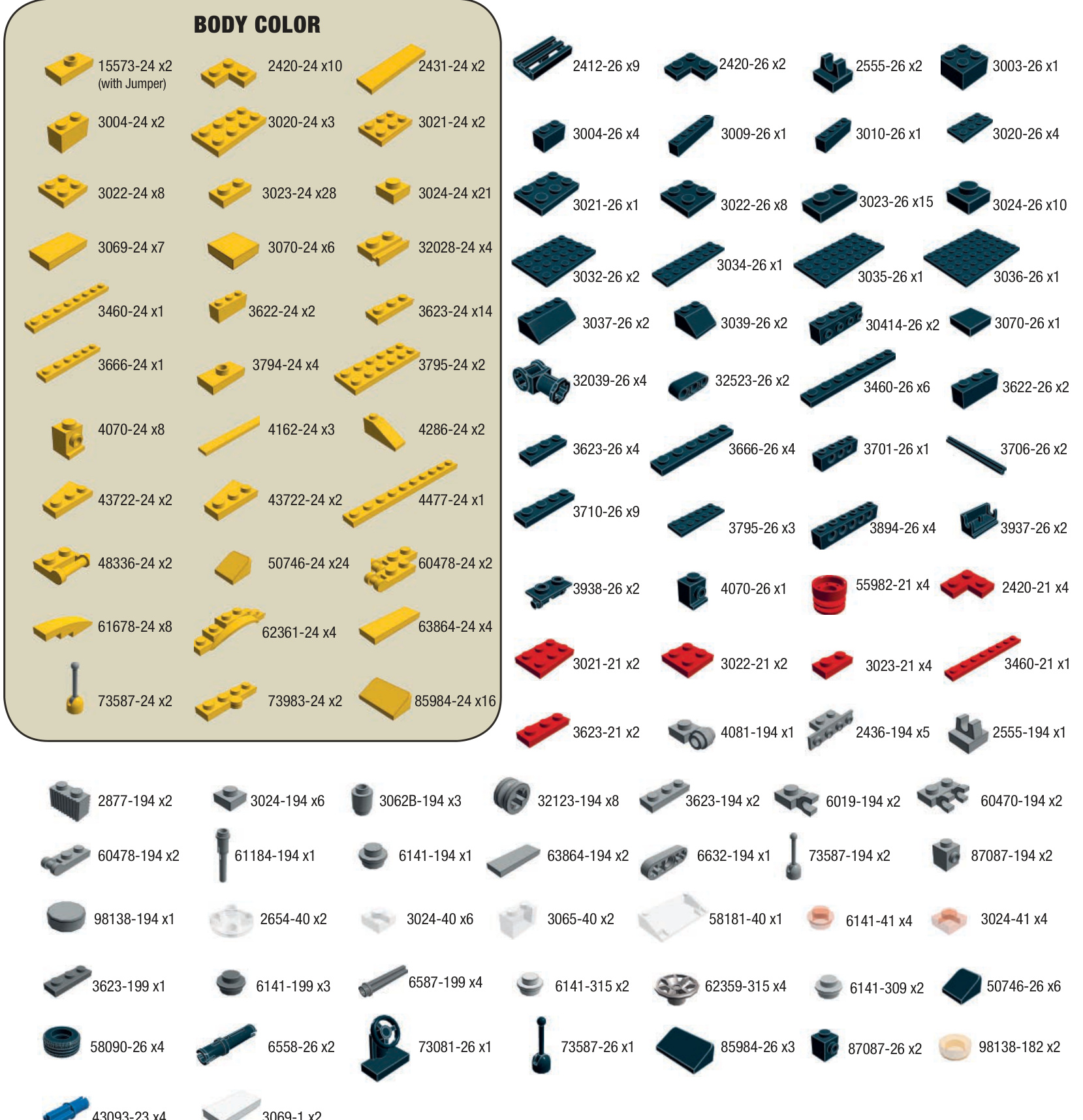
A note on part numbers: You will see each part required for the model in the form of xxxx-yy. The xxxx refers to the LEGO Part ID. This part type number is used in LDD and other software. It is also the part number that you need to use to order parts from LEGO or a third-party seller. The yy refers to the part color. LEGO uses these numbers to identify specifc colors. For example, red is color 21.
One of the most fun things about LEGO is the vibrancy and range of colors you can use. Colors for the models in this book have been selected satisfy a generally available palette. In each chapter, a color guide will indicate which colors should be used, but beauty is in the eye of the beholder—let your imagination run wild!
SECTION 1
FOUNDATION
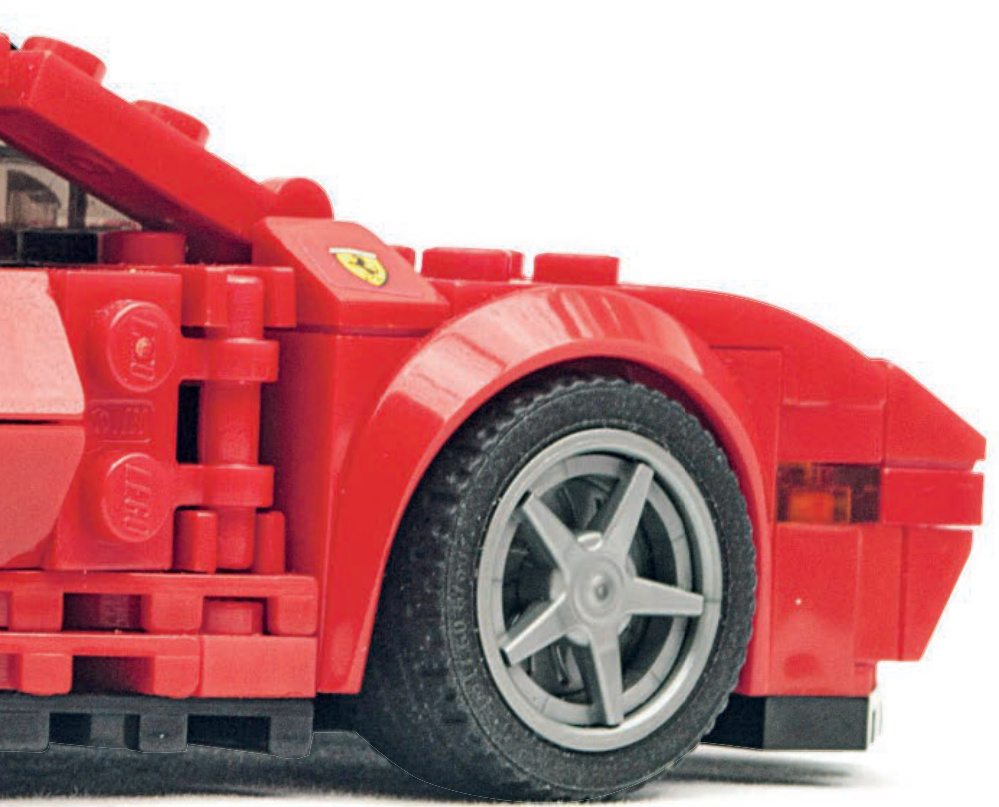
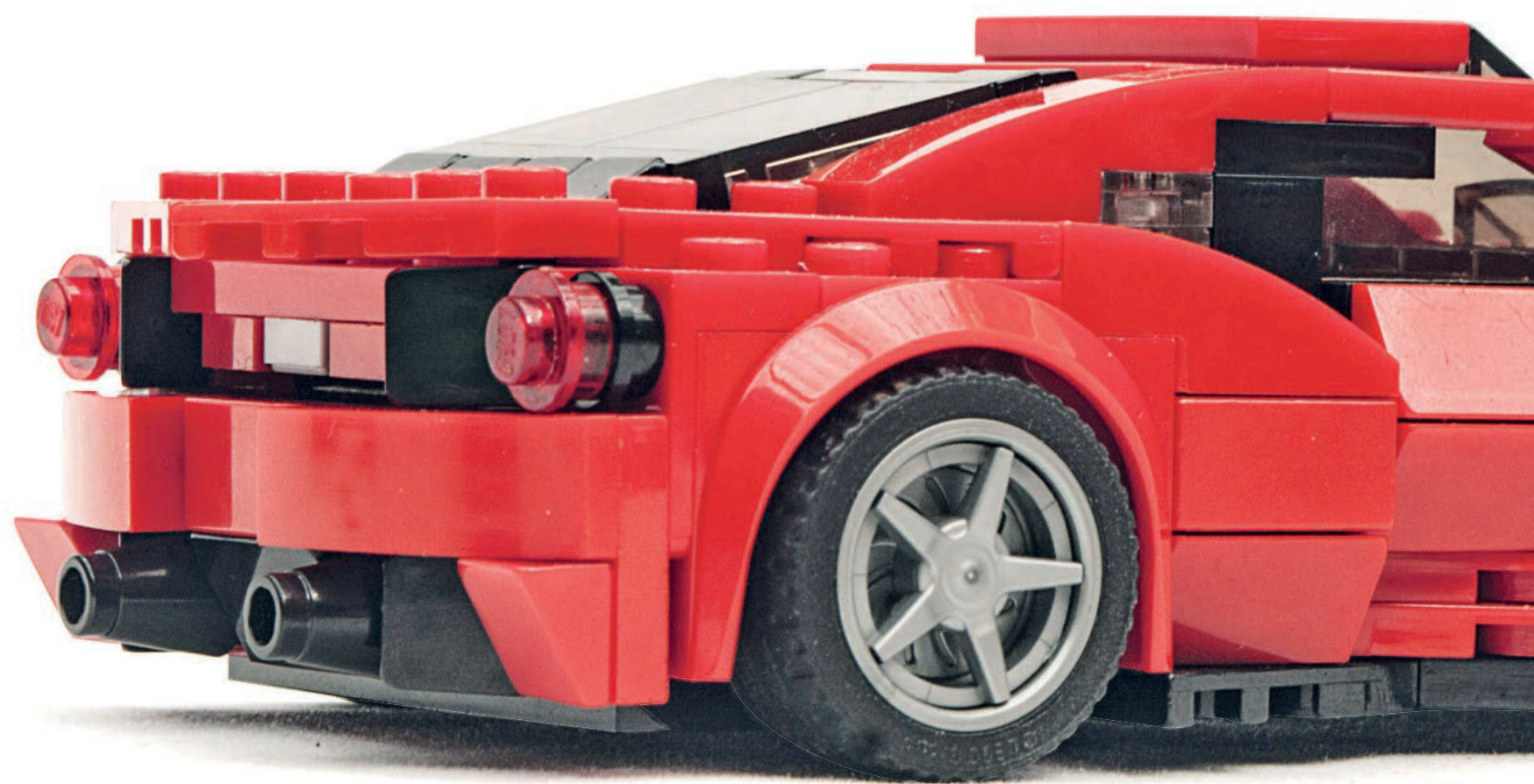
he models in Section 1 are some of the most recognizable vehicles in the history of the automobile. We recognize these cars from their designs—distinct silhouettes arriving at historically signifcant moments in time.
These models are not generic LE cars for kids. They are detailed models at a smaller scale (1:28), take less time to build, and do not require many specialist pieces. These models can seat LEGO minifgures.
The builds become more detailed and complex as you work through the section. The 1932 Ford V-8, Ferrari 488, and Jaguar E-Type also provide instructions to build these cars in both convertible and coupe forms, along with some other modeling differences, such as wheels.
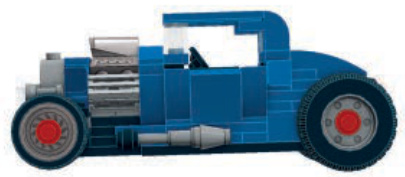
1932 FORD
V-8 COUPE & ROADSTER
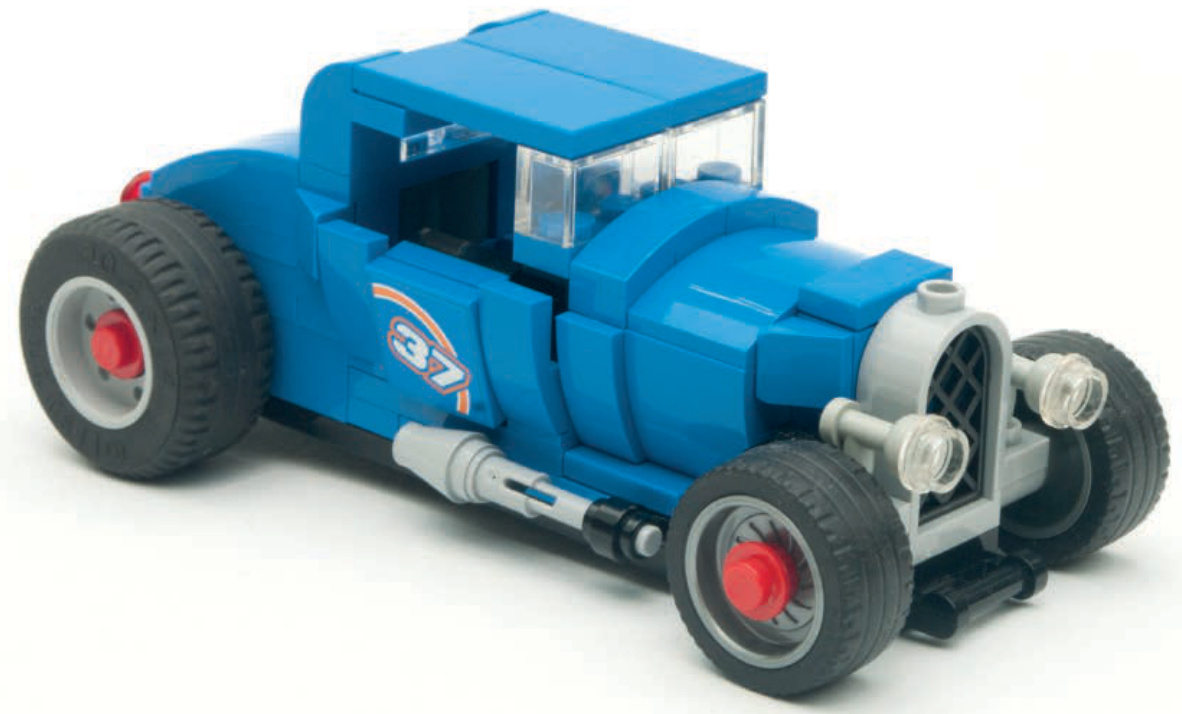
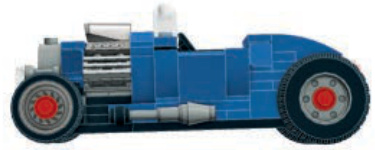
T ohfeaFnoredraMofdaeflf o1r8d a(absleitpwoawserofforcitahlleycnoammedo)nmarnk.eTdhteheMboedgeiln1ni8ng luxury cars. Priced from \490($495$10$ less) would have been a failure but for Ford’s inability to produce greater numbers of V-8 engines and cars.
A V-8 had many advantages. Chiefy, it offered smooth running and high power density for its overall length. The engine was barely heavier than an inline-four and lighter than an inline-six. This made for a fantastic recipe: small car big engine maximum mayhem. All getaway drivers knew this. Bonnie and Clyde, while on the run, famously penned a thank-you note to Henry Ford:
Dear Sir While I still have got breath in my lungs I will tell you what a dandy car you make. I have drove Fords exclusivly when I could get away with one.

For sustained speed and freedom from trouble the Ford has got every
other car skinned and even if my business hasen’t been strickly legal it don’t hurt anything to tell you what a fne car you got in the V-8. Yours truly, Clyde Champion Barrow [April 10th, 1934]
COUNTRY OF ORIGIN: USA PRODUCTION: 1932 NUMBER MADE: 298,647 LAYOUT / DRIVE: Front engine / Rear-wheel drive ENGINE: V, 8 cylinders, 221 cid (3.6L) CAPACITY: 65 hp (48 kW) CONSTRUCTION: Separate frame, steel body/ 2-door coupe and roadster
After World War II, returned servicemen sought the adrenaline a modifed Ford V-8 could offer. The Ford V-8 was the original hot rod. The culture of hot rodding came to life chiefy thanks to cheaply available prewar Ford V-8s. Roadsters and coupes were the favored styles, and very few cars from this period are left in original condition.
The Ford V-8 was updated in 1933 to the Model 40 and in 1934 to the 40B, offering a styling change to a more shovel-like radiator and hood line.
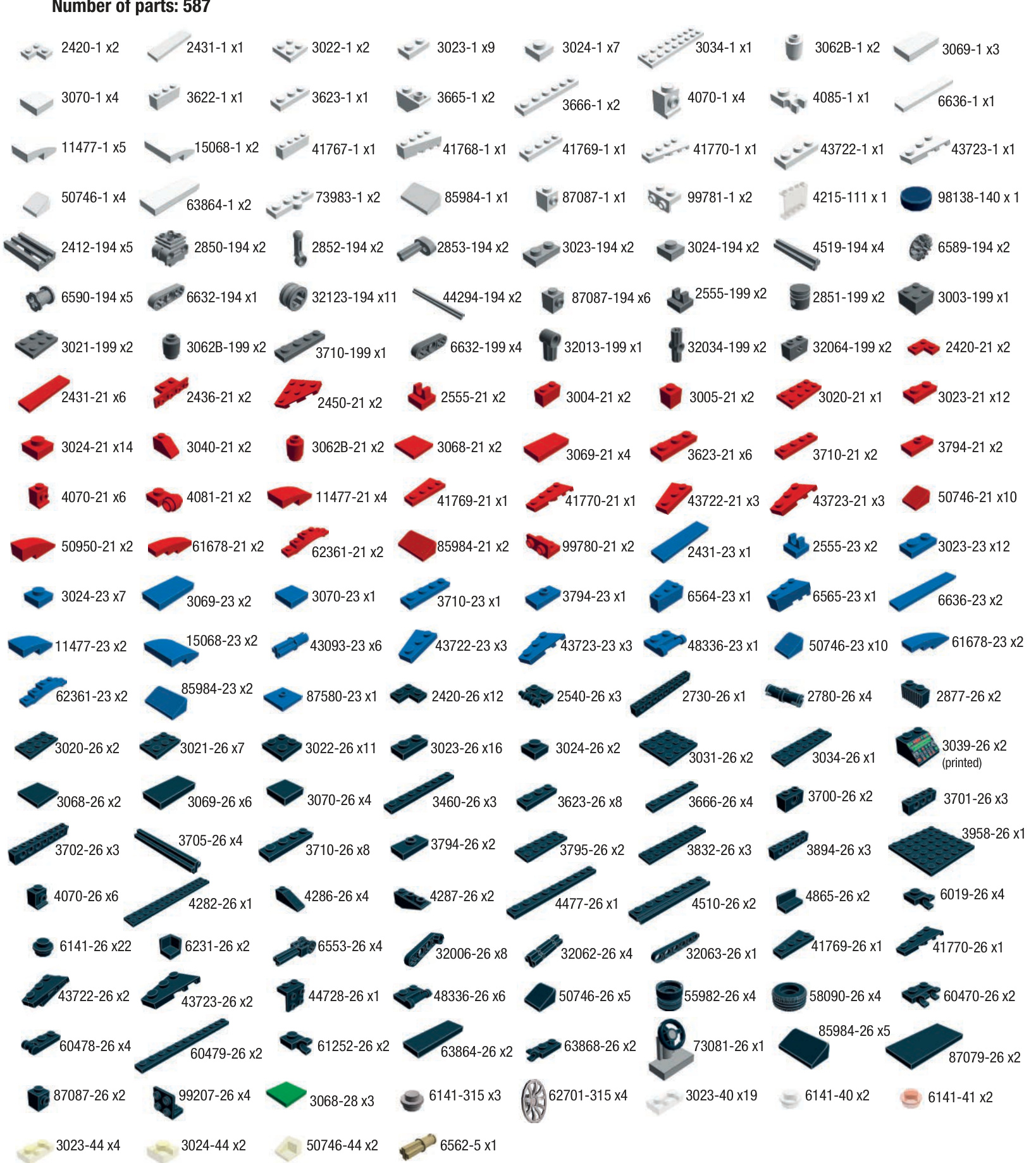
This model can also be built in the folowing colors: Number of parts: 155
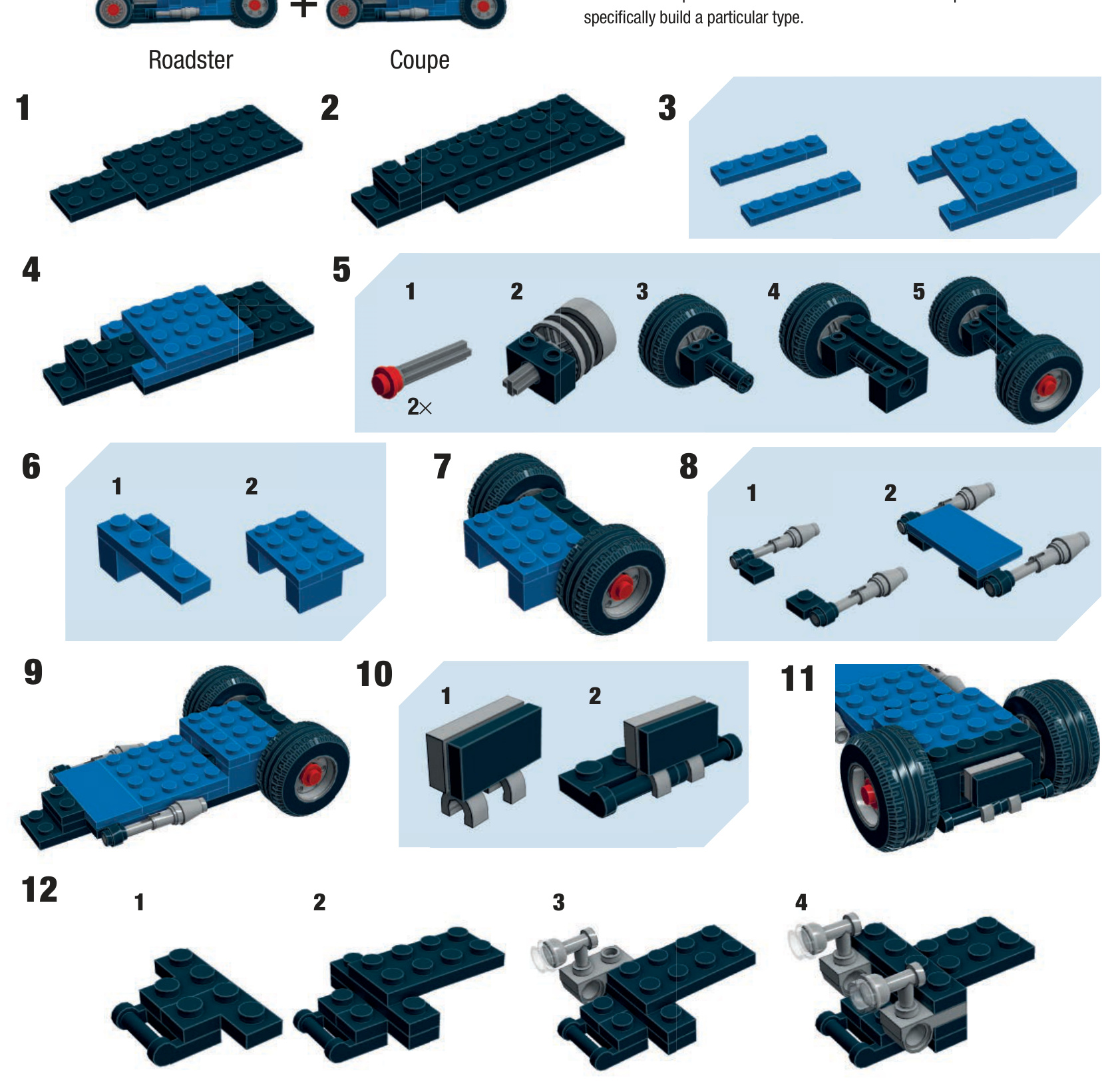
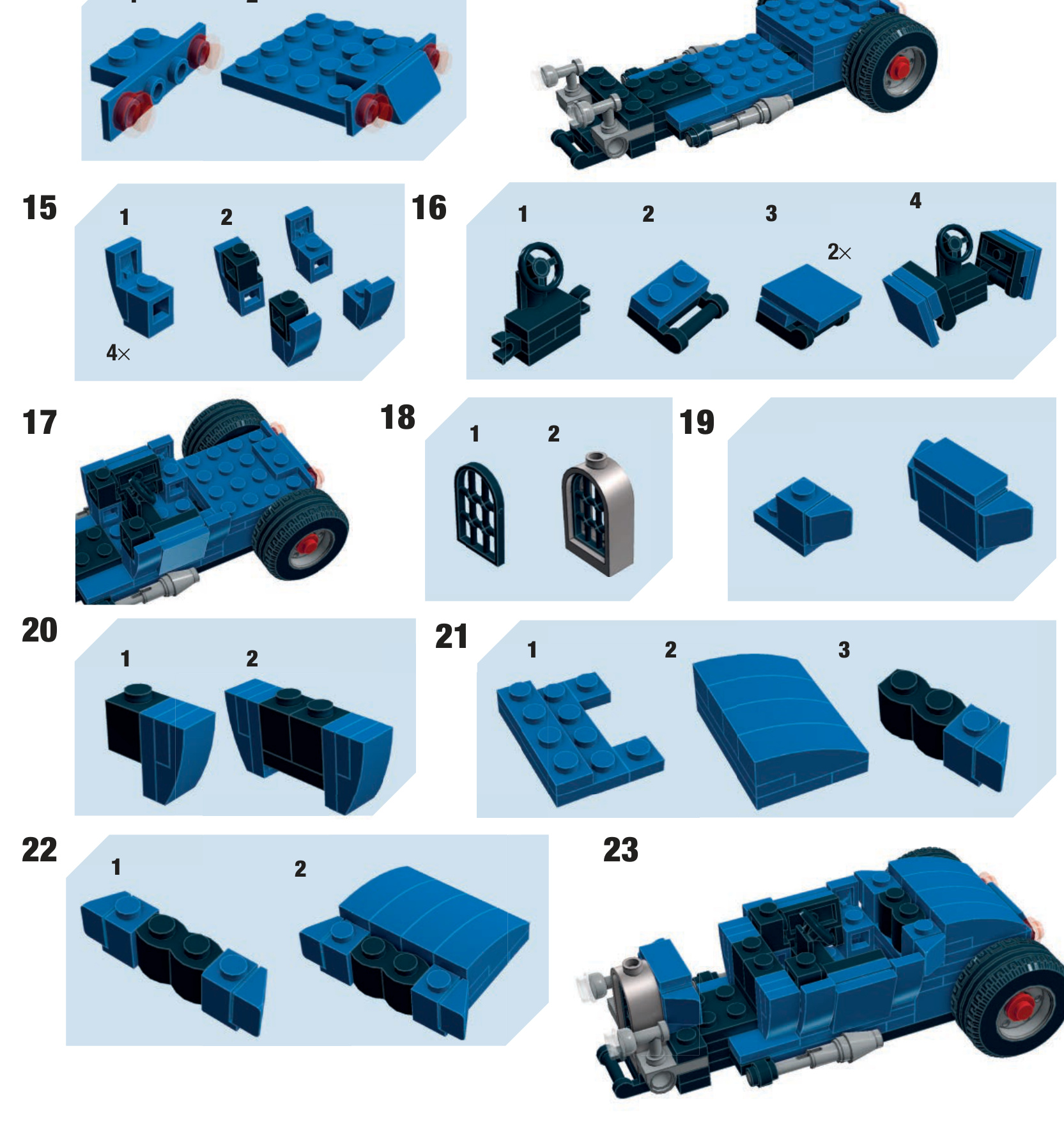
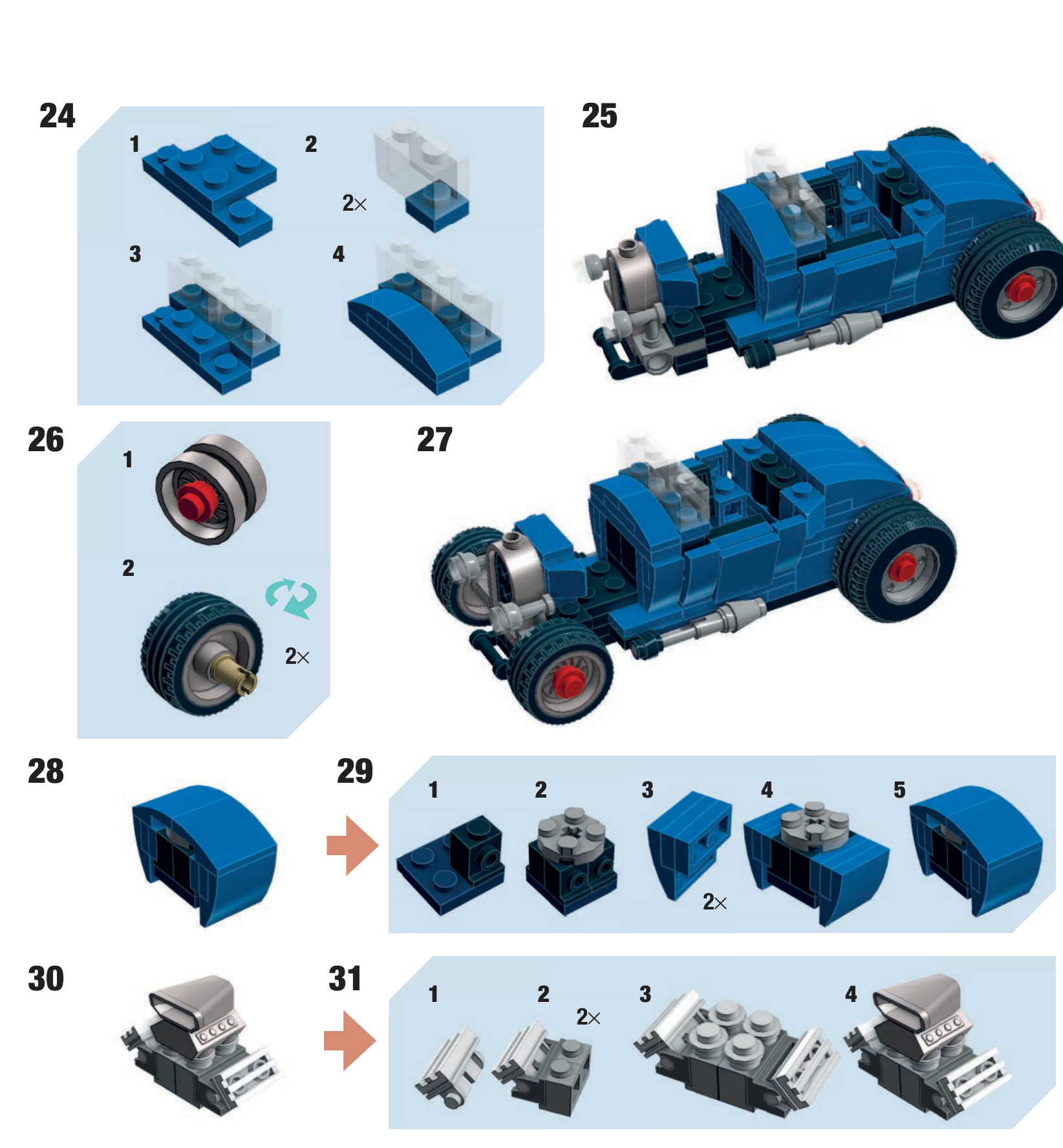
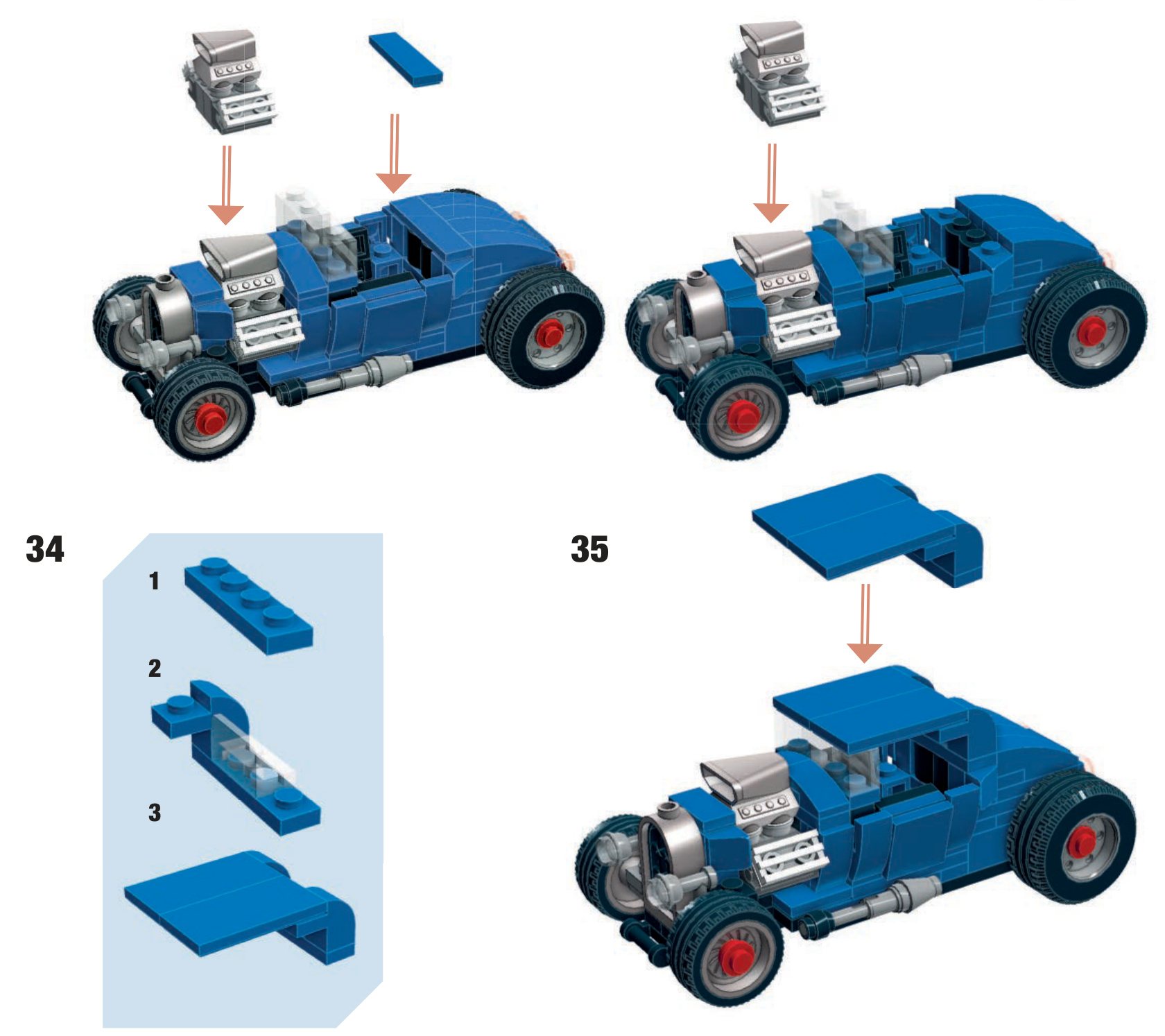
roadster or coupe
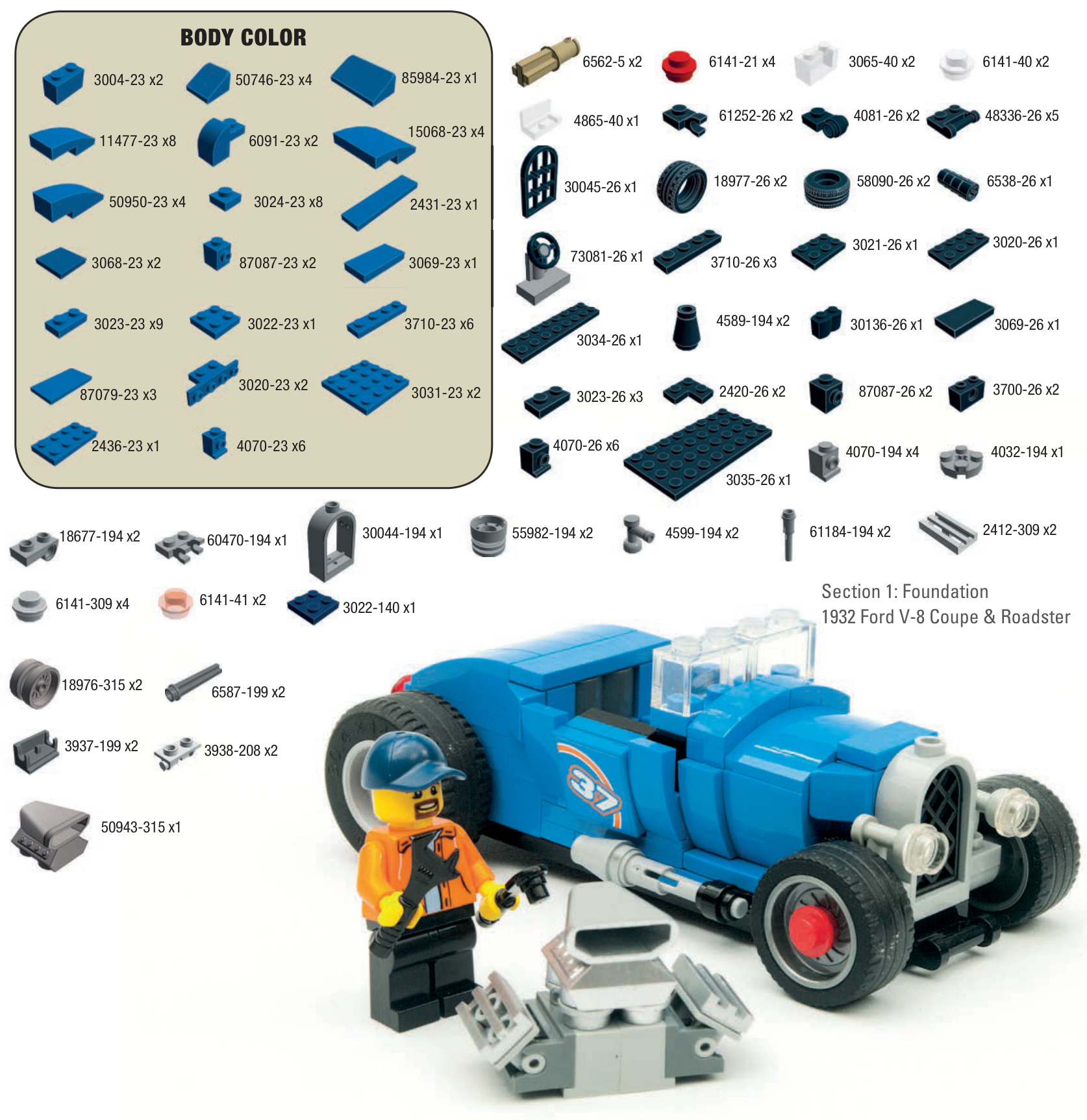
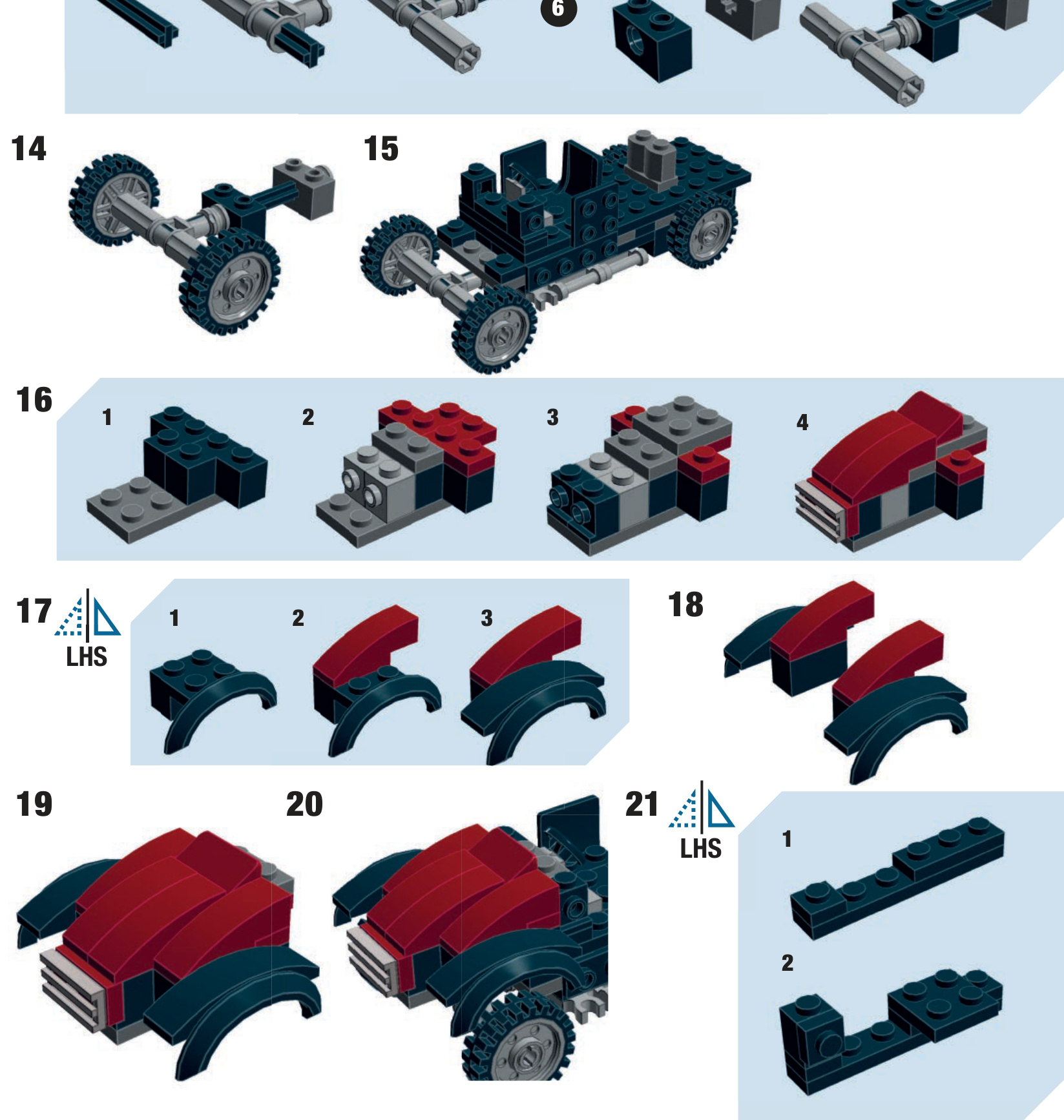
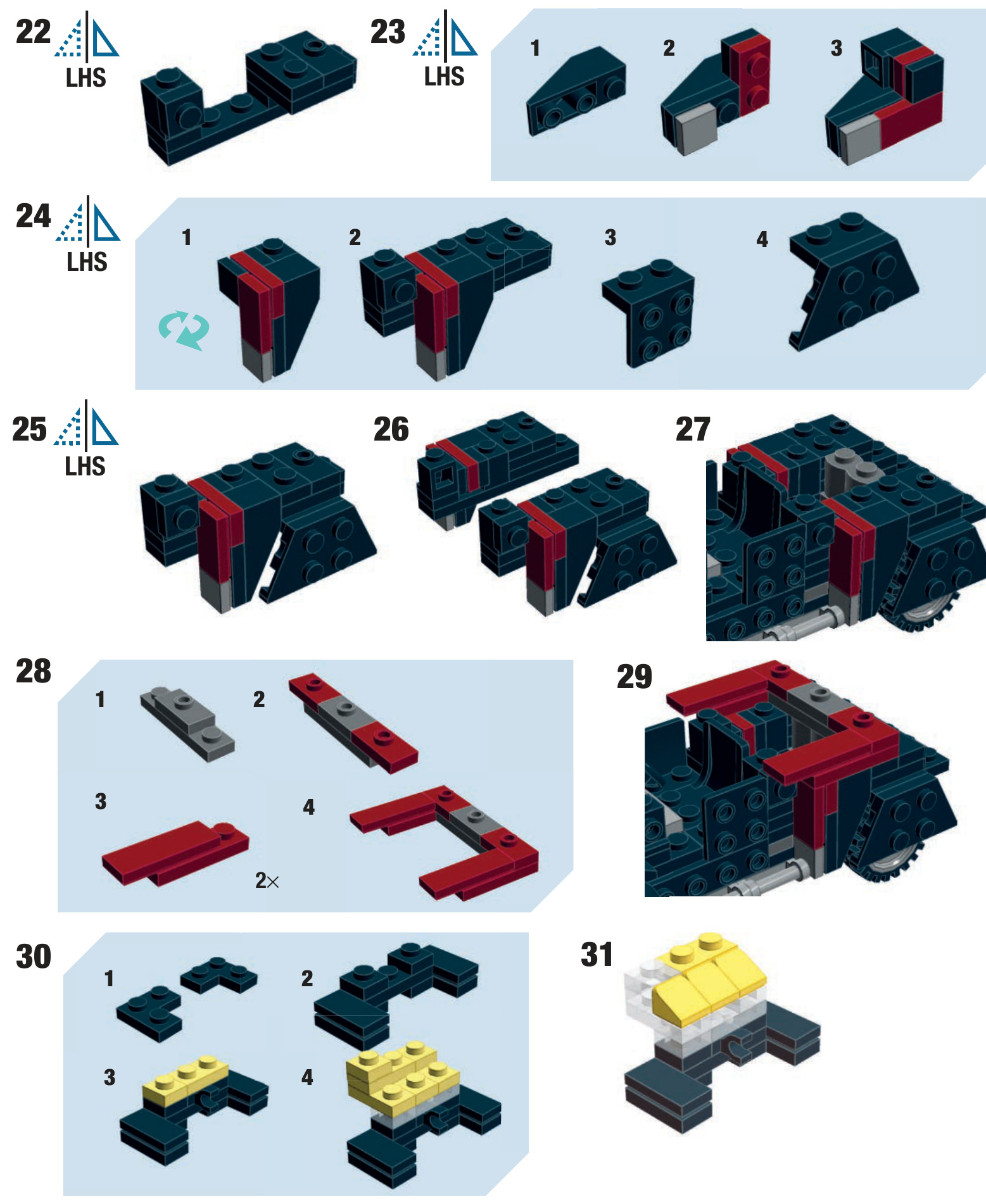
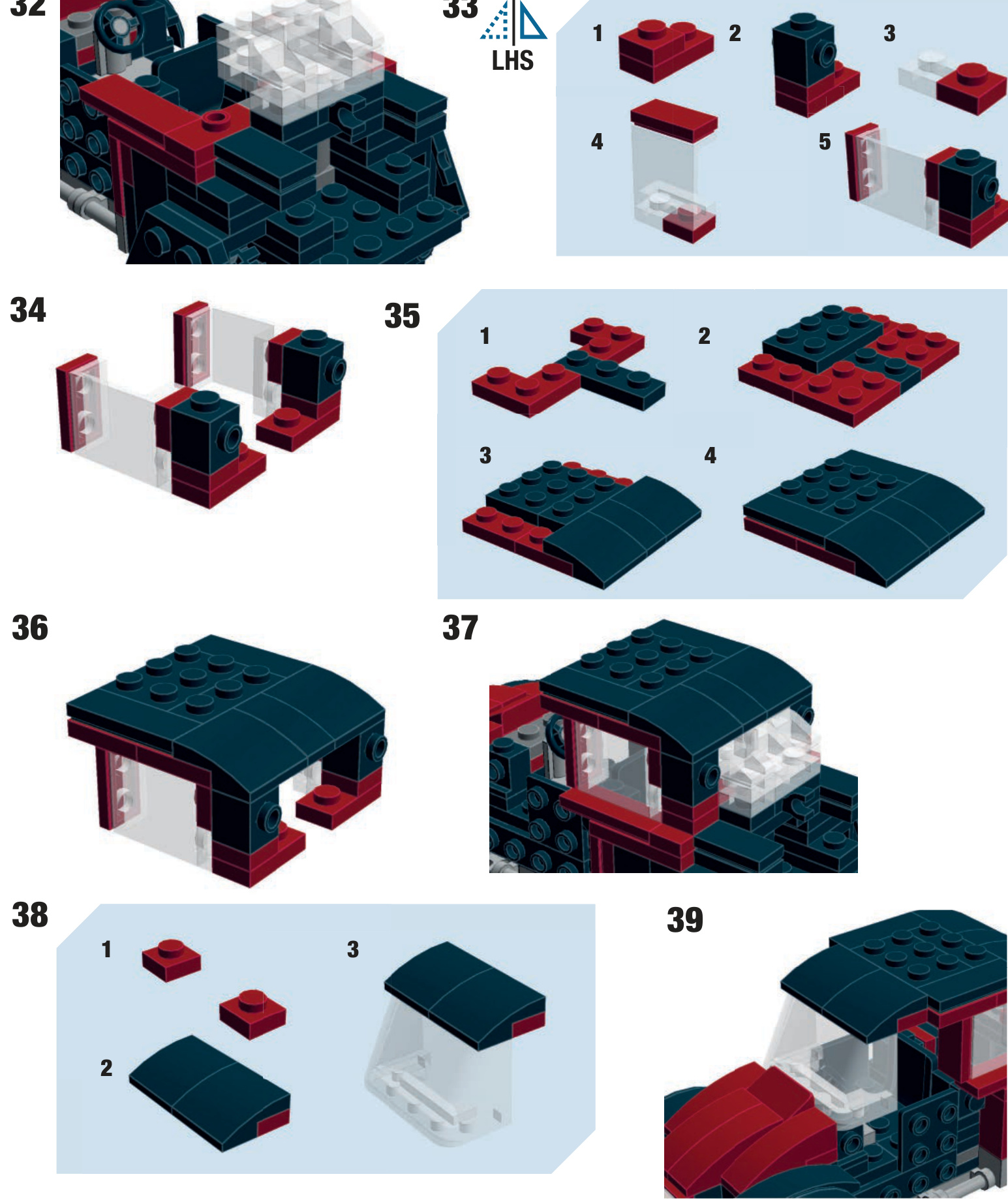
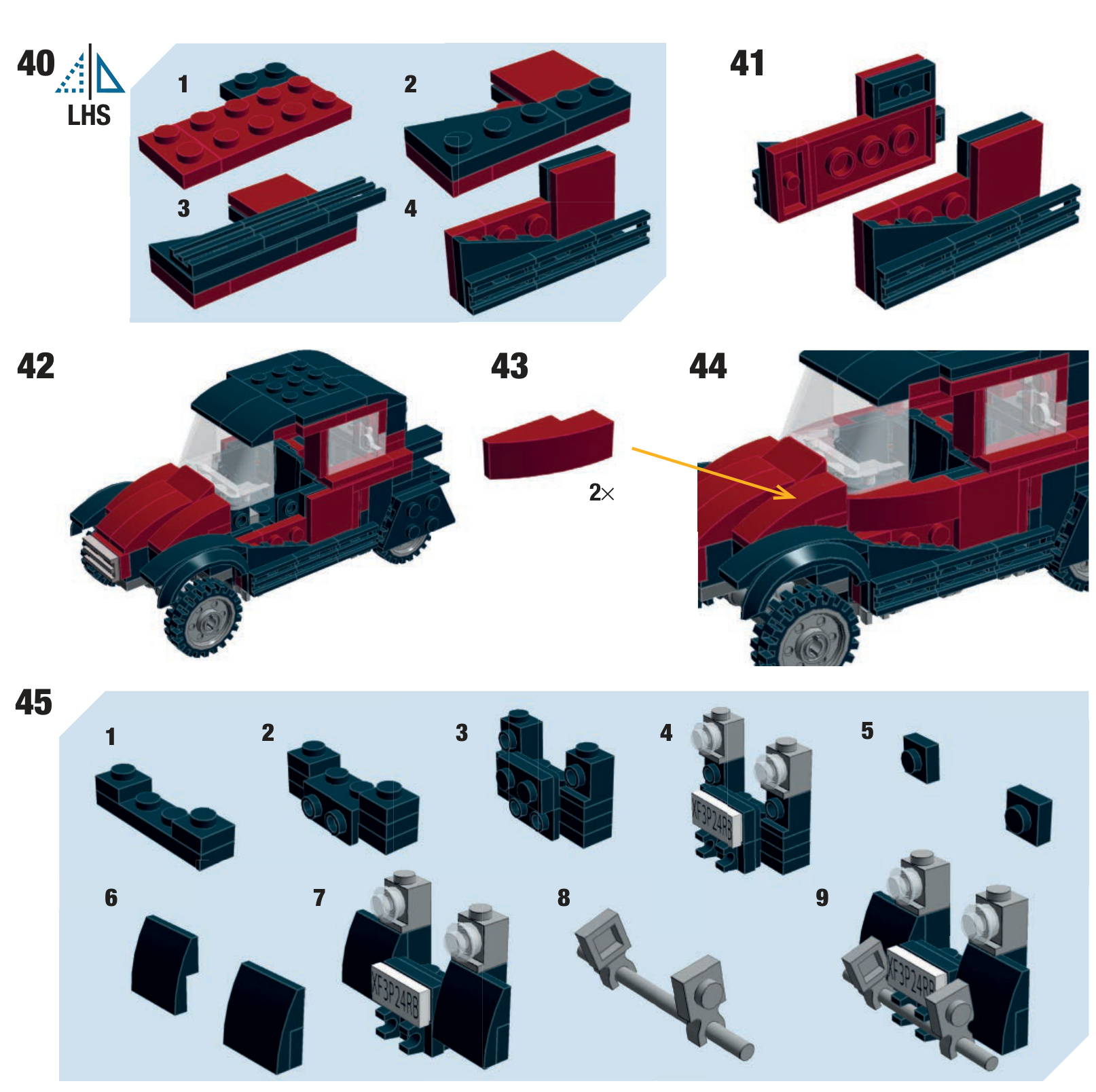
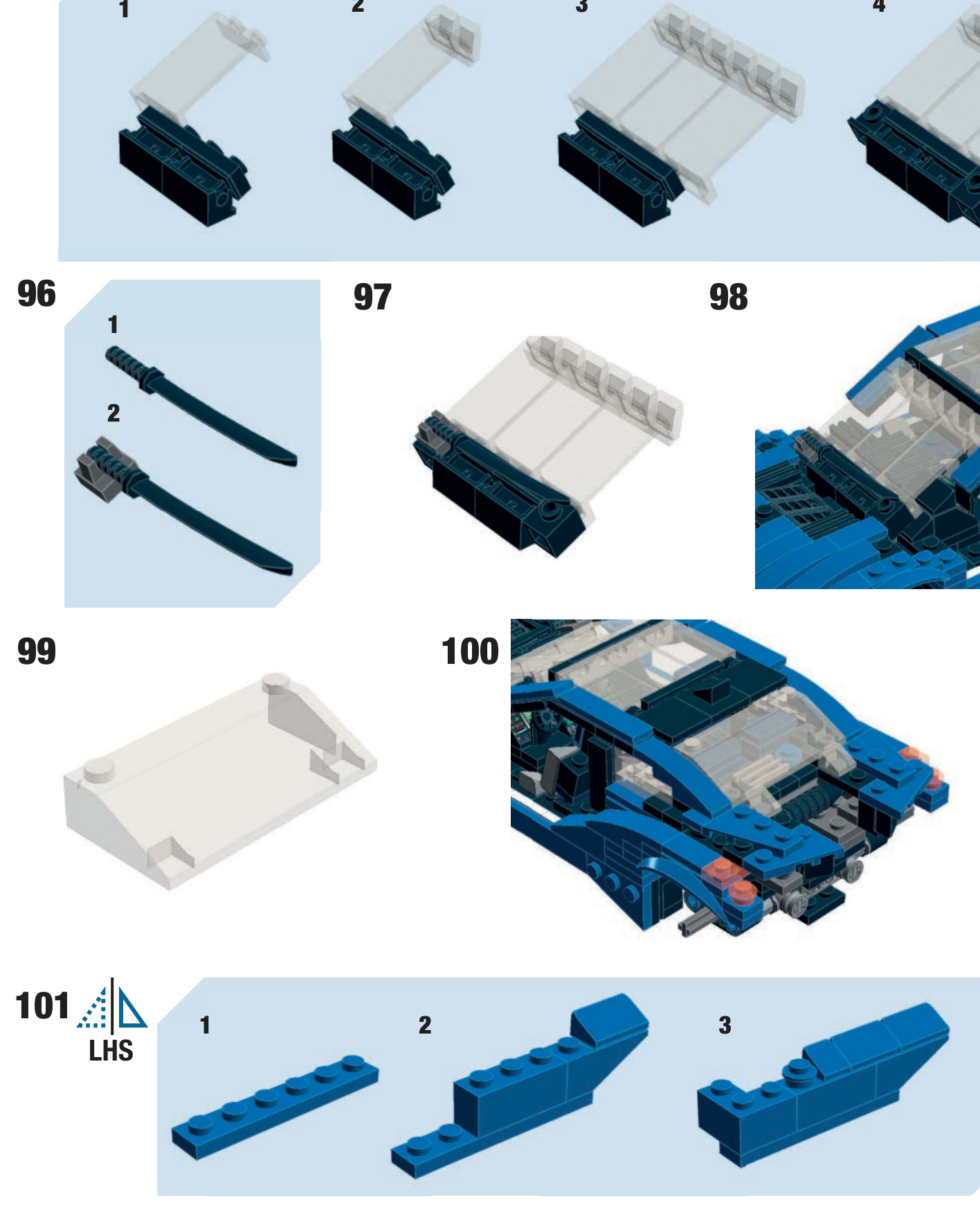
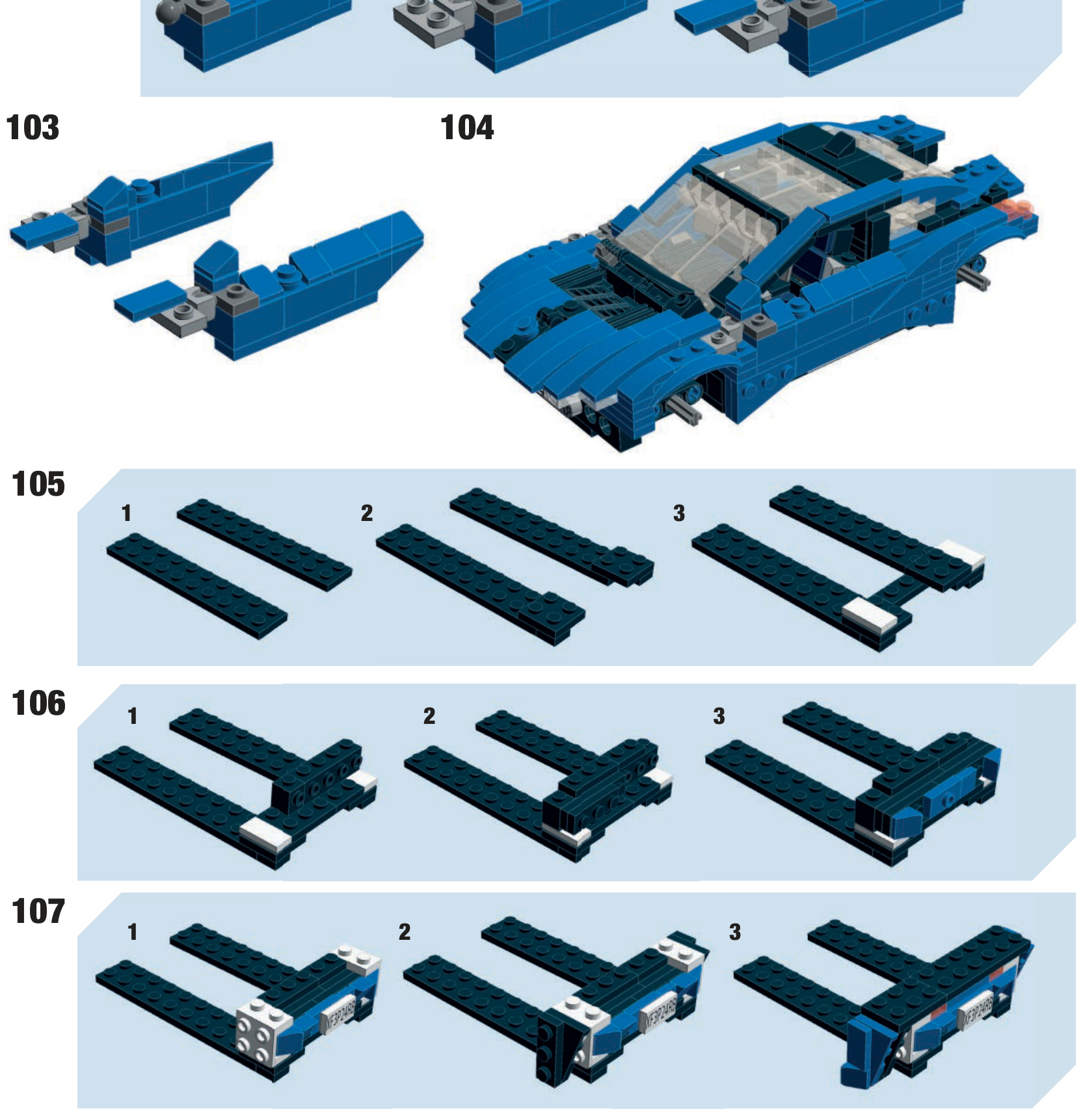
These instructions will allow the construction of either the roadster or coupe. The fnal instructions will cover the steps to
FERRARI
488 GTB & 488 SPIDER
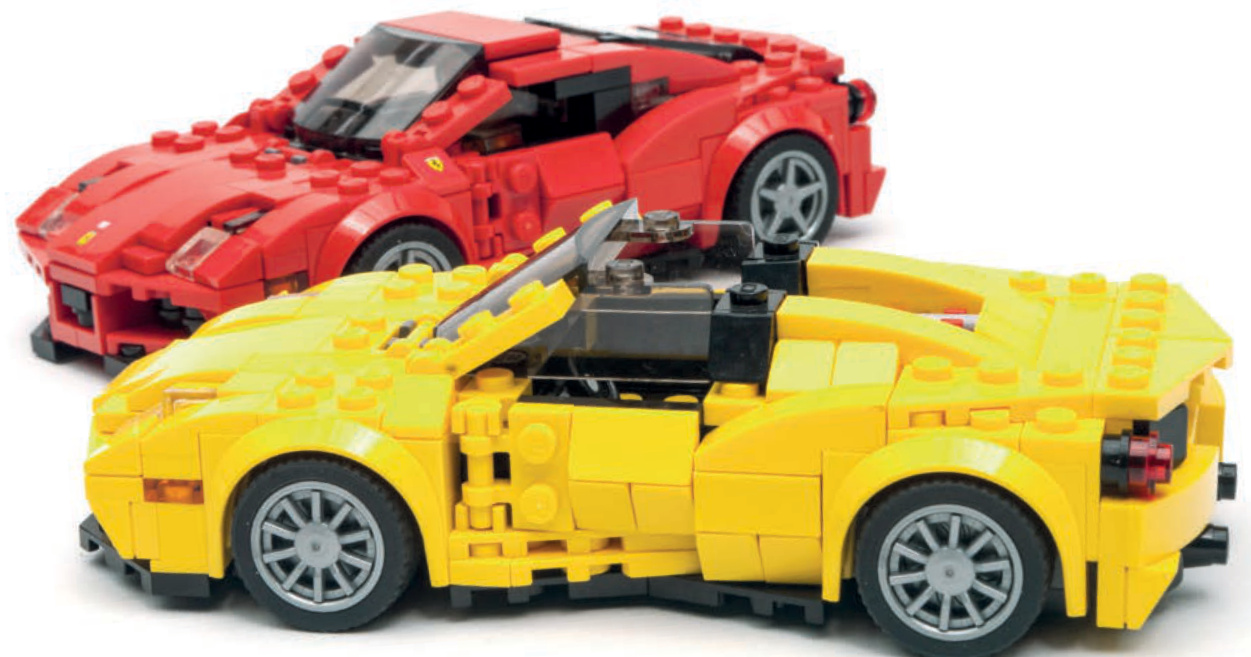
amiliar and yet different. The Ferrari 488 GTB, launched in 2015, in many ways closely resembled the 458 Berlinetta model it replaced. The car looked very similar in overall form, size, and proportion.
The heart and soul of any Ferrari, though, is the engine. In the 488, the V-8 engine remains. Capacity was reduced from 4.5L to 3.9, but two turbochargers were added. The turbos add power and, more importantly, torque. For each measure, the 488 has the highest specifc power and torque of any road Ferrari engine ever. This means that for every cubic centimeter of engine capacity, the 488 produces the most useable go. Power is transmitted to the rear wheels via a twin-clutch, 7-speed gearbox. This gearbox design uses two independent clutches. One clutch engages gears 1, 3, 5, and 7, while the second operates on 2, 4, 6, and reverse. The gears are preselected electromechanically for the next shift.
The 488 is available as both a Berlinetta (coupe) and Spider (convertible), the names commonly used for these body styles in Italy.
COUNTRY OF ORIGIN: Italy PRODUCTION: 2015–present NUMBER MADE: Currently in production LAYOUT / DRIVE: Mid engine / Rear-wheel drive ENGINE: 3,902 cc, 8 cylinders, V, turbocharged POWER / TORQUE: 661hp (493kW) / 561 lb-ft (760 Nm) CONSTRUCTION / DOORS: Aluminum-alloy spaceframe / 2 doors
Ferrari was founded by Enzo Ferrari in 1948, after he had run the racing team for rival Alfa Romeo. Originally he had built very limited numbers of road cars for well-heeled and well-connected customers—primarily to fund his racing team, Scuderia Ferrari. Early road cars were almost exclusively V-12 and front-engined. Ferrari introduced a companion brand with assistance from FIAT and produced a V-6 mid-engine design in the mid-1960s. It was named “Dino” after his son Alfredino Ferrari, a name he also used for the V-6 engine that Alfredino helped design. In 1975, the V-6 Dino 246 was replaced by a new V-8 engine model—the 308, with a 3.0-liter engine. The V-8 line moved through the 1980s to the 2010s with progressively larger engines. Along with a few low-capacity tax specials, Ferrari added turbos to the V-8 engine, high-performance 288 GTO, and F40 models—the pinnacle Ferraris of their day.
This model can also be built in the folowing colors: Number of parts: 284
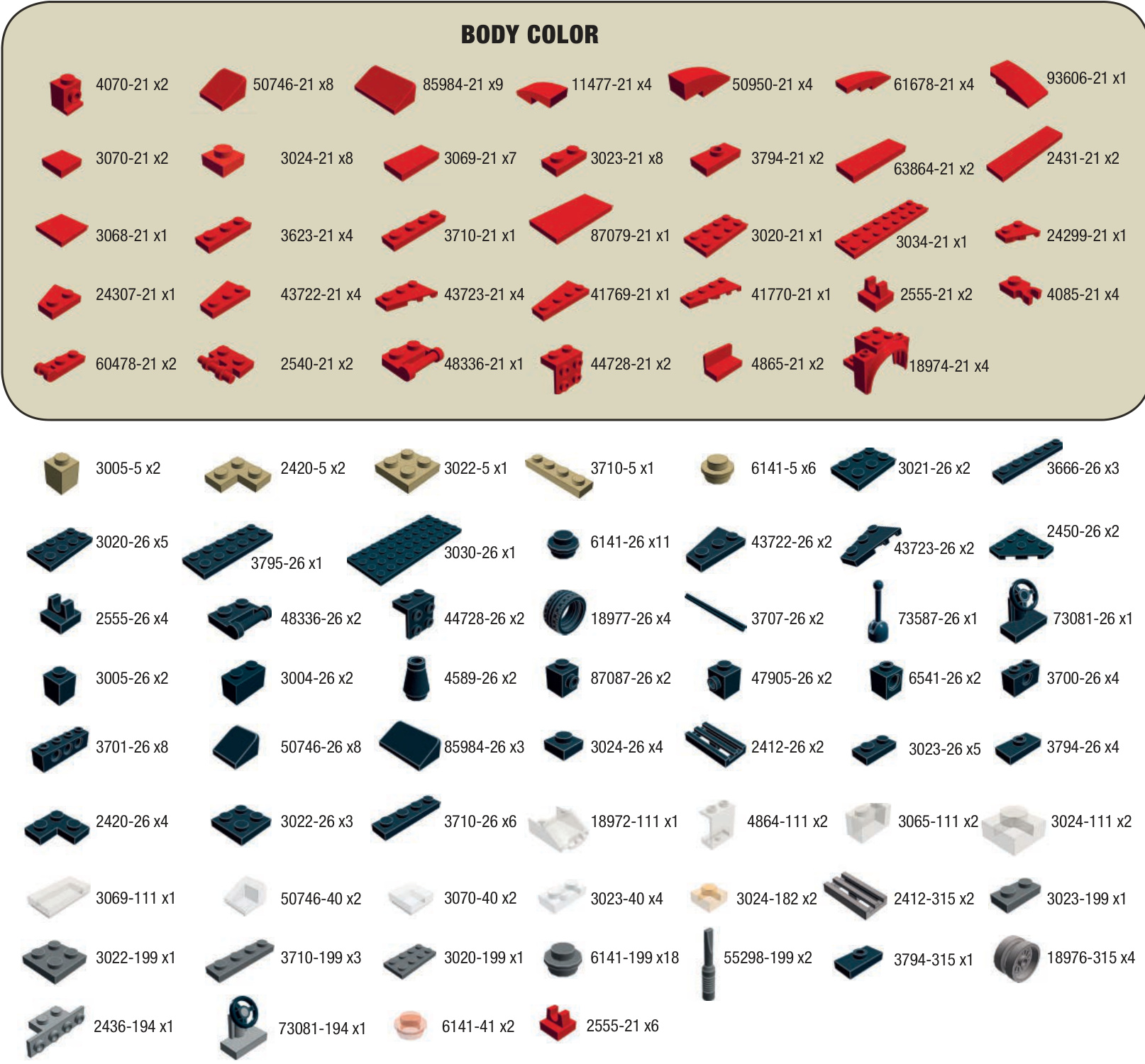
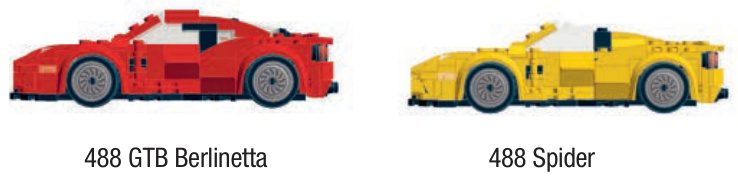
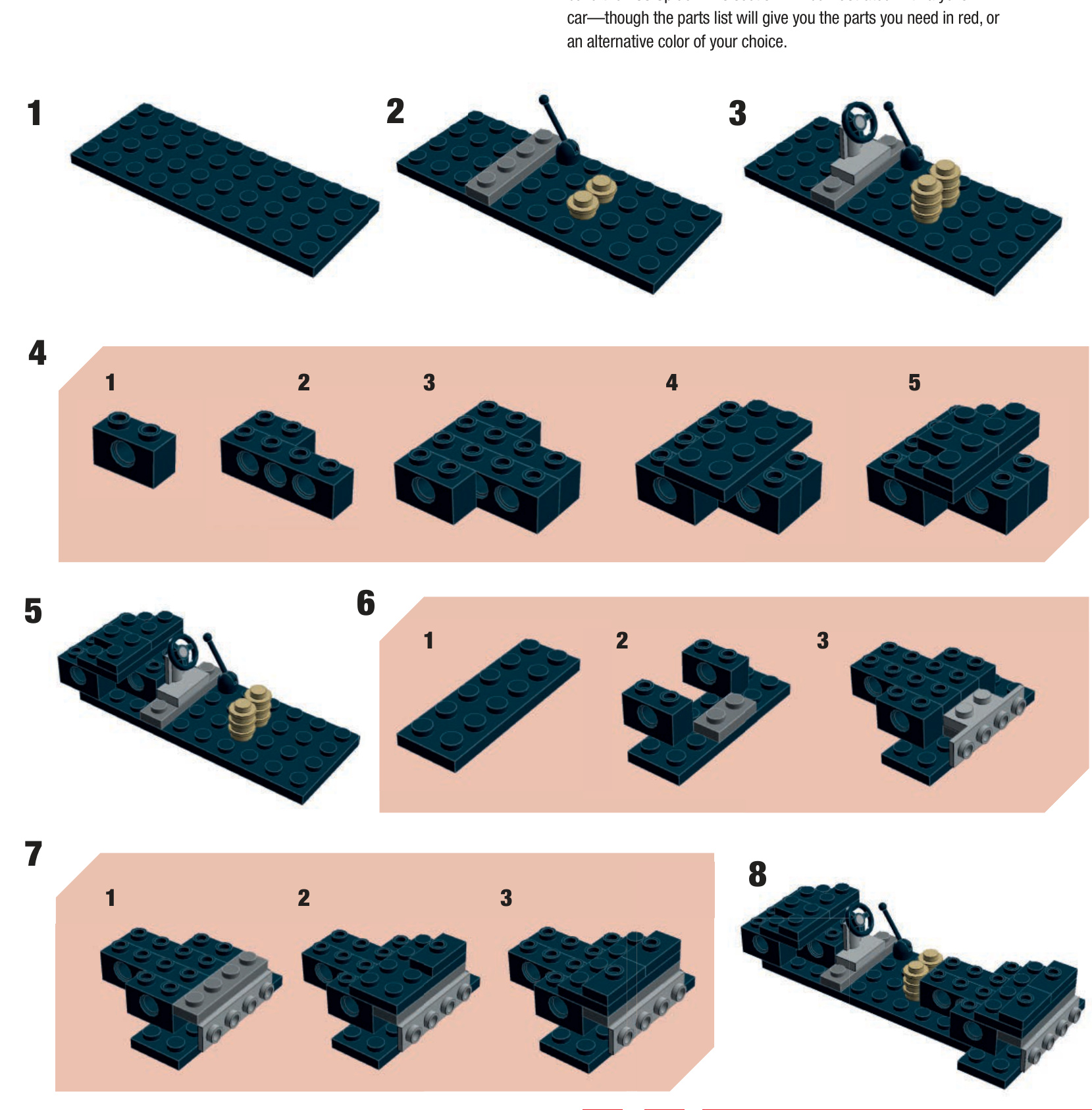
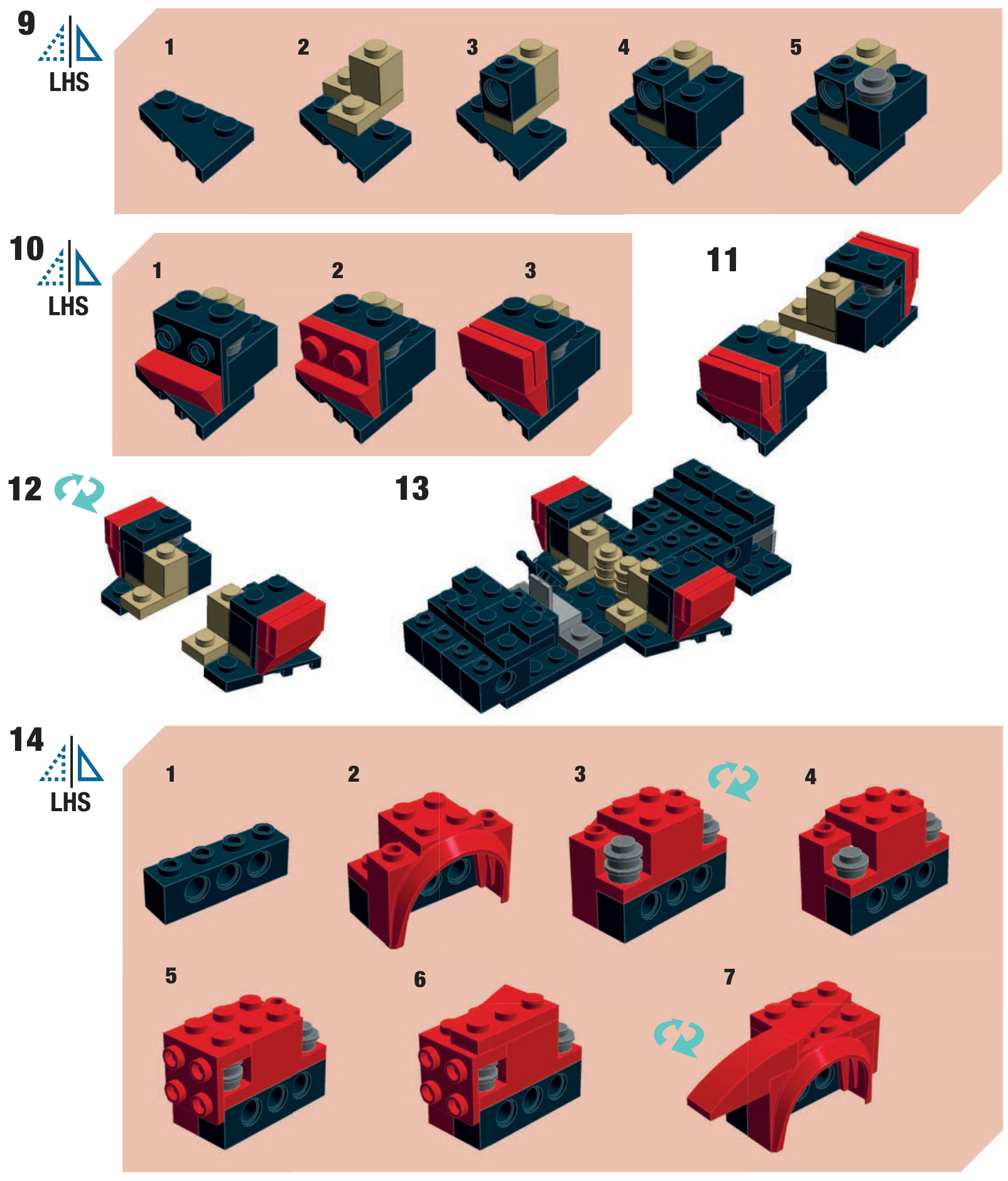
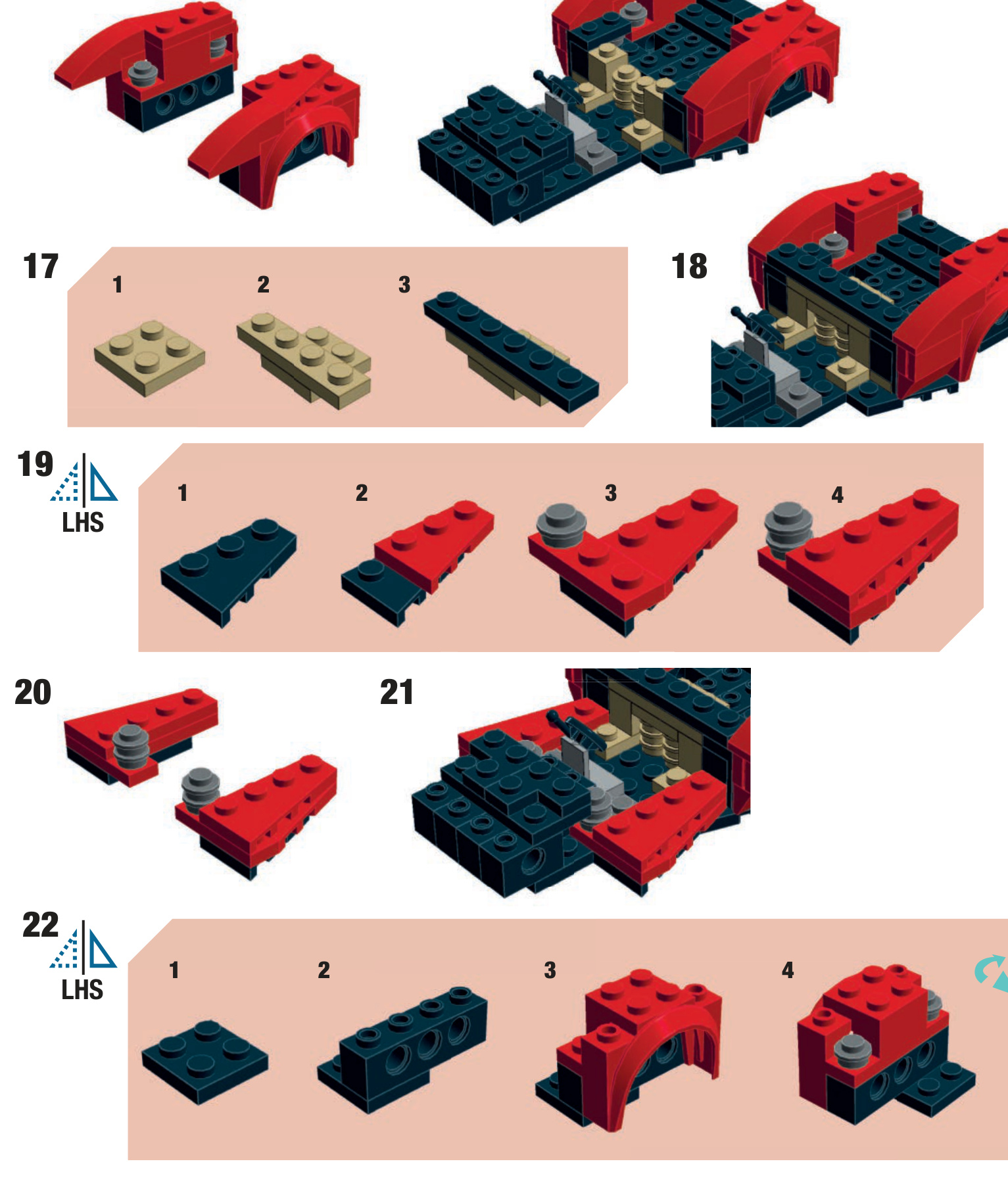
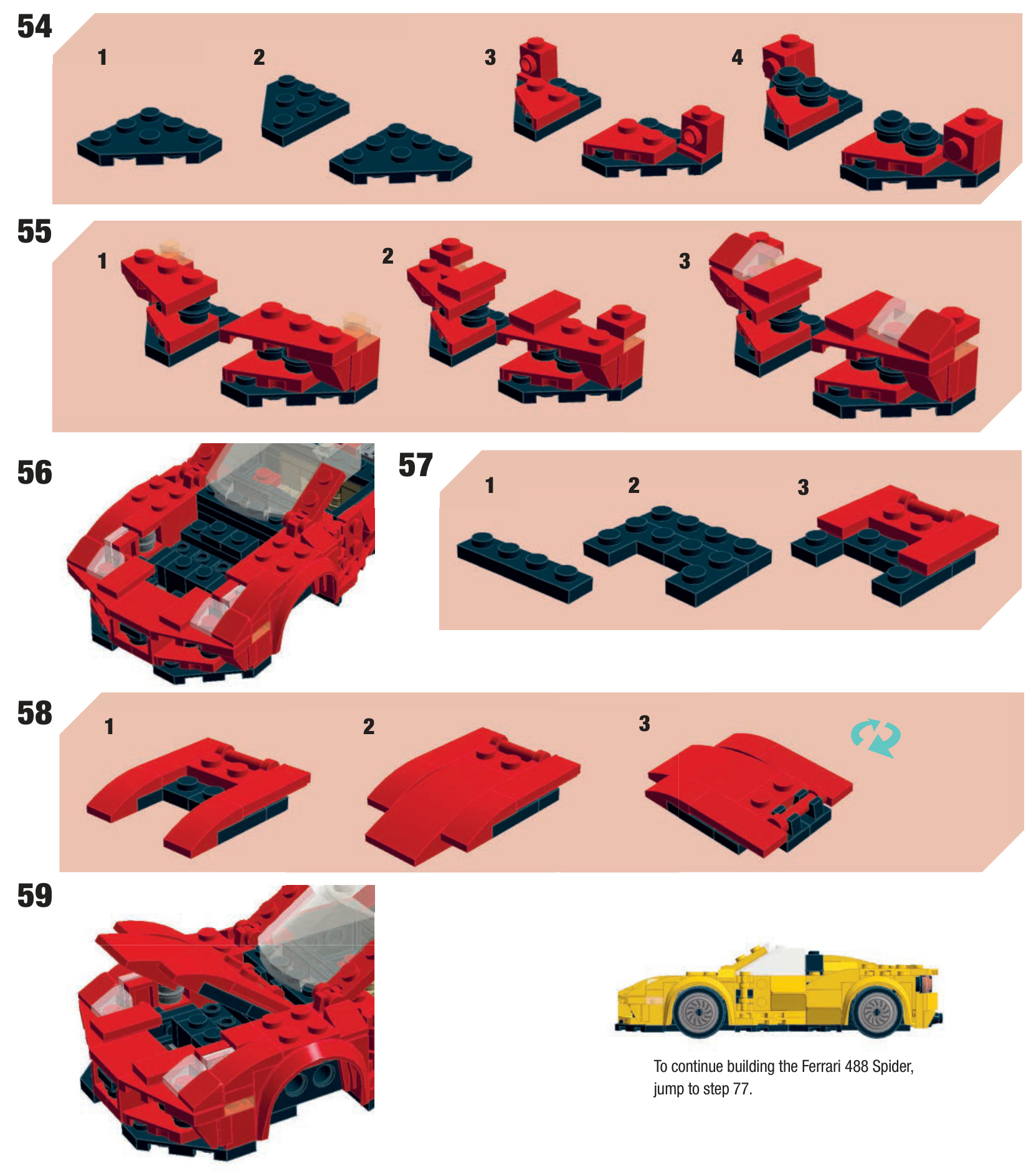
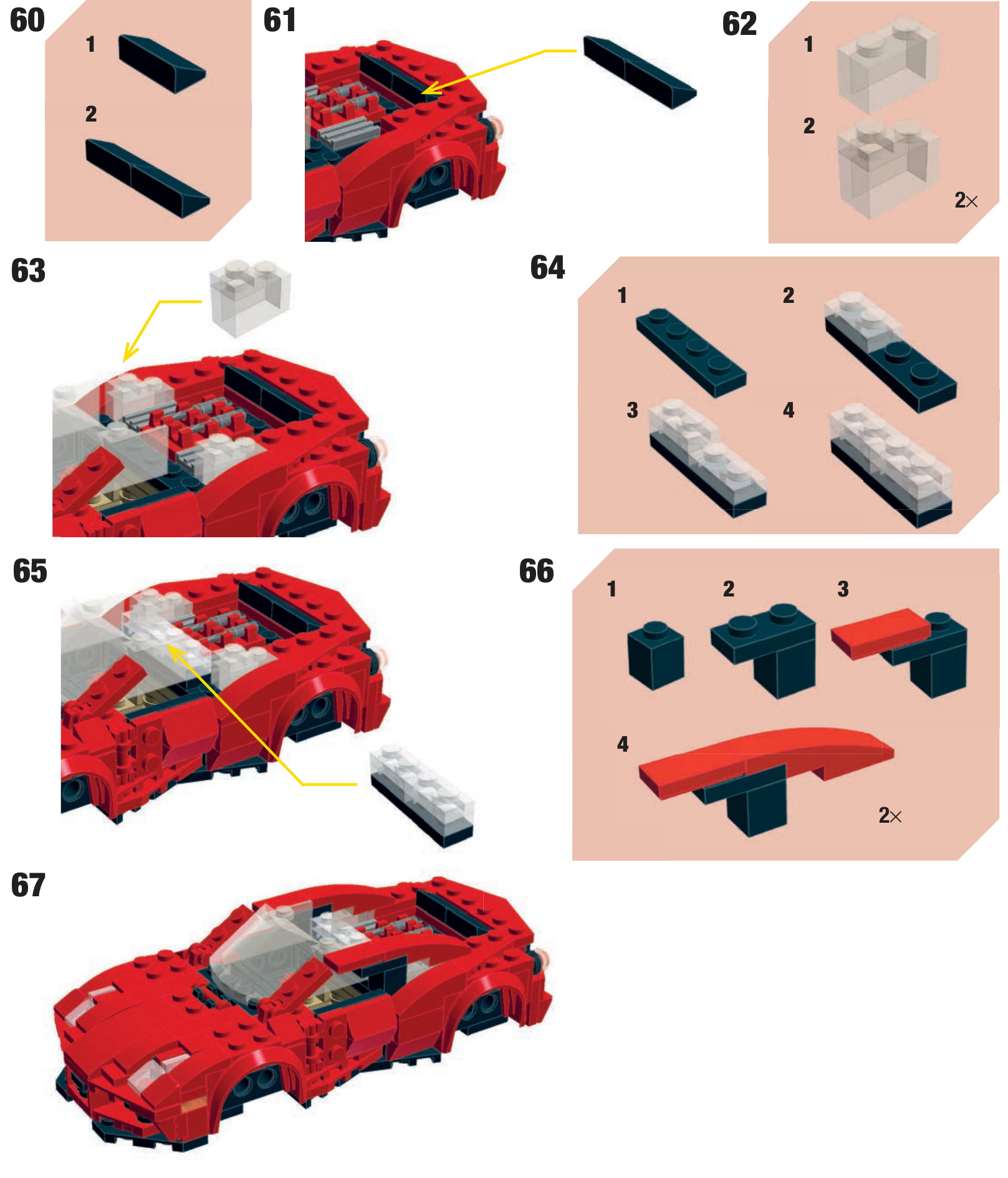
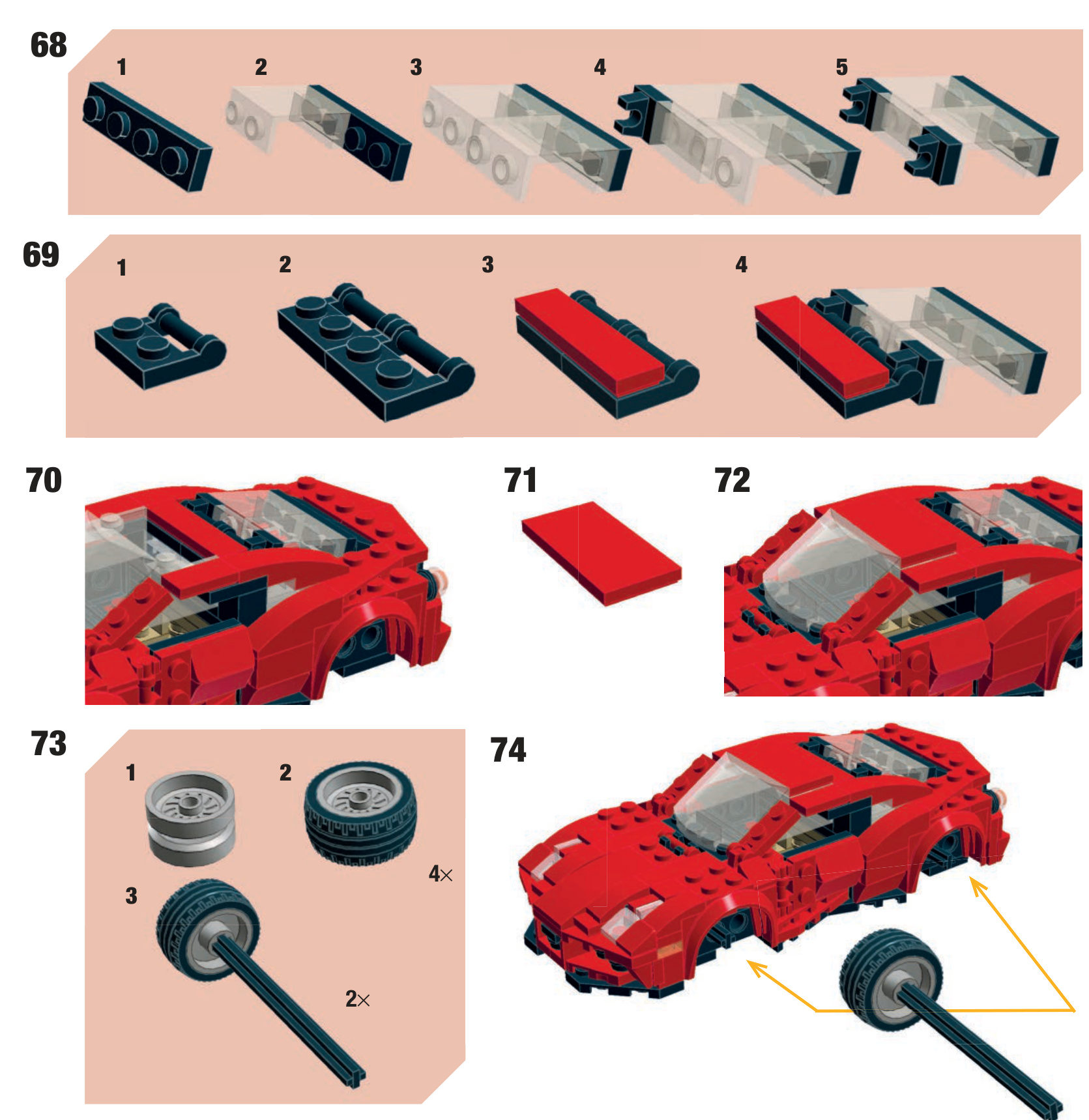
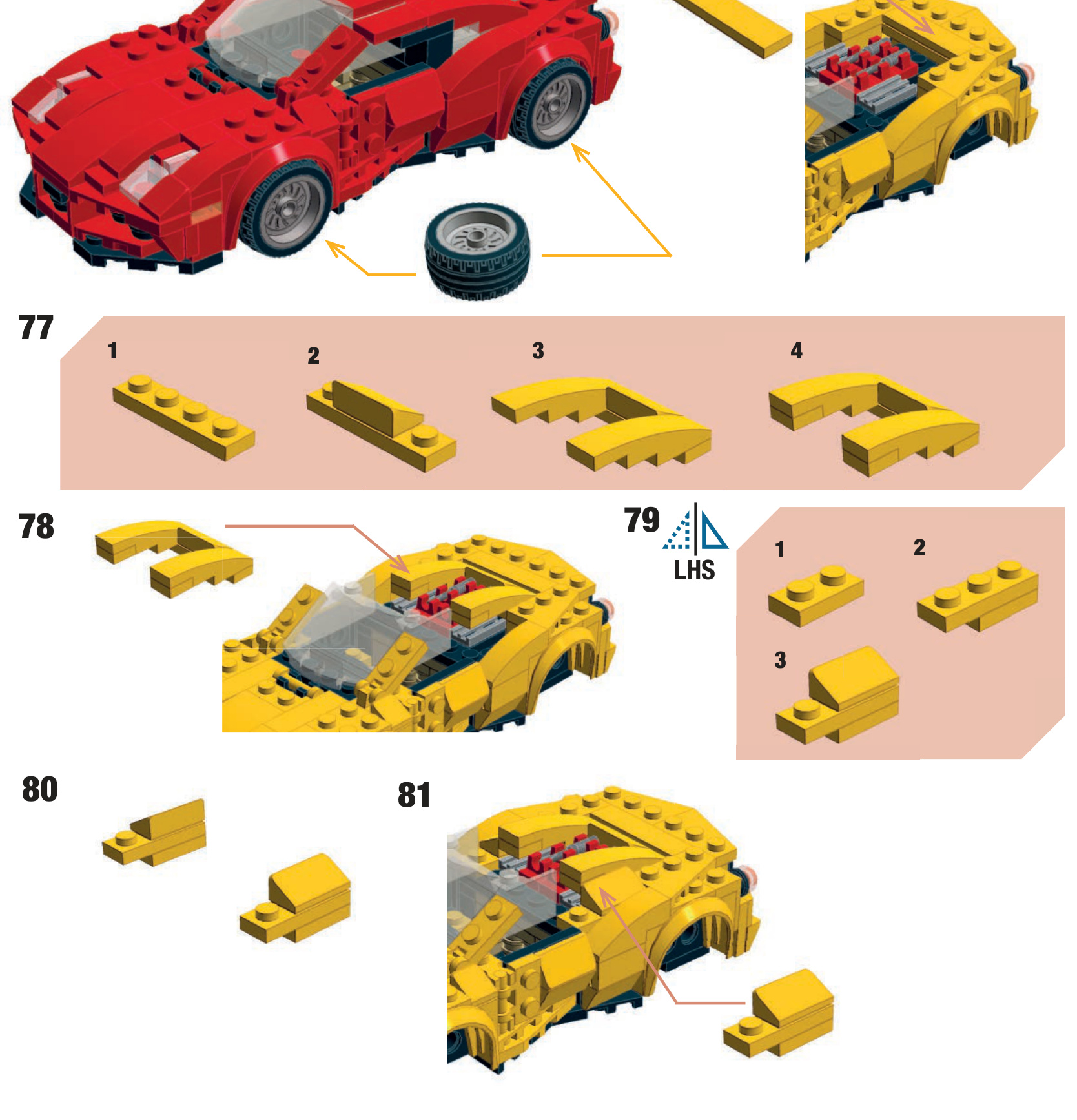
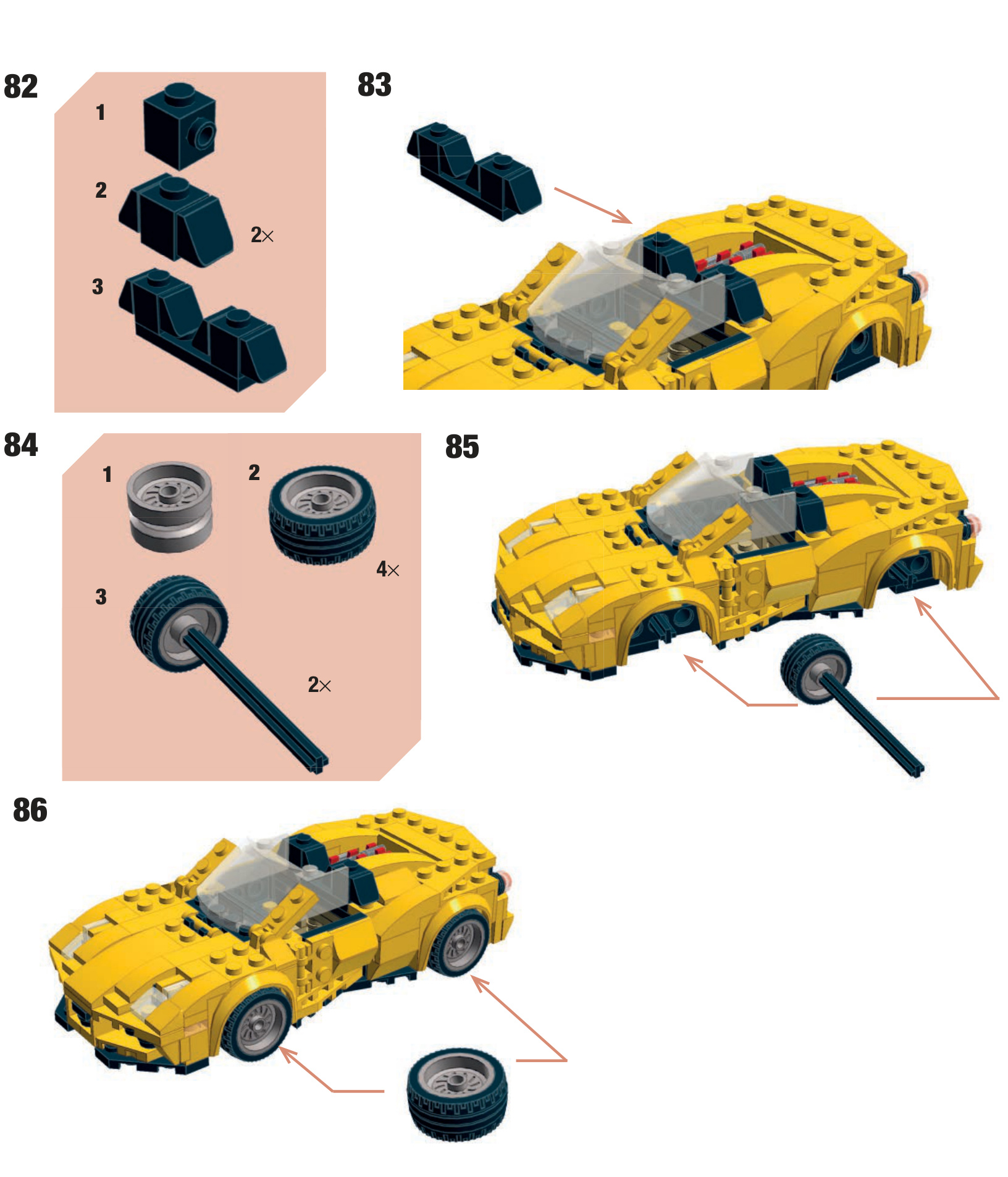
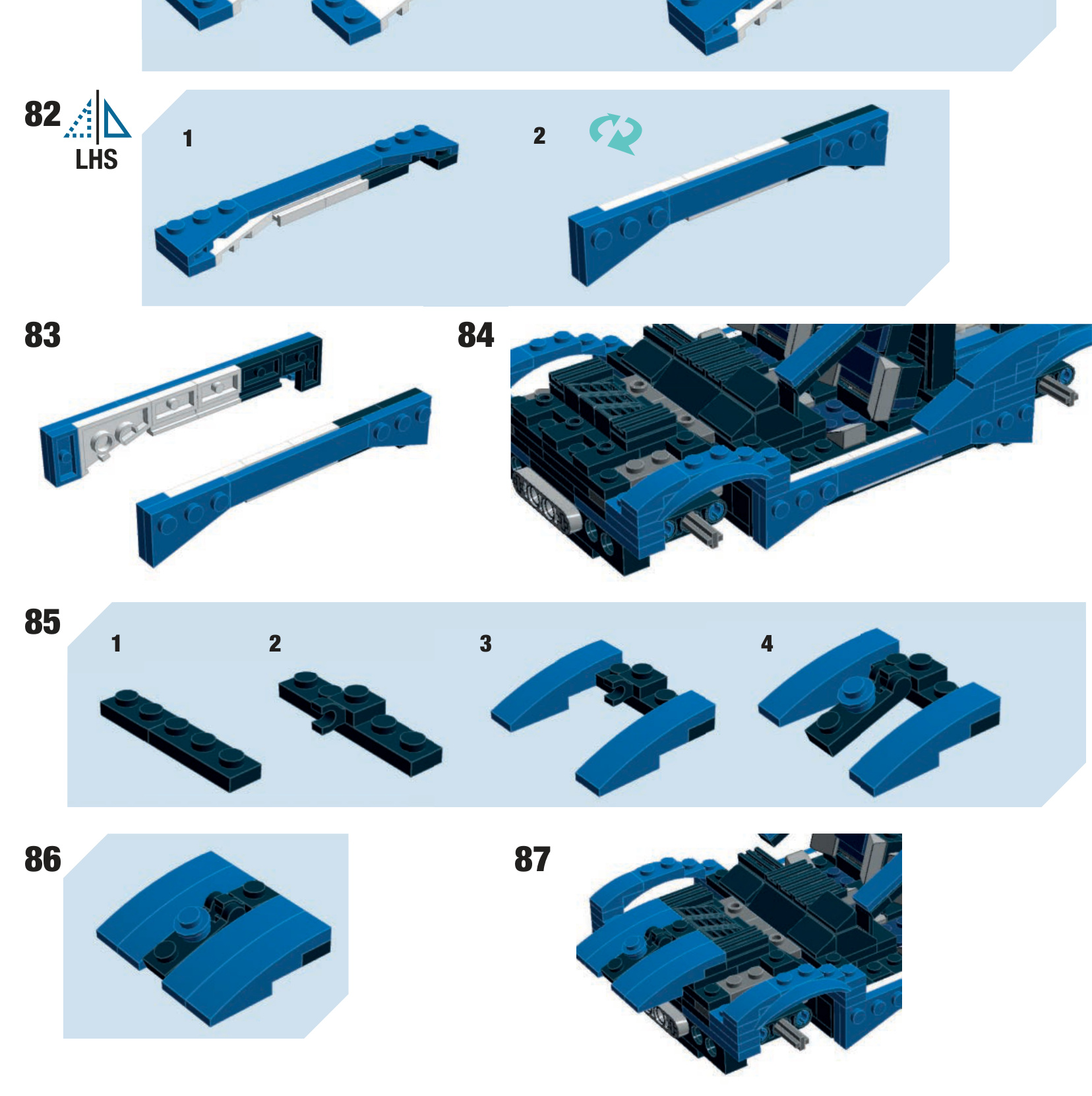
These instructions will allow the construction of either the Ferrari 488 GTB Berlinetta or the 488 Spider. The two body variations are common up to step 61. Beyond that, the 488 GTB will continue instructions in red. Jumping to step 77 will allow you to continue to build the 488 Spider. This section will be illustrated with a yellow
CITROËN 2CV CHARLESTON
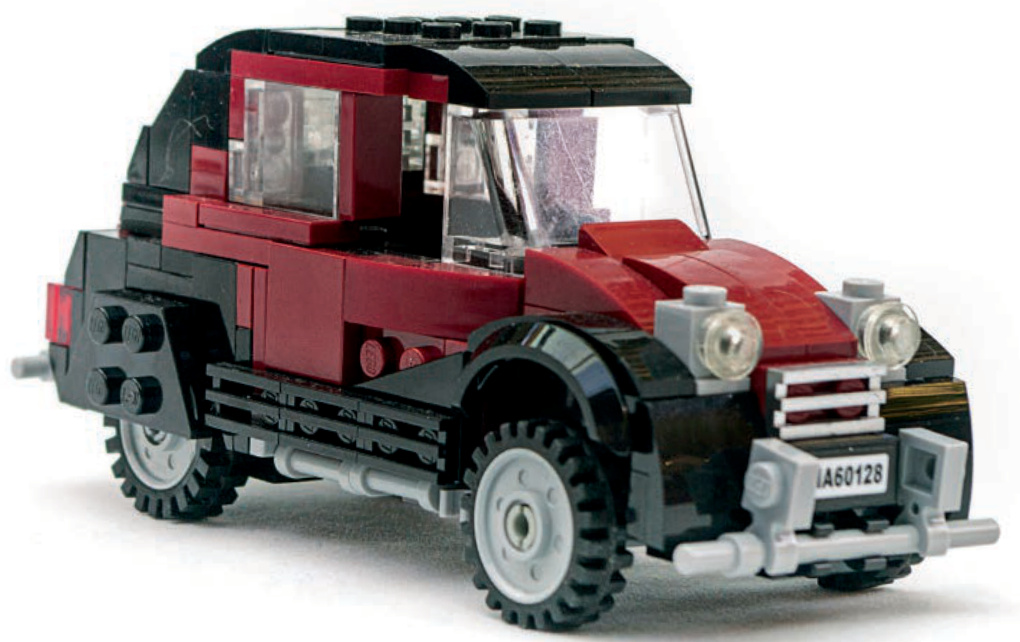
T huep tCoitrWooërnld2WCVarisI .aTchoemcpara cbteegcaon pormodyucatriodneivnel1o9p4e8d ian dFrqaunicekllye ading lean during cornering but also made for a very smooth ride. The suspension interconnected the front and rear wheels, allowing the car to remain level but with long wheel travel. One of the original design requirements was to be able to carry eggs over a ploughed feld without breaking any! The 2CV also formed the basis for small delivery vans and pickup trucks, ideal for compact European city streets.
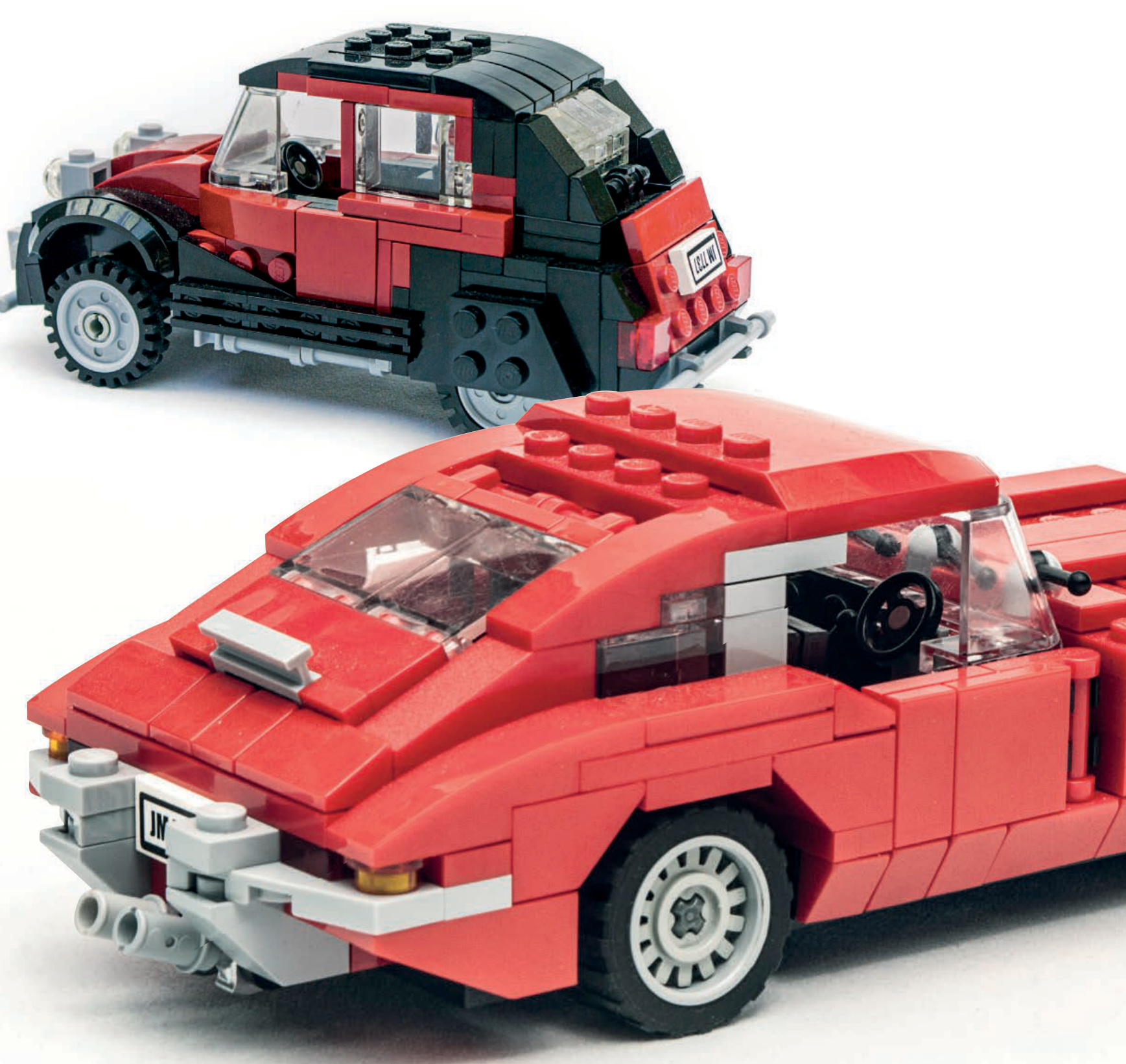
The 2CV Charleston was introduced in 1980, originally as a special edition, and became a regular production model the following year. The Charleston introduced a limited number of colors combined with a black roof and fenders; it was one of many special editions released late in the 2CV’s life to maintain interest in the model.
COUNTRY OF ORIGIN: France PRODUCTION: 1948–1990 NUMBER MADE: 3.8 million LAYOUT / DRIVE: Front engine / Front-wheel drive ENGINE: 602 cc, 2 cylinders, horizontally opposed POWER / TORQUE: 29 hp (22 kW) / 28.8 lb-ft (39 Nm) CONSTRUCTION / DOORS: Platform chassis / 4 doors
The Citroën 2CV had a remarkably long production period, fnally ceasing in 1990. By that time, the car had become uncompetitive in areas such as safety, pollution control, and NVH (noise—vibration and harshness). At this point, the car was sold on quirky period design and charm. The 2CV was a very minimalist vehicle—the side windows hinged up from the middle because window winders were considered heavy and expensive!
By the time the 2CV Charleston was launched, the engine was a 602-cc, horizontally opposed 2-cylinder producing 29 hp. Earlier versions had smaller engines of 375 to 435 cc, with as little as 9 hp. (The 2CV was never considered to be anything but a slow car.) The early models could only achieve a top speed of 40 mph (64 km/h), but the Charleston could achieve 71 mph (115 km/h).
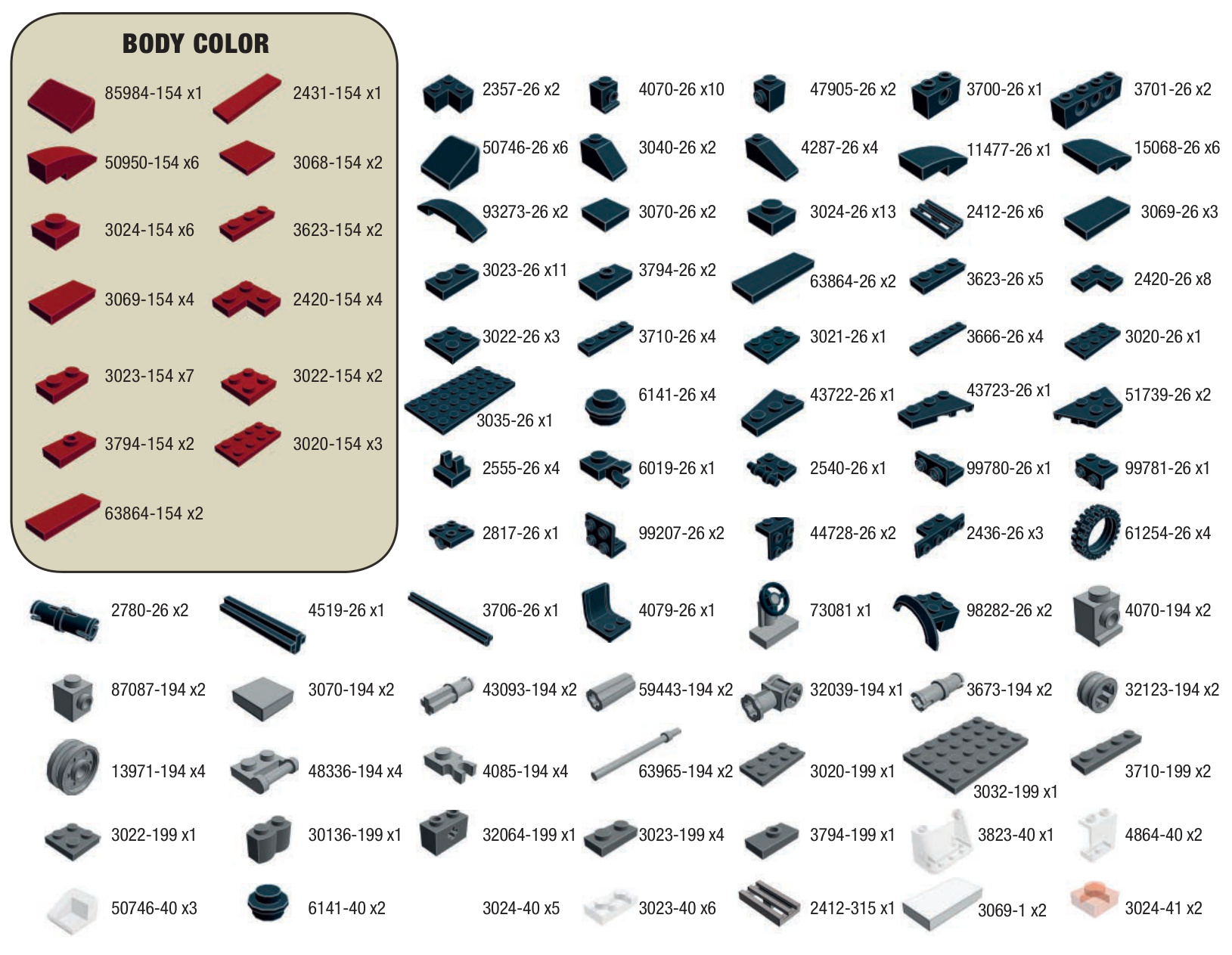
This model can also be built in the folowing colors: Number of parts: 249
JAGUAR E-TYPE COUPE & ROADSTER
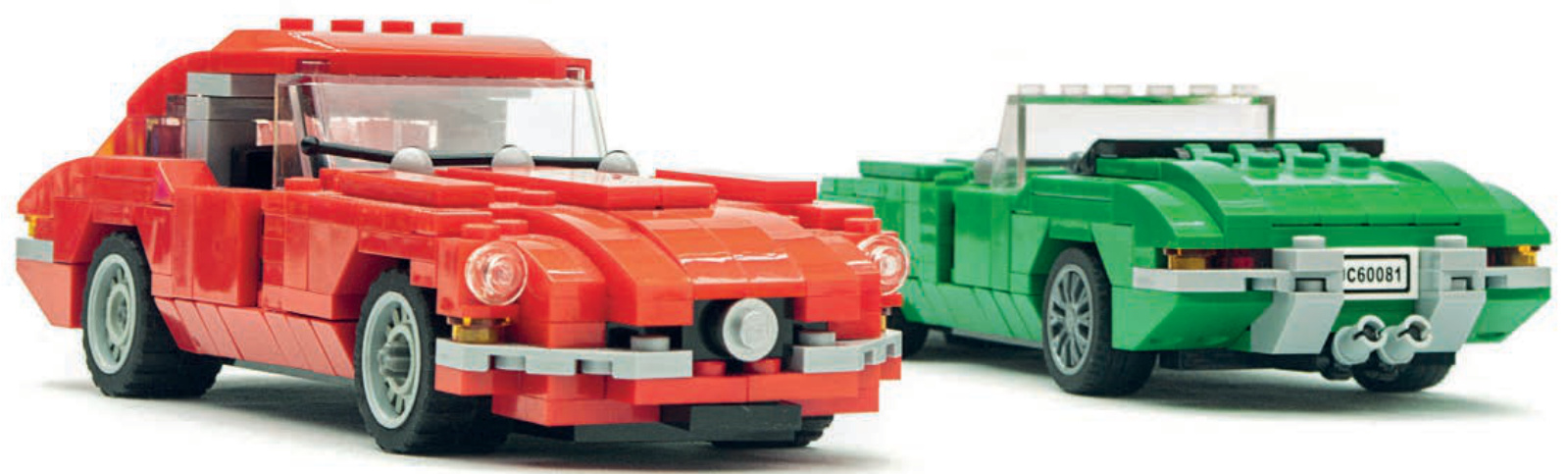
A tabfietaserul ta2ifu0unl0c0cha,drEencvlzaeor eFmietrarcdaleroi”she— tmohsitgehlhfepdtroeapcisaoerfeitndhdetehliesdtE.o-MfTytahpney “pmtohollestmcboeonsatdu sports cars of the twentieth century. The E-Type is a template 1960s sports car. Long, long hood, slinky rounded lines, wire wheels, thin blade bumpers, and multiple exhaust pipes.

The car was not just all show—the Jaguar sports car had an evolved version of the XK 6-cylinder engine. Originally of 3.8L capacity and sporting twin overhead camshafts to produce 265 bhp , in 1964 the engine was increased in capacity to 4.2L. The power remained the same at lower engine speeds with a 10 percent increase in maximum torque. In any guise, this made for a fast car: 0 to 60 mph (0 to 97 km/h) in 7.1 seconds and a maximum speed of 149.1 mph (240 km/h). Original press cars had been “optimized” with modifcation to the engines, tires, and other parts to achieve this performance—customer cars were a little slower.
COUNTRY OF ORIGIN: England PRODUCTION: 1961–1975 NUMBER MADE: 75,515 (Series 1: 38,419) LAYOUT / DRIVE: Front engine / Rear-wheel drive ENGINE: 3.8L, 6 cylinders, inline POWER / TORQUE: 265 bhp (198 kW) / 240 lb-ft (325 Nm) CONSTRUCTION / DOORS: Steel monocoque with tubular steel subframe
and the roadster. The cars shared basic dimensions and had seating for two. In 1966, a coupe was added, with an additional 9 inches (225 mm) added to the body and the roofine changed to increase occupant space (but not attractiveness).
By the time of the Series 3 cars in 1971, the E-Type had begun to lose competitiveness as a sports car, despite the addition of a 5.3L V-12 engine. The car was now heavier and slower, and had lost handling prowess. The 12-cylinder, mid-engine exotics from Lamborghini and Ferrari had taken over the mantle of the ultimate supercar, though they lacked the beauty of the original E-Type Jag.
This model can also be built in the folowing colors: Number of parts: 316
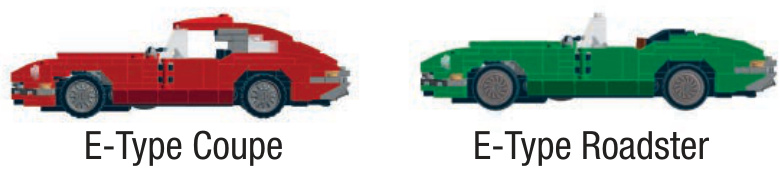
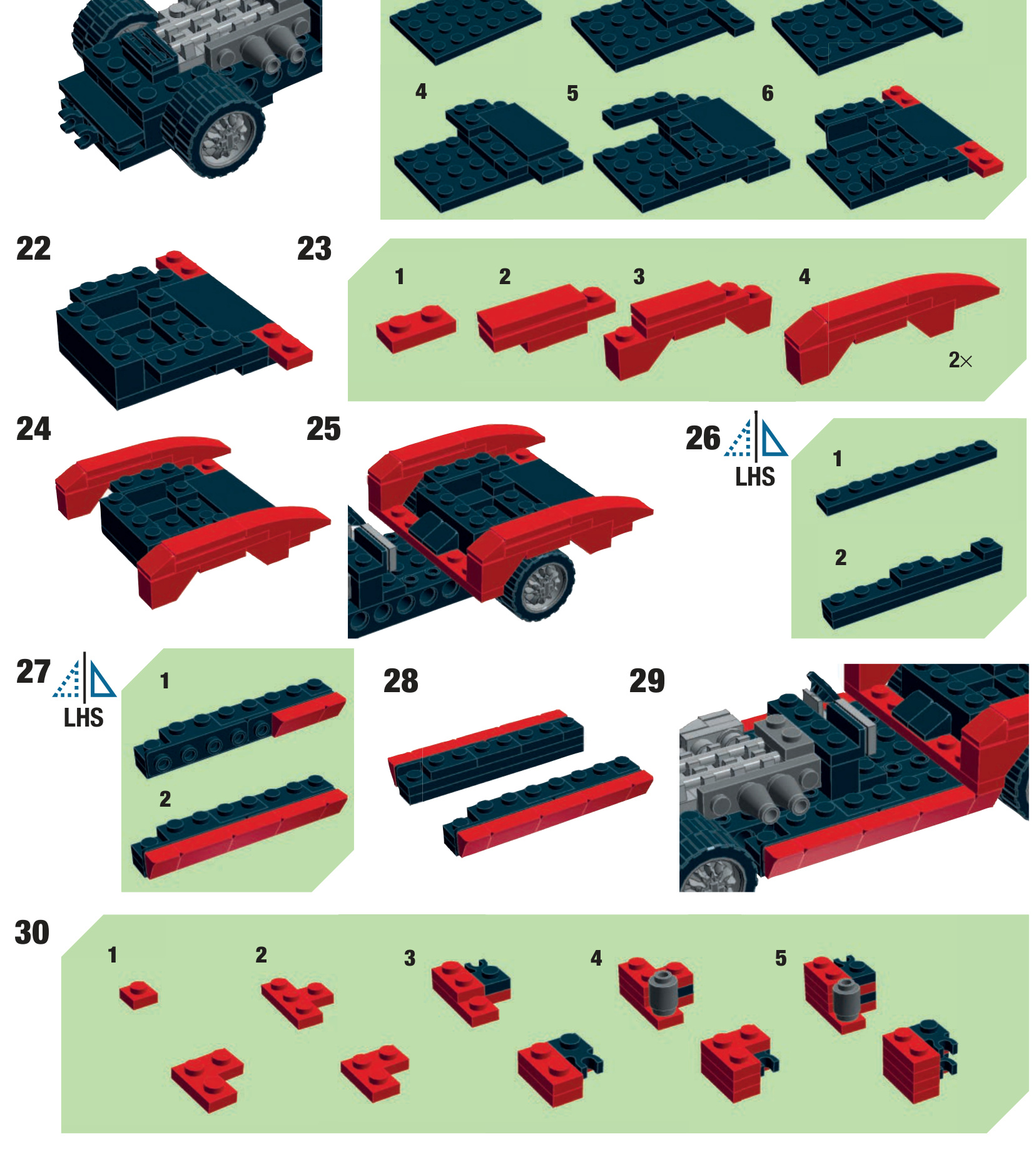
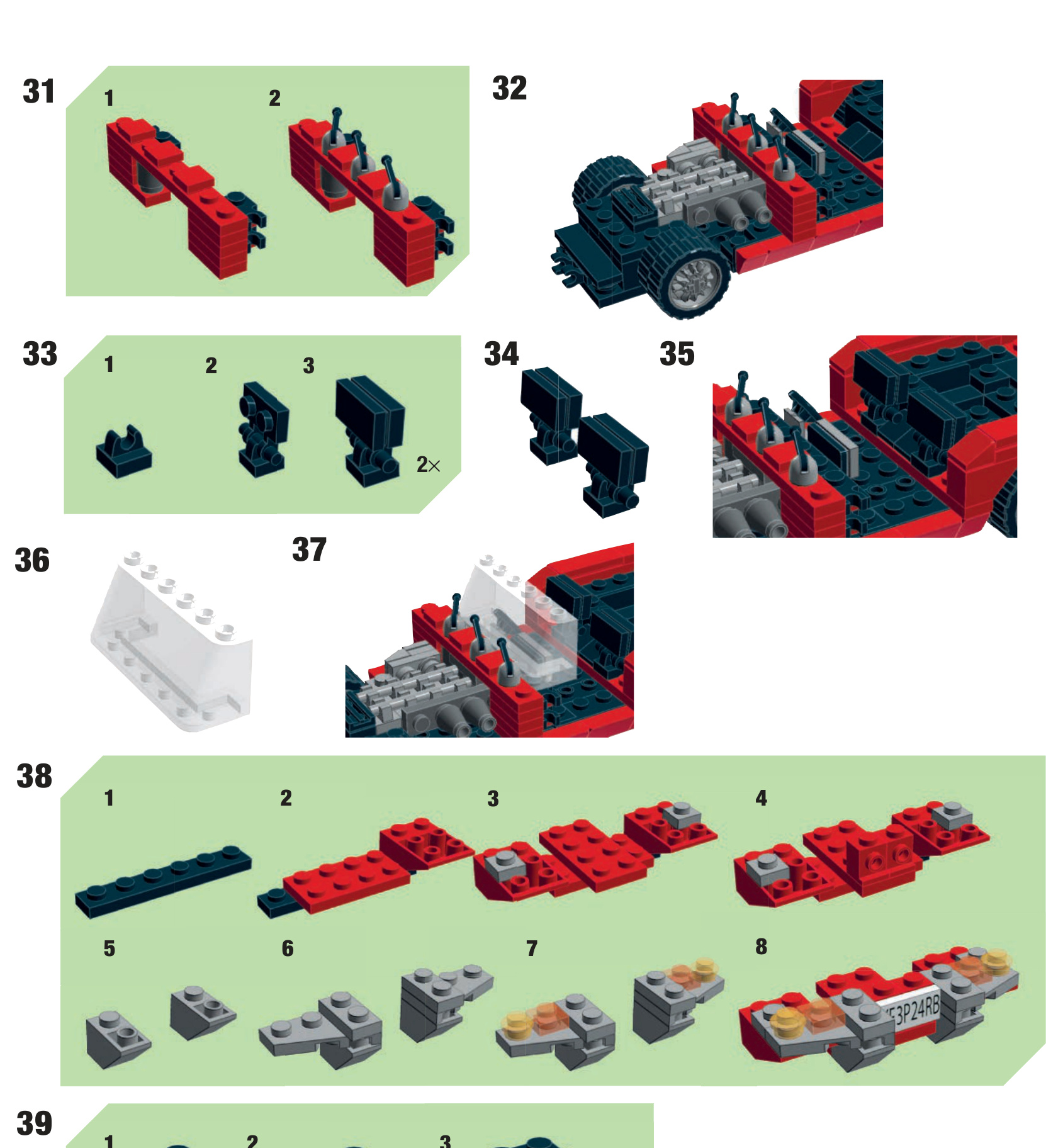
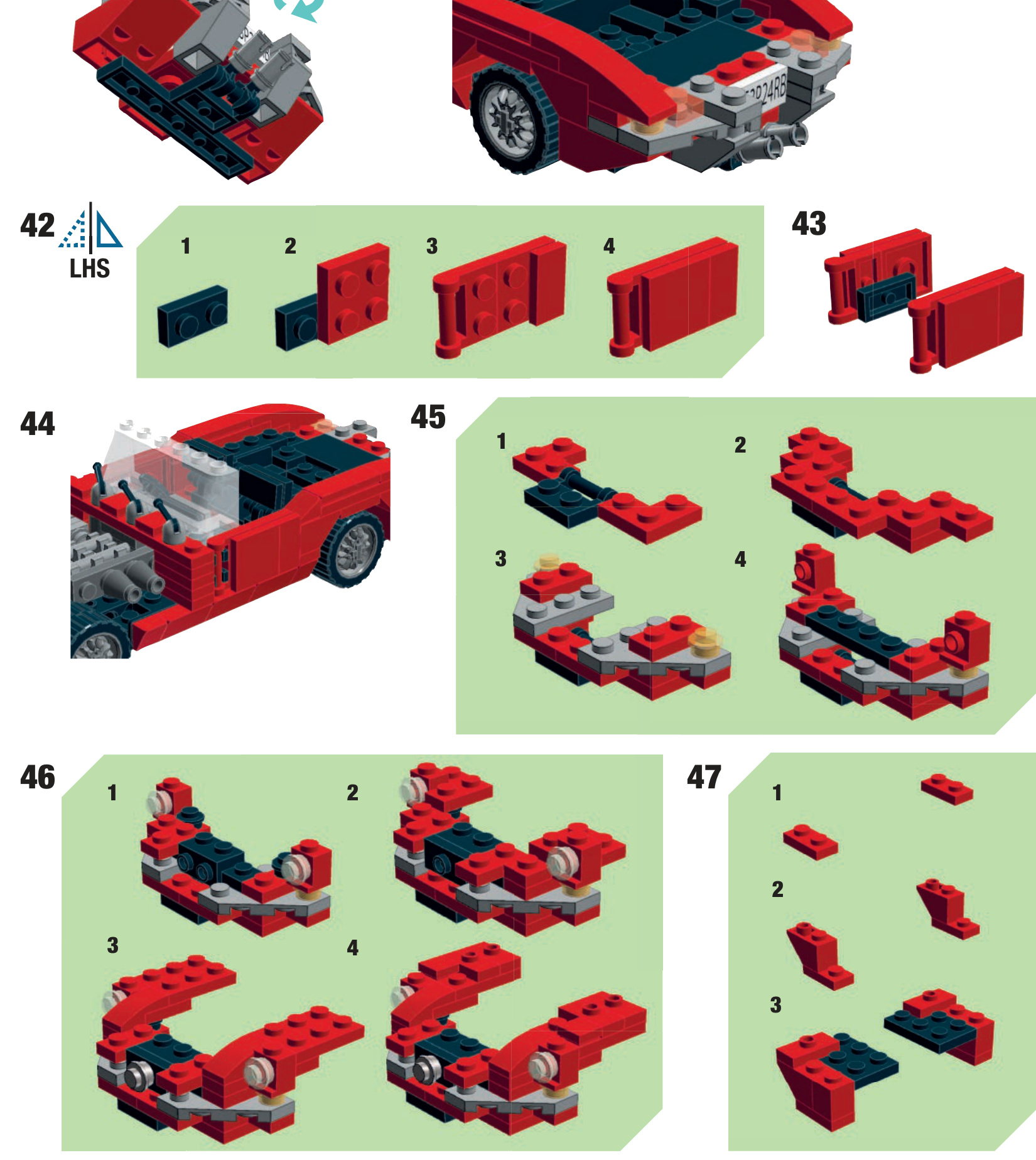
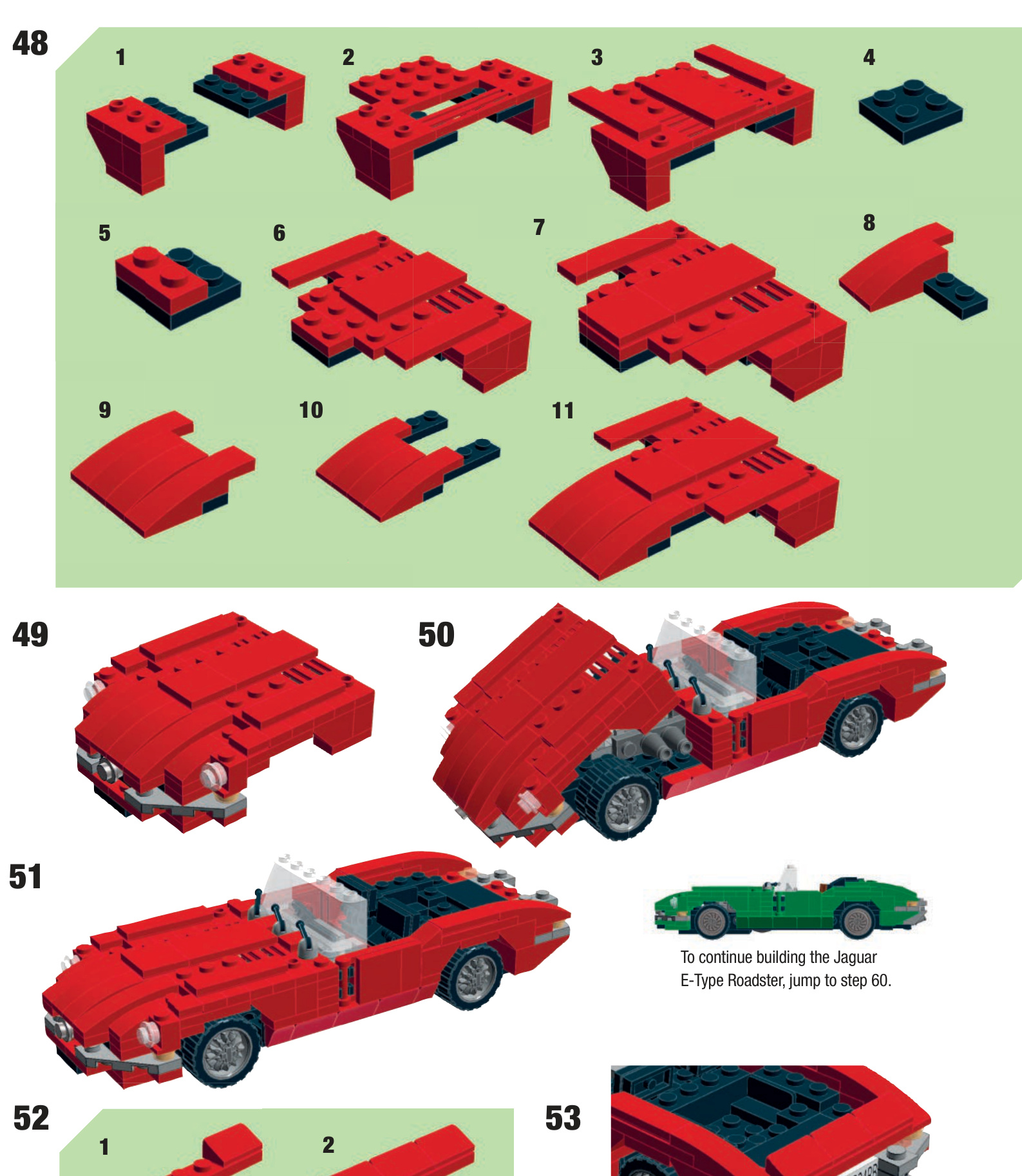
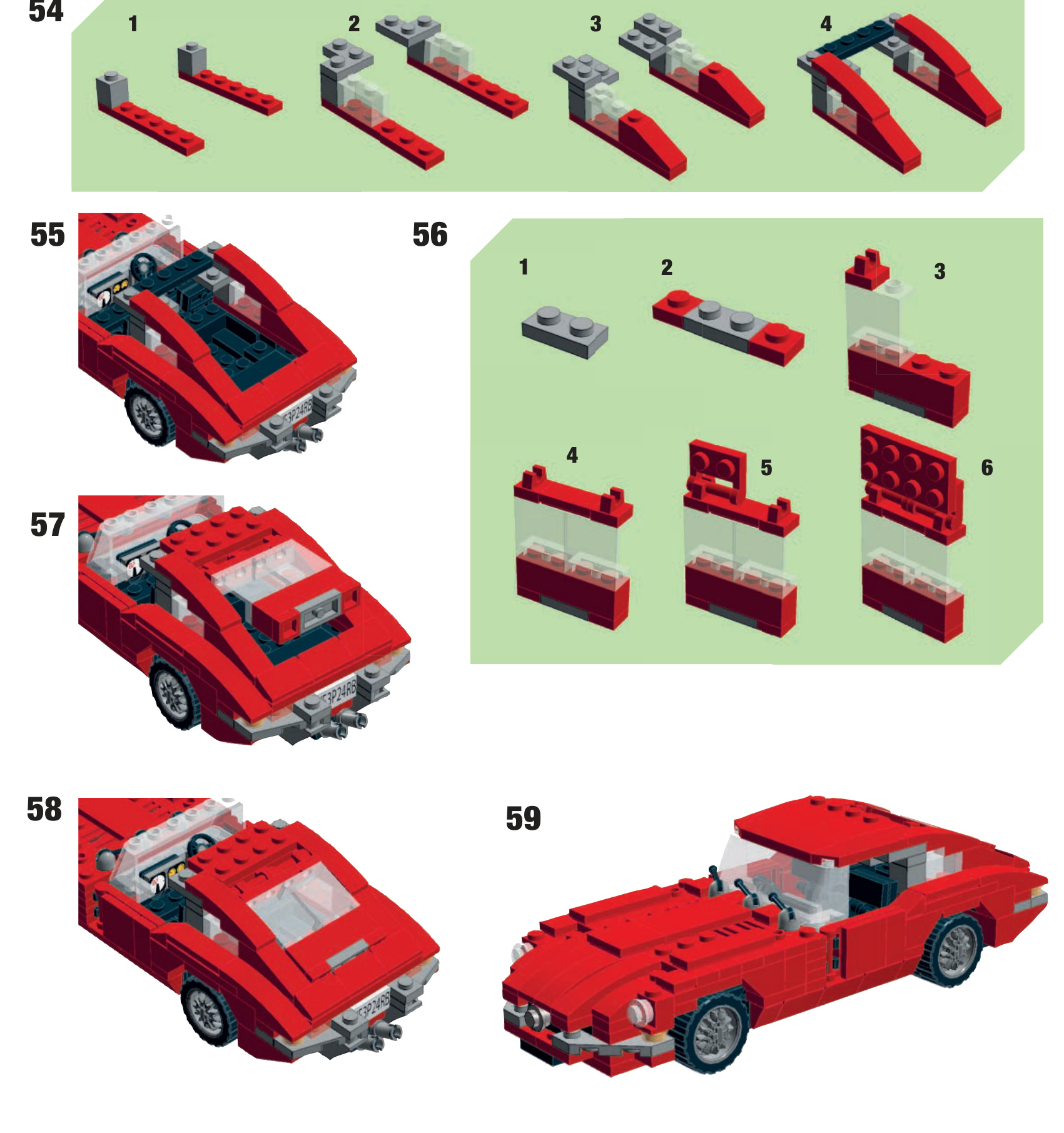
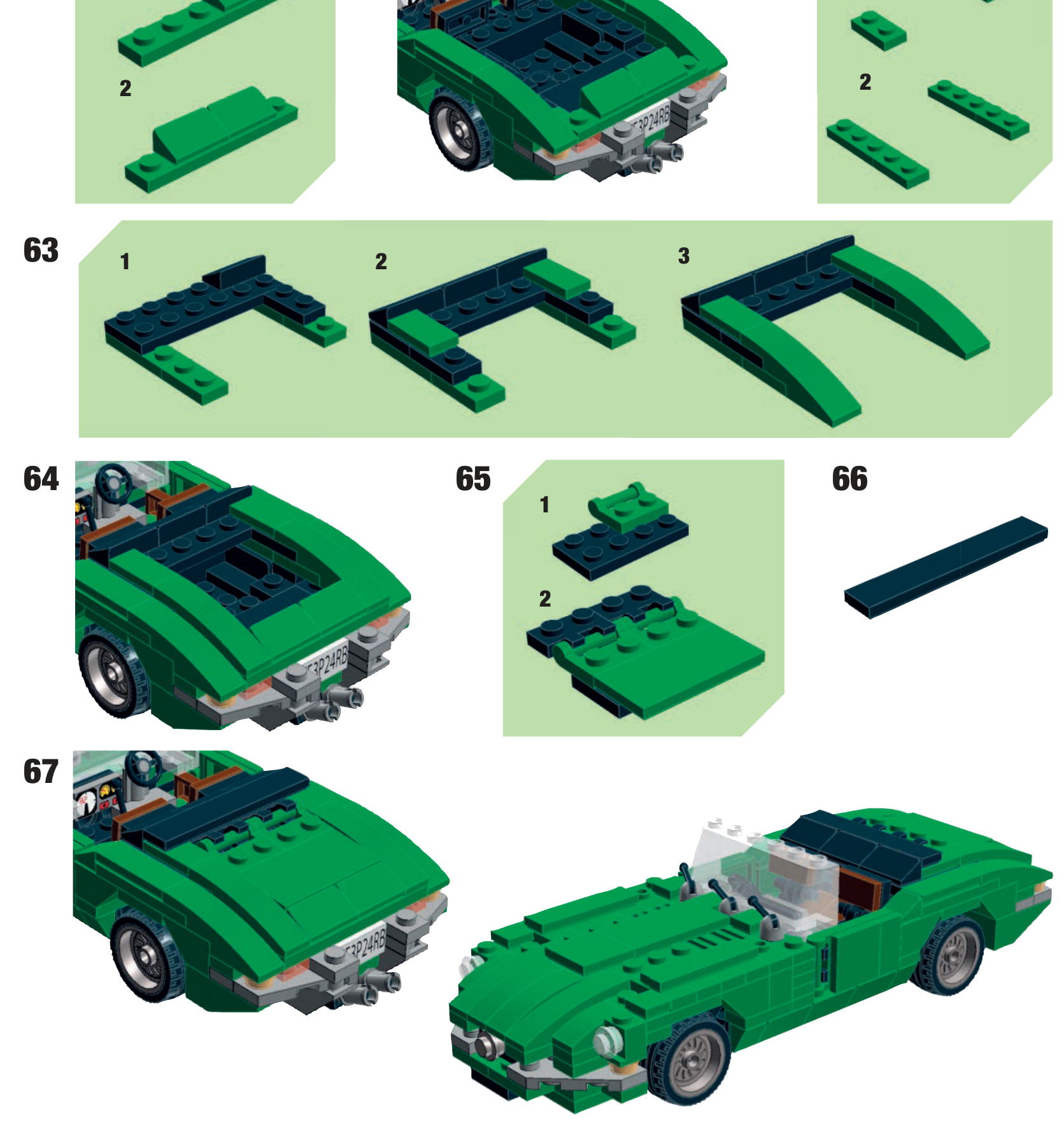
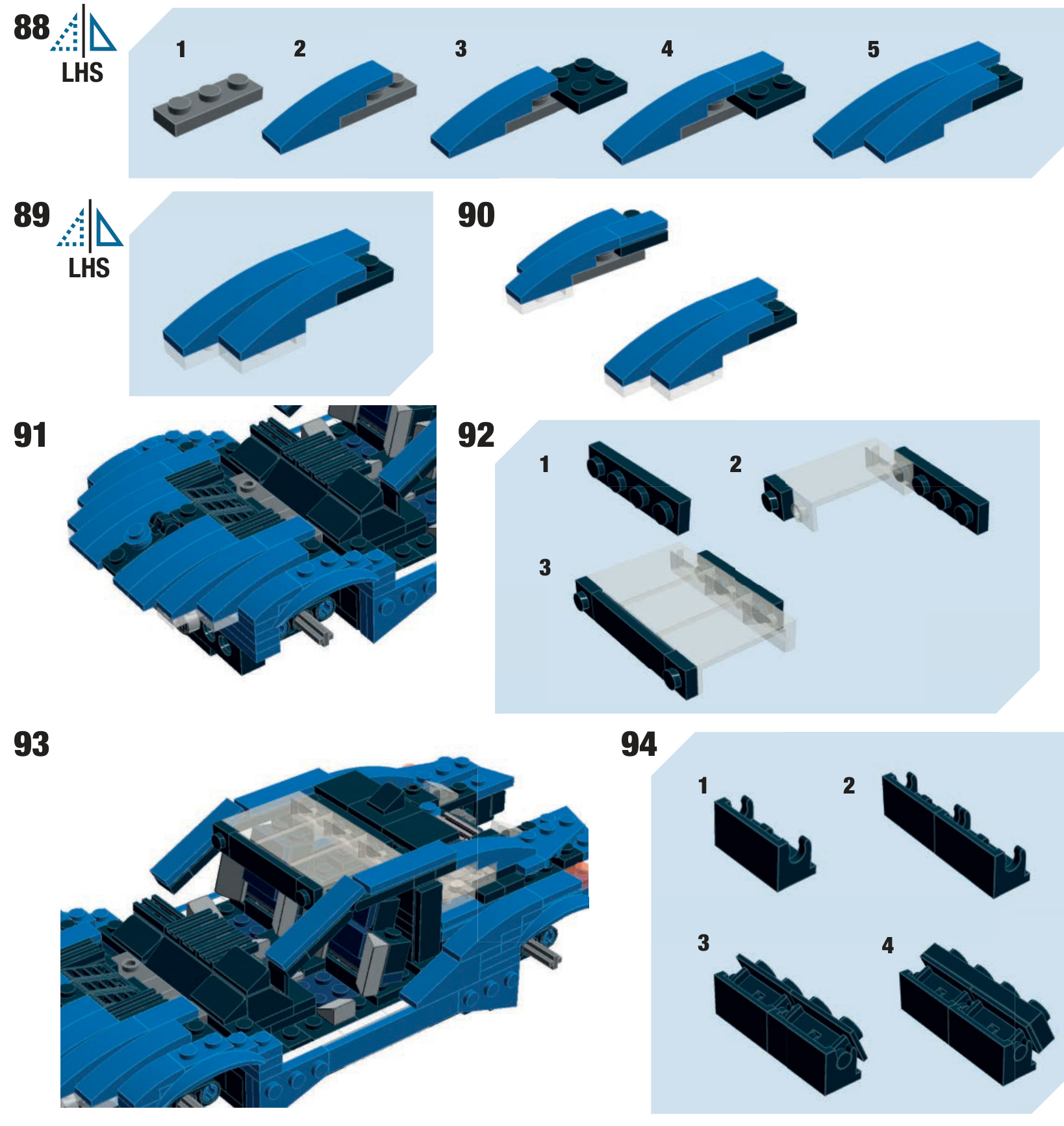
These instructions will allow the construction of either the Jaguar E-Type Coupe or the E-Type Roadster. The two body variations are common up to step 52. Beyond that the E-Type Coupe will continue instructions in red. Jumping to step 60 will allow you to continue to build the E-Type Roadster. This section will be illustrated with a green
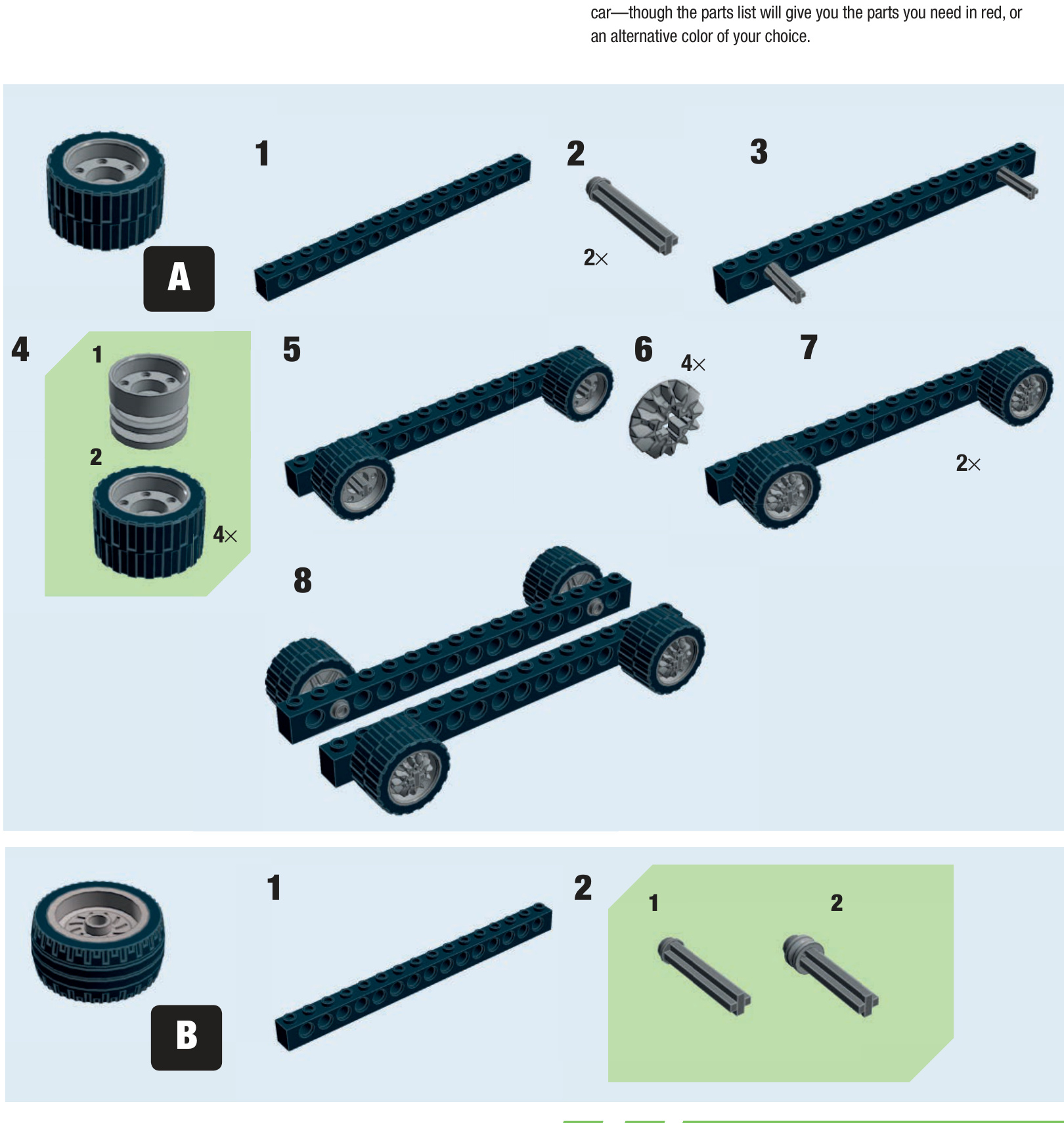
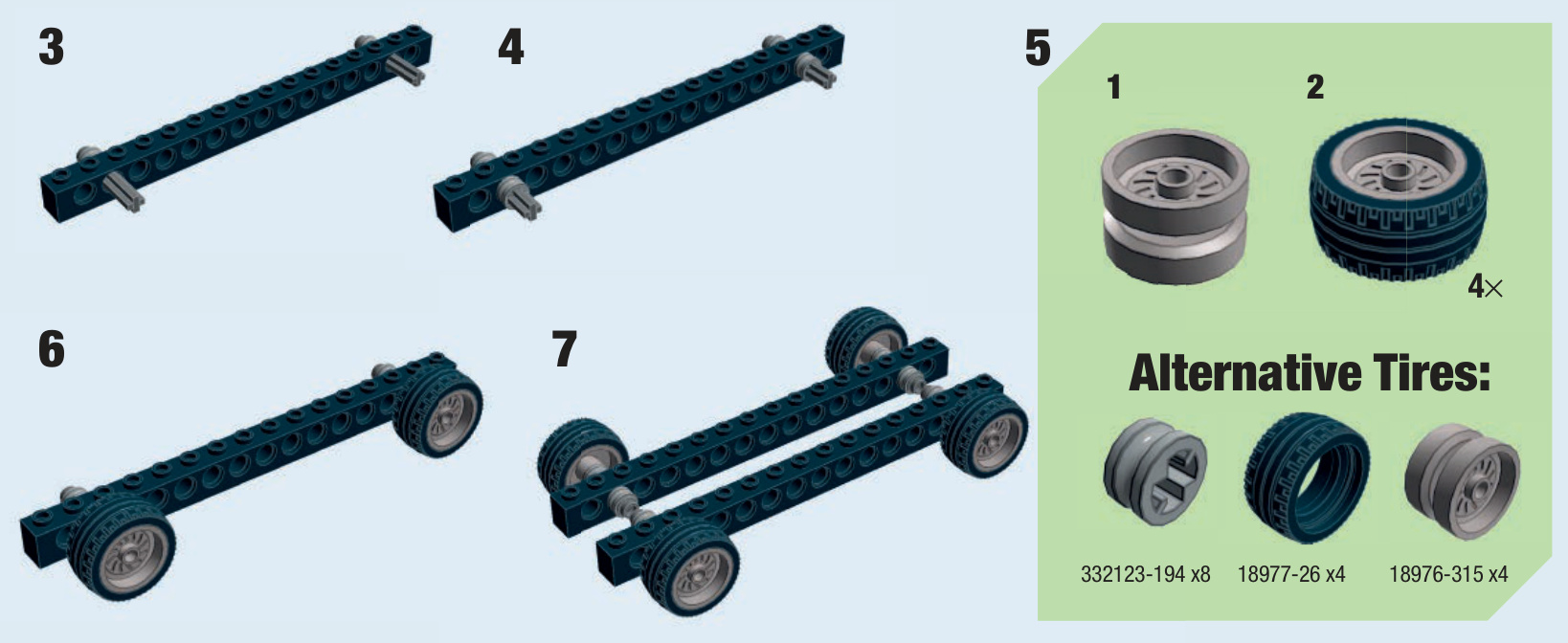
A B
SECTION 2
INTERMEDIATE
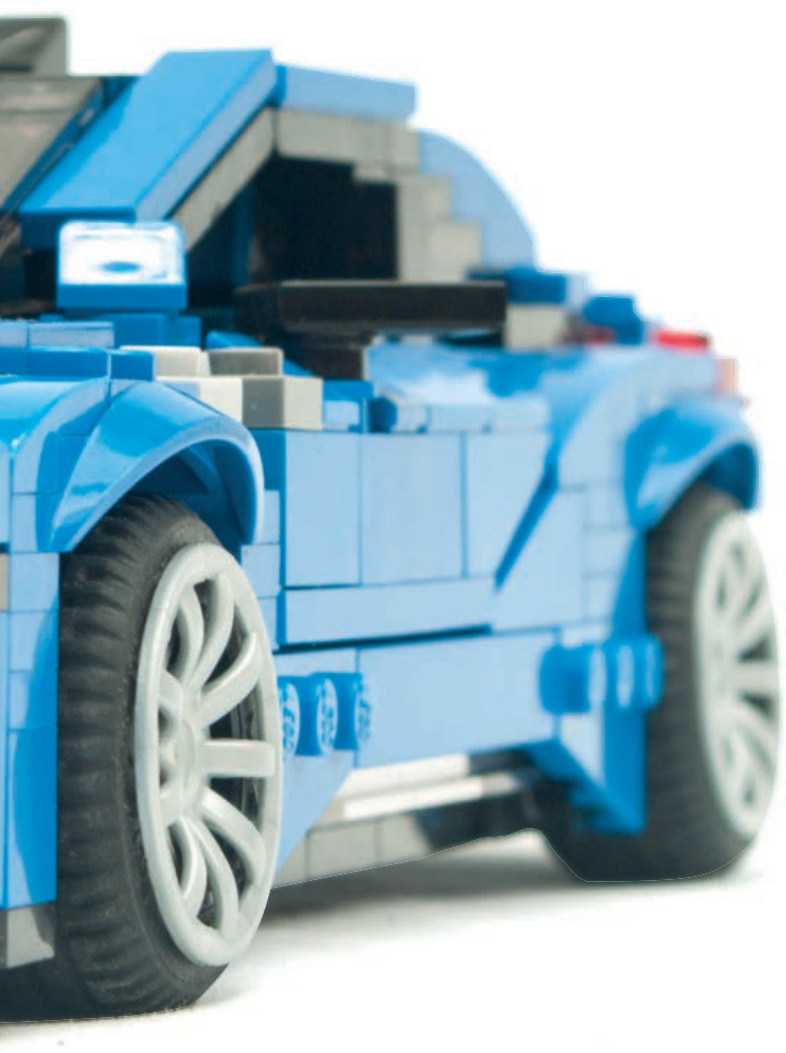
Sifpnotrrtmosds,cuadcrestsacislaosp,mtsueoreuofnodtuhsr,eamnadogsitnpriaertiivto.enrTehwdisitnhsaetmchteiiosrn sports car history—each left iconic wheel tracks for others to follow.
Most of the models in Section 2 move to a larger scale—Miniland (1:20)—the scale used in the LEGOLAND® theme parks across the globe. The larger scale allows the scope for introducing moreadvanced modeling techniques.
Most of these cars include suspension systems, where the wheels move relative to the body via spring systems.
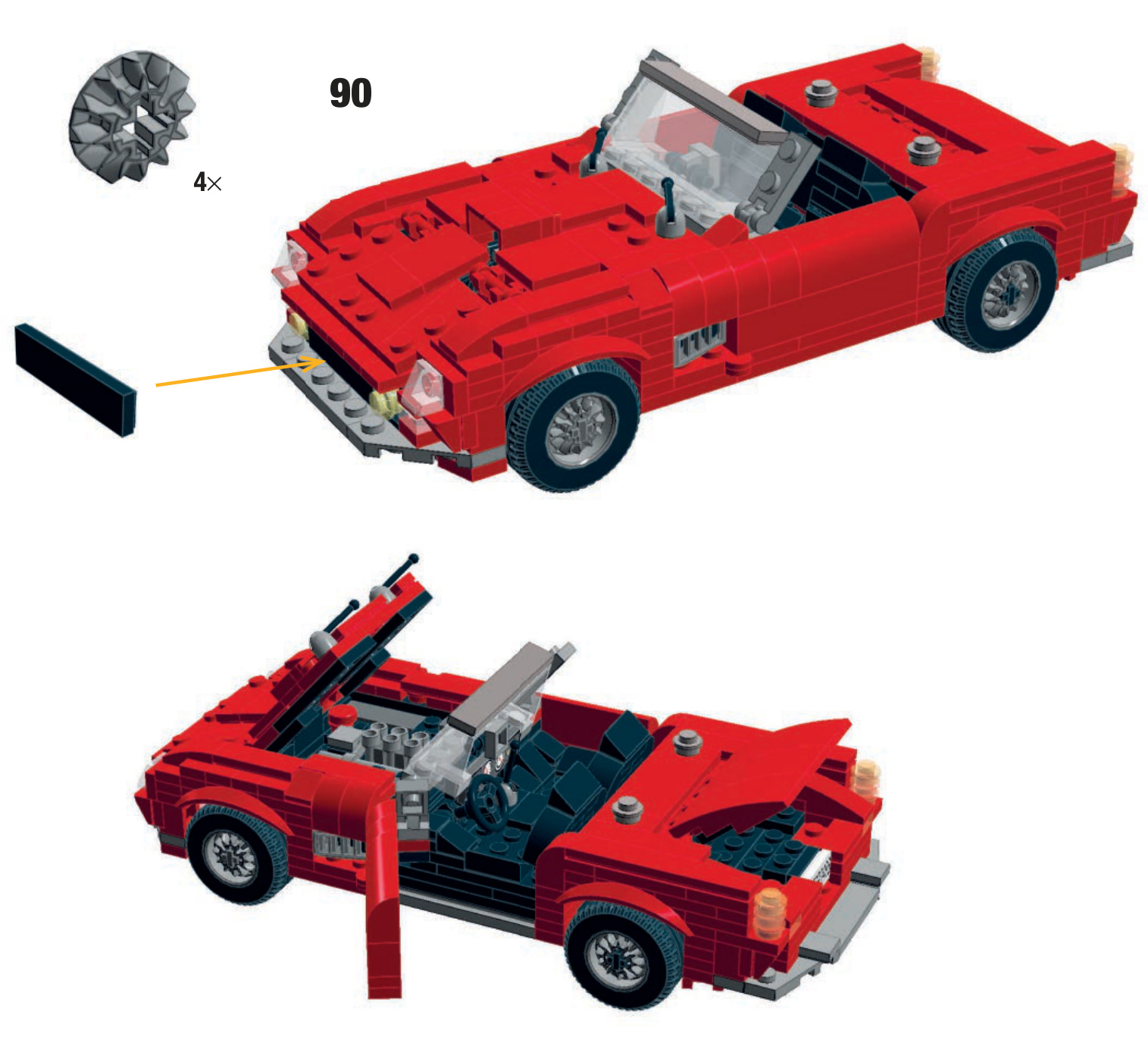
At this scale, the models can also include added details, such as brick-built engines, engine compartments, doors, luggage compartments, and interiors. Though these models include some very specifc details, I encourage builders to see them as a basis for creating models personalized to their own tastes.
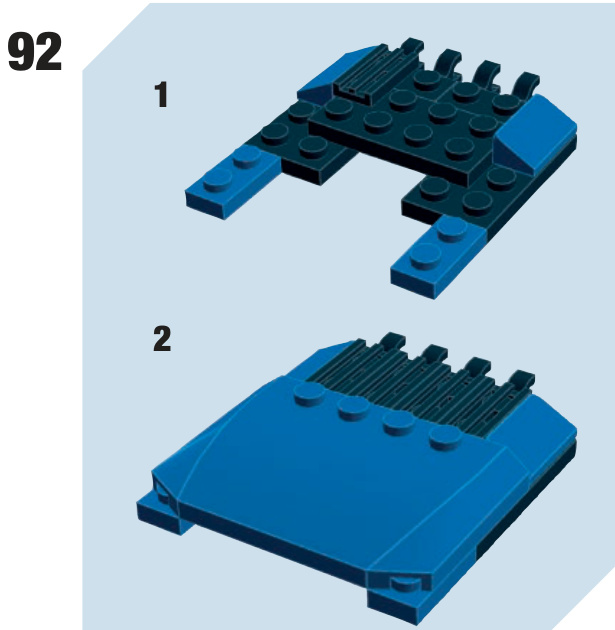
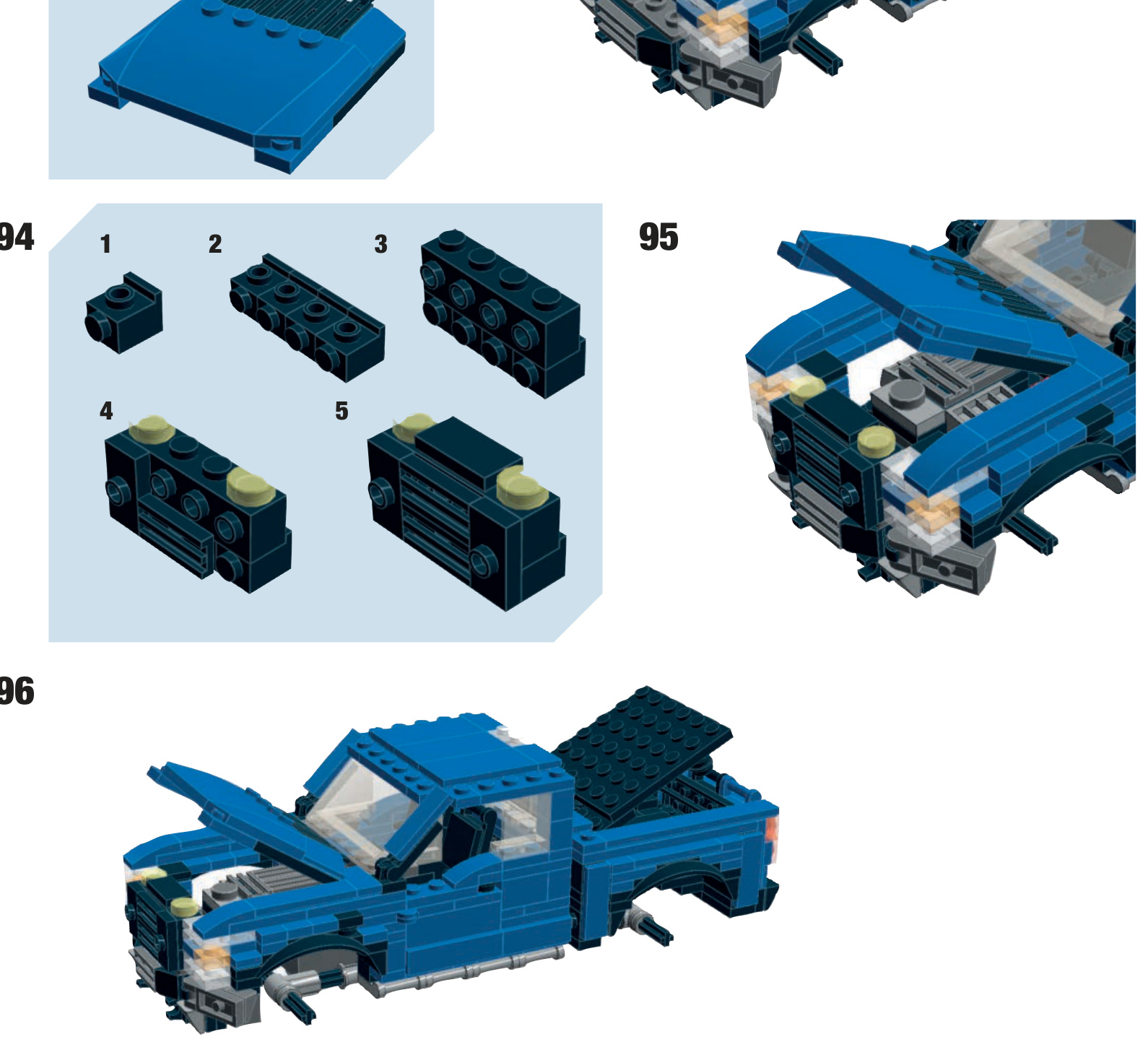
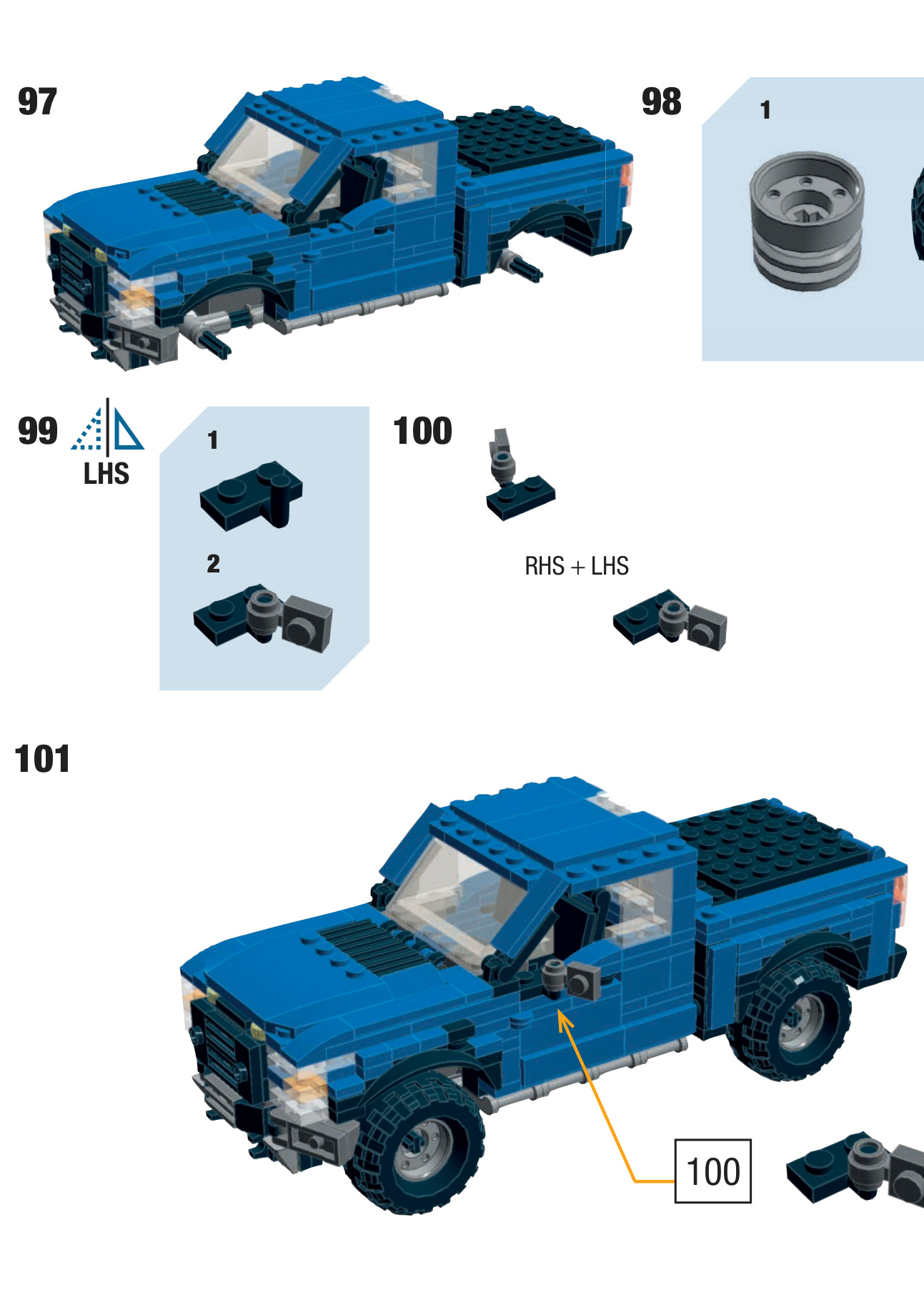
2017 FORD
F-150 RAPTOR
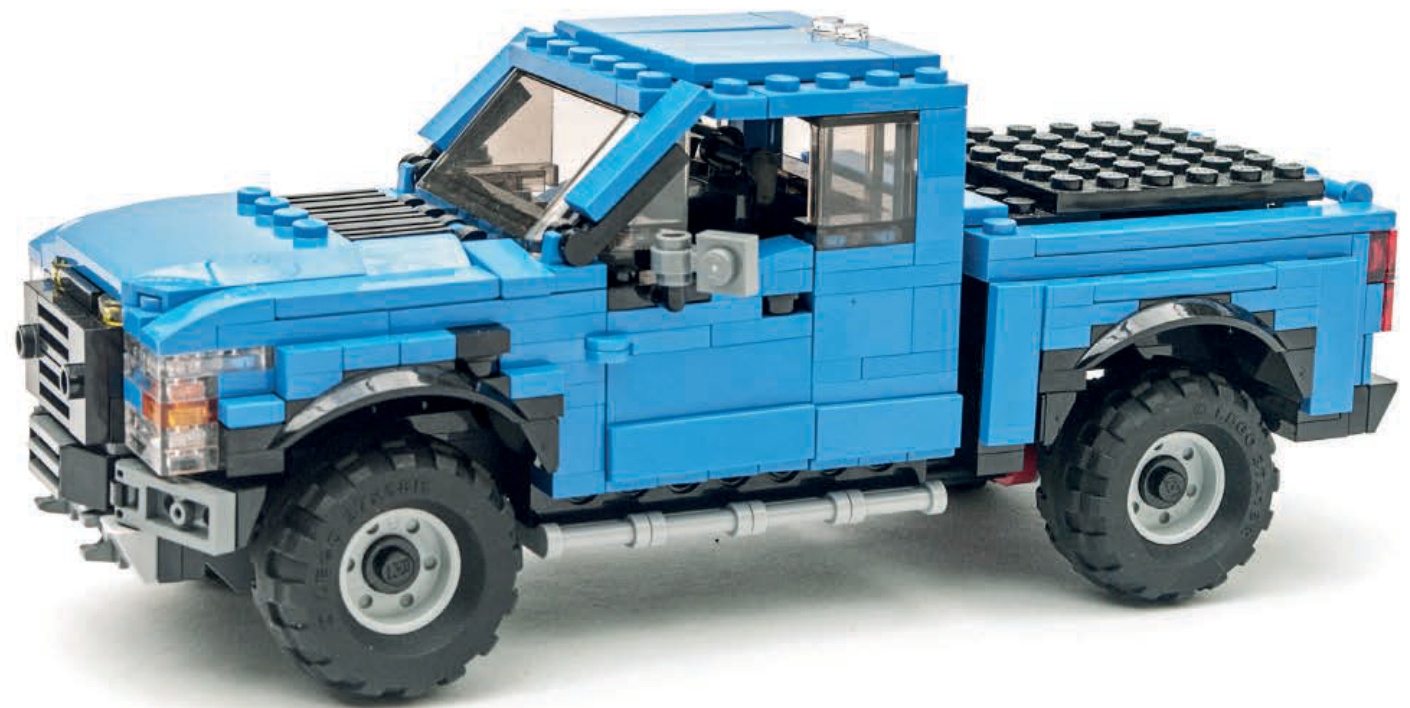
Micoxraitrg,oiagnneatldlhyeorcauamphreaeltfut-pytowmn tuphcichtkhguepitdtrehuaec, kFb,ourBtdaitjFah-a1Rs5ac0perRro,avseptnorp.tosI’pcmua ran,roatsnisnducfreaemtwsilhy introduction in 2010. The second-generation P552 Raptor shown here was introduced as a 2017 model. Gone was the previous V-8 engine, replaced by a 450-hp (340-kW) version of the 3.5L GTDi EcoBoost V-6—a group of technologies including direct fuel injection and turbocharging, punching out 591 lb-ft (691 Nm) of torque.
Putting all this power to the ground are a 10-speed automatic transmission, dual-ratio electronic transfer case, and AWD with locking front and rear axles. Ford developed an advanced chassis control technology system that selects ratios, throttle maps, transfer case torque distribution, and brake and stability program settings to maximize performance on a large number of different terrains, including tarmac. The goal: to be the fastest pickup truck on any and every track and surface.

COUNTRY OF ORIGIN: USA PRODUCTION: 2017–Present NUMBER MADE: Currently in production ENGINE: 3.5L EcoBoost, 6 cylinders, V POWER / TORQUE: 450 hp (340 kW) / 10 lb-ft (691 Nm) CONSTRUCTION / DOORS: Steel chassis, aluminum body / 4-door pickup
As well as all the power and chassis drivetrain technologies, Ford added a wider front and rear track, long travel suspension, FOX-brand shock absorbers, and larger 33-inch tires. Brand imaging for the original 2010 Raptor included a bright-orange truck jumping in the air—no doubt accompanied by a bellowing V-8 roar. Many YouTube videos show customers attempting to repeat the feat, sometimes heading home in an ambulance with the Raptor heading back on a fatbed truck. Although the Raptor is capable, driving any vehicle in this manner is not recommended for one’s long-term health.
Many Raptor customers buy two: one stock version for the road and a modifed, trailered second truck for off-road racing events such as the Baja series in the US Southwest.
This model can also be built in the folowing colors:
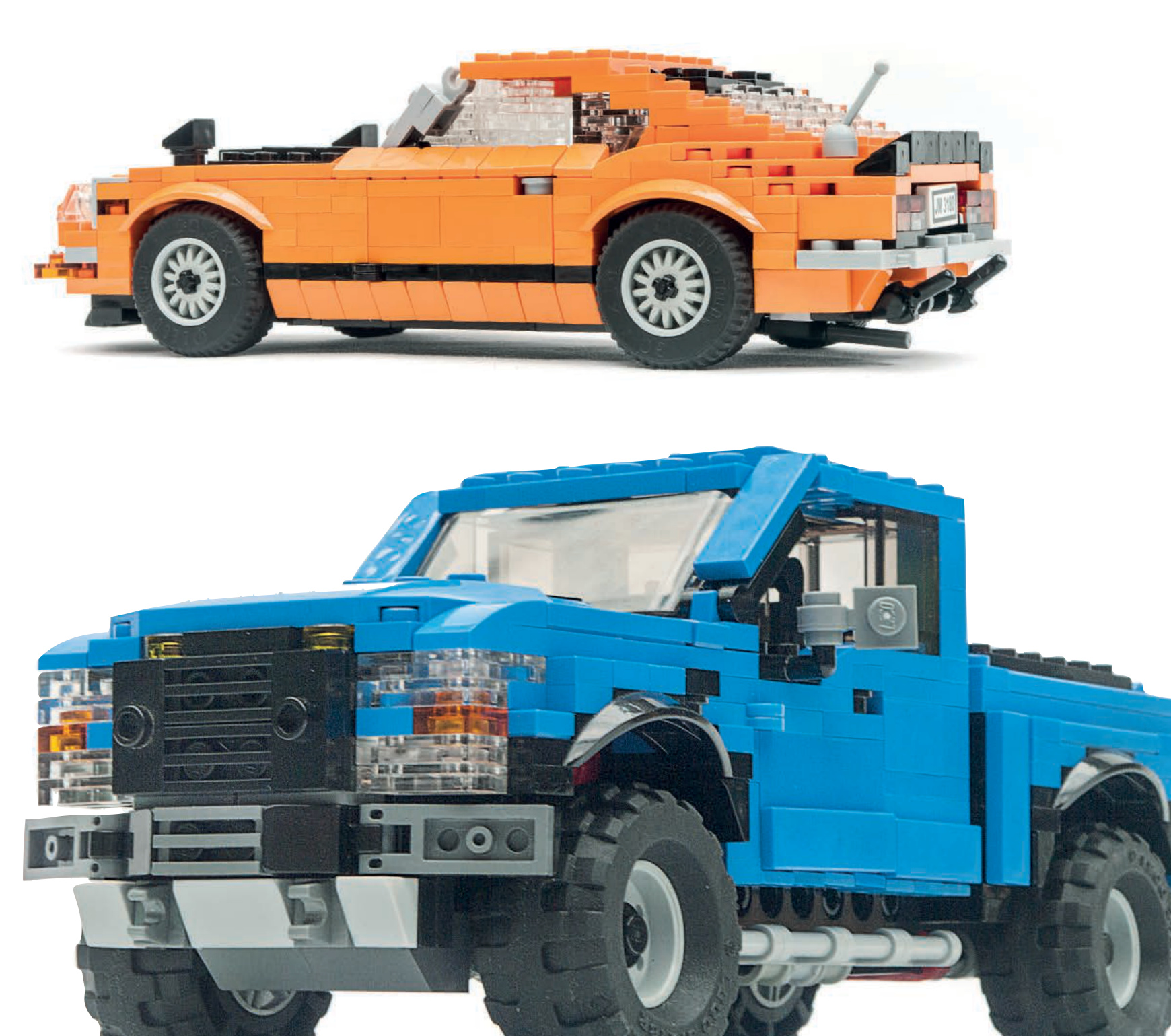
DATSUN 240Z COUPE
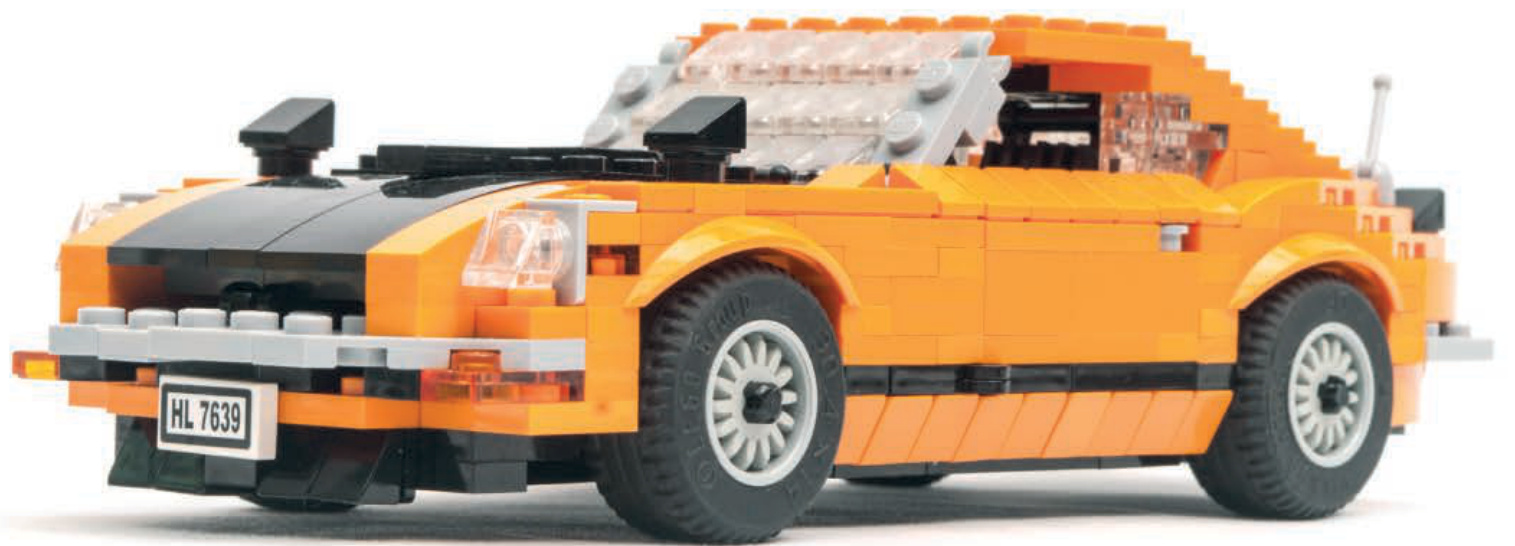
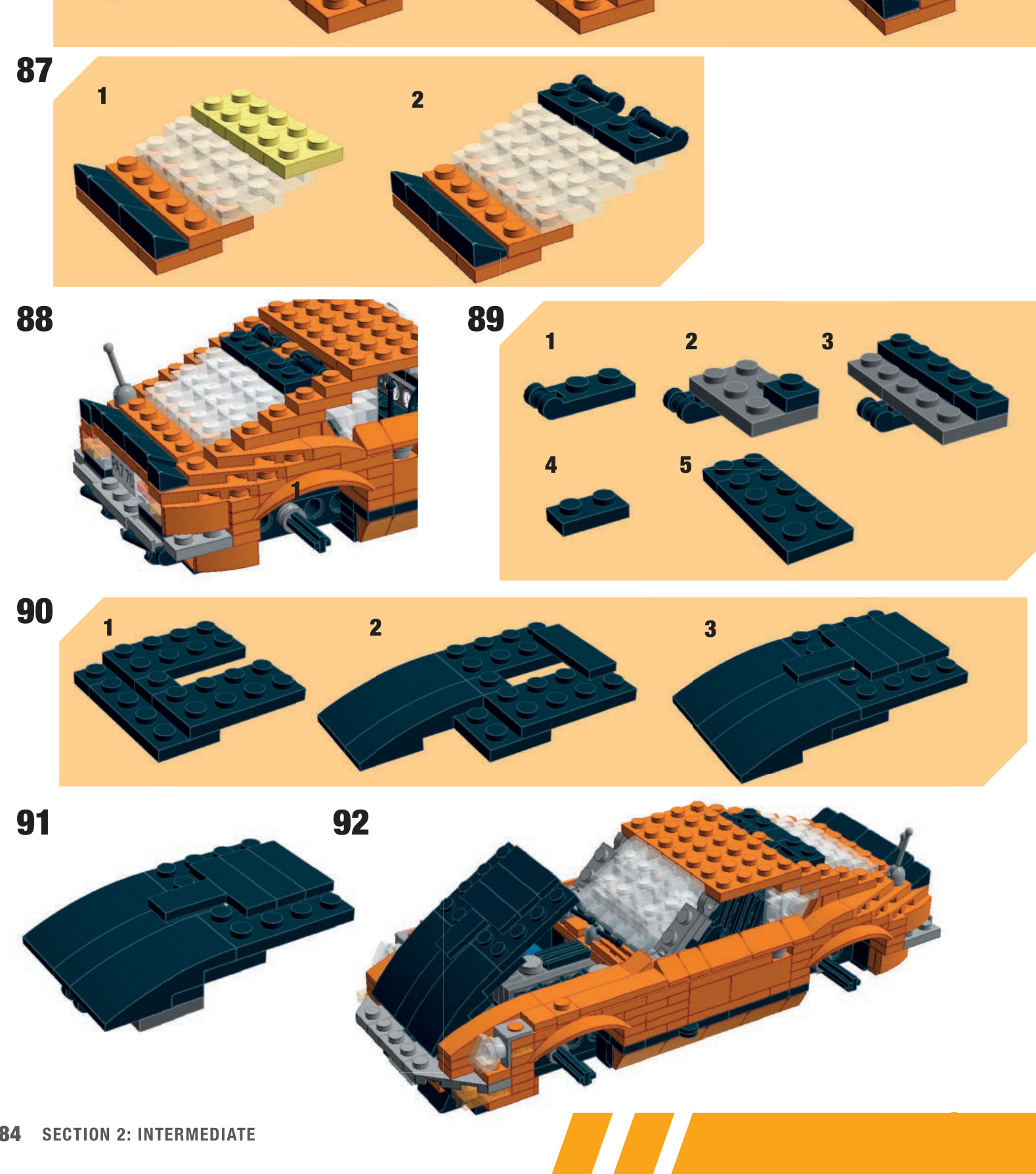
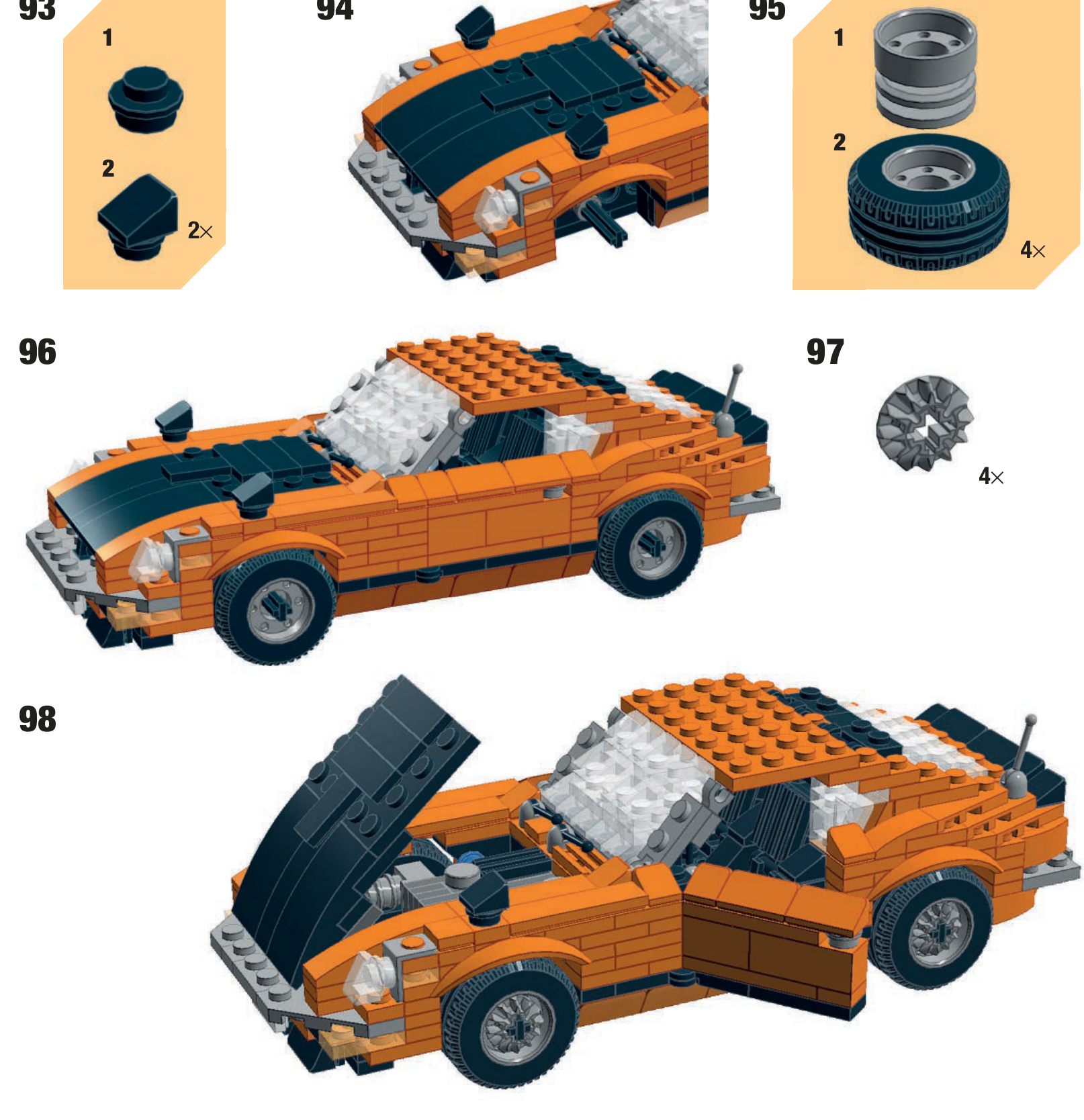
T he S30 Datsun 240Z (also known as the Nissan Fairlady Z in its home market) was not the frst Japanese sports car. Nissan, Honda, Toyota, and Mazda had each produced low-volume, domestic-consumption models that were largely ignored by the West. The 240Z was different—mainly in that its intended market was the United States. With 168,584 cars produced over four years, the 240Z marked a major shift in emphasis for the Japanese makers, all of which began to turn their focus across the Pacifc.
The 240Z was not overly radical. The engine was a 2.4L inline-six. Tuning was spritely, at 151 bhp. Performance was aided by the 240Z’s light weight; the car was small and thus handled very well on independent front and rear suspension. Notably, the 240Z represented an amalgam of contemporary automotive technologies rolled into one vehicle and was built to the high standards that the Japanese were becoming known for.
The US market posed a signifcant conundrum—big-power V-8s dominated the performance scene in pony cars such as the Mustang and Camaro or muscle cars such as the Charger and GTO. The 240Z’s secret lay in its nimble size, classic proportions, and focused two-seat layout. This market had been substantially owned by the Europeans—UK makers in particular—after World War II, but poor build quality and lack of investment in new technologies had meant that they easily fell to the Z’s charm and performance. As a comparison, a Porsche 911 of the era also had engine of 2.4L and was little faster.
COUNTRY OF ORIGIN: Japan PRODUCTION: 1970–1973 NUMBER MADE: 168,584 LAYOUT / DRIVE: Front engine / Rear-wheel drive ENGINE: 2,393 cc, 6 cylinders, inline POWER / TORQUE: 151 bhp (113 kW) / 146 lb-ft (198 Nm) CONSTRUCTION / DOORS: Steel monocoque / 2-door coupe
In 1974, the 240Z received an increase in engine capacity to 2.6L, and in 1978 (in the United States only), it increased to 2.9L as a result of pollution regulations. At the same time, the car also received a slightly longer version, losing some of the design balance. The build model is a special 2.0L twin-cam engine JDM Fairlady Z432R rally special, which was sold in orange paint with a black engine cover.
This model can also be built in the folowing colors: Number of parts: 499
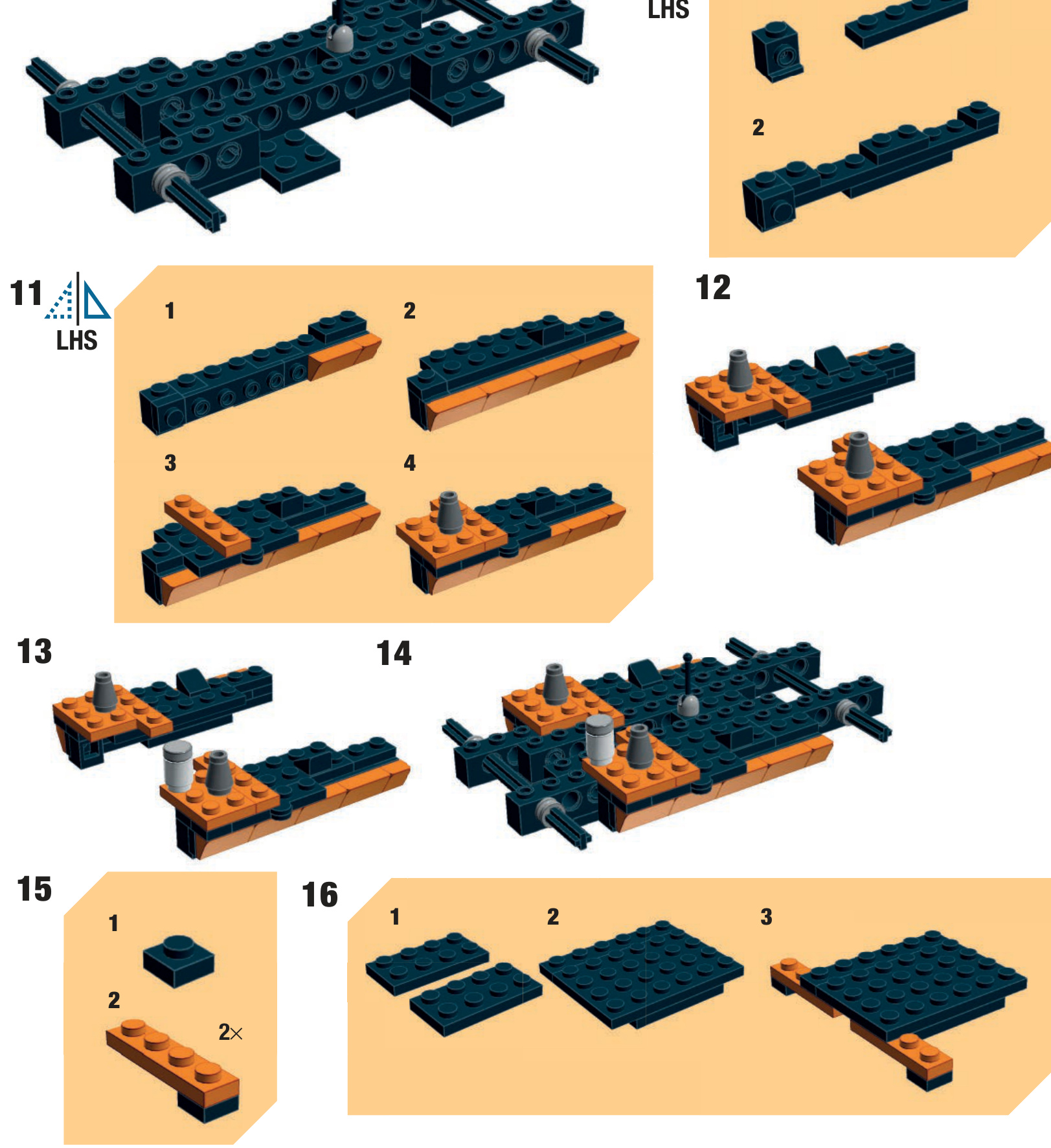
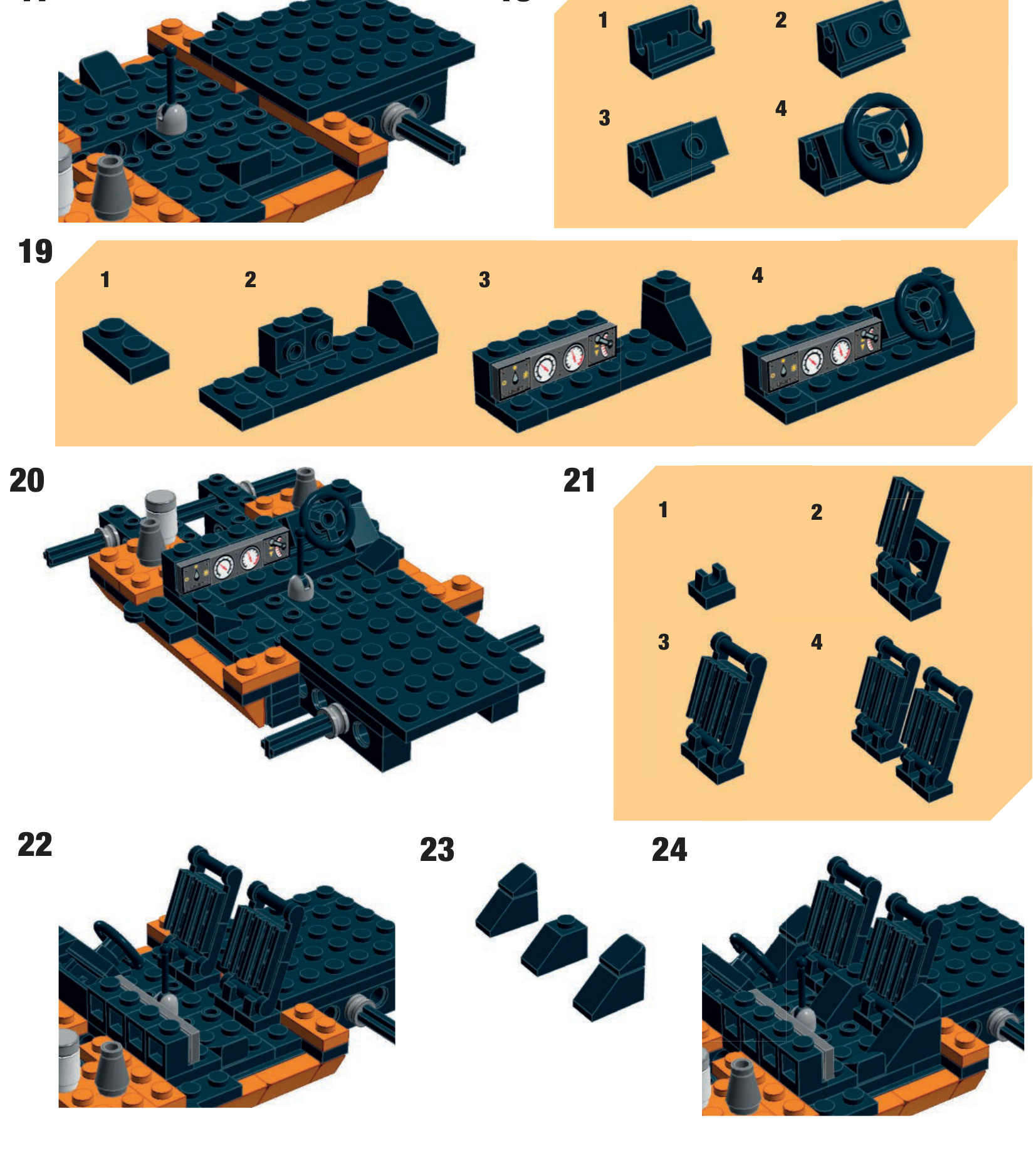
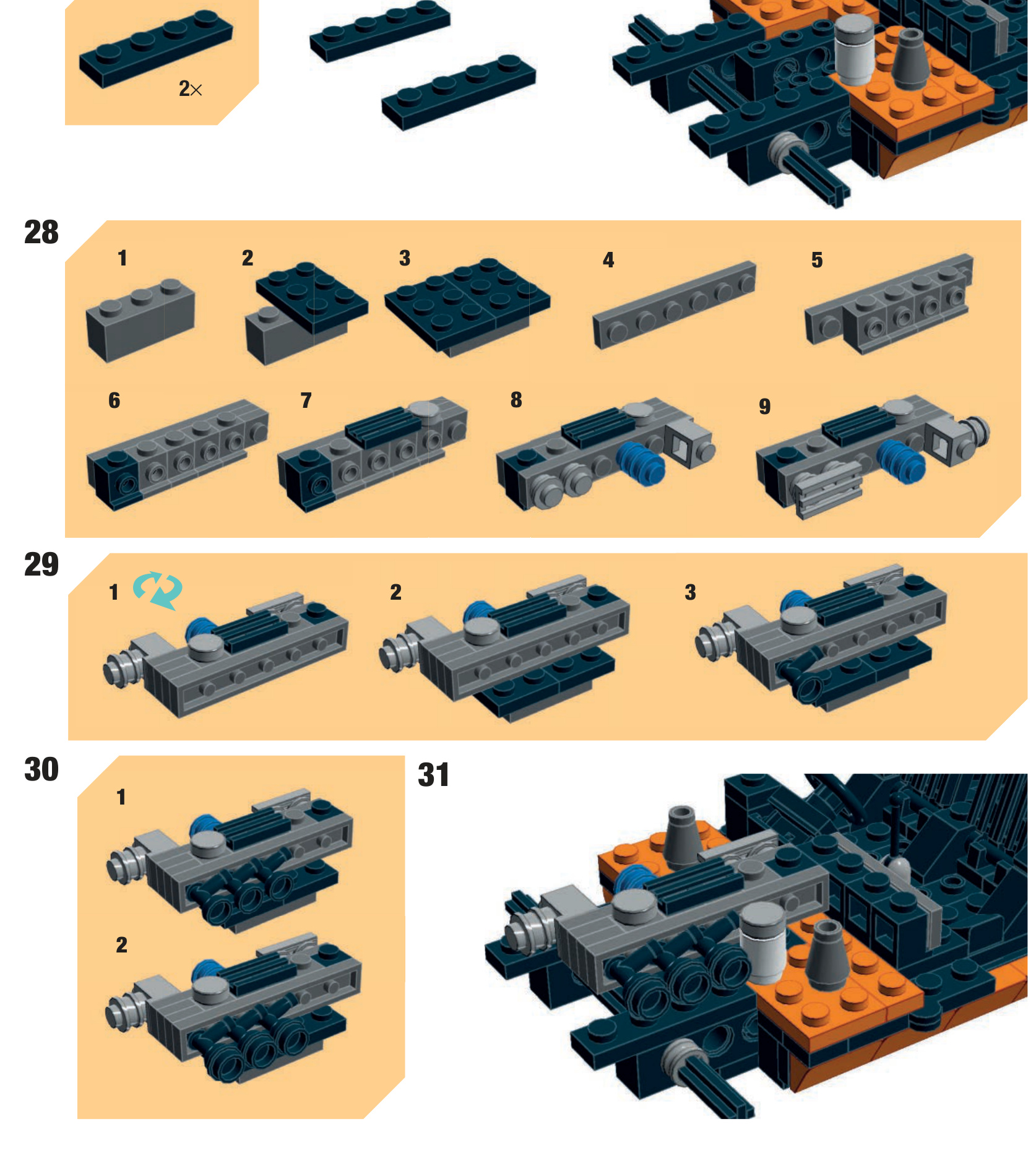
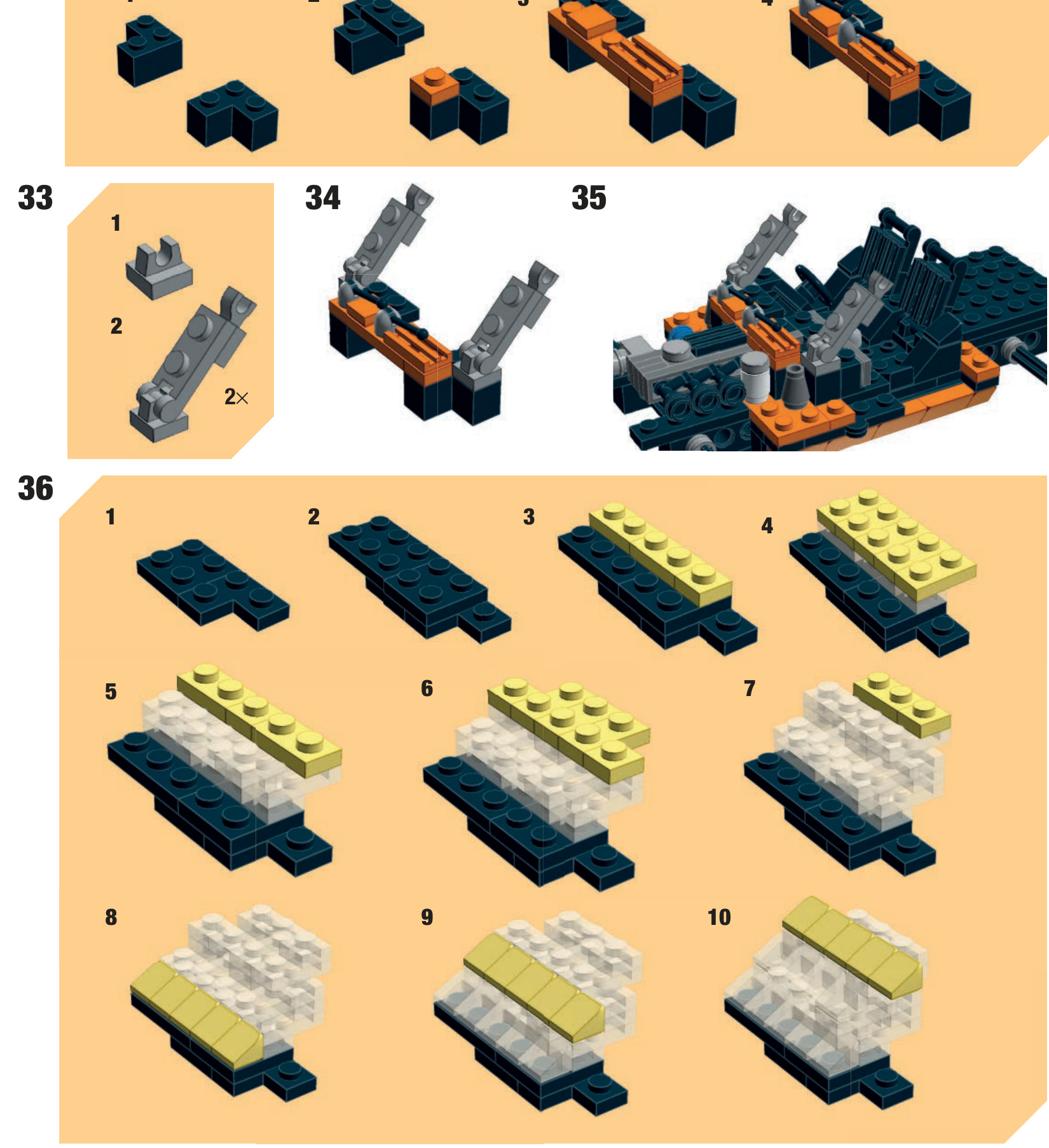
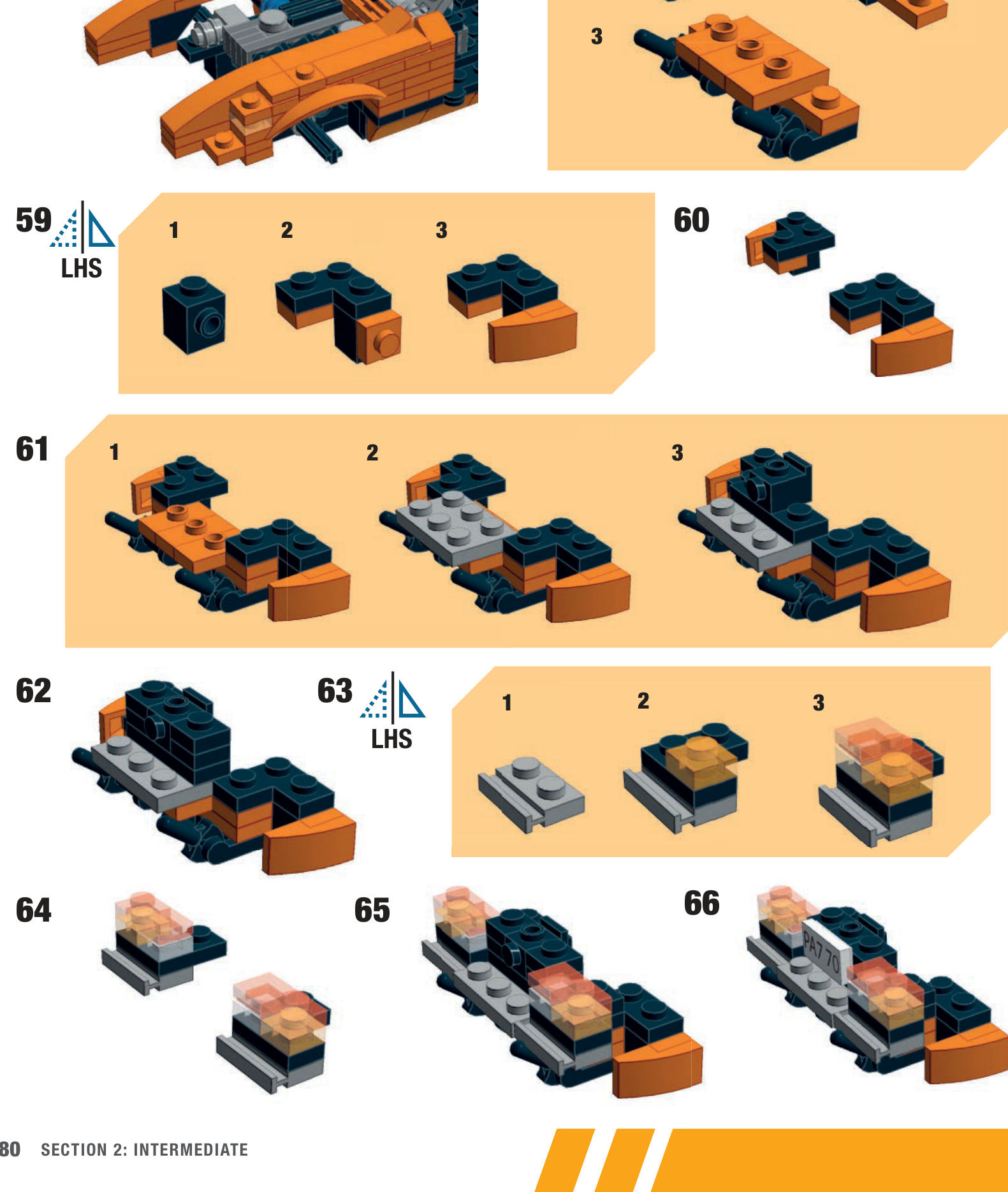
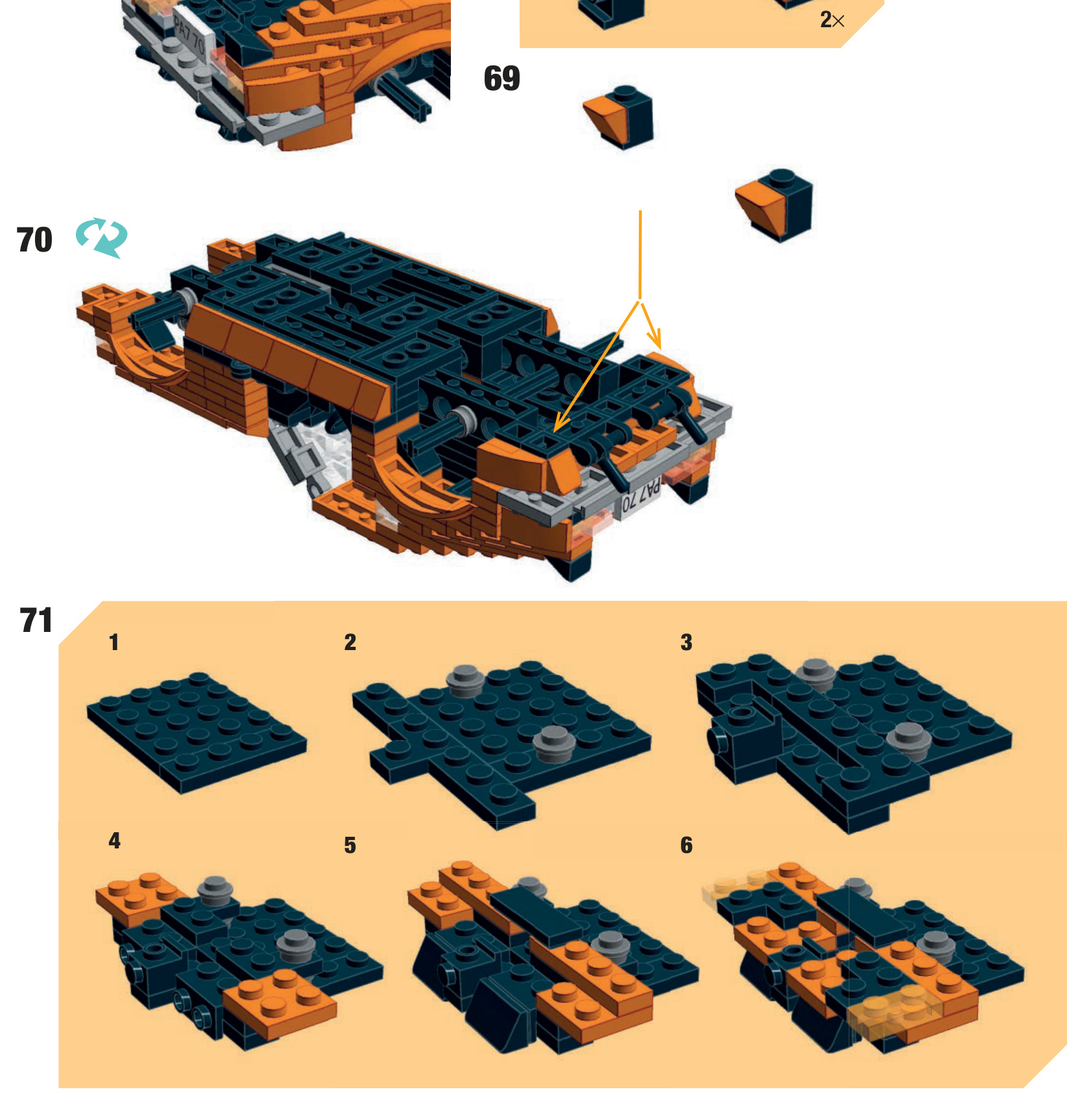
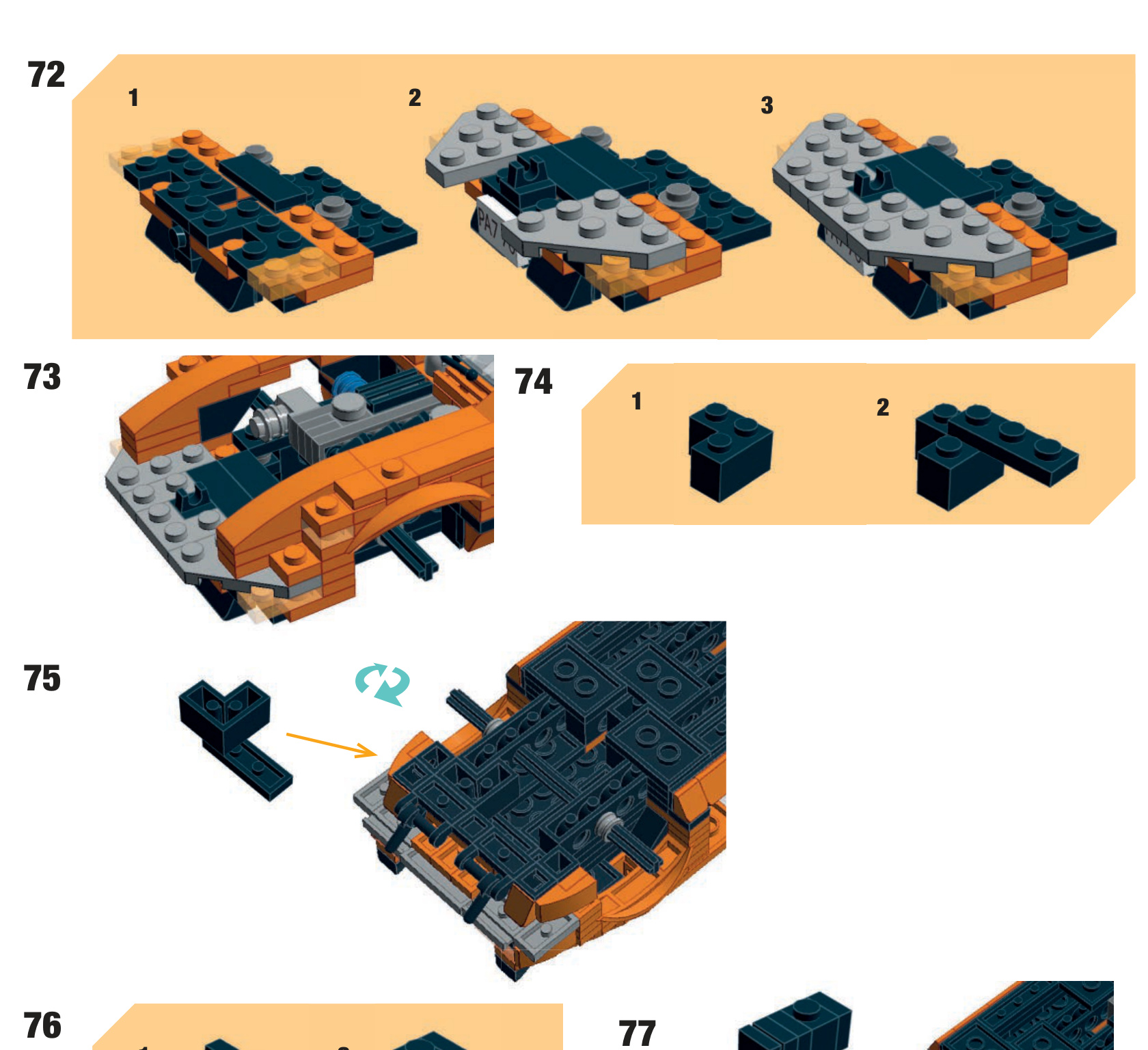
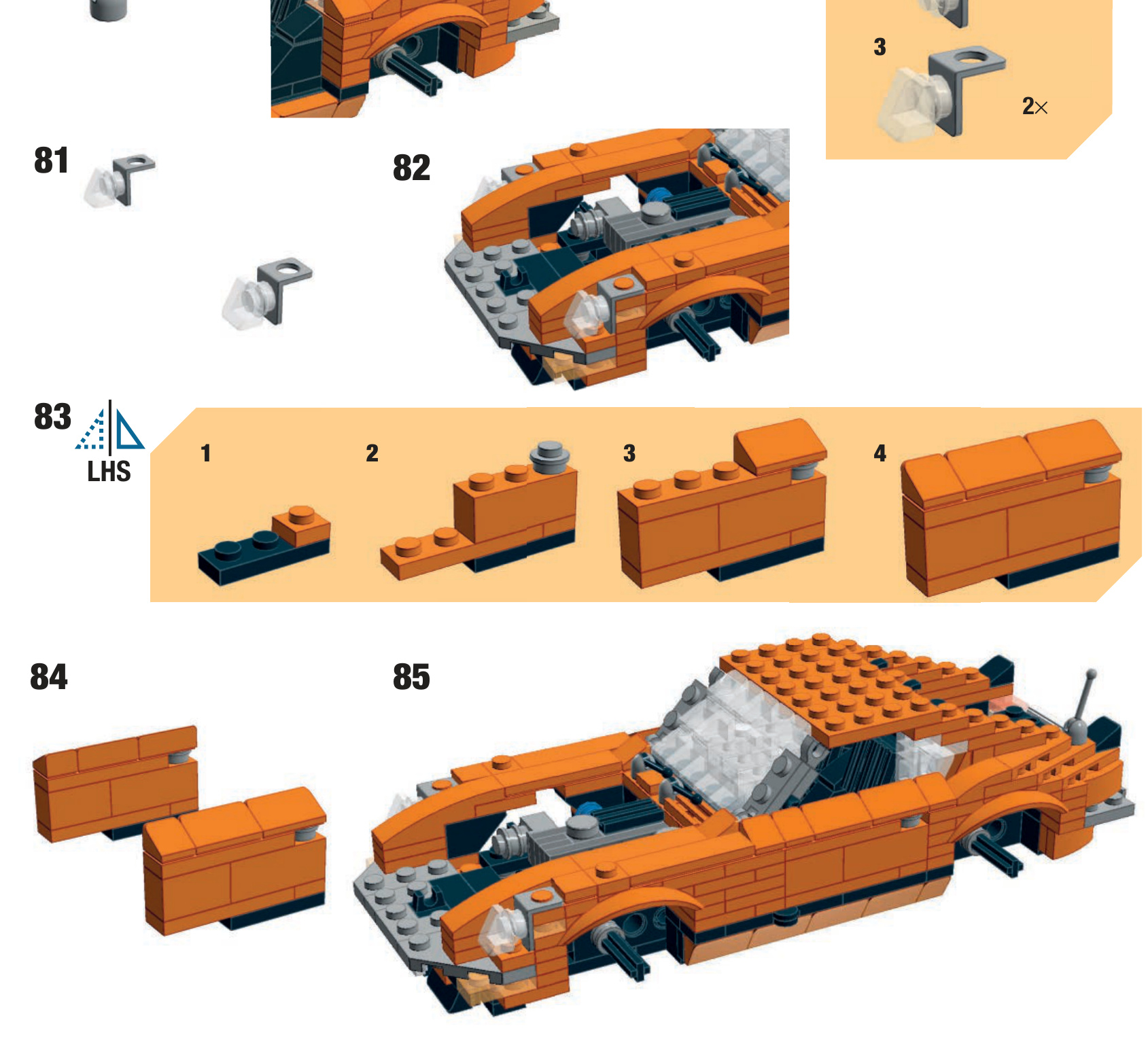
F E R R A R I
250 GT SWB CALIFORNIA SPYDER
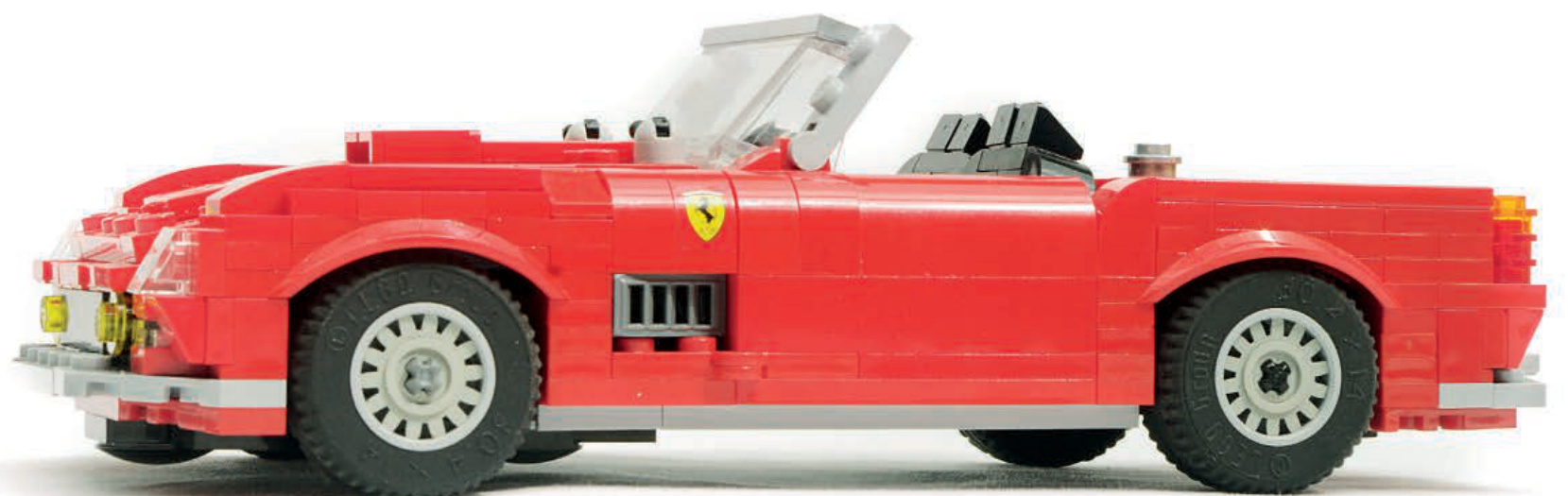
T here are fast Ferraris and there are beautiful Ferraris. When the two are combined, a legend is usually born. The Ferrari 250 GT SWB California Spyder is such a car. This legend was reincarnated in popular culture in the 1986 flm Ferris Bueller’s Day Off—a replica based on an MG that suffered an unfortunate fate!
The Ferrari 250 line had enjoyed half a decade of development by the time of the 250 SWB Spyder. The car featured an uprated 3.0L V-12 engine with 276 bhp (206 kW), nearly as much power as the Le Mans racing and FIA GT championship–winning 250 GTO. The 250 line actually refers to the sweptvolume cubic capacity of each of the V-12’s cylinders. The SWB chassis was based on the 250 GT SWB road racer, one of the last of the breed of racing cars that were also produced as road cars.
The beauty came in the form of the open-top Spyder bodywork. This was ftted to the 2,400mm wheelbase frame, a reduction on the earlier road car. The car was built in both steel- and aluminum-bodied versions, and the latter were also used as race cars. The car’s styling typifes the period—a
COUNTRY OF ORIGIN: Italy PRODUCTION: 1960–63 NUMBER MADE: 55 LAYOUT / DRIVE: Front engine / Rear-wheel drive ENGINE: 2,953 cc, 12 cylinders, V POWER / TORQUE: 276 bhp (206 kW) / 206 lb-ft (280 Nm)
CONSTRUCTION / DOORS: Tubular steel / 2-door Spyder
long hood housing the engine, Borrani wire wheels, egg-crate grille, fender grilles to help keep the engine bay cool, and a thin-chrome-rimmed, swept-back windscreen. Most cars were ftted with blade-like chrome bumpers, often removed for track work.
For all these reasons and more, the car was popular with celebrities—actors, singers, racers, and others. The pedigree of both car and owners ensures that today, as cars become available for sale, many change hands in excess of \10$ million, making the 250 GT SWB Spyder one of the most valuable and coveted of all classic cars.
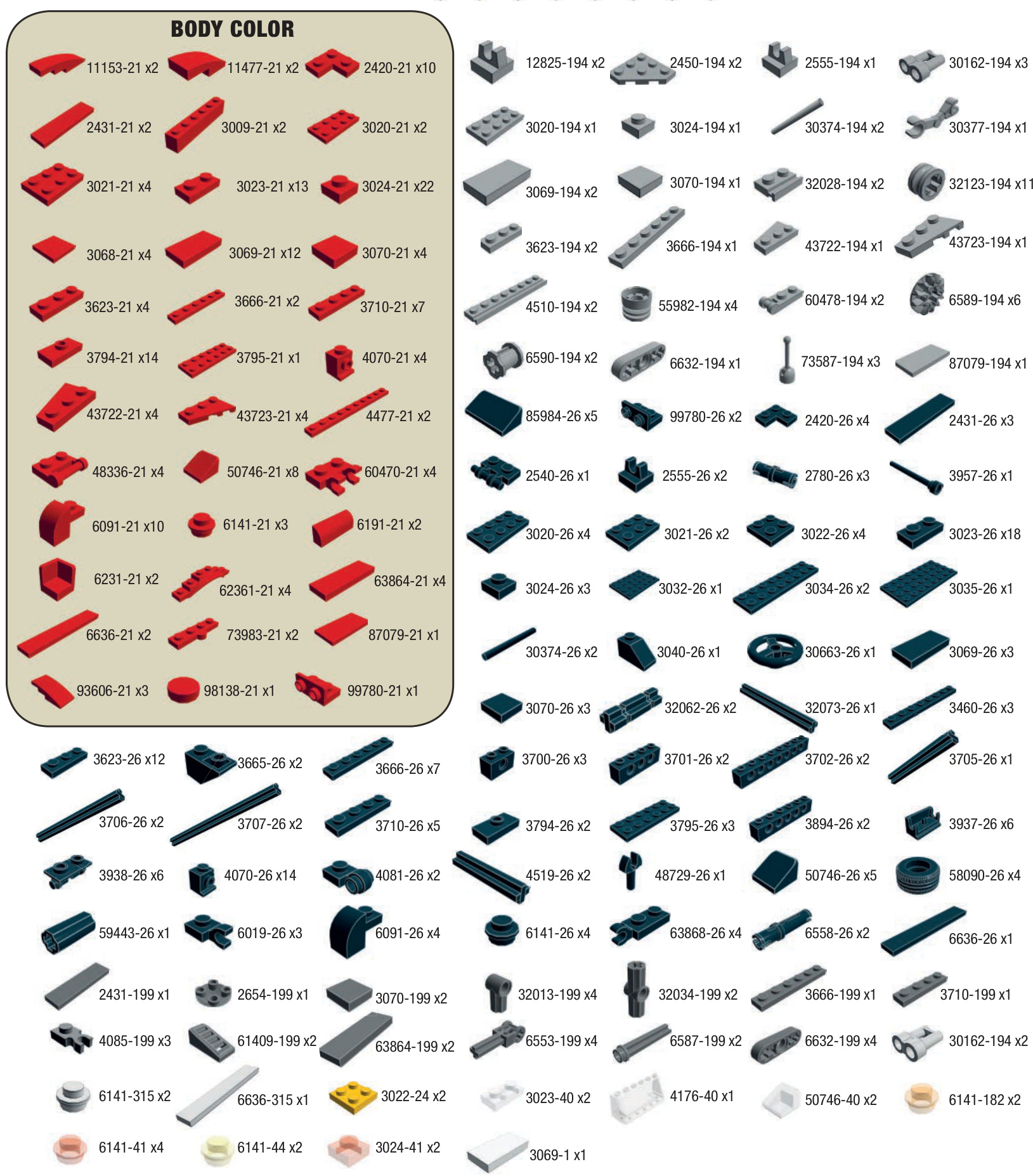
This model can also be built in the folowing colors:

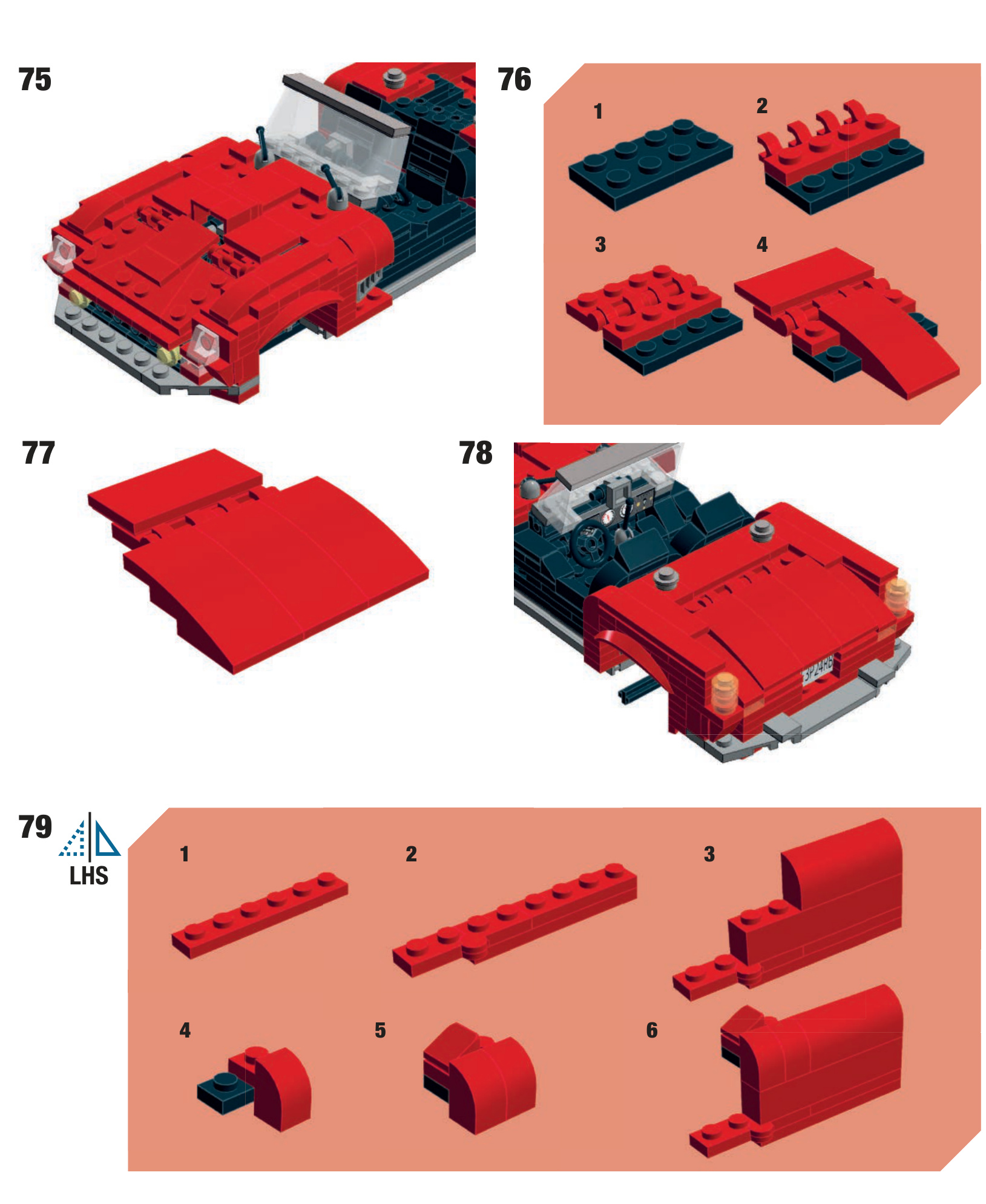
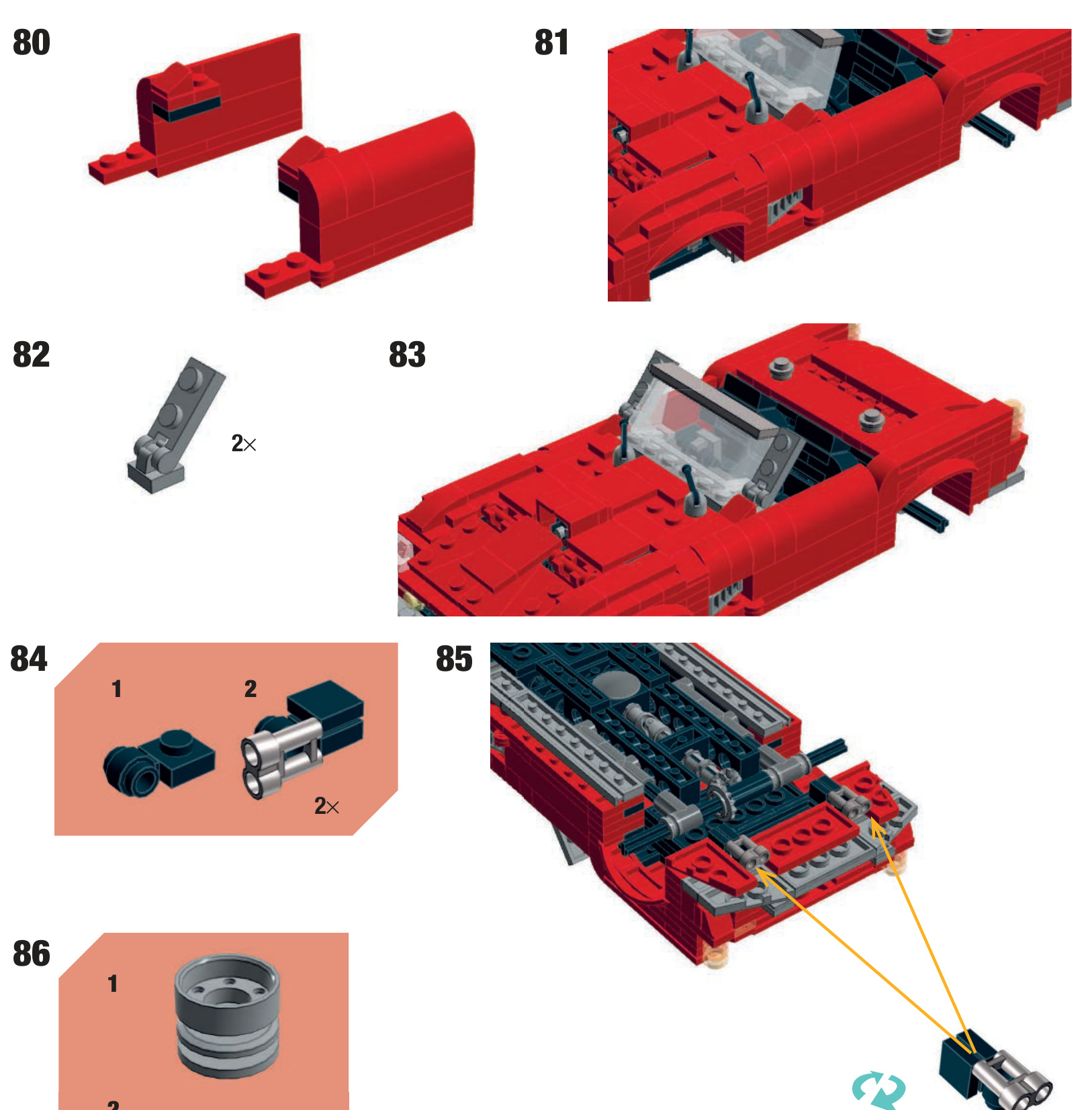
B M W
i8 HYBRID COUPE
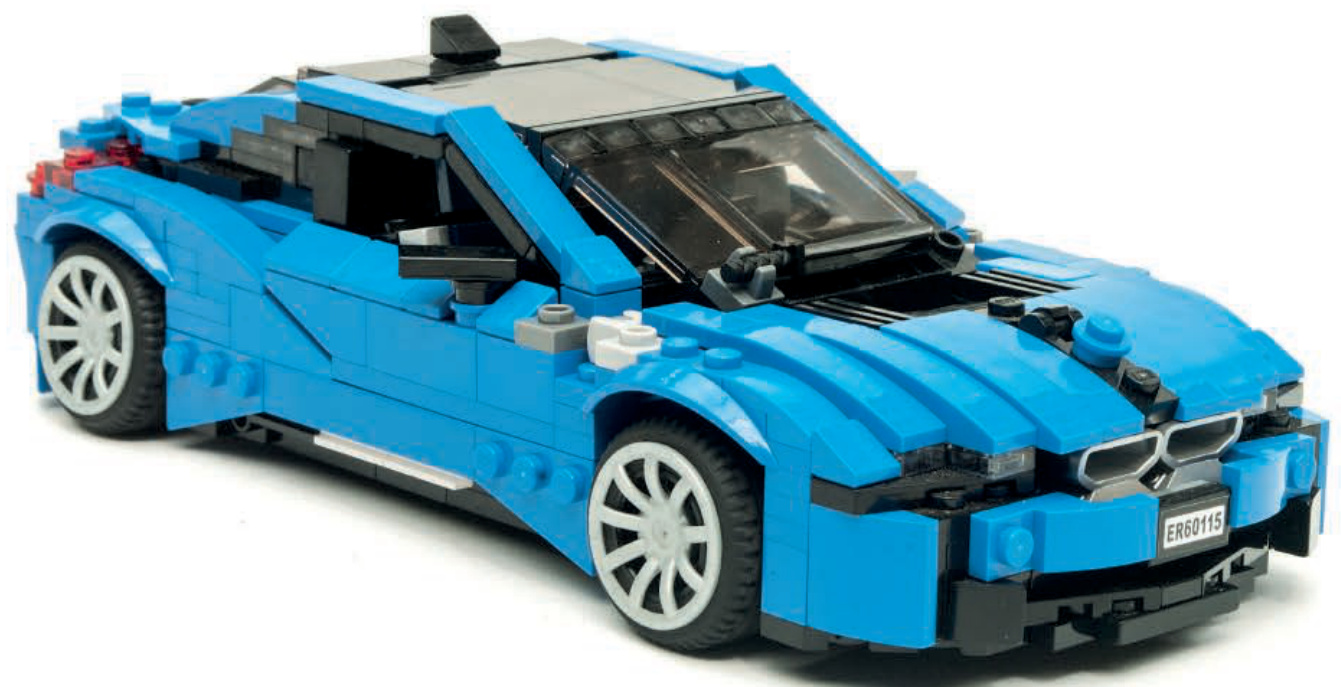
T hwehfouthuroeugohfttthheatwaesnutyp-efrrcsatr-cnenetdureyd s8uoprermcaorestcayrltisndherse.aAnndysohnoe by this high-performance coupe from BMW. The i8 has only 3 cylinders in its mid-mounted 1.5L engine, yet it produces a solid 231 PS (170 kW), augmented by a 131 PS (96 kW) Synchronous Electric Hybrid Drive. The characteristics of each propulsion system complement one another—the electric drive produces instantaneous low-speed torque (184 lb-ft/250 Nm), progressively transferring torque demand to the gasoline-powered internalcombustion engine as speed increases.
The performance is brisk: 0 to 62 mph (0 to in 4.4 seconds and a top speed of 155 mph ). The hybrid drive alone allows 120-km/h cruising in electric mode, aided, no doubt, by an impressive coeffcient of aerodynamic drag of 0.26. The acceleration is also aided by a low vehicle weight of 3,274 lb. ), the result of focused system selection and weight-saving measures, such as the aluminum-alloy subframes attached to the carbon-fber-reinforced plastic (CFRP) composite body. One compromise normally imposed by a hybrid drivetrain is the large and heavy battery; the i8 uses a 7.1-kWh lithium-ion battery, permitting an all-electric (zero emissions) range of 23 miles
COUNTRY OF ORIGIN: Germany PRODUCTION: 2014–Present NUMBER MADE: Currently in production (2014: 1,741, 2015: 5,456) LAYOUT / DRIVE: Mid engine / All-wheel drive ENGINE: 1,499 cc, 3 cylinders, inline, turbocharged POWER / TORQUE (GASOLINE MOTOR): 231 PS (170 kW) / 236 lb-ft (320 Nm) POWER / TORQUE (HYBRID SYNCHRONOUS MOTOR): 131 PS (96 kW) / 184 lb-ft (250 Nm) CONSTRUCTION / DOORS: Aluminum-alloy spaceframe, carbon-fber body / 2-door
) as calculated by the European NEDC cycle. The US EPA test reduces this by approximately 35 percent.
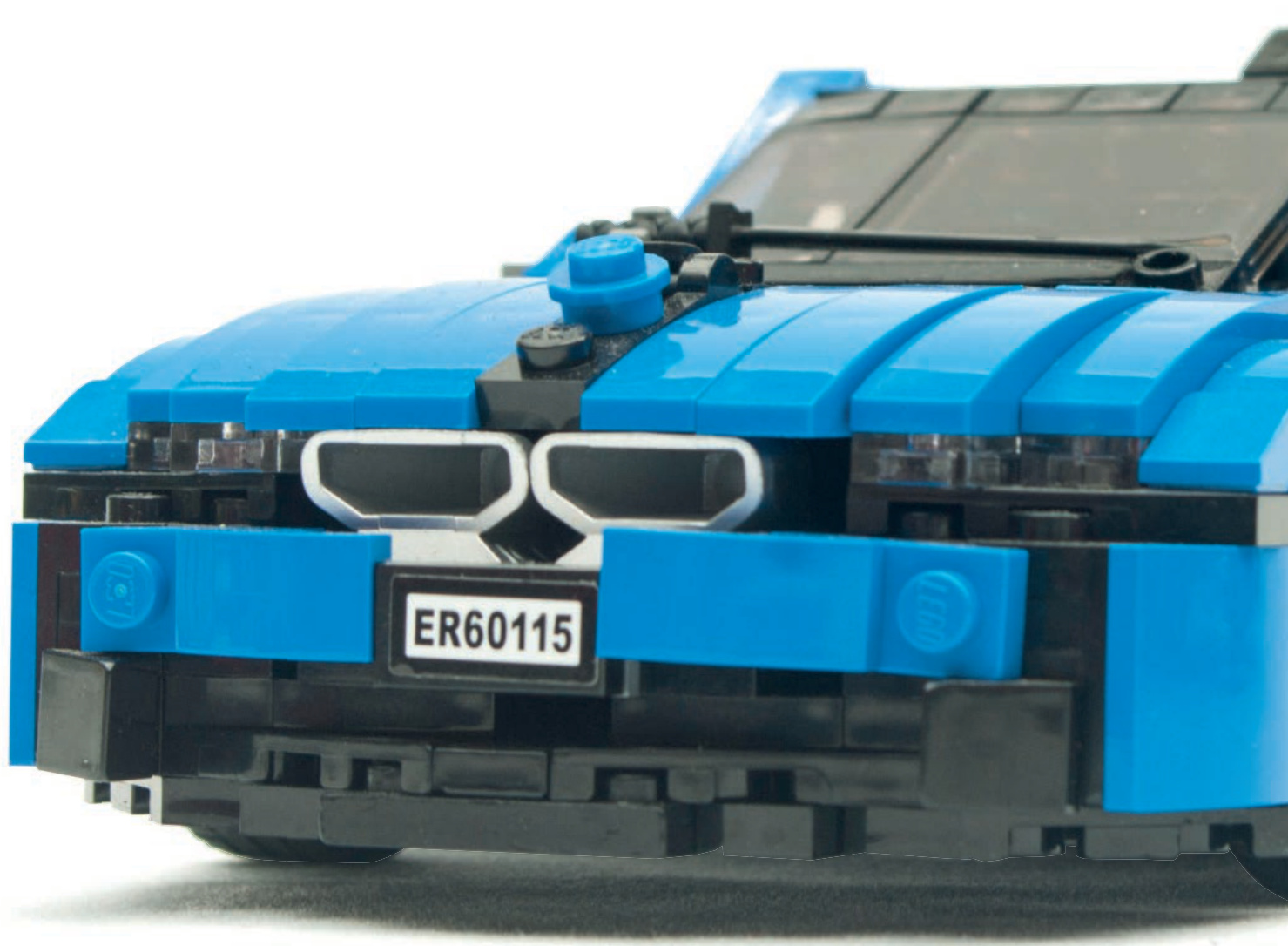
Supercars are nothing without a little drama. The preceding BMW Vision EffcientDynamics show car of 2009 showed off a dramatic form, including a new interpretation of butterfy doors. All these elements translated largely intact to the i8 production car, down to the contrasting color “blades” along the sill line and air-guide vanes on the tail of the car.
The BMW i8 marks the start of a new line of BMW models; a follow-up city car, the BMW i3, was launched later in the year, deploying the same technology set in a more practical everyday form.
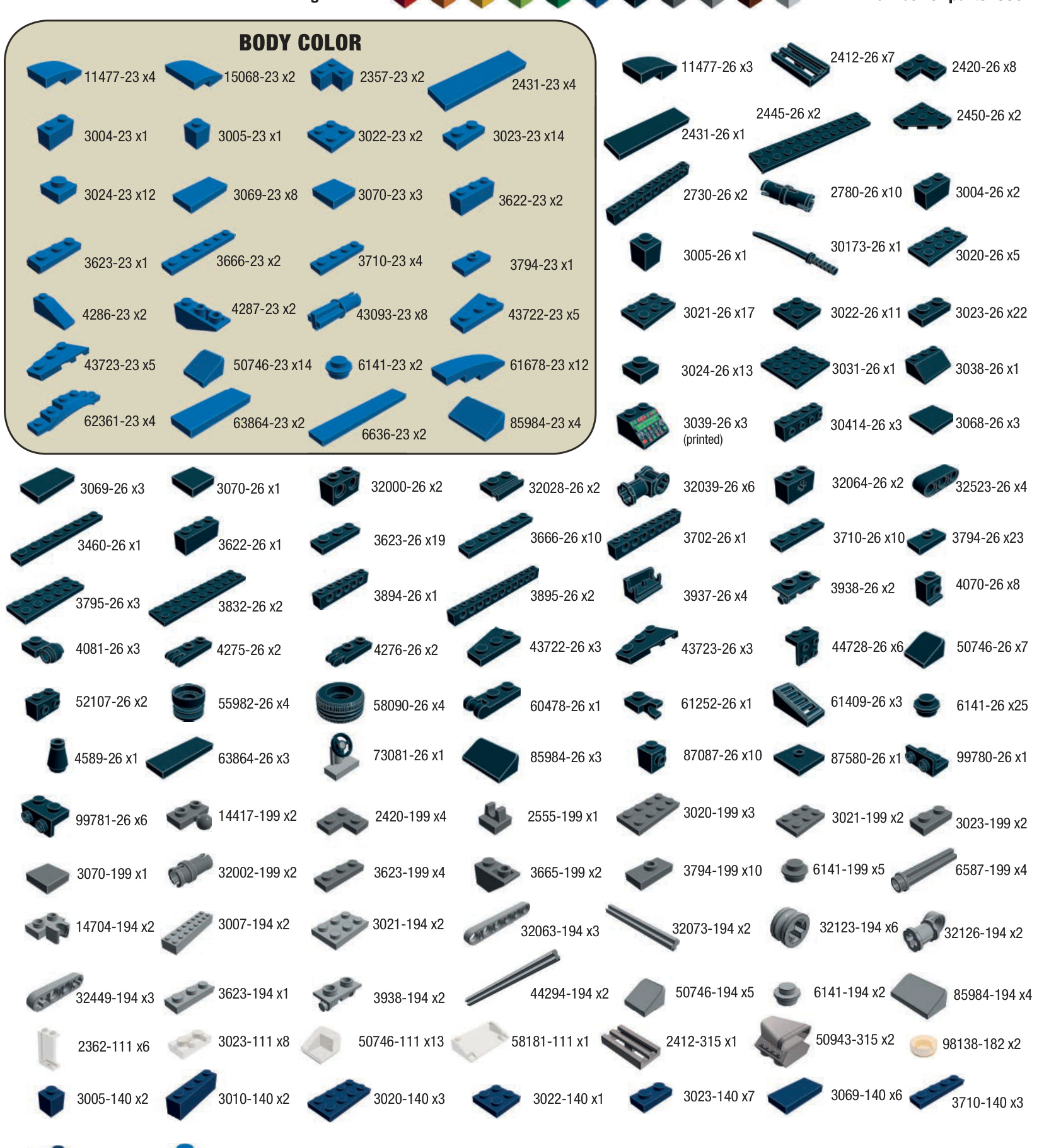
This model can also be built in the folowing colors:
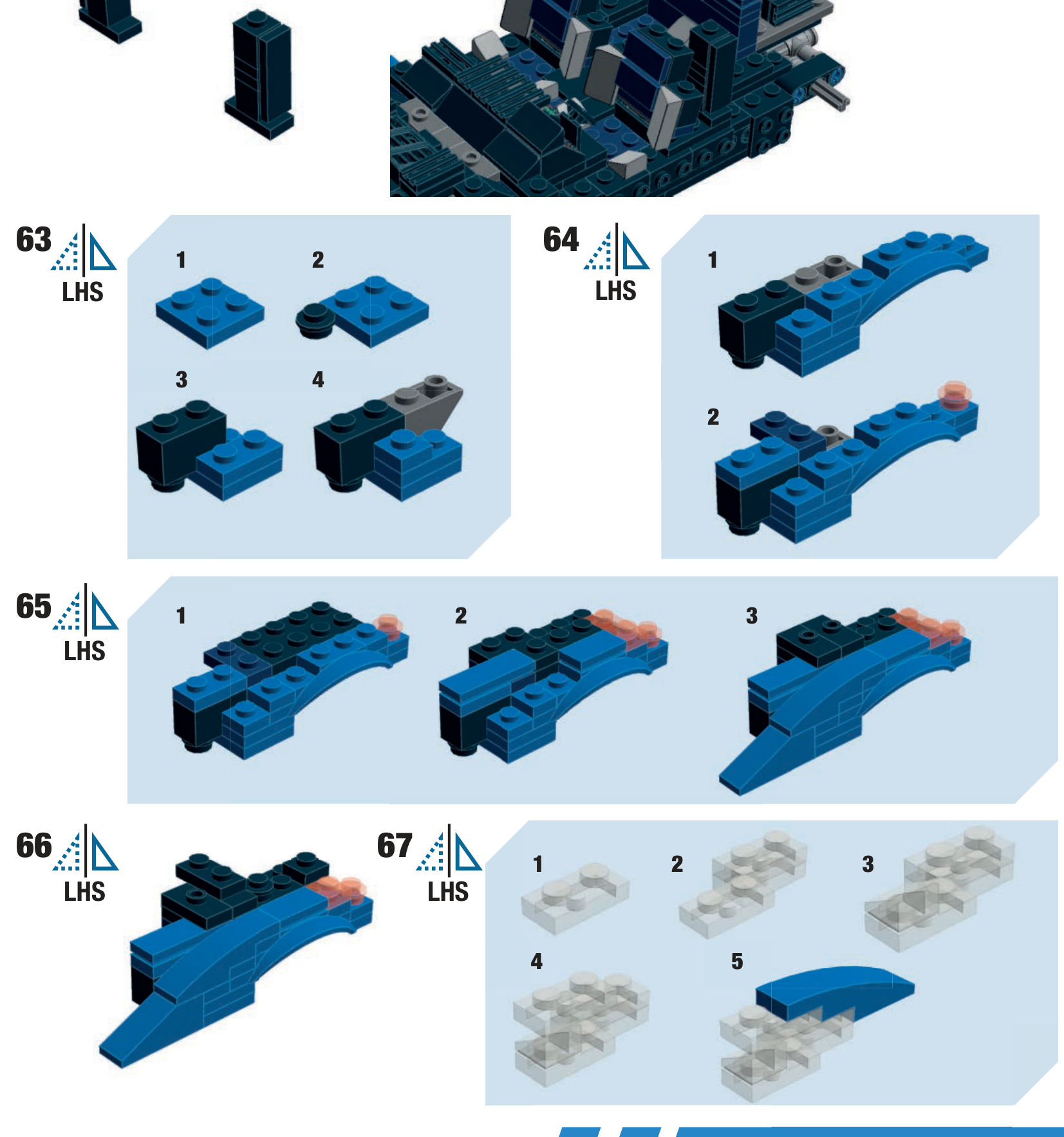
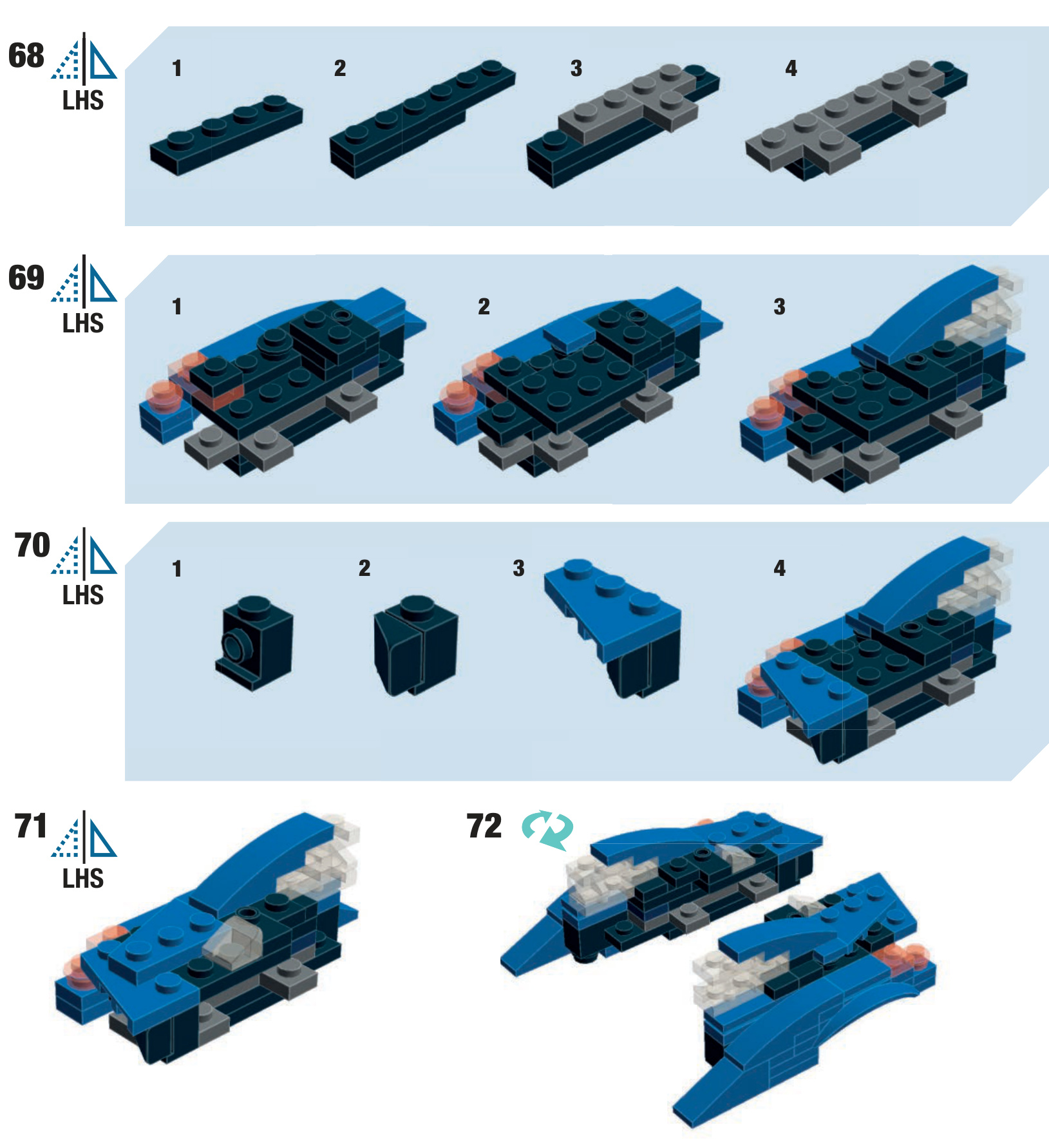
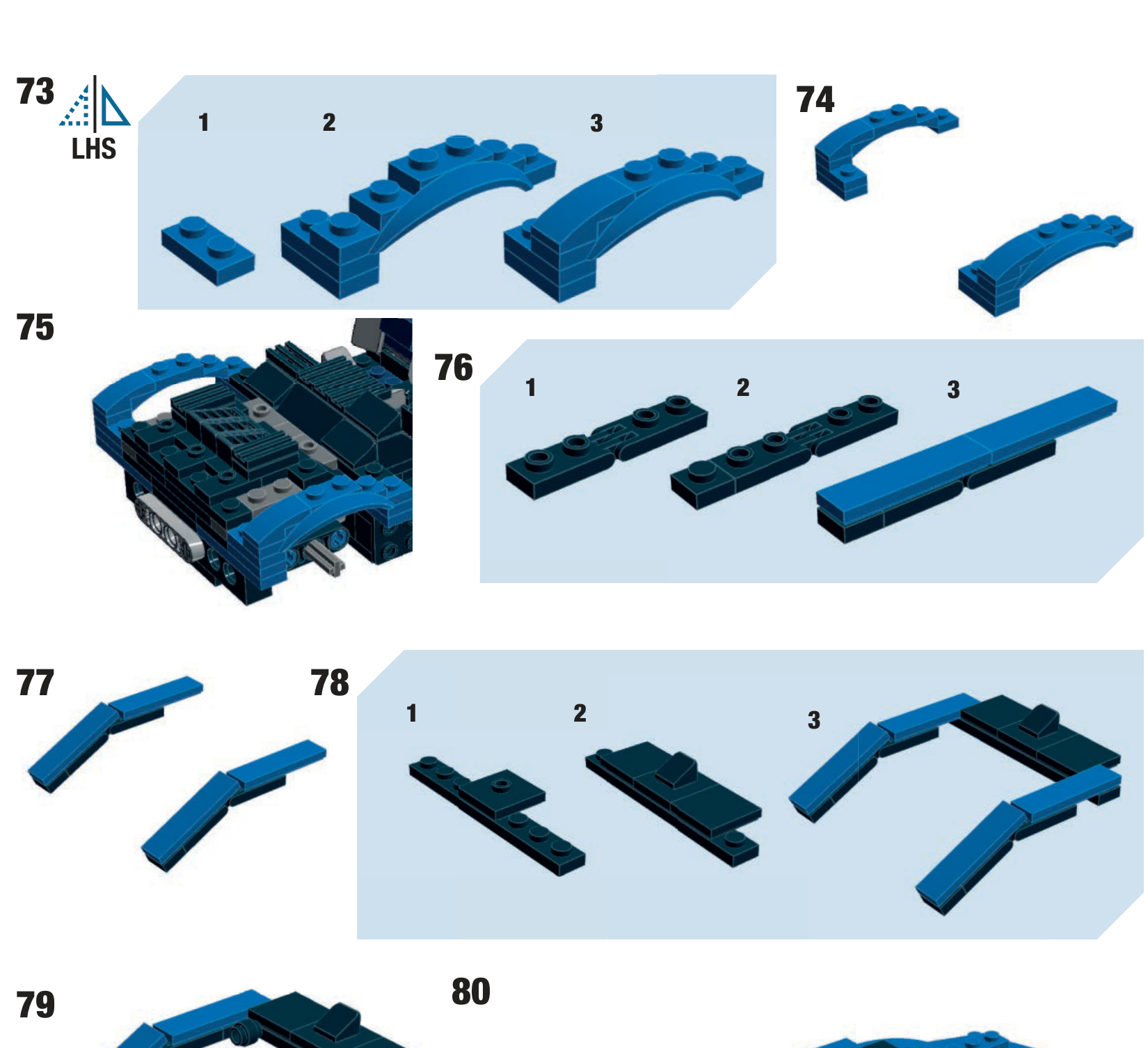
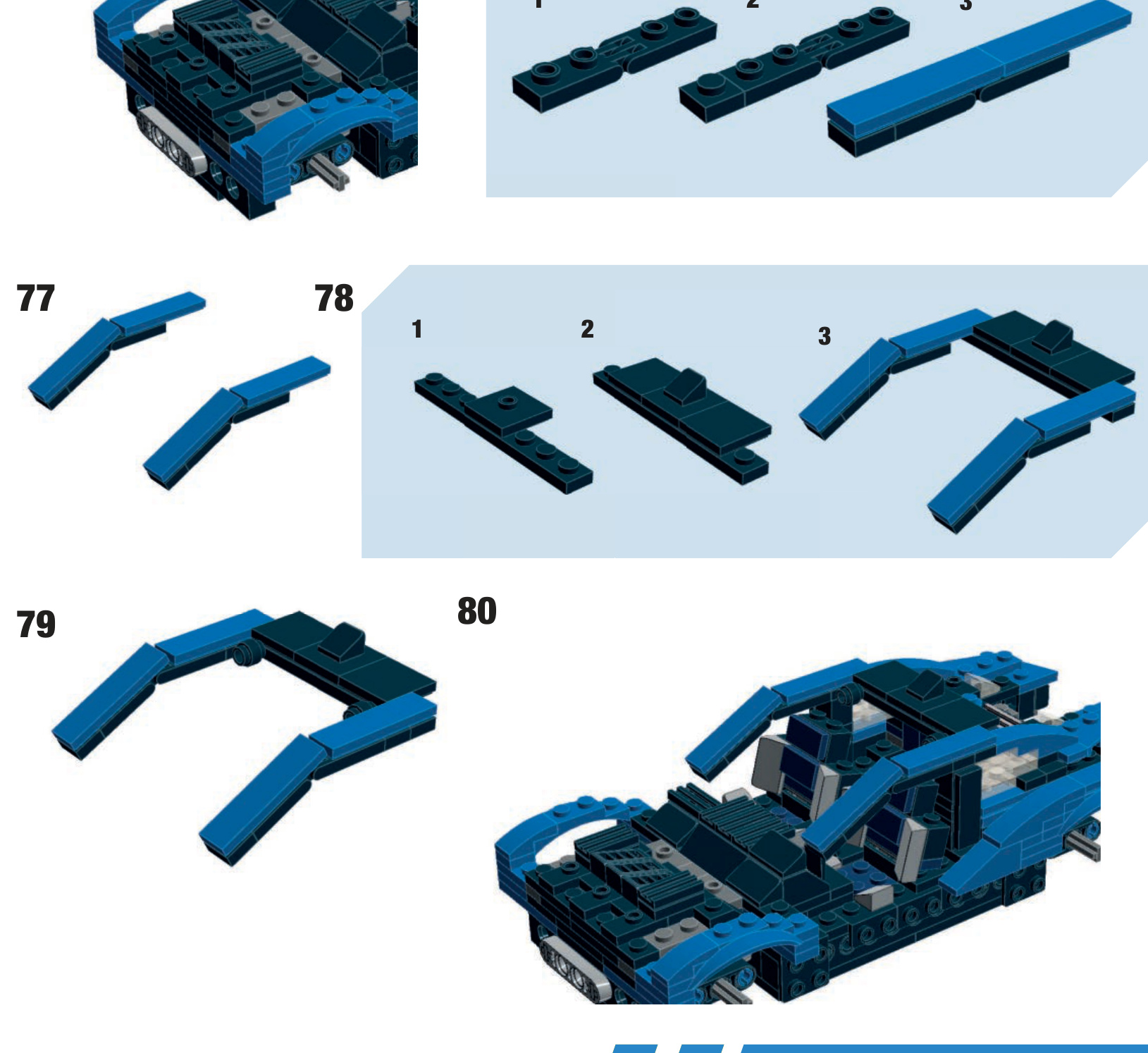
P O R S C H E
911 CARRERA 2.7 RS
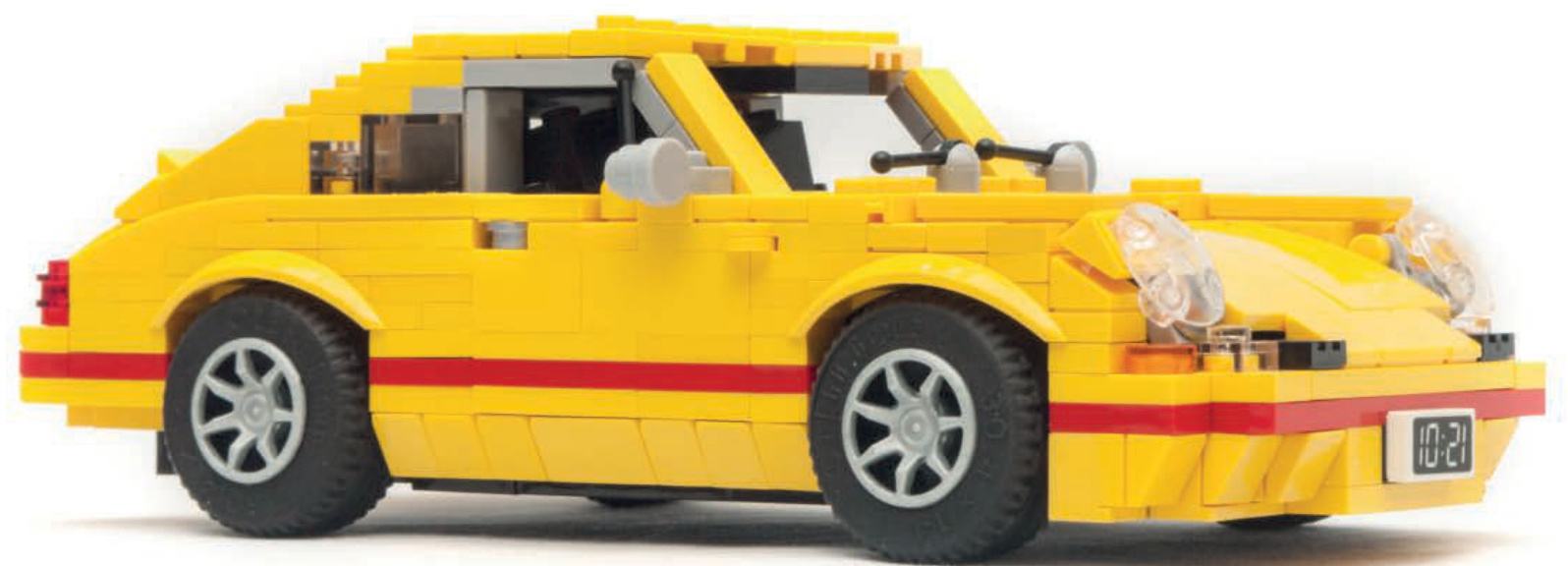
T hbecPaoursechiteh9a1s1bheaesn tphreodmuocsetd-rceocnotginiuzaelldy sfrpo rmts1c9a6r3stilohtoudeattyea—ndpartly longitudinally behind the rear axle. The shape was an evolution of the earlier 356 model. The new distinction for the 2.7 RS was the addition of the small “ducktail” spoiler mounted to the engine cover.
Ten years of continued evolution led to the most coveted of collector 911s, the 1973 RS. This model had the perfect blend of poise and performance. The car was a lightweight at 2,150 lb. (975 kg), making the most of the 2.7L engine’s output of 210 hp (155 kW). The Carrera 2.7 RS was built by Porsche to homologate the car for FIA Group 4 racing (fve hundred units required). The car derived its name from the Carrera Panamericana, a famous road race through Mexico where racing Porsches had many victories during the 1950s.
Further evolution of the 2.7 RS occurred in 1974 with the RSR—the engine gained another 121 cc (to 2.808L), producing 300 hp .
COUNTRY OF ORIGIN: Germany PRODUCTION: 1973 NUMBER MADE: 1,580 LAYOUT / DRIVE: Rear engine / Rear-wheel drive ENGINE: 2.7L, 6 cylinders, horizontally opposed POWER / TORQUE: 210 hp (155 kW) / 188 lb-ft (255 Nm) CONSTRUCTION / DOORS: Monocoque / 2 doors
From 1974 onward, all 911 road cars gained US-style impact bumpers, adding weight, and though the engines increased in capacity, emission regulations reduced power output and response. The 1973 2.7 RS is considered the fnest of the breed.
Porsche intended to replace the 911 with water-cooled, front-engined models, notably the luxurious V-8 grand tourer Porsche 928 of 1977, but fo many enthusiasts, the 911 was the Porsche. The classic 911 shape remained until the Porsche 996–generation model 911 in 1998.
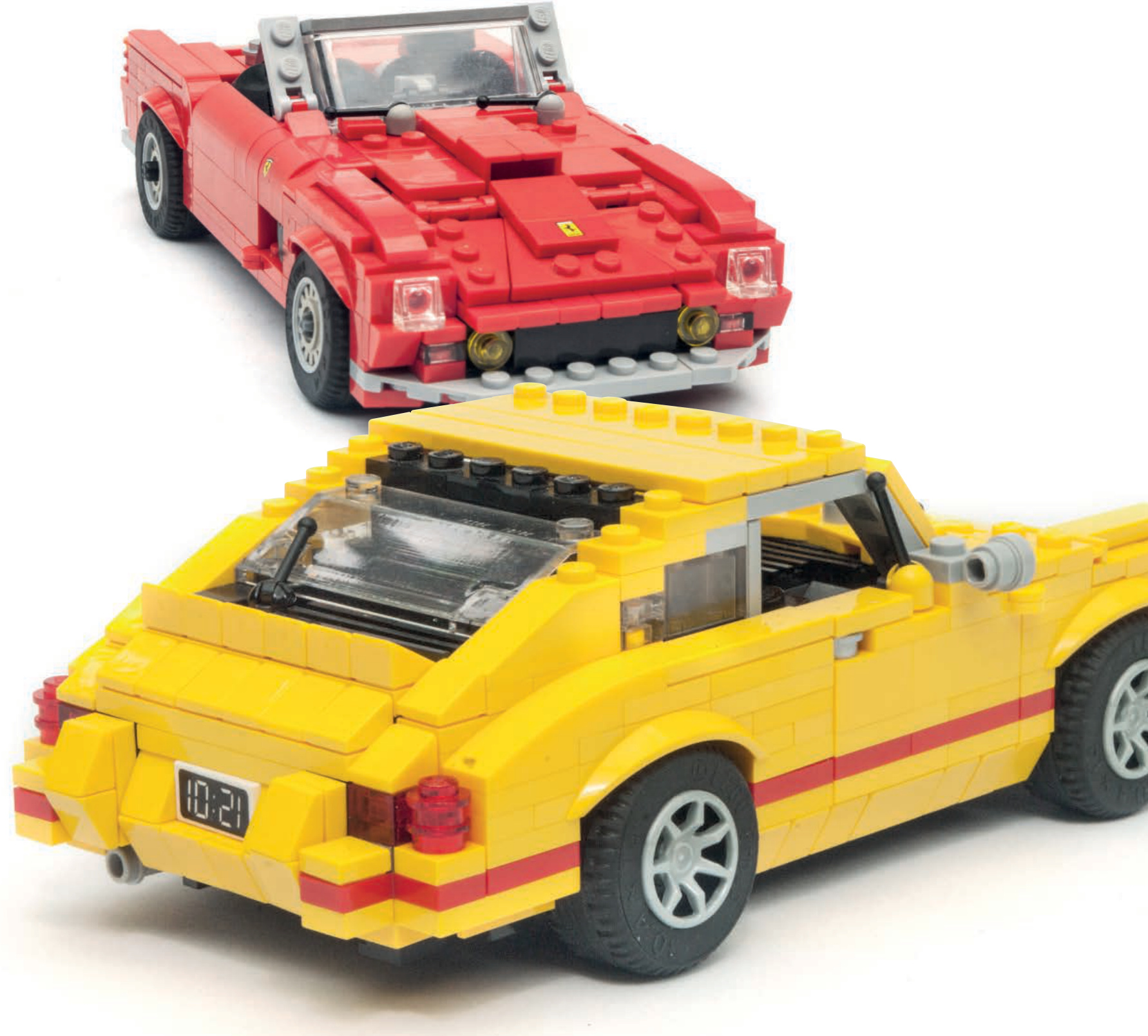
This model can also be built in the folowing colors: Number of parts: 442
SECTION 3
ADVANCED
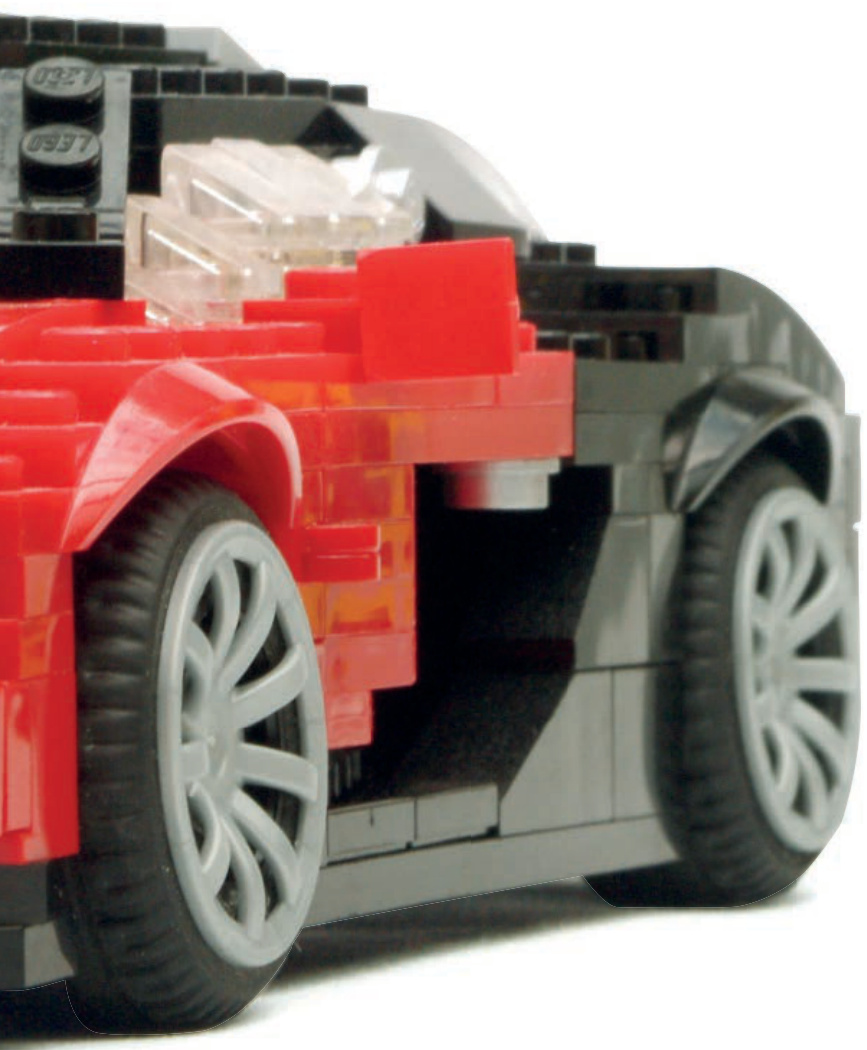
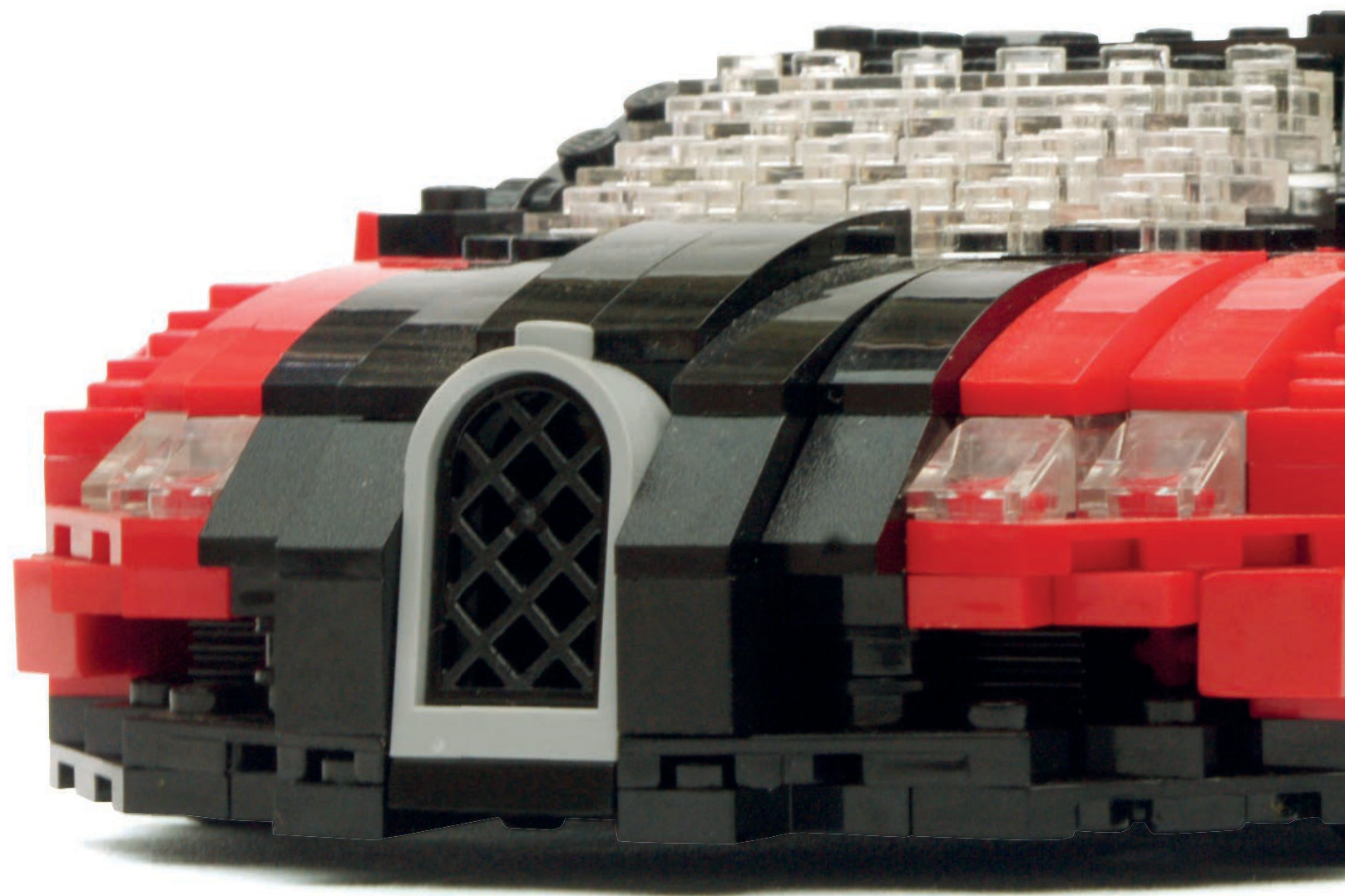
T his is the fast end of the book—serious machines with serious performance. Along with their shape, performance cars are known for their powertrain performance—engines, gearboxes, and axles. The Plymouth Hemi ’Cuda sported plenty of performance for the money, a big engine wrapped up in budget clothes that made for a wild, wild ride. In complete contrast, the Bugatti Veyron provides the last word in vehicle complexity—16 cylinders, four turbochargers, 4-wheel drive, advanced electronics, and active aerodynamic spoilers.
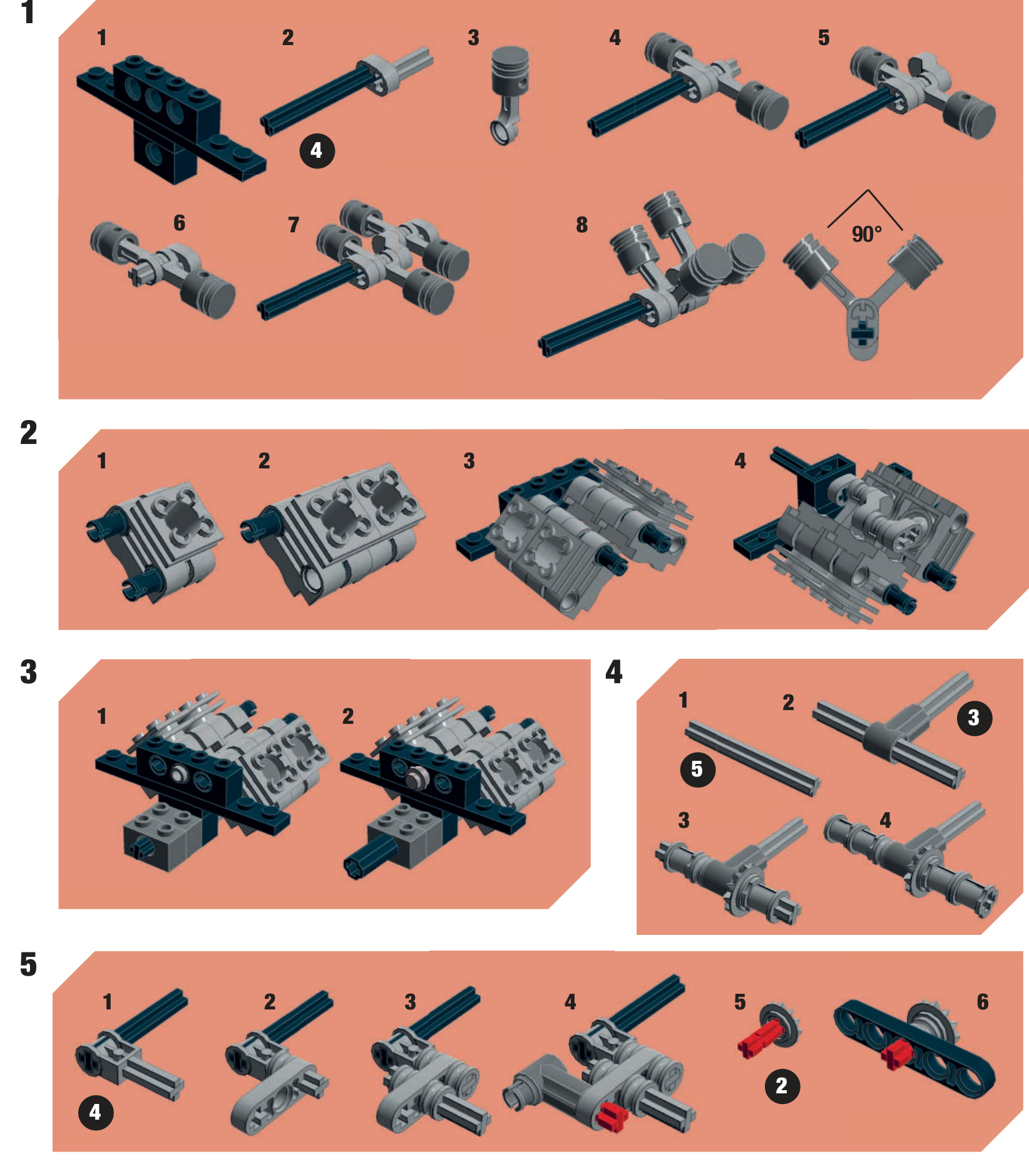
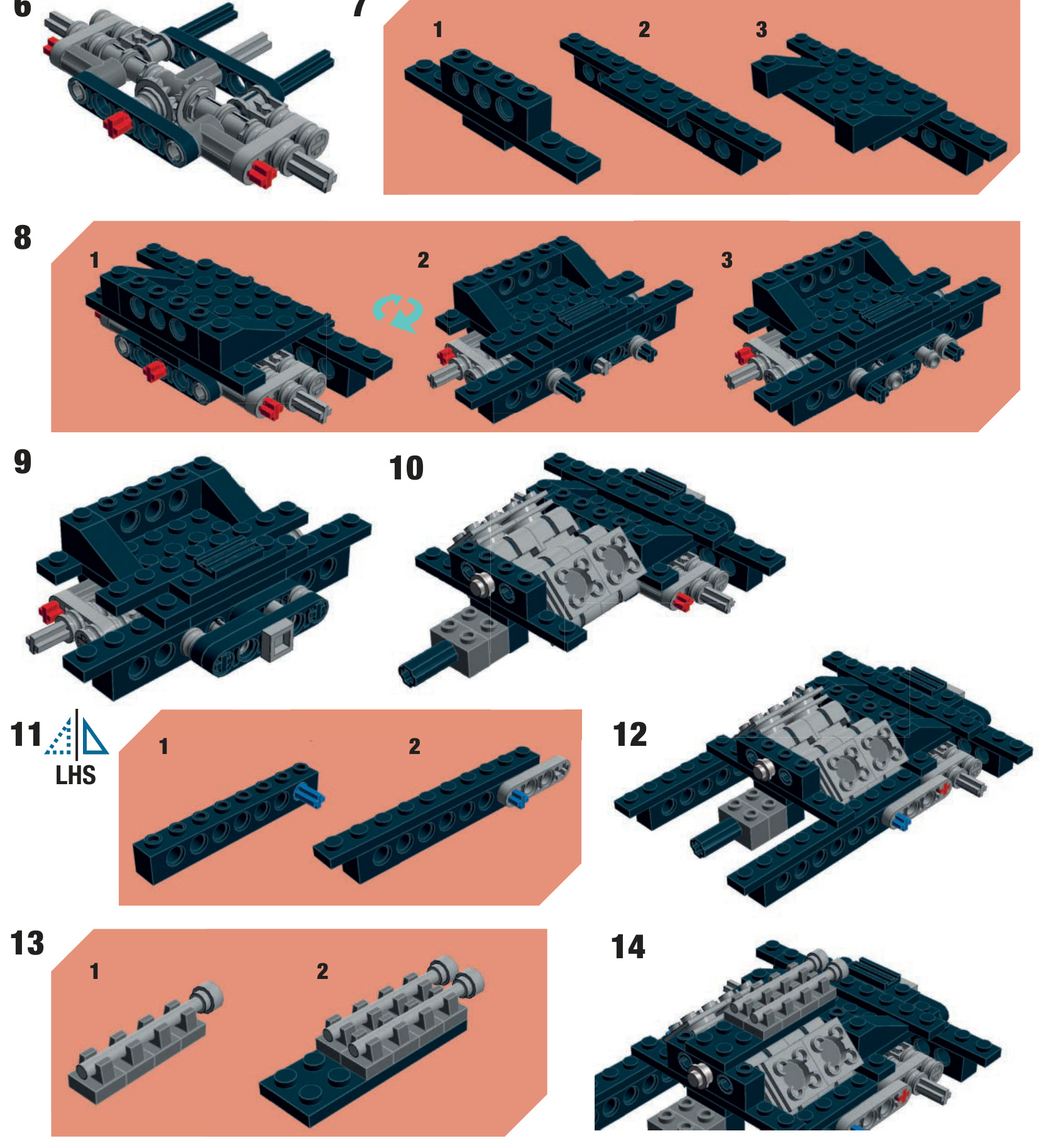
These models are again presented in Miniland scale but include much more detailed chassis and engines, utilizing Technic theme parts. As you assemble these models, you will even experience constructing major systems as they exist in the real cars. These are the functioning internal mechanical parts that are wrapped up in iconic bodywork.
Once the models from this book are completed, you should feel free to expand and develop the techniques further in the building of your own advanced brick cars.
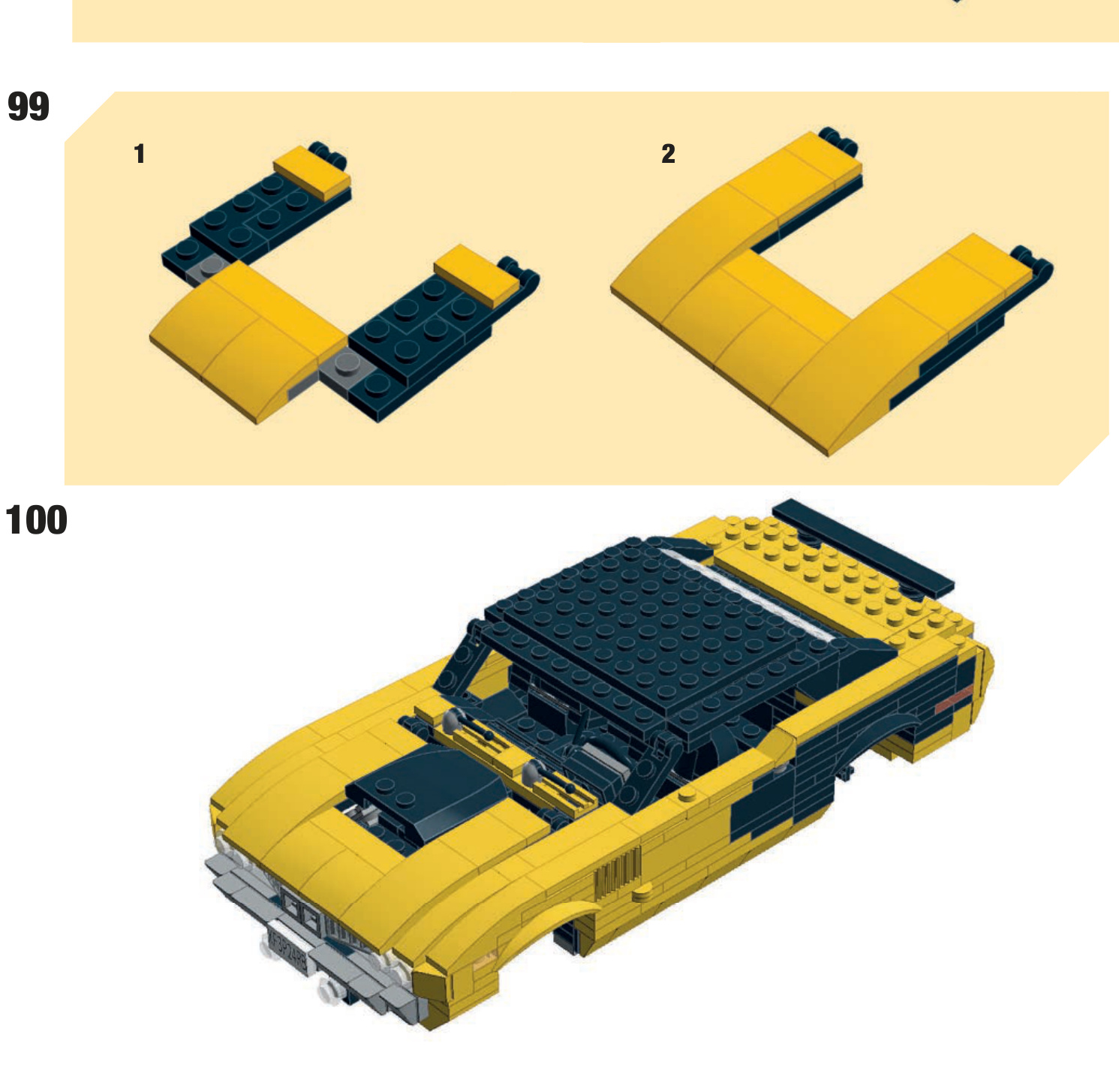
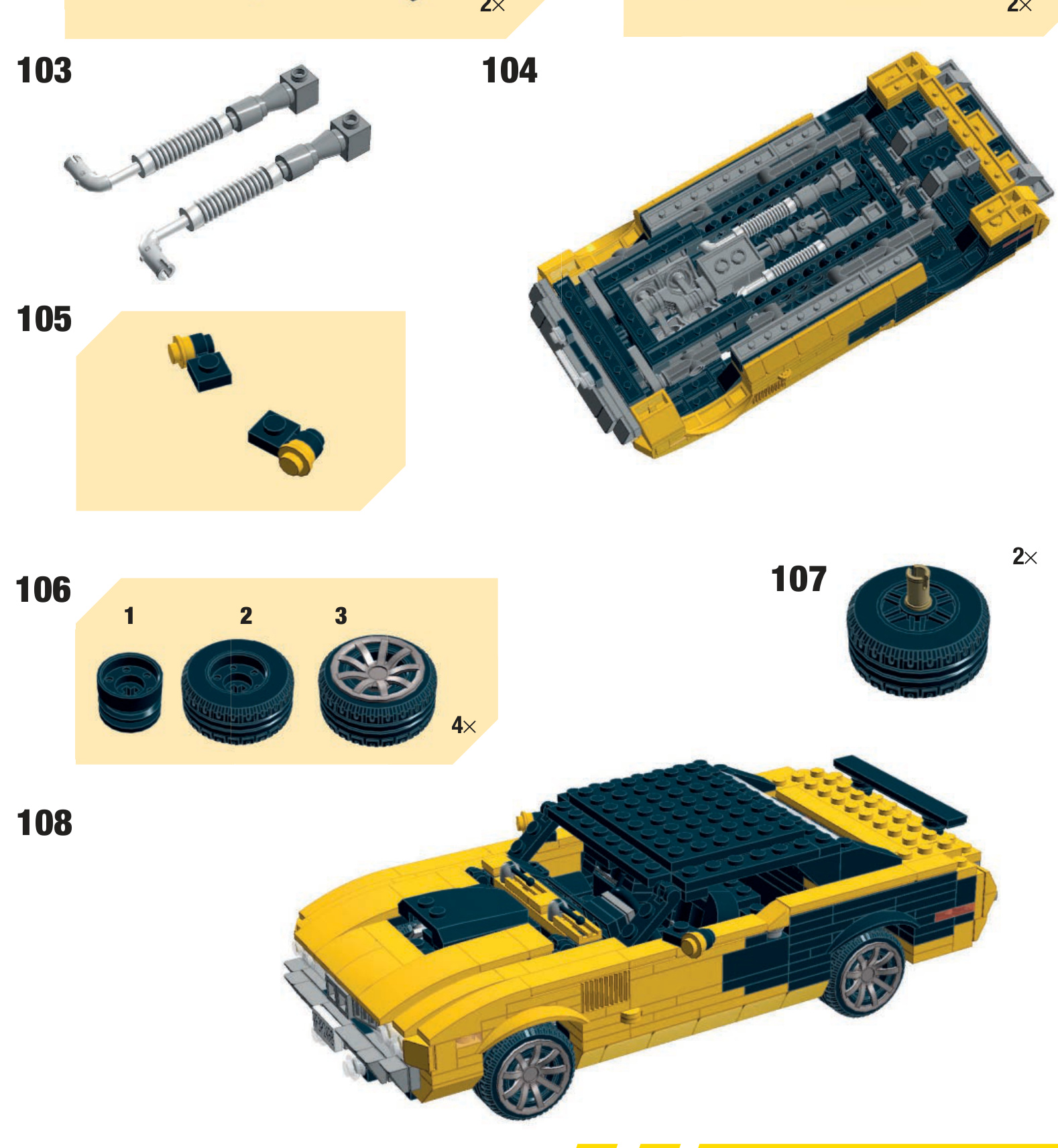
1971 PLYMOUTH HEMI ’CUDA
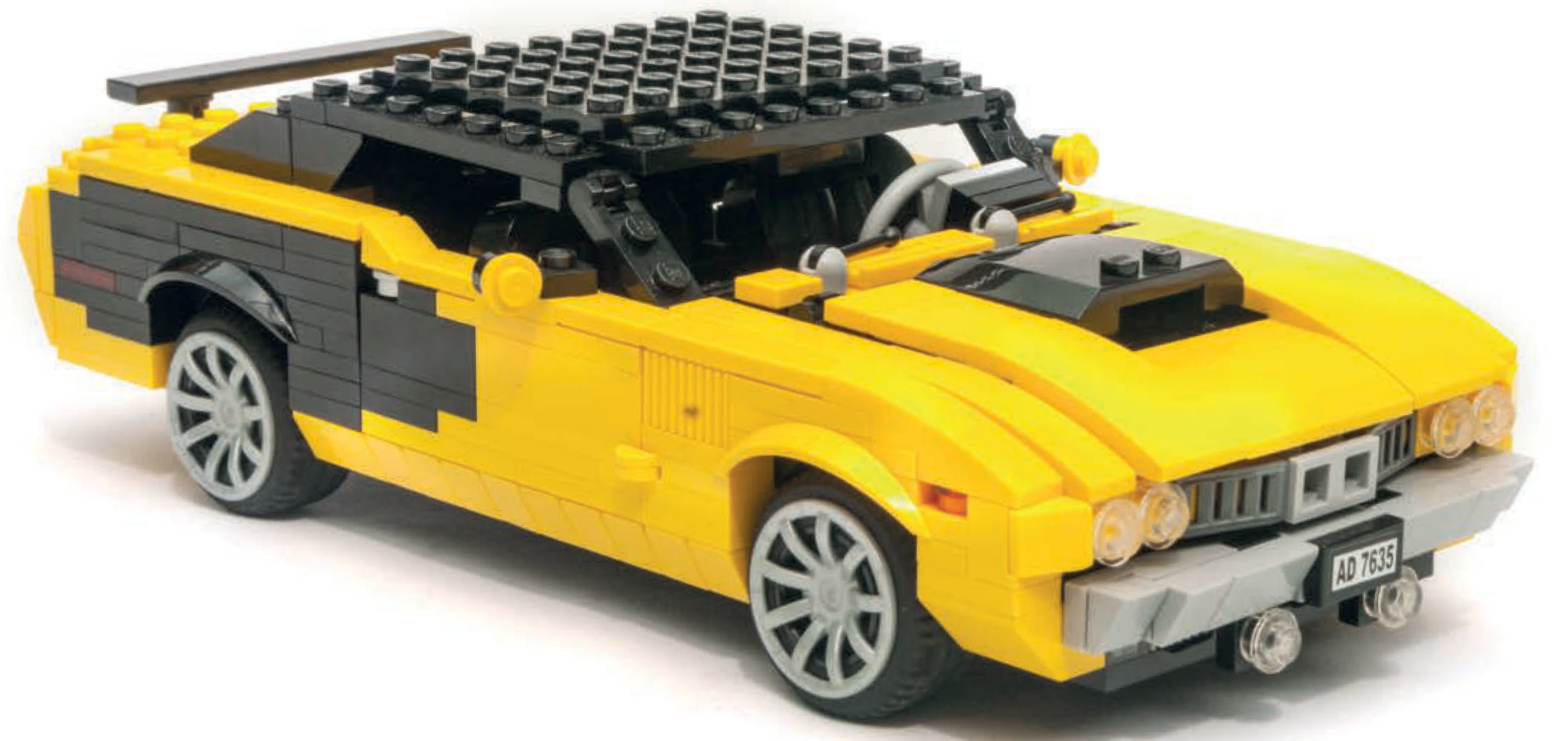
he muscle car era was one of the automobile industry’s golden eras.
The formula was simple: small car, big engine.
This was all relative, of course. Even the US compacts were very large cars from the perspective of Europeans and the Japanese. The engine was not a relative measure—the V-8 ftted to the Plymouth shown was a mighty 7.0L at the time when American engines were measured in cubic inches—426 to be exact. And a feature of the engine formed part of the car’s name Hemi—short for hemispherical combustion chambers, a method for achieving high compression ratio and large valve diameters.
’Cuda was just a shortened form of Barracuda, the offcial name of the car on which this model is based. Most Barracudas were a bit less wild than the Hemi version, with various engines of 3.2L to 7.2L capacity. For afcionados, though, the Hemi model is the real deal—perhaps even the greatest of all muscle cars. Coupes and a much more rare convertible were available, and the rarity of such cars is elevating the current market value— a 1971 Hemi ’Cuda convertible, one of eleven cars, sold for a staggering \3.5$ million in 2014.

COUNTRY OF ORIGIN: USA PRODUCTION: 1971 NUMBER MADE: 16,159 (108 Hemis) LAYOUT/DRIVE: Front engine / Rear-wheel drive ENGINE: 426 cid (6,981 cc), 8 cylinders, V POWER / TORQUE: 424 bhp (317 kW) / 490 lb-ft (664.35 Nm) CONSTRUCTION / DOORS: Unibody / 2-door coupe
To add to the drama, the Hemi ’Cuda was available in a number of wild colors, many of them citrus-toned, with matching groovy names. Yearon-year changes included various special paint schemes, including the black panels on the rear fenders of this car, which match the roof. For 1971, the car adopted twin headlamps, a one-year-only feature. The Hemi was also ftted with a shaker hood, an exposed air intake protruding from the hood—the intake “shakes” as the engine reacts to the mighty torque loads.
Alas, all golden eras must come to an end, and this one was brought down by insurance premiums, unleaded fuel, and vehicle emissions standards. For this reason, bona-fde muscle car legends remain the poster child for high-octane-fueled dreams.
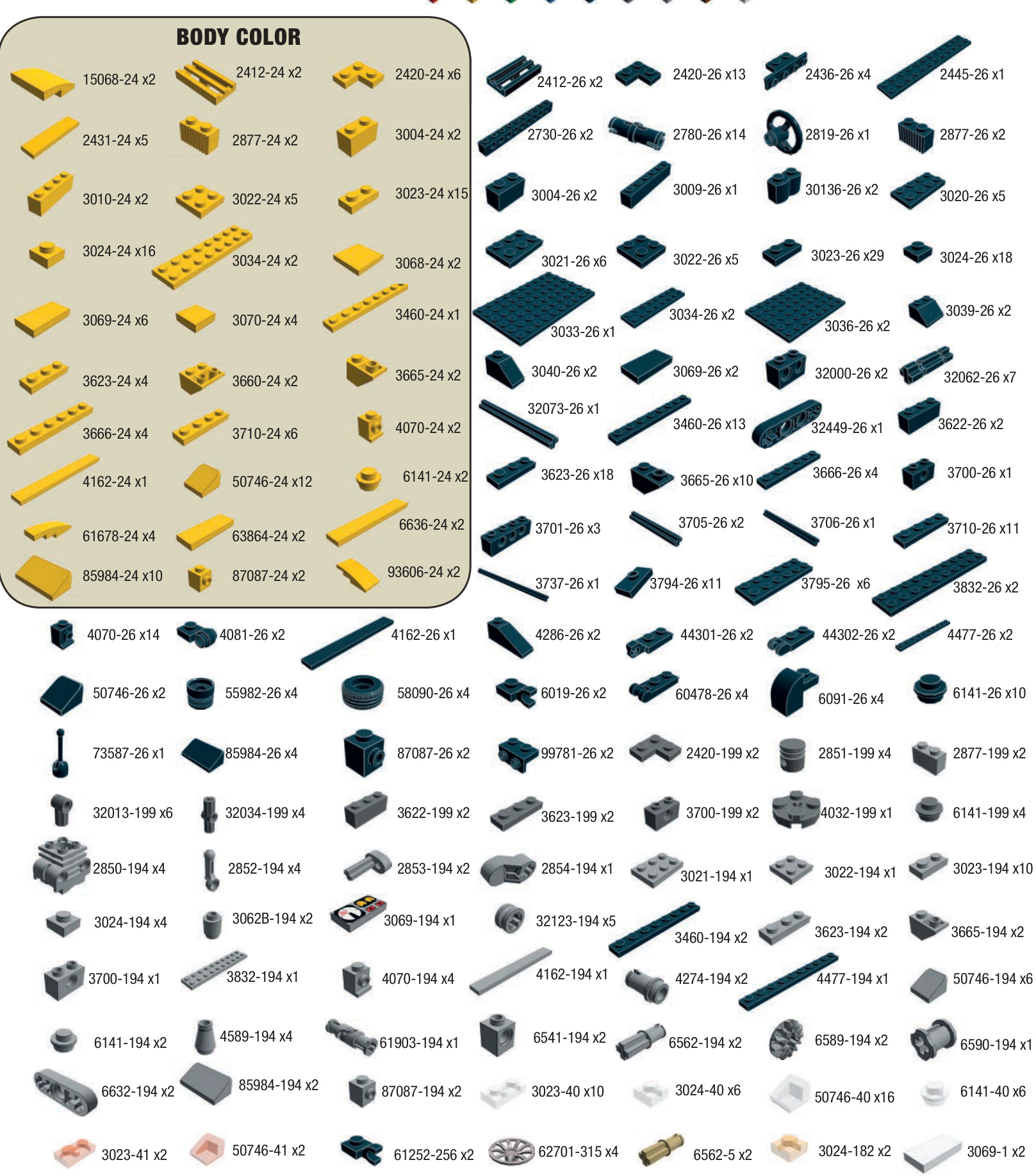
This model can also be built in the folowing colors:
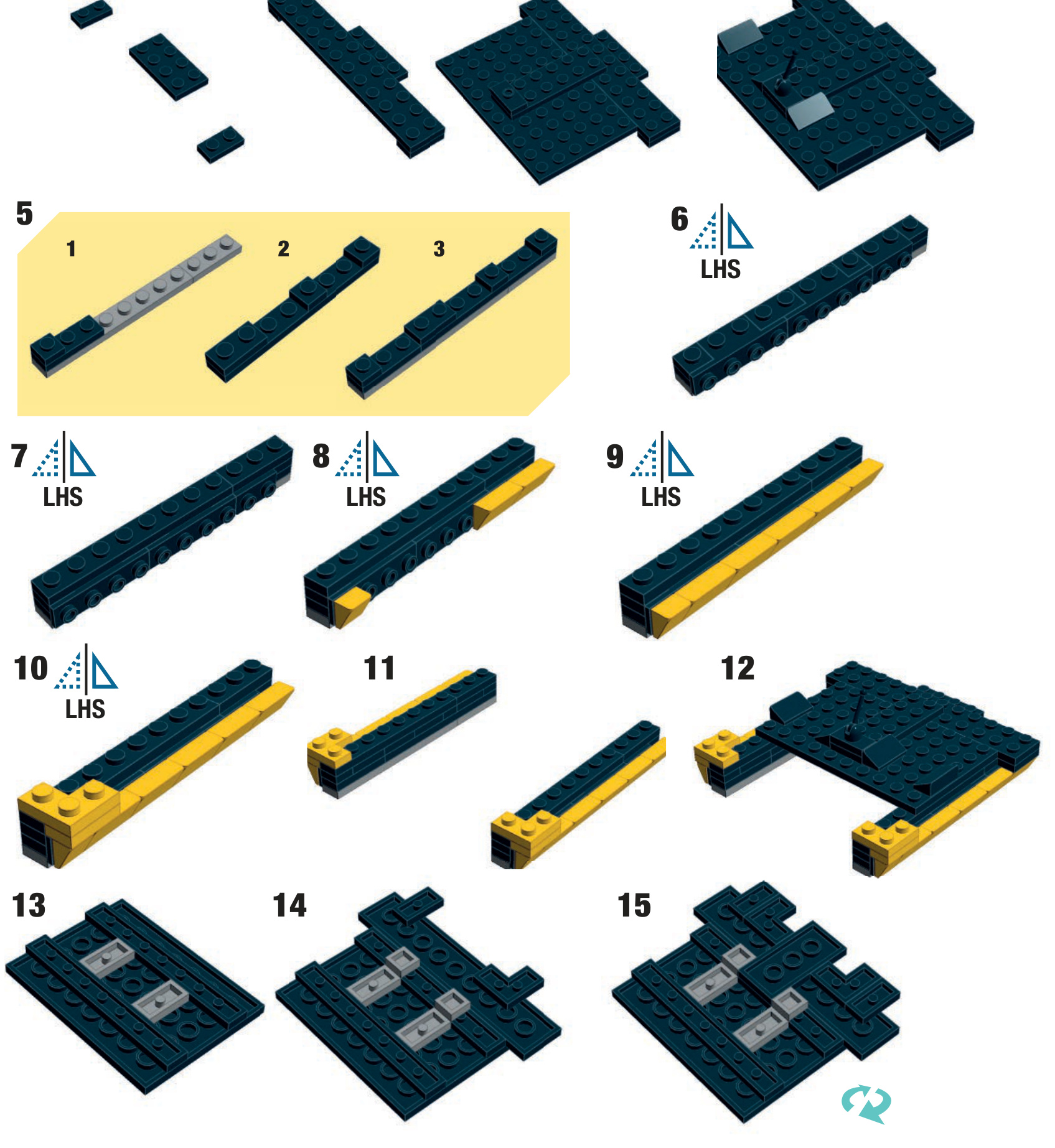
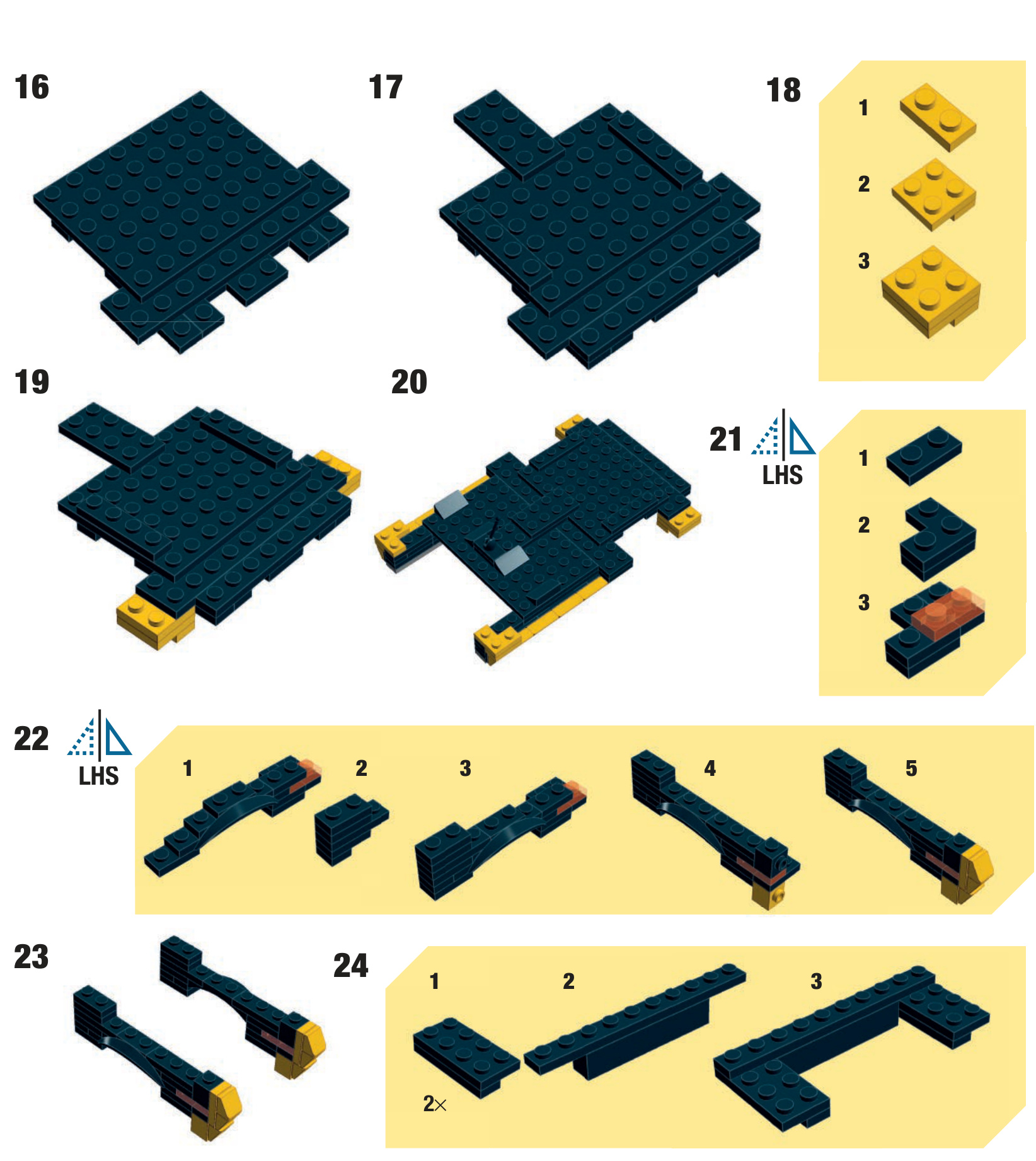
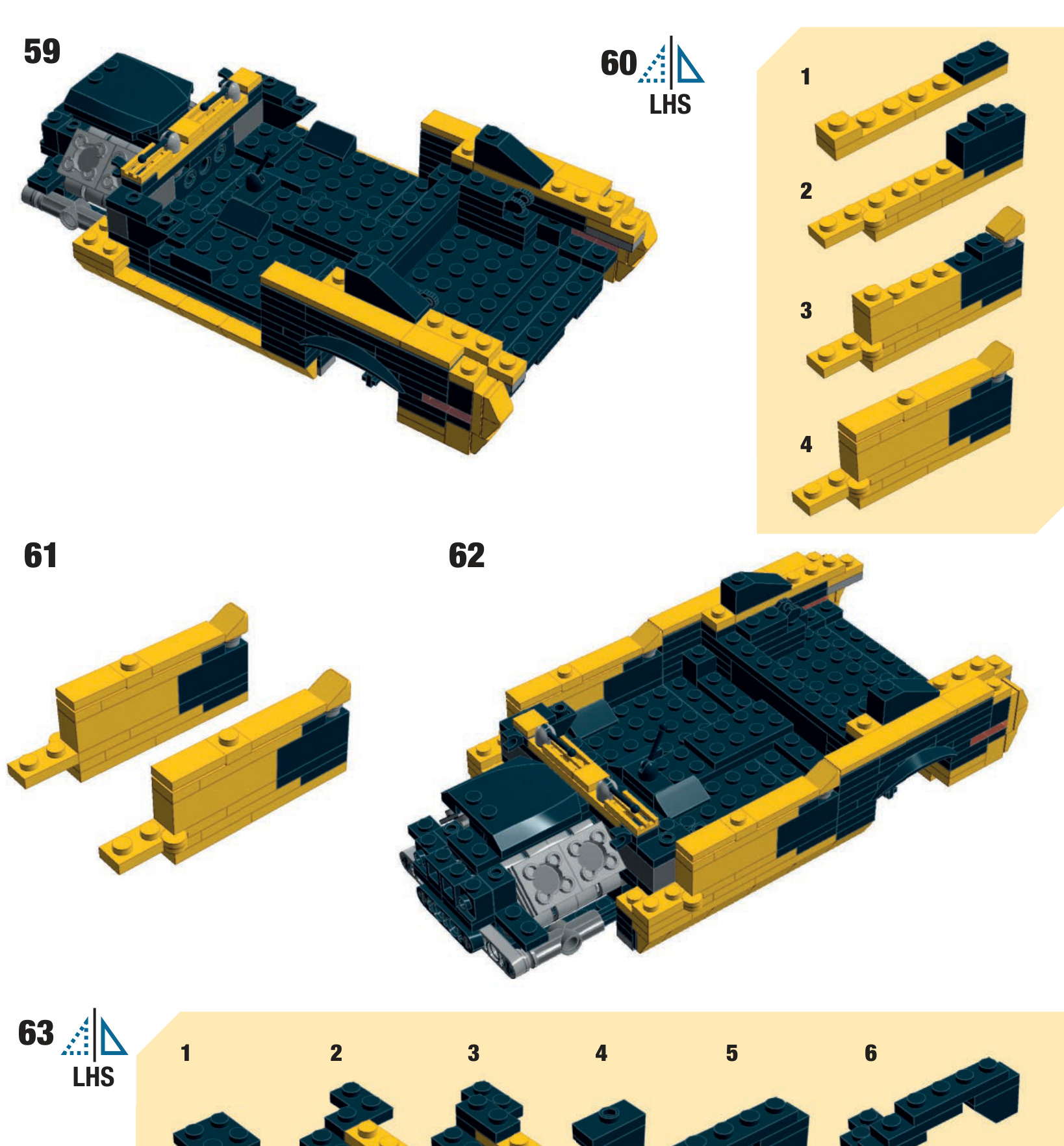
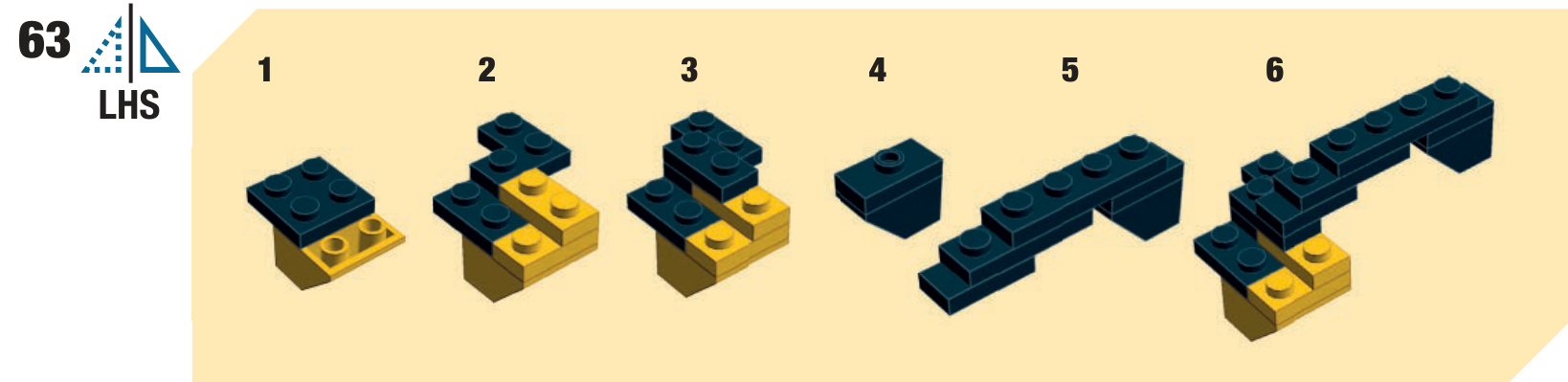
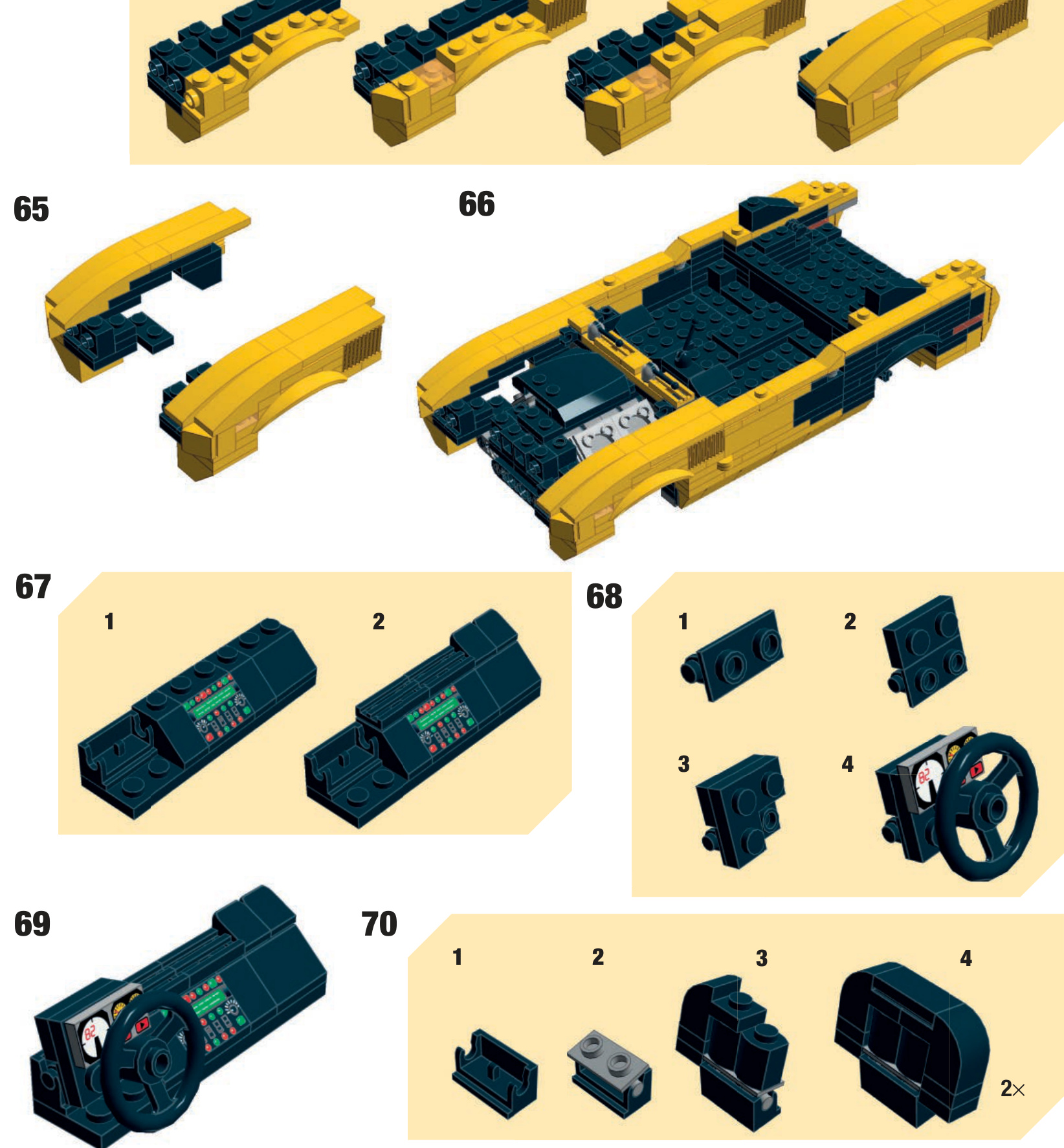
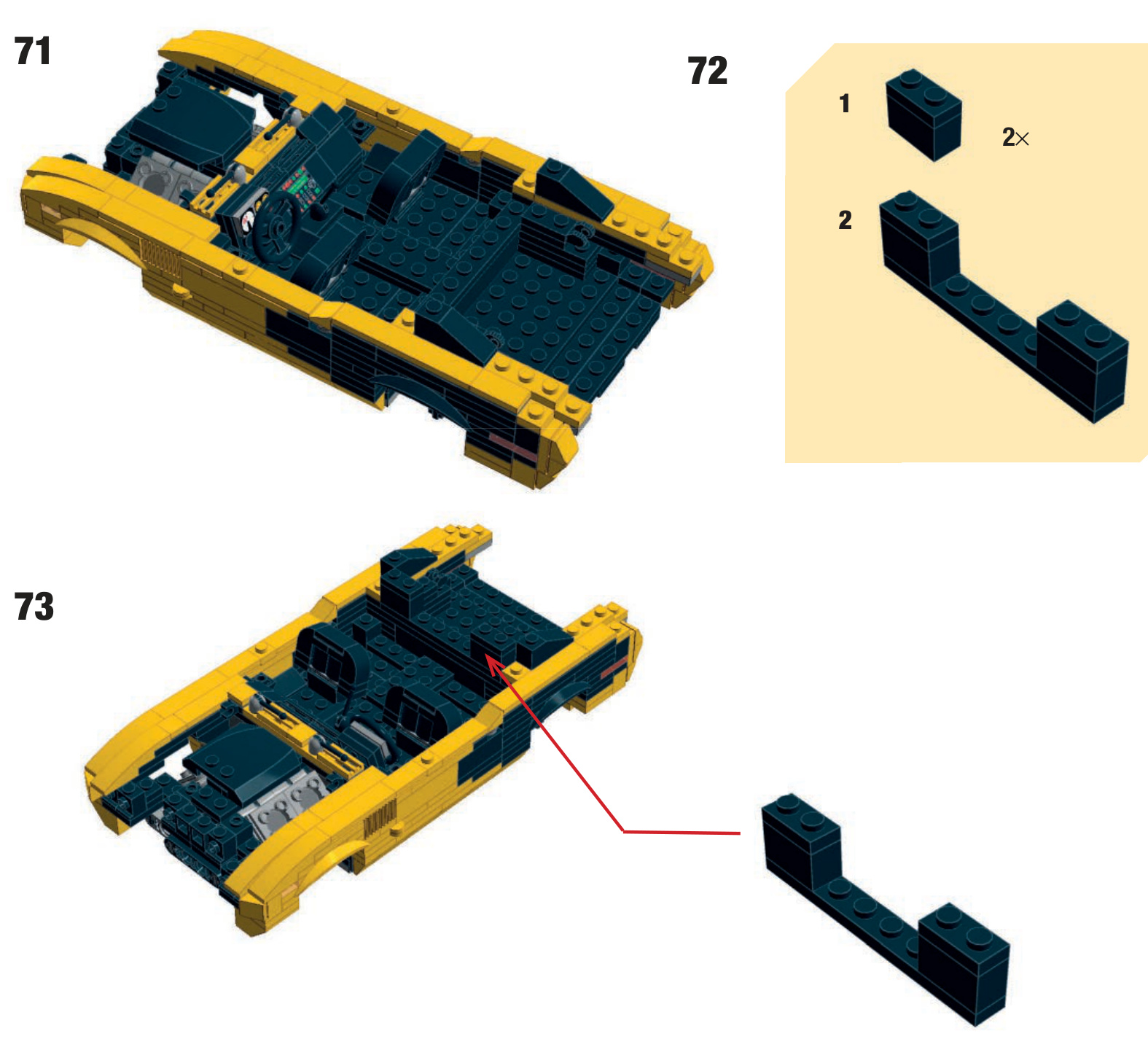
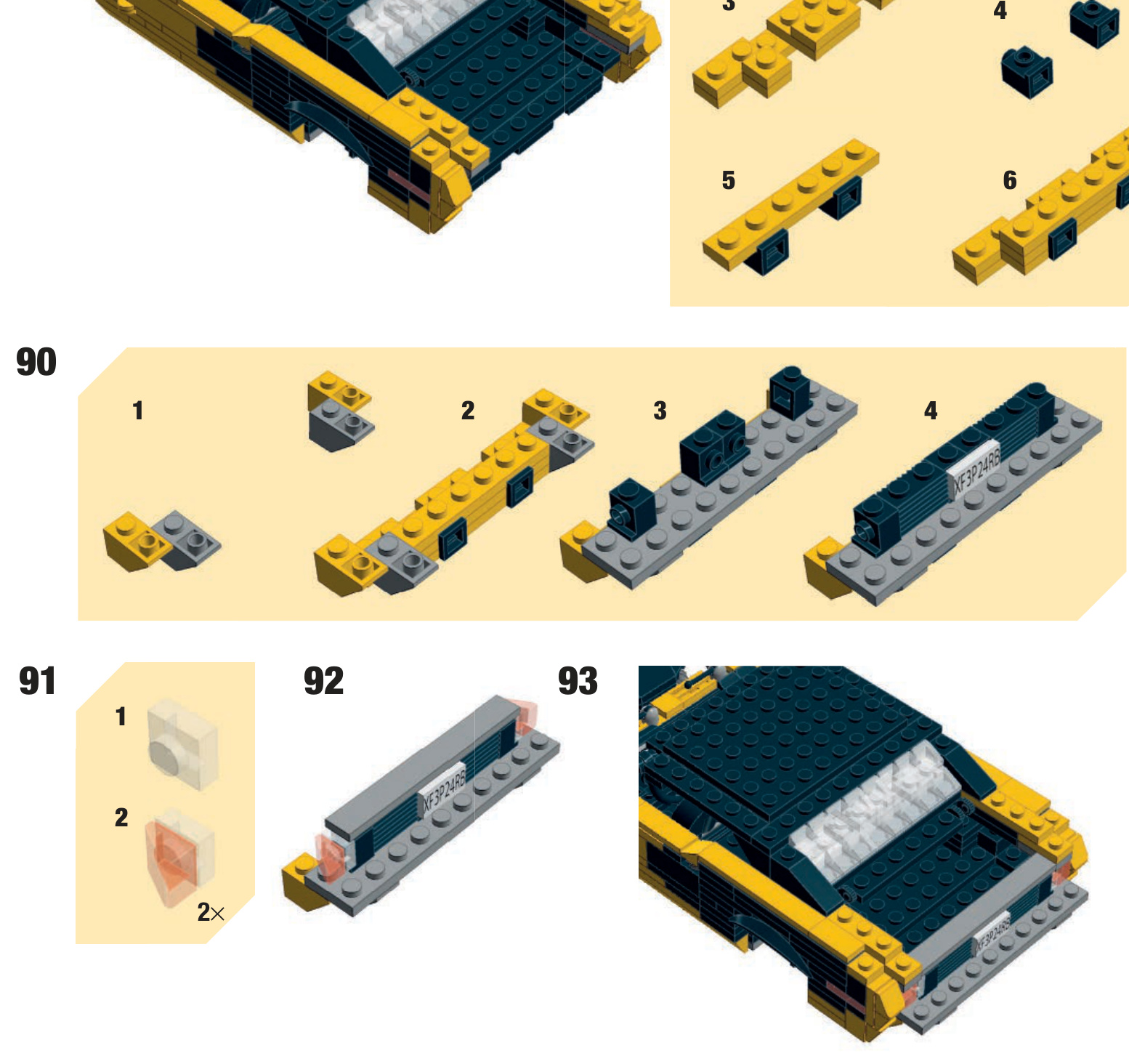
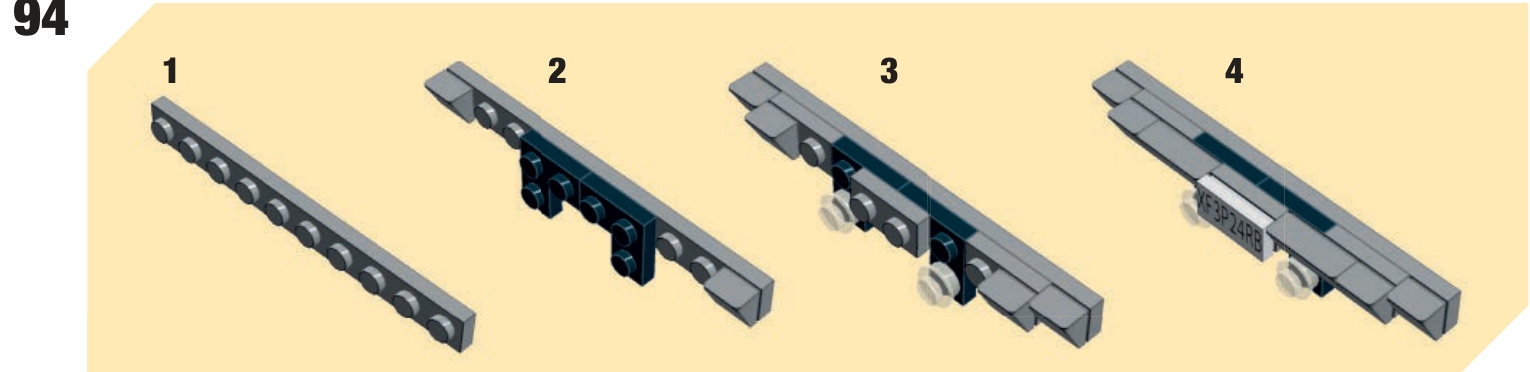
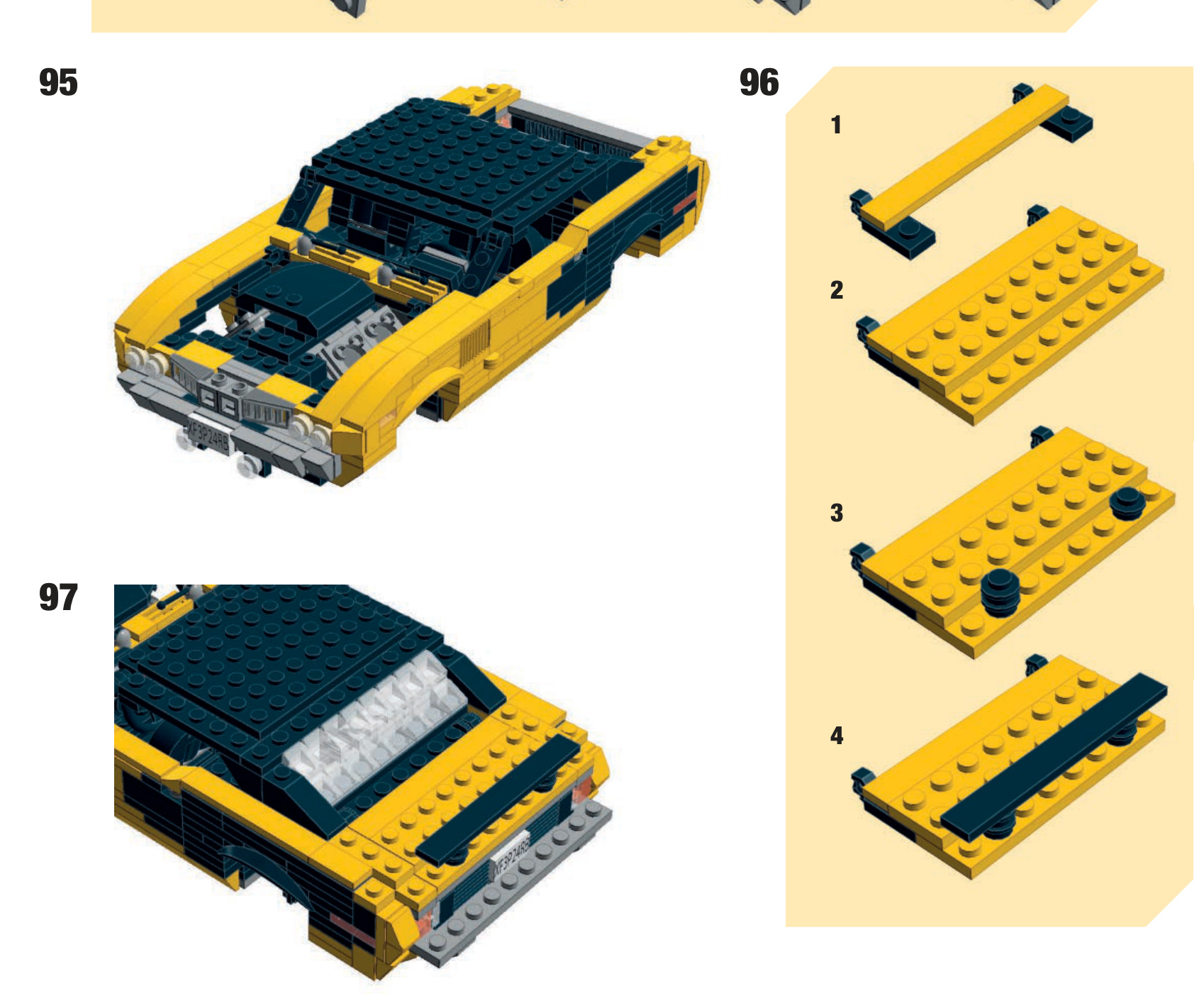
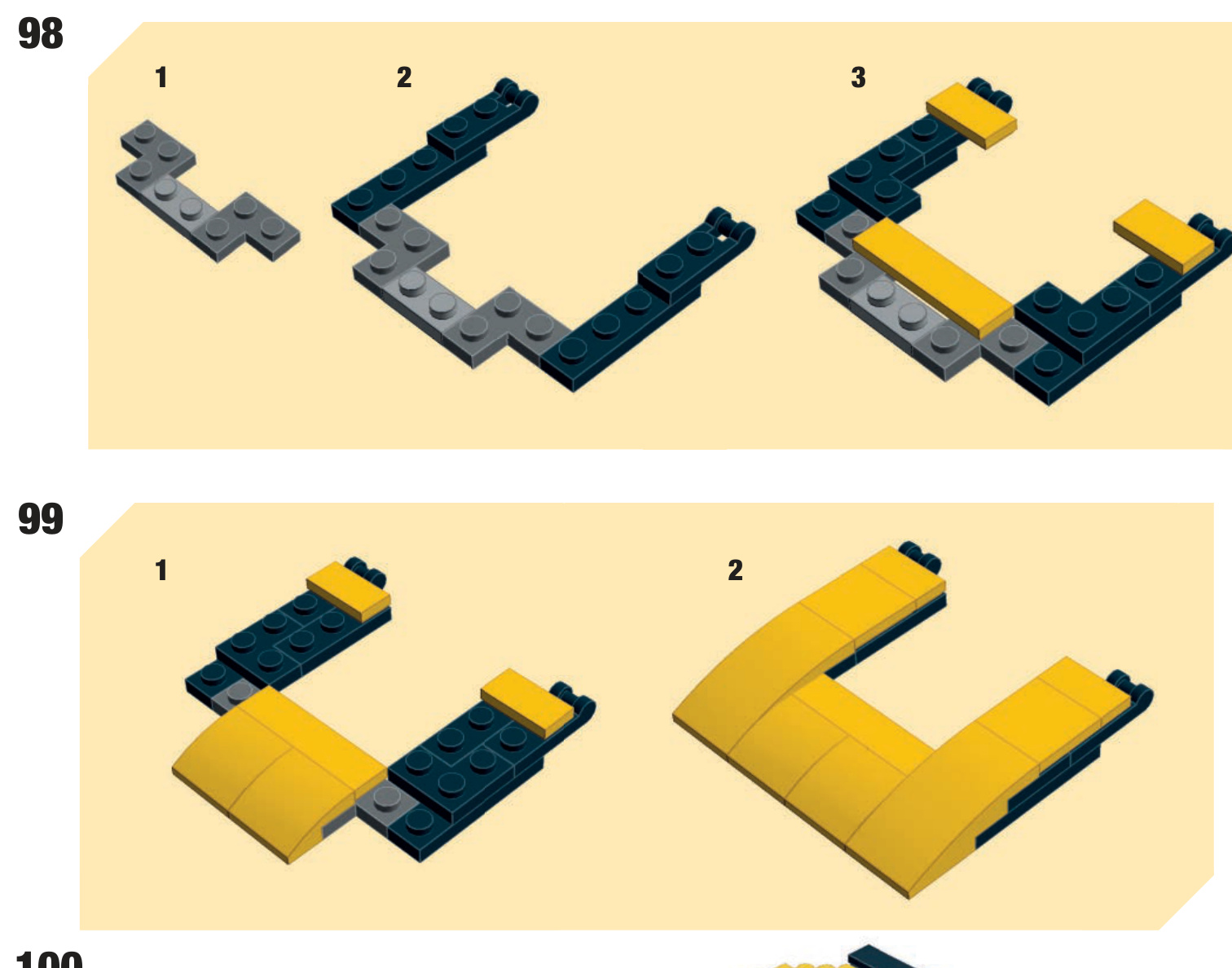
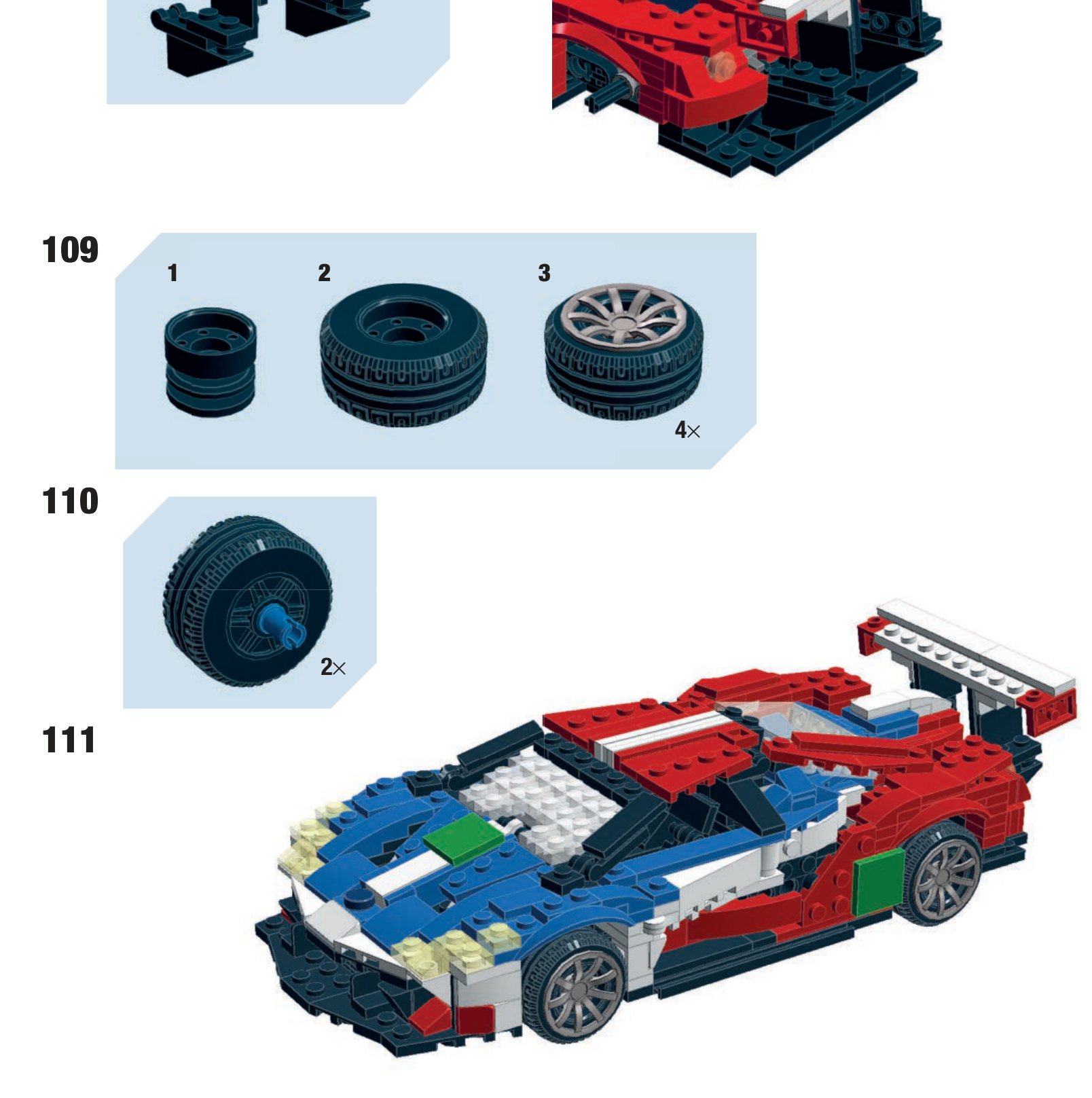
2016 FORD
GT Le MANS RACER
n the early 1960s, Henry Ford II courted Ferrari for the opportunity to purchase the company ahead of other automotive rivals. Ferrari had reportedly been keen on the deal, but Henry Ford II’s offer was rebuffed by Enzo Ferrari due to disagreements over il Commendatore’s desire to maintain directorial control over all of Ferrari’s racing operations.
As grudge matches go, this was a doozy!
The Le Mans endurance race in France had become a Ferrari playground—it won six years straight from 1960 to 1965. Henry Ford II saw this as the place to strike at the heart of Ferrari and set about doing so with a Ford-powered and backed racing car—the GT40. Ford achieved its aim, winning from 1966 to 1969, and Ferrari was forced to sell the road-car business to FIAT while retaining control of the racing team.
In 2015, at the launch of the unexpected Ford GT supercar, the company announced that it would return to Le Mans the following year in celebration of the fftieth anniversary of the 1966 1-2-3 win. Most commentators considered
COUNTRY OF ORIGIN: USA/Canada PRODUCTION: 2015–2016

NUMBER MADE: 4 chassis entered Le Mans 2016 LAYOUT / DRIVE: Mid engine / Rear-wheel drive ENGINE: 3.5L EcoBoost, 6 cylinders, V POWER / TORQUE: hp kW) / unspecifed CONSTRUCTION / DOORS: Carbon-fber unibody / 2-door coupe
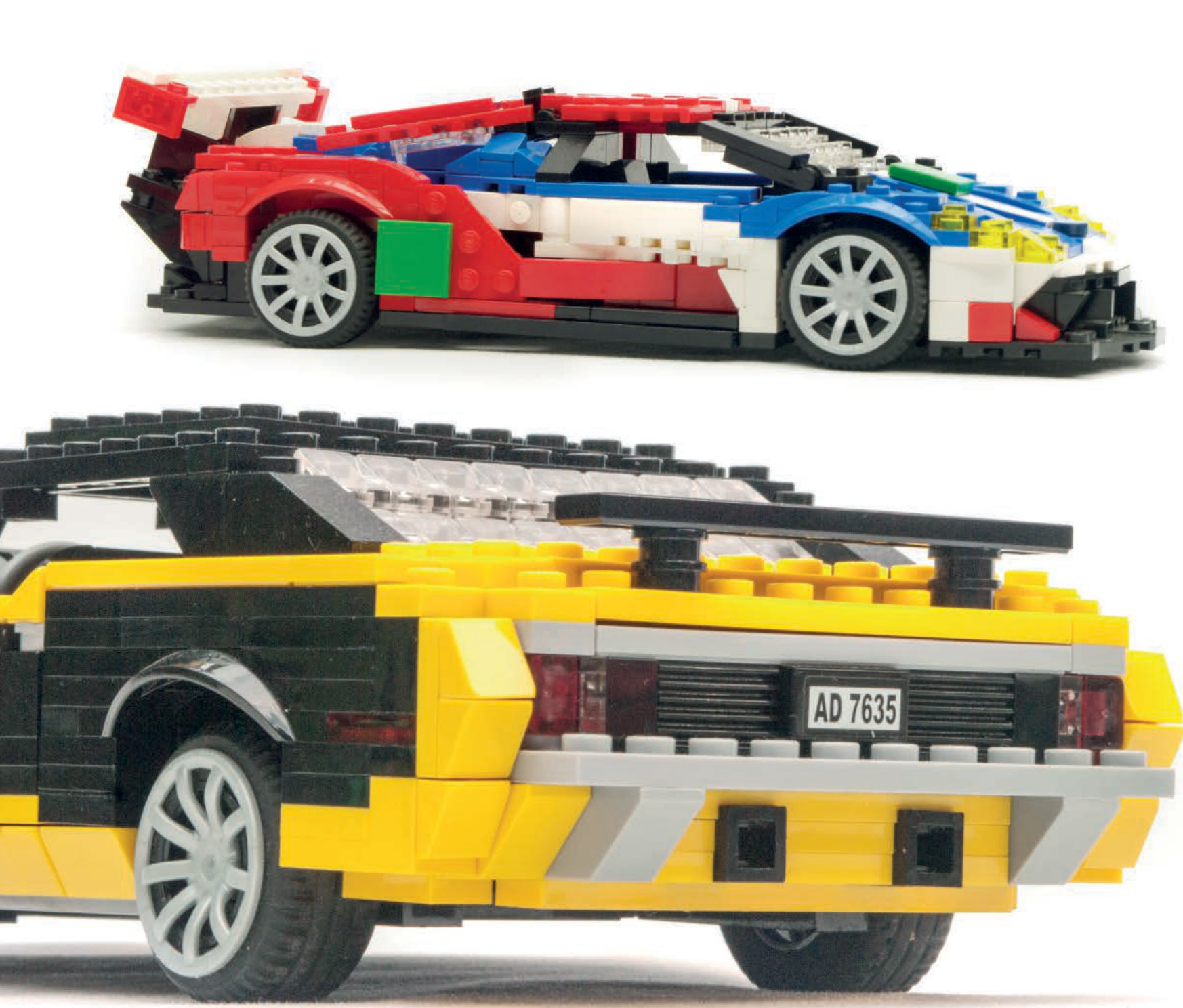
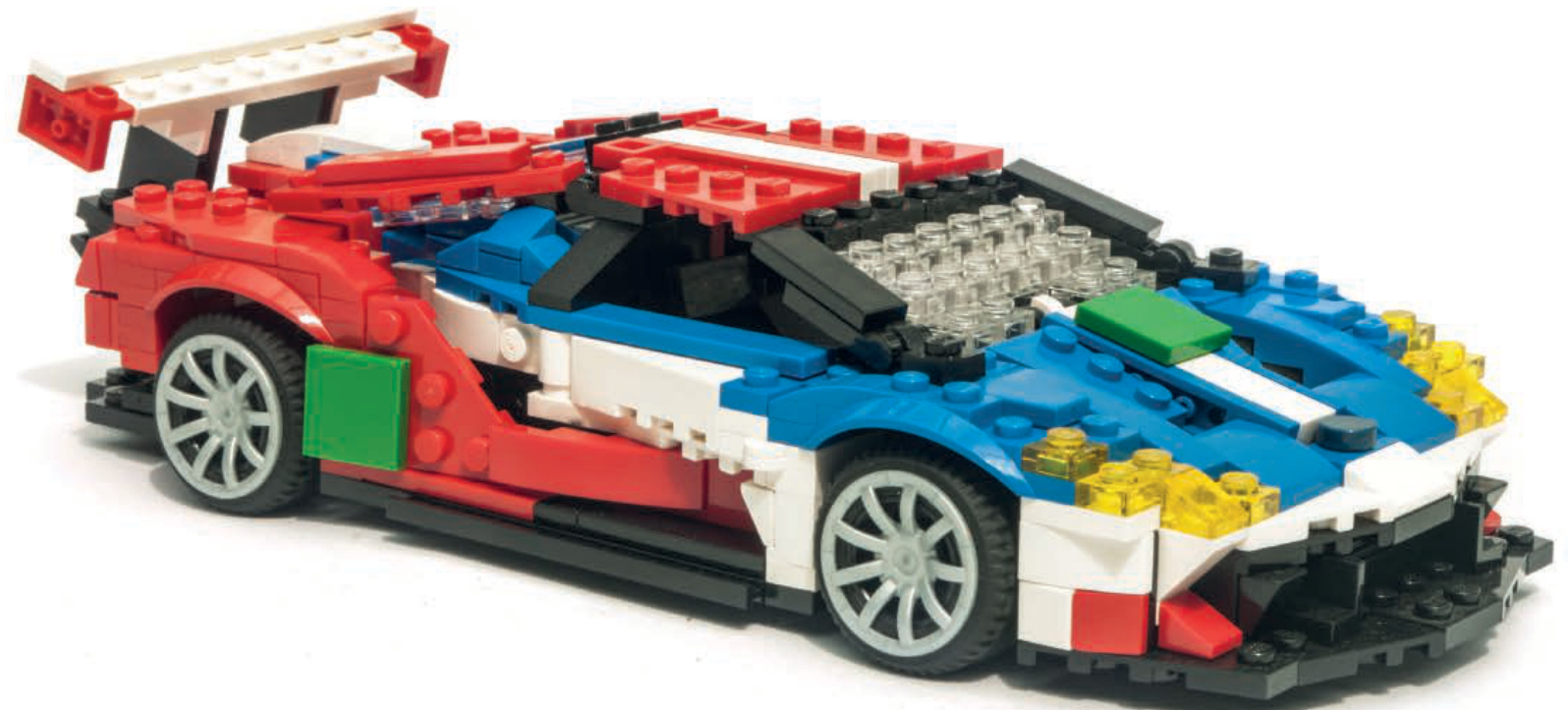
this to be a naïve ambition. Ford had obviously done its homework, selecting endurance-proven production components, including much of the 3.5L EcoBoost V-6 engine, along with robust prep work, and delivered on their promise. The four Ford Chip Ganassi factory team racers placed frst, second, fourth, and ninth in the GTE Pro class.
The GT Le Mans racer is closely based on the limited-volume, road-going vehicle launched as a 2017 model year. A limited number of black and silver Le Mans 50 Year celebration road cars were made available following the 2016 race win.
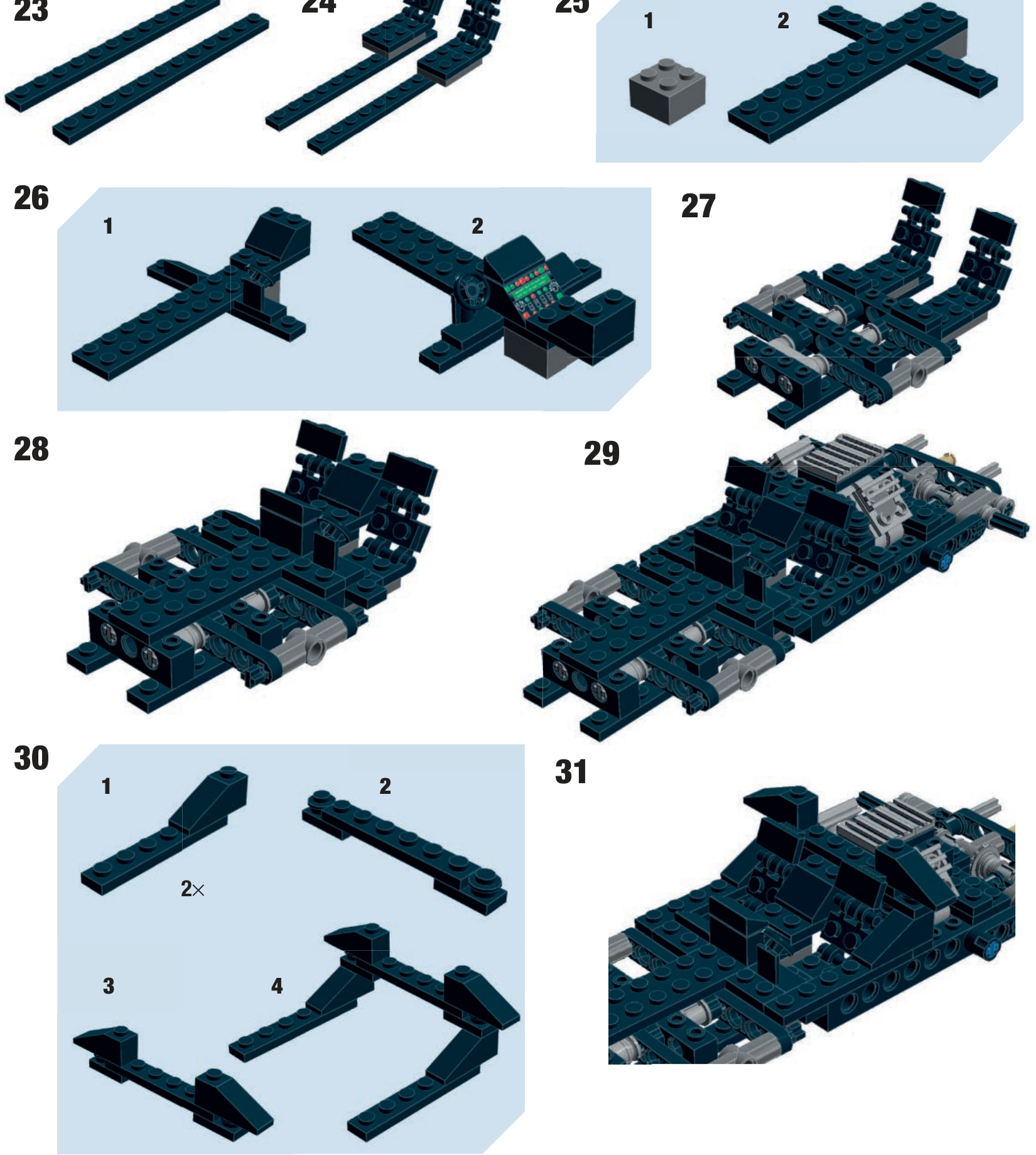
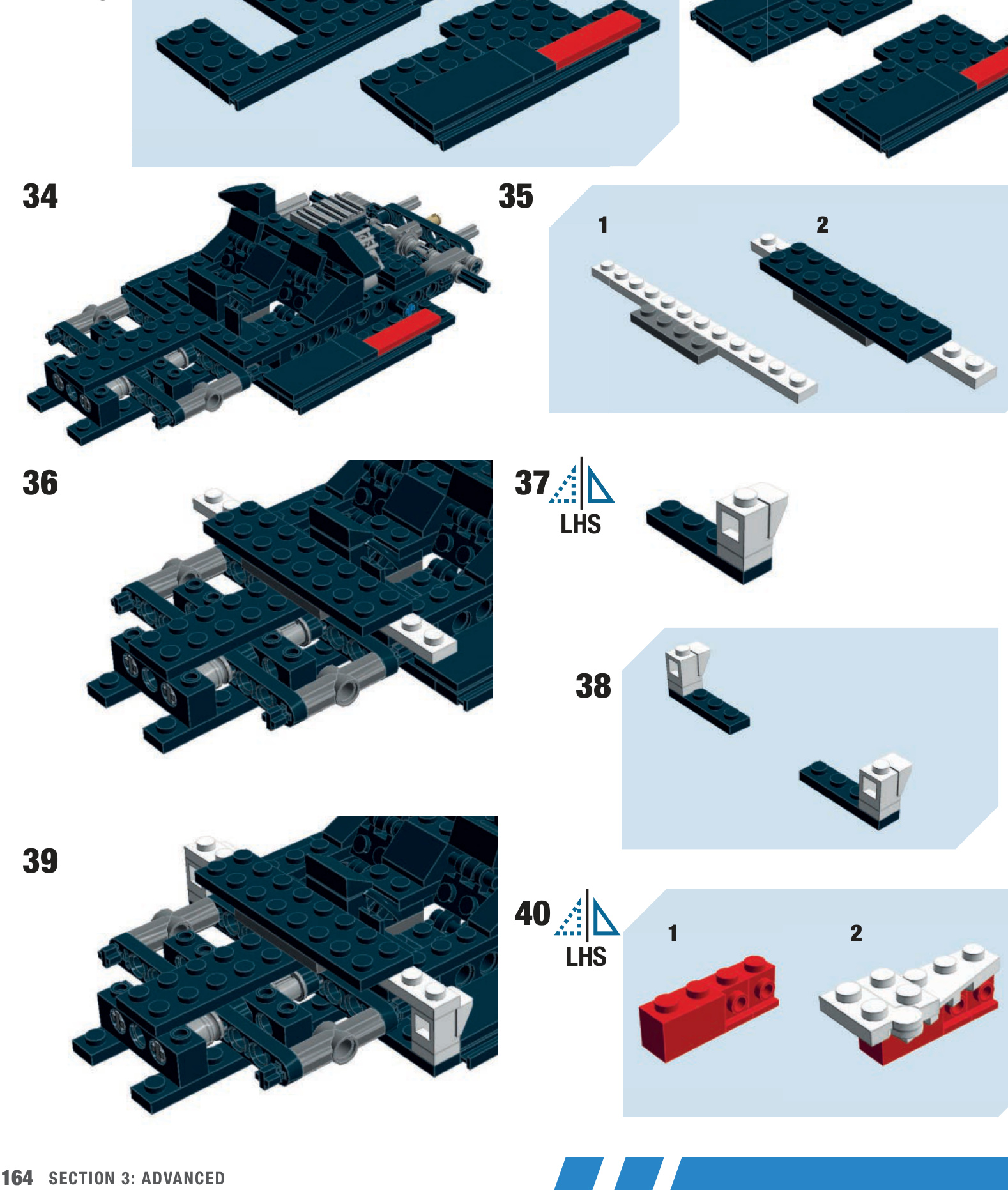
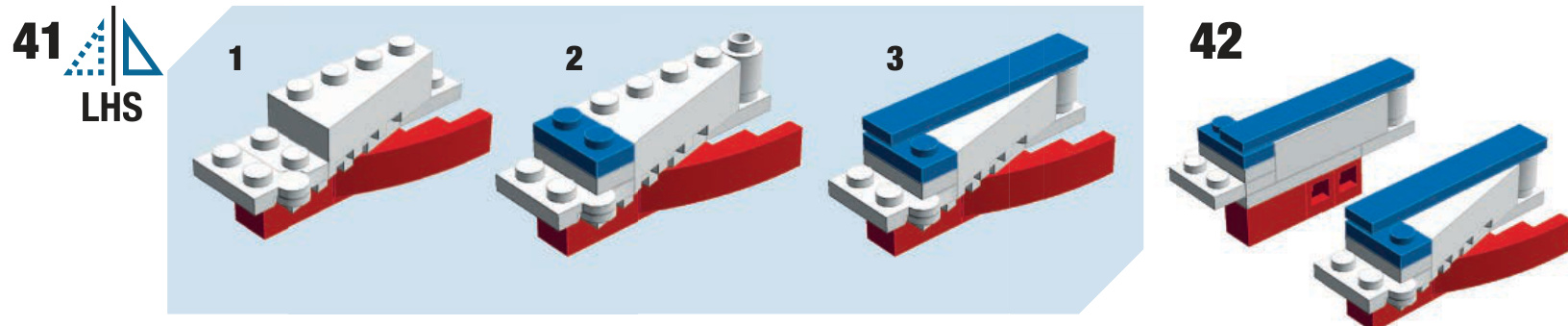
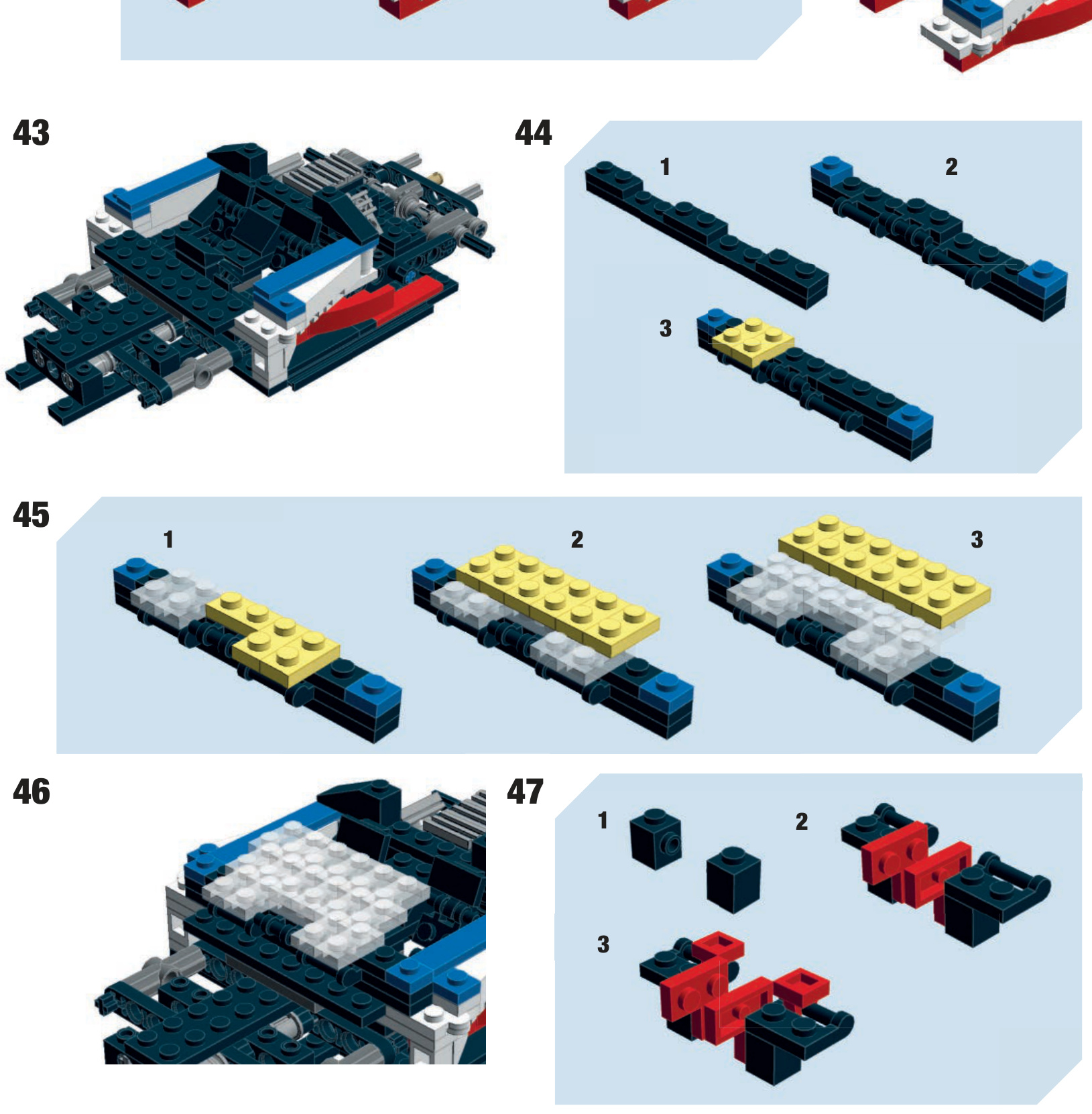

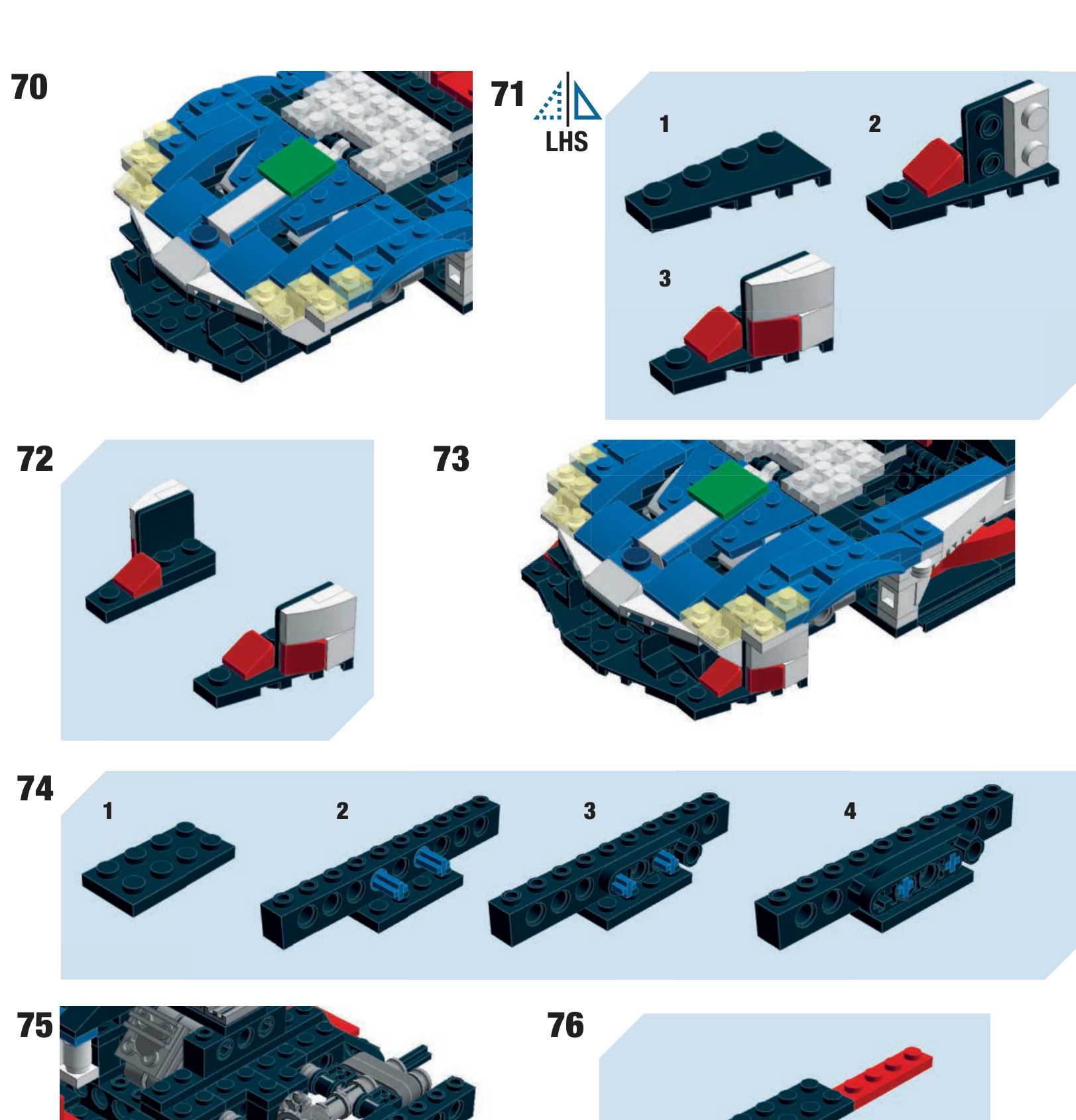
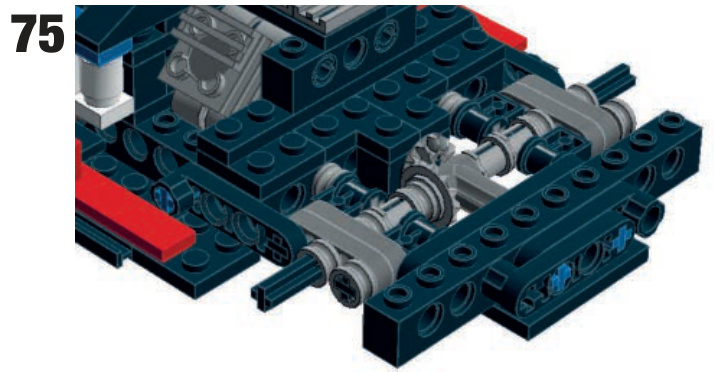
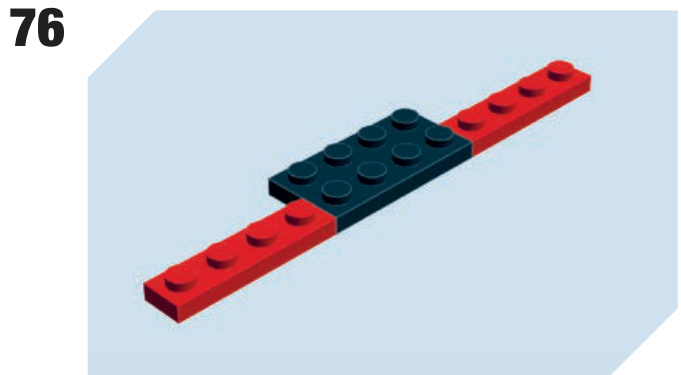
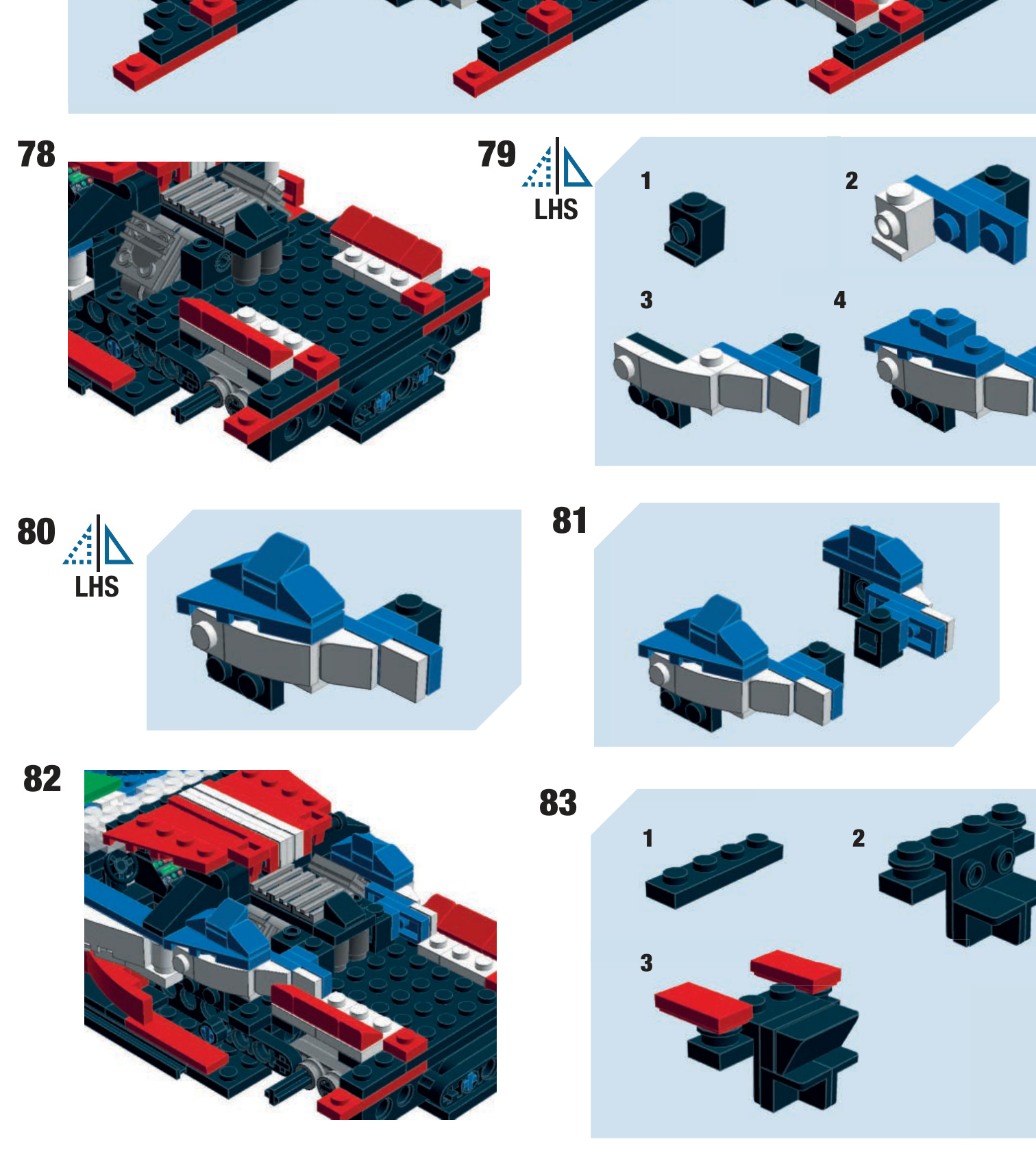
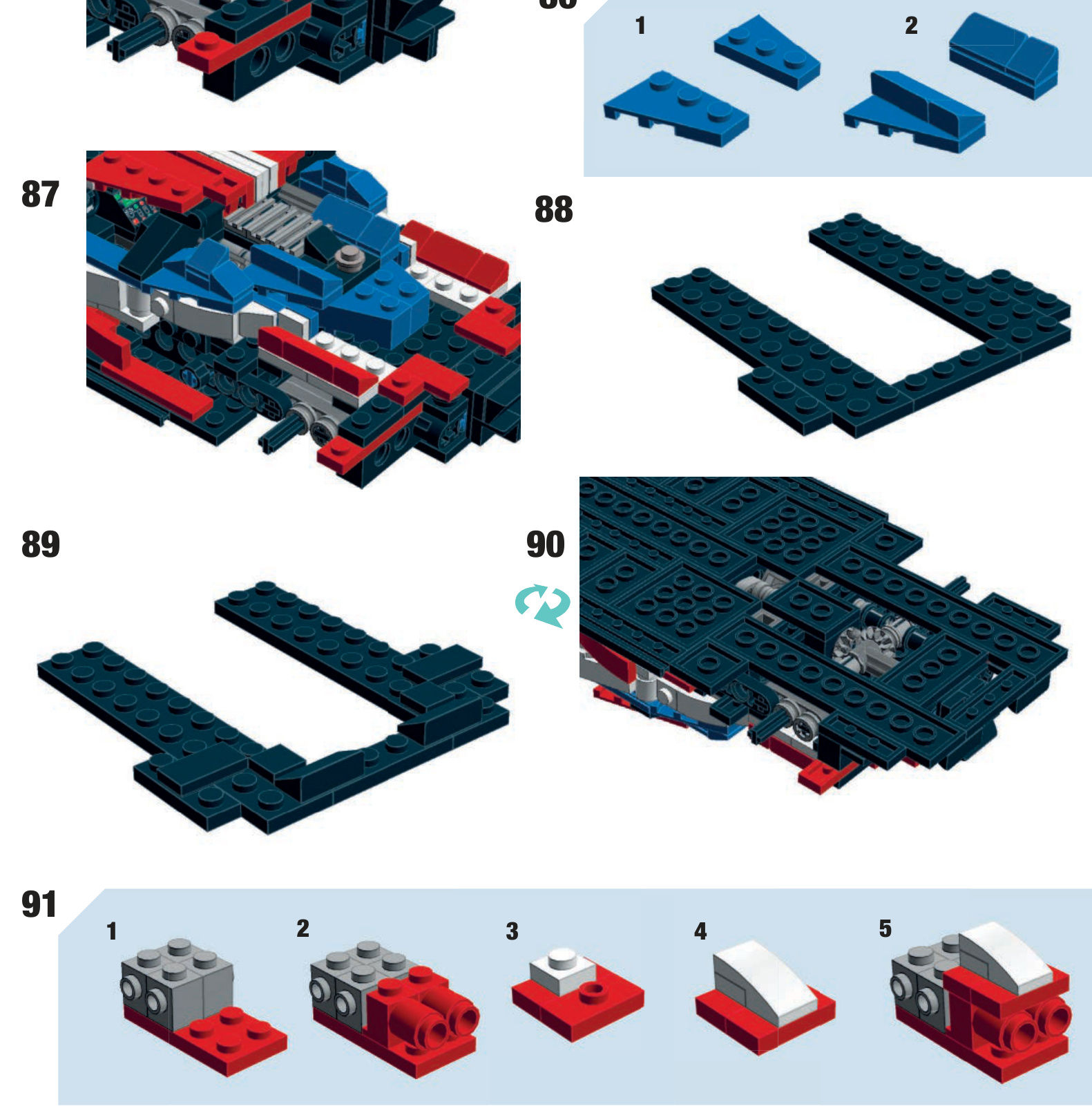
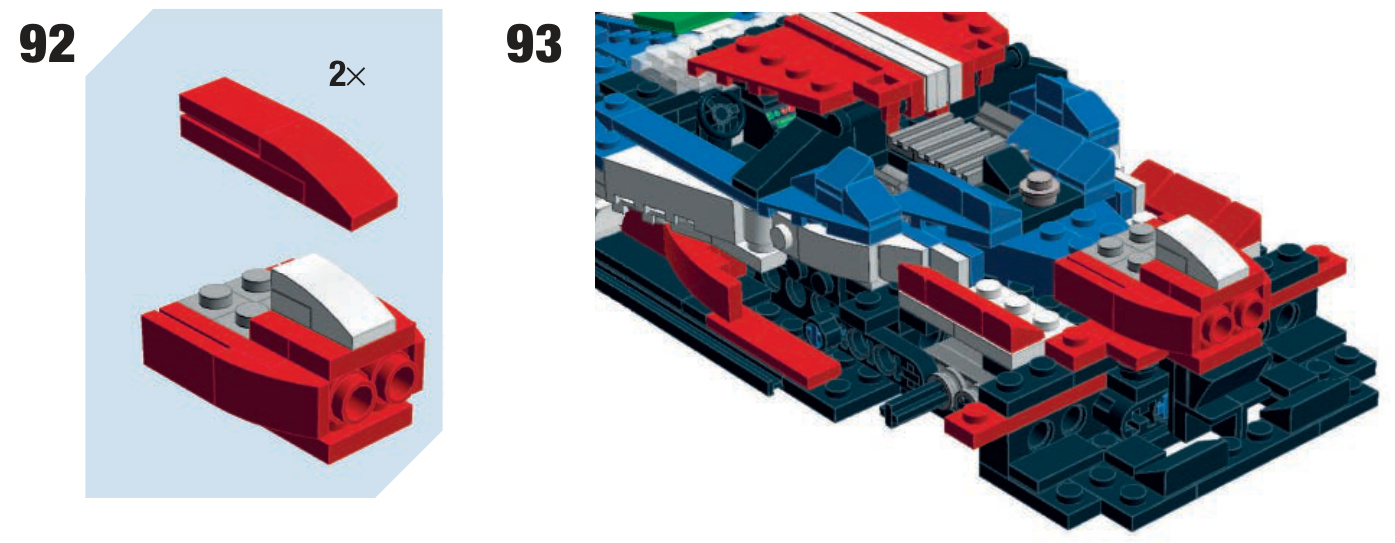
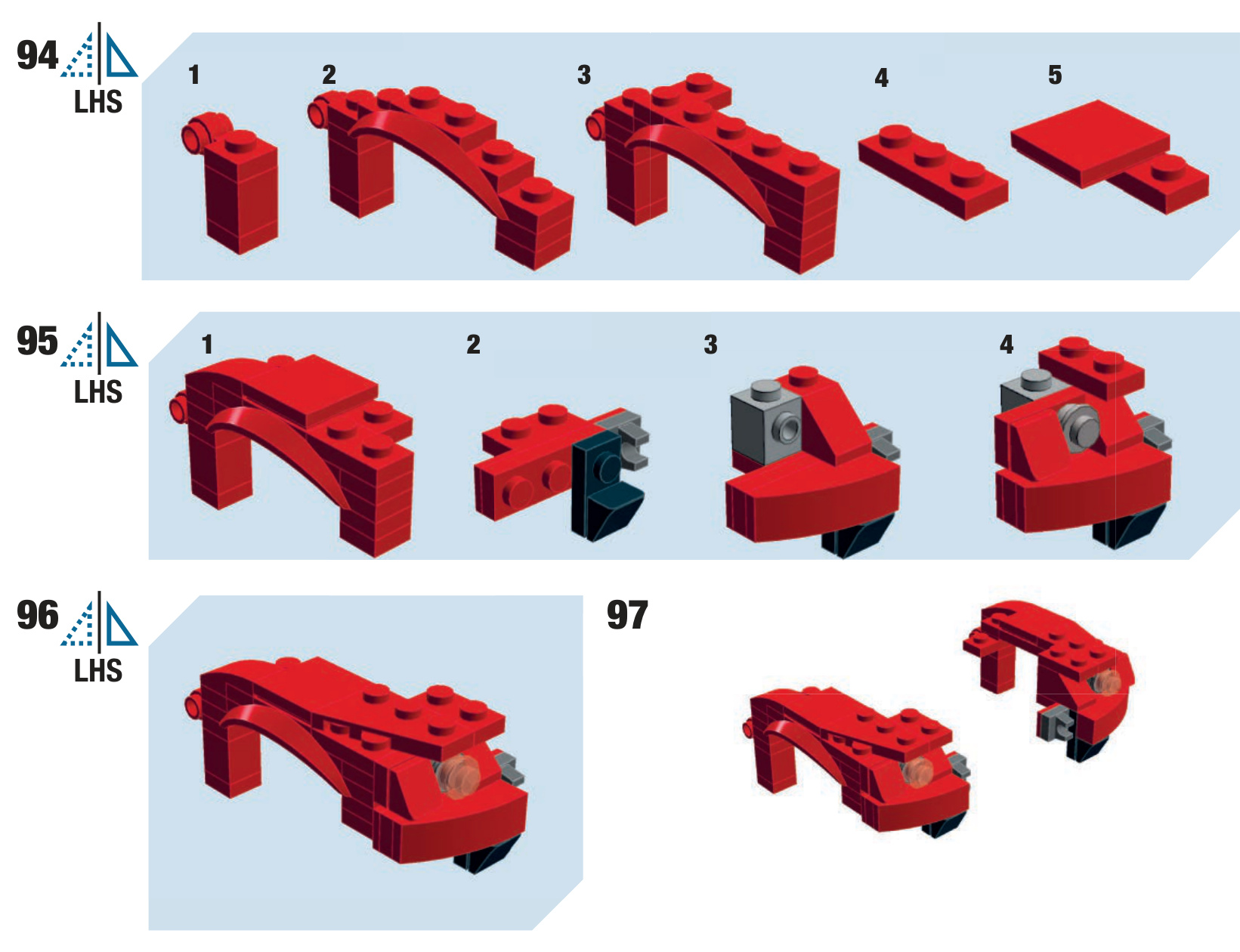
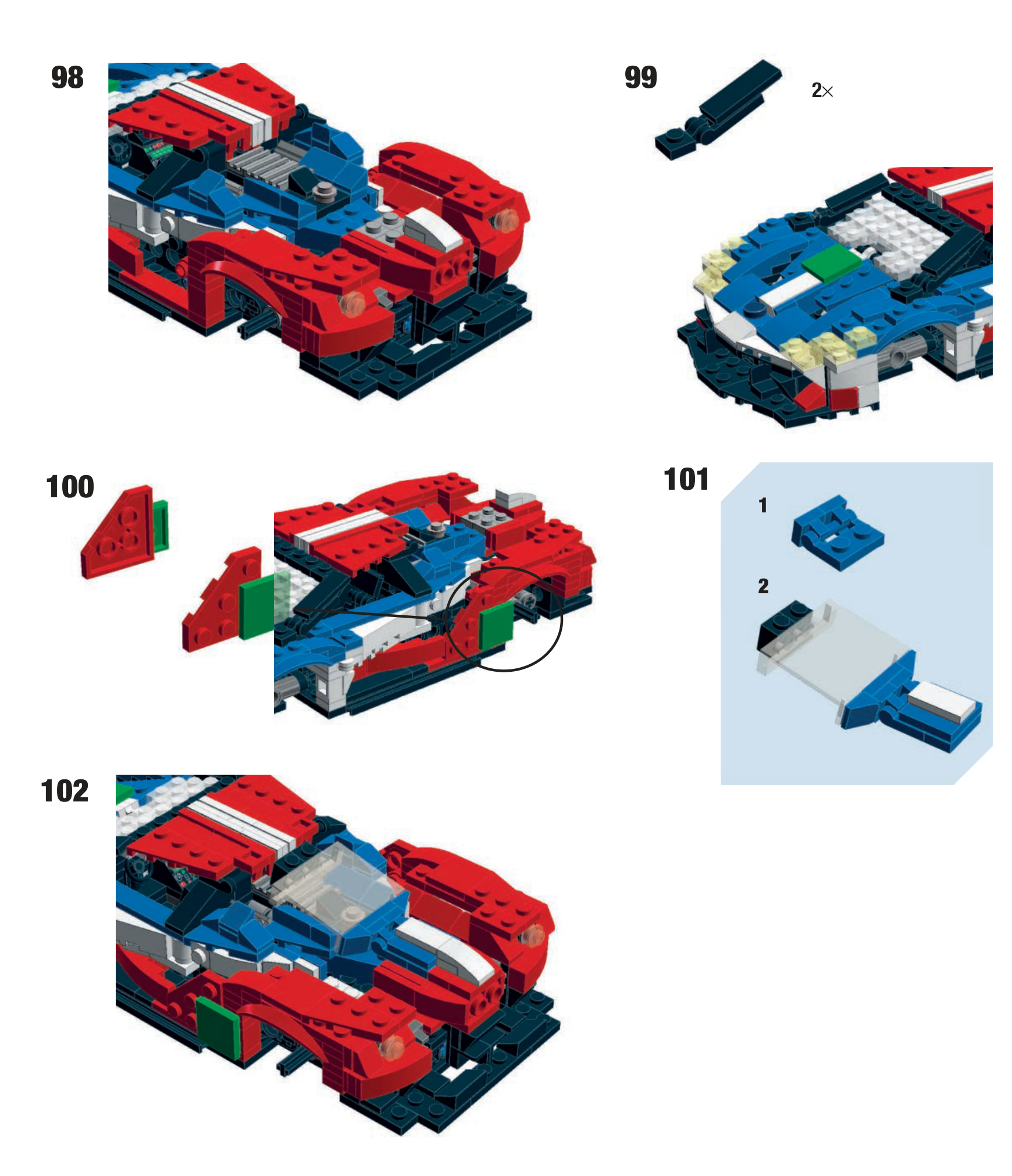
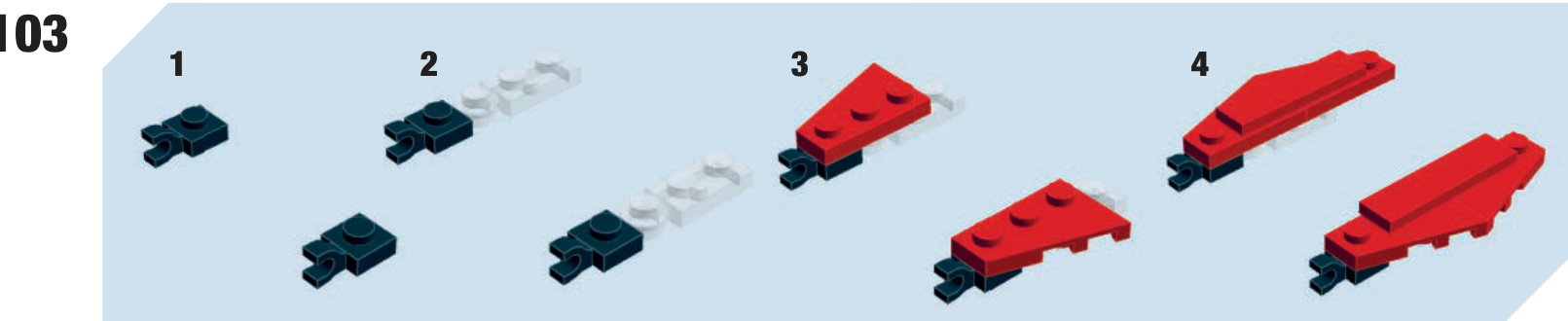
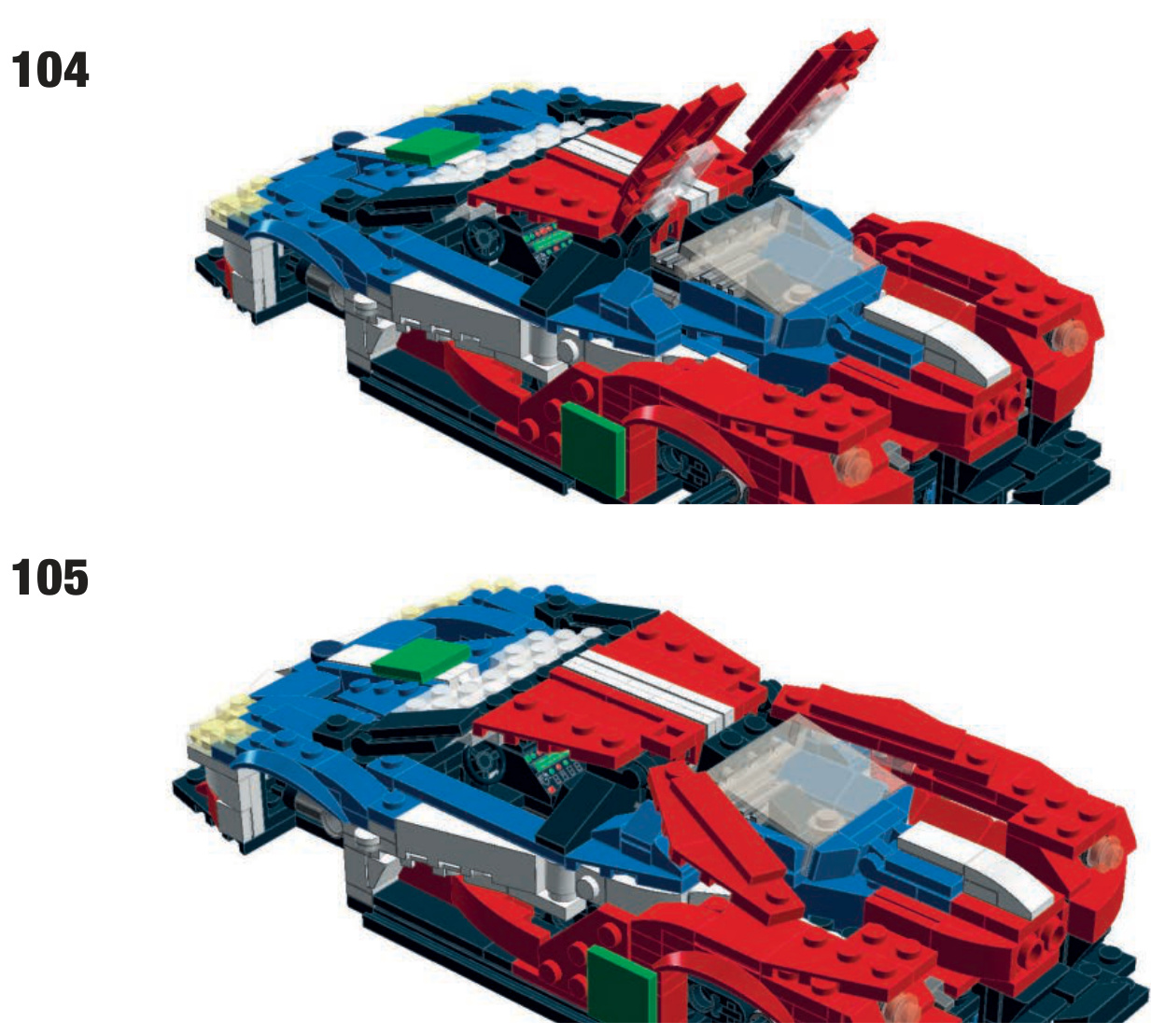
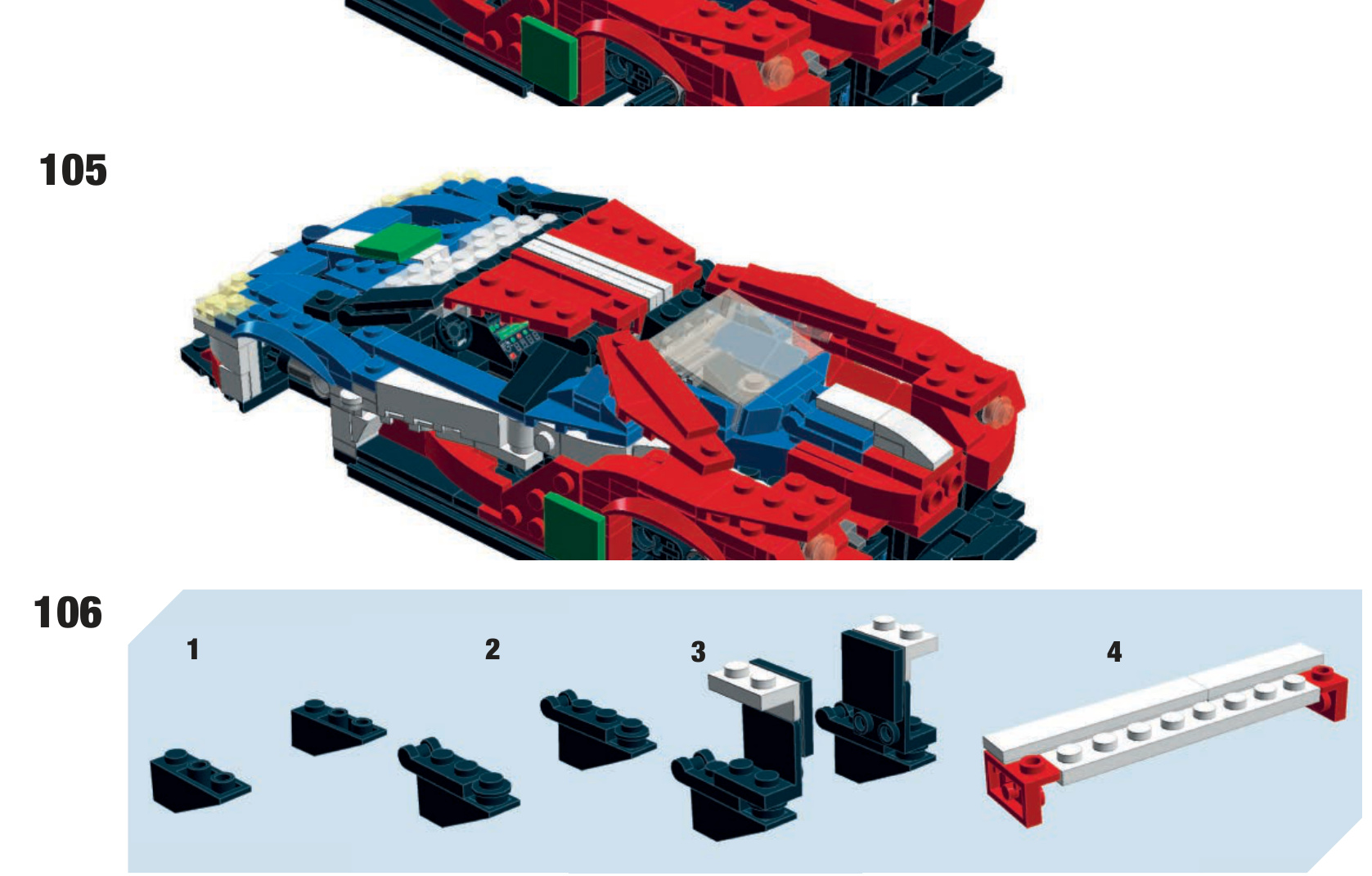
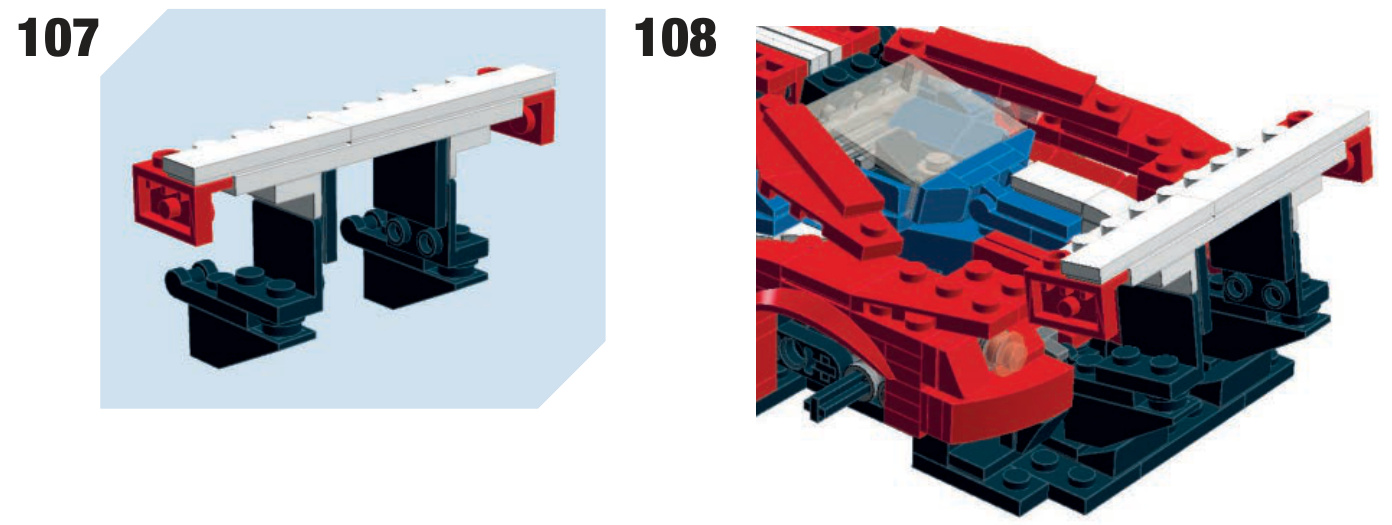
BUGATTI
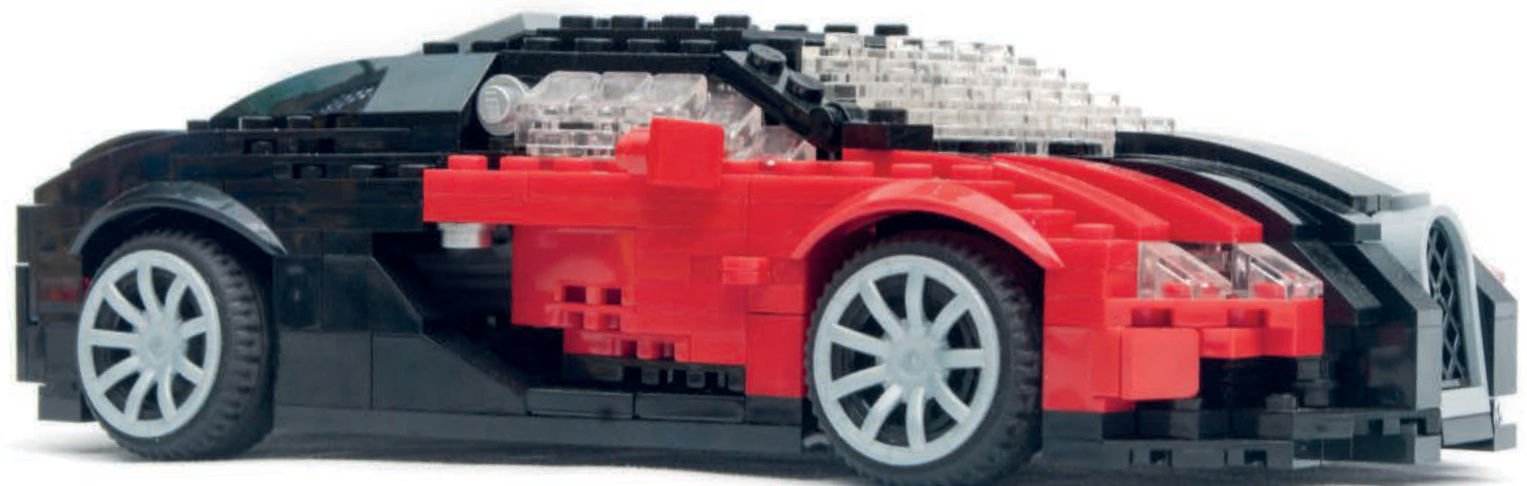
VEYRON EB 16.4
BVuiolldktshweagrenatGersotucparCehivefrF—ertdhiinsawnadsPtihëechc(hgarllaendgseo lnaiodf FdeorwrynPboyr
The Veyron was to be the most powerful (1,001 hp/736 kW), the fastest (253.81 mph/408.47 km/h), and the quickest (0 to 62 mph/100 km/h in 2.46 seconds) and set new benchmarks for almost all performance attributes.
The engine is a mighty 8.0L and 16 cylinders, boosted by four turbochargers. The twin-clutch transmission has 7 speeds and drives through all four wheels. The car is ftted with ten radiators to cool various systems.
To reach the 254 miles per hour top speed, a special mode must be entered with the vehicle stationary. This driving mode uses the deployable rear wing from speeds between 137 and 213 miles per hour (220 and ) to aid stability. Beyond this speed, the car lowers closer to the ground and retracts the spoilers to decrease drag—at the expense of downforce! Driving at 249 miles per hour probably isn’t a good idea on a public road. In fact, there are very few places where this can be done
COUNTRY OF ORIGIN: France 1 PRODUCTION: 2005–2015 NUMBER MADE: 450 LAYOUT / DRIVE: Mid engine / All-wheel drive ENGINE: 7,992 cc, 16 cylinders, V POWER / TORQUE: 1,001 hp (750 kW) / 1,100 lb-ft (1,500 Nm)
CONSTRUCTION / DOORS: Carbon-fber monocoque / 2-door cou
safely. Former BBC Top Gear presenter James May drove a Veyron at 259.49 miles per hour at Volkswagen’s Ehra-Lessien highspeed test track. The very steep banking on the track allows the car to run at very high speeds without scrubbing the tires through curves and losing speed—though this also pushes the driver down frmly into his or her seat!
All this car doesn’t come cheap, and when sold new, the Bugatti Veyron cost about \1$ million, though later exclusive versions were sold for more than twice this amount.
In 2016, Bugatti announced the replacement for the Veyron—a very similarly conceived V-16 hypercar called the Chiron.

This model can also be built in the folowing colors: Number of parts: 593
RESOURCES
COMMUNITY
One of the great things about is the worldwide community. There are LEGO Clubs in almost every country where LEGO is sold. Furthermore, if you are interested in a particular LEGO theme or creation type (like cars), there is likely a group on the internet that caters to this interest. The photo-sharing website Flickr is home to many specialist LEGO interest groups. The following websites may be useful starting points:
Offcial LEGO website: www.lego.com Bricklink (part purchase): www.bricklink.com/v2/main.page News and amazing creations of all types: www.brothers-brick.com Extensive online community: www.eurobricks.com/forum LEGO cars and other vehicles: www.thelegocarblog.com
I DON’T HAVE ANY TECHNIC®— HOW CAN I BUILD THE COMPLEX MODELS?
To this good question, I have two answers:
- If your LEGO collection lacks any of the pieces required to build the model, you can buy them online. You can buy parts directly from the LEGO Company via the LEGO Shop@Home service—a place to purchase full LEGO sets, but also spare parts. This website is available across most of Europe, Asia, and the Americas. You can also purchase bricks via a service called Bricklink (see link above). Bricklink is a web service for thousands of individual stores around the world. Most will be able to supply common parts while others will also be able to supply specialist and rare parts. The LEGO Company has no affliation with Bricklink, so there are more risks associated with pricing, purchase, and shipping.
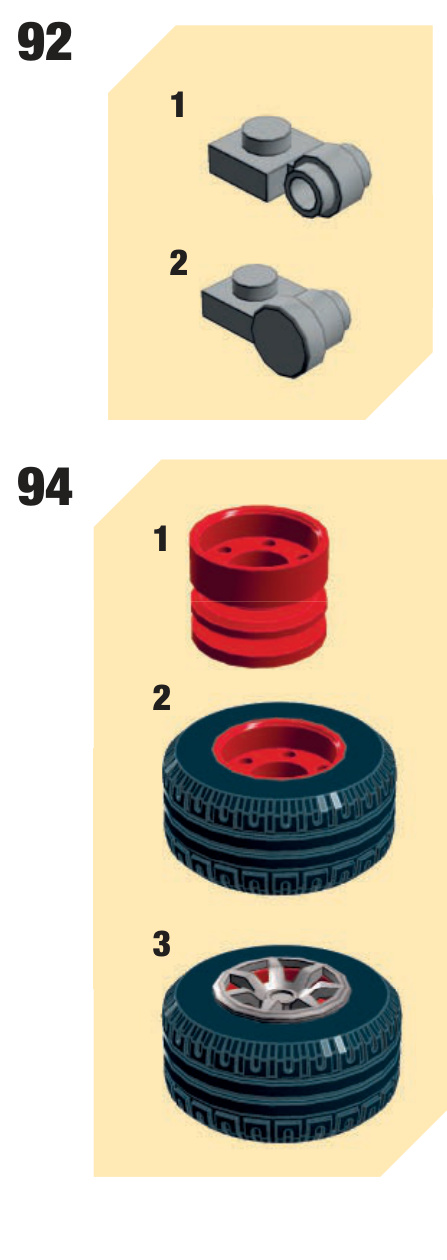
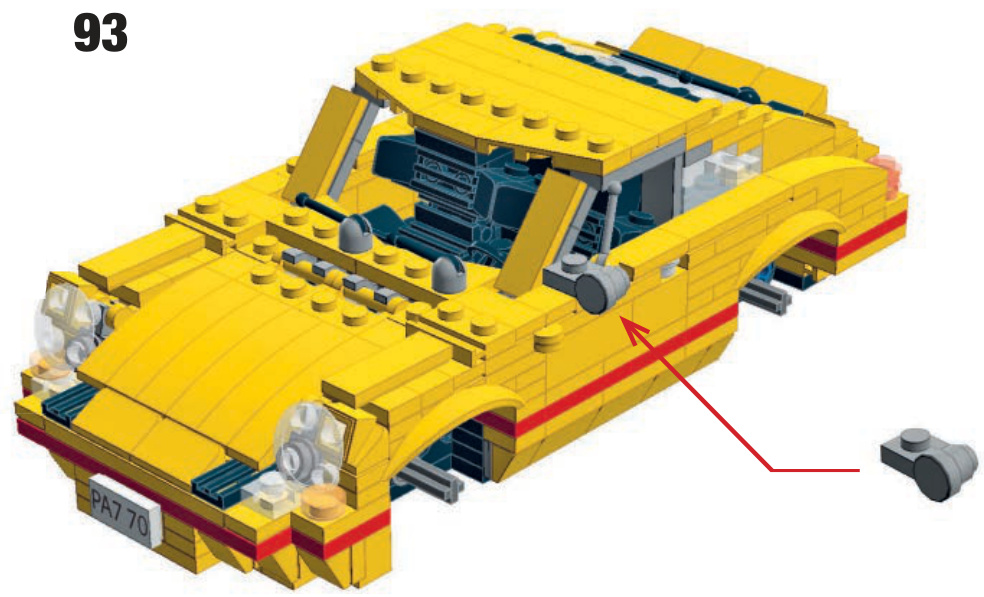
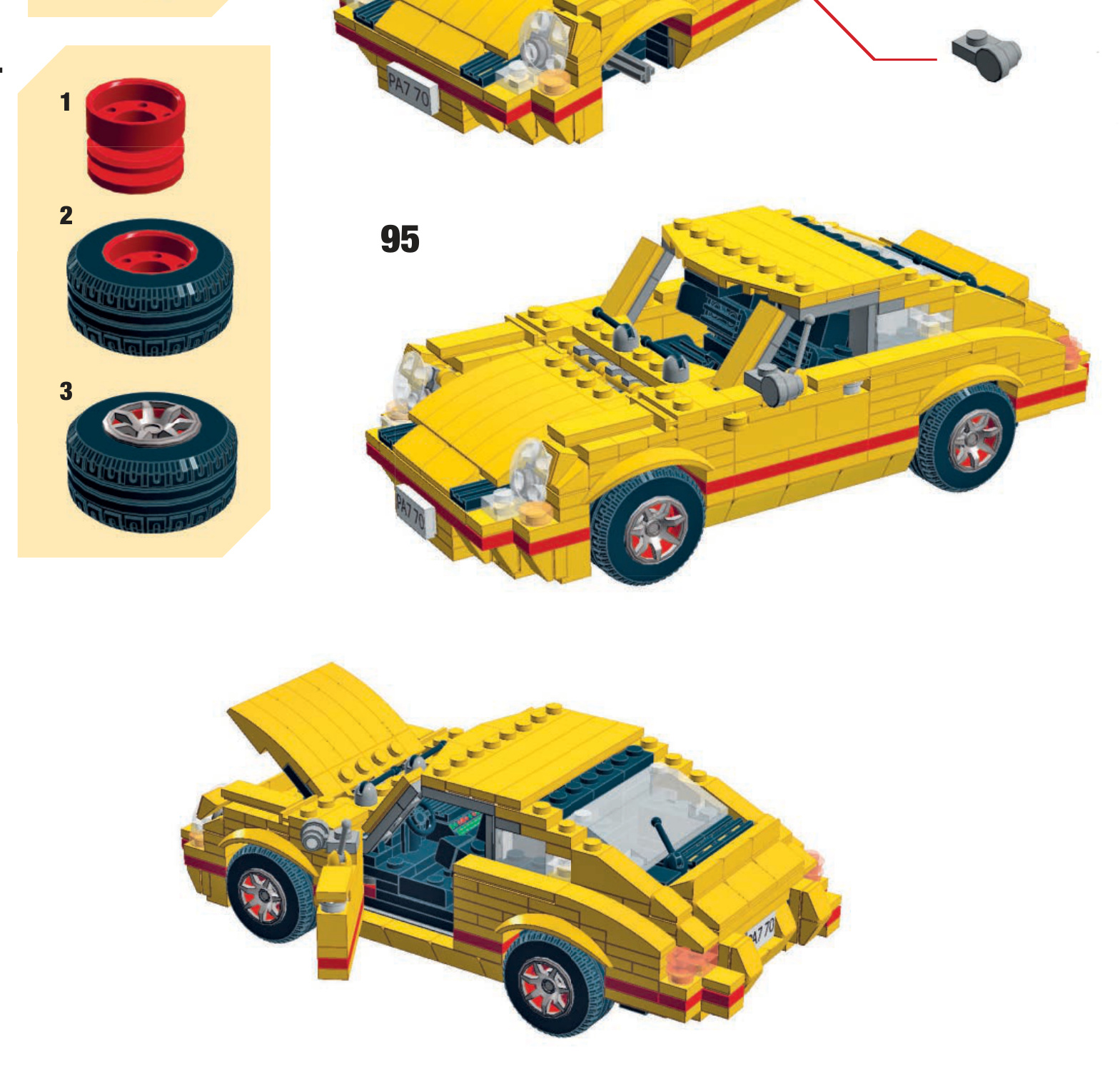
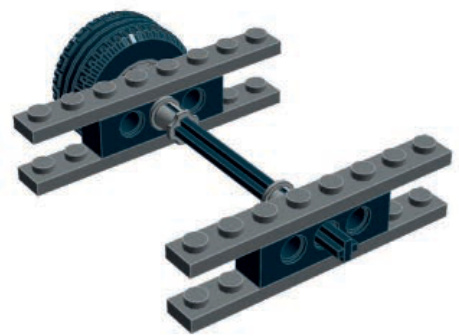
- Many of the Intermediate and Advanced builds include Technic system suspension and engines. Understanding that both part availability and complexity/dexterity issues may discourage the building of these cars, it may please you to know that prior to designing these intricate assemblies, I nonetheless still needed my cars to have wheels attached, and so simpler techniques were employed. For most of the cars in this book, a variation of the following assembly should suffce:
PART SUBSTITUTIONS
You may also fnd that you need parts that are unavailable from or a third-party vendor. If this is the case, remember LEGO is a pretty adaptable building medium—there is always a way to build an assembly of parts other than the one shown here. Use your imagination and try with the parts you have access to. This is what expert MOC builders do every time they design their own models. It is the essence of their creativity.
DETAILS AND CUSTOMIZATION
As you progress through the models, you will observe that they employ different part and assembly solutions for systems that might be common between vehicles. In particular, LEGO has wheels and tires that are available in close approximate geometric measurements. Though these wheels have a specifc millimetric measure, it is much simpler to refer to them by their approximate LEGO part dimension.
In this book, most of the smaller models use wheels and tire combinations approximating 3-studs (24mm, or 1 inch), in various widths. Unfortunately, this does not quite mean that they will ft inside a 3-stud gap—so creative solutions are required to provide close-ftting wheel arches that nonetheless allow the wheel to spin freely. For the larger Miniland-scale cars, wheel and tire combinations approximating 4-studs (32mm, or 1¼ inches) are used; they closely ft a 4-stud gap. When building any of these models, please use the wheels and tires you have available. Not only that, there are a variety of creative ways of designing fancy wheel trims or hubcaps, and I encourage you to select designs that suit your style, as would a customizer in real life.
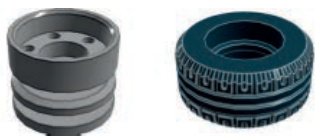
32mm: 55982 & 58090
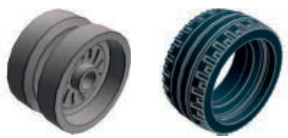
24mm: 18976 & 18977
Most of the models in this book have been created to an exact specifcation of vehicle. The Porsche 911 is a case in point. There have been a great variety of 911s over ffty years. Each model is different. Even within a single year of production, there is considerable variation in details—wheels, spoilers, light units, seat designs, rear-view mirror placement, and antennae. If you want to follow the instructions precisely, enjoy. If you want to build the model with your own eye for customization, be my guest!
ABOUT THE AUTHOR
PETER BLACKERT is perhaps uniquely positioned to write this book, being both a well-known and productive LEGO® modeller, and a design engineer for the Ford Motor Company. Peter has published hundreds of LEGO vehicle designs, including cars, trucks, motorcycles, and buses. In real life Peter spends his time in Ford’s Asia-Pacifc Engineering Centres in Geelong and Melbourne, Australia. His focus is on Powertrain and Chassis Systems Engineering—skills that are transferred to the detailed engineering suspension and engine design content included in many of his LEGO vehicles. Peter studied engineering at the University of Sydney and the Australian National University.
Peter has written this book to provide a challenge to a breadth of builders of all ages, and as a guide to advanced automotive engineering in compact scale.
BUILD.LEARN.PLAY. CUSTOMIZE!
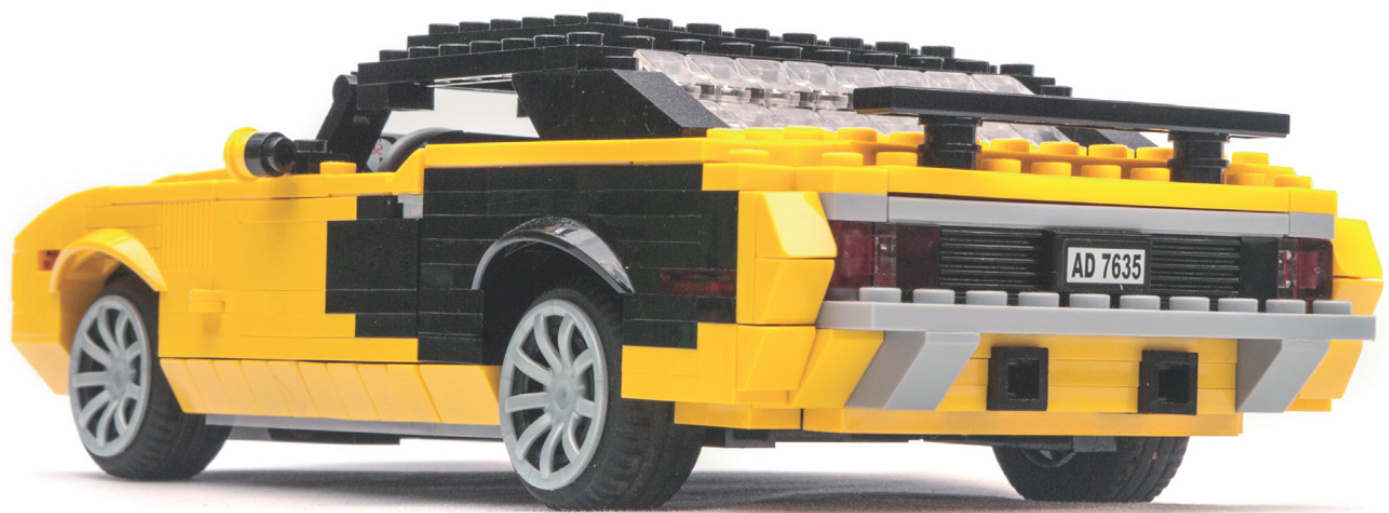
THE WORLD’S BEST CARS IN THE PALM OF YOUR HAND
Ladies and gentlemen,boys and girls,start your engines and bust out your bricks! How to Build Brick Cars is here.Featuring over a dozen fully realized builds of classic and contemporary sports cars,race cars,and muscle cars, How to Build Brick Cars features a range of levels to challnge brick newbies and veteran block-builders alike.
Inside,readers willfind detailed,full-color illustrations and step-by-step instructions for such classic and contemporary vehicles as a 1932 Ford hot rod,2016 Le Mans Ford racer, Ferrari 250,Jaguar E-Type, Ford F-150 Raptor, and Bugati Veyron.The vehicles represent a range of manufacturers from around the globe including the United States, England, Germany, France,Italy, and Japan.
Featuring informative and historicaltext about each car with builds designed exclusively by renowned custom builder Peter Blackert, How to Build Brick Carswillkeep you busy from theflip of thefirst page to the end of the race track!
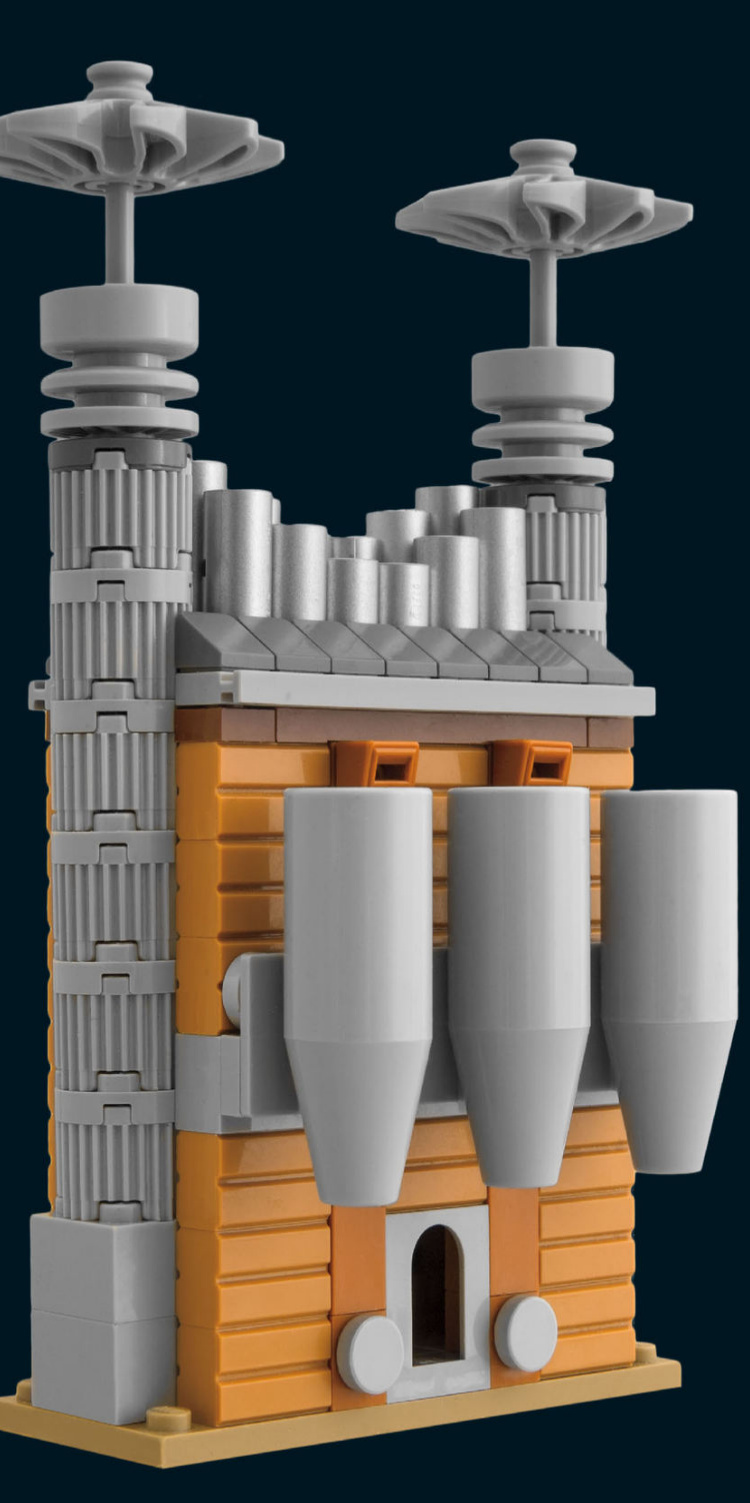
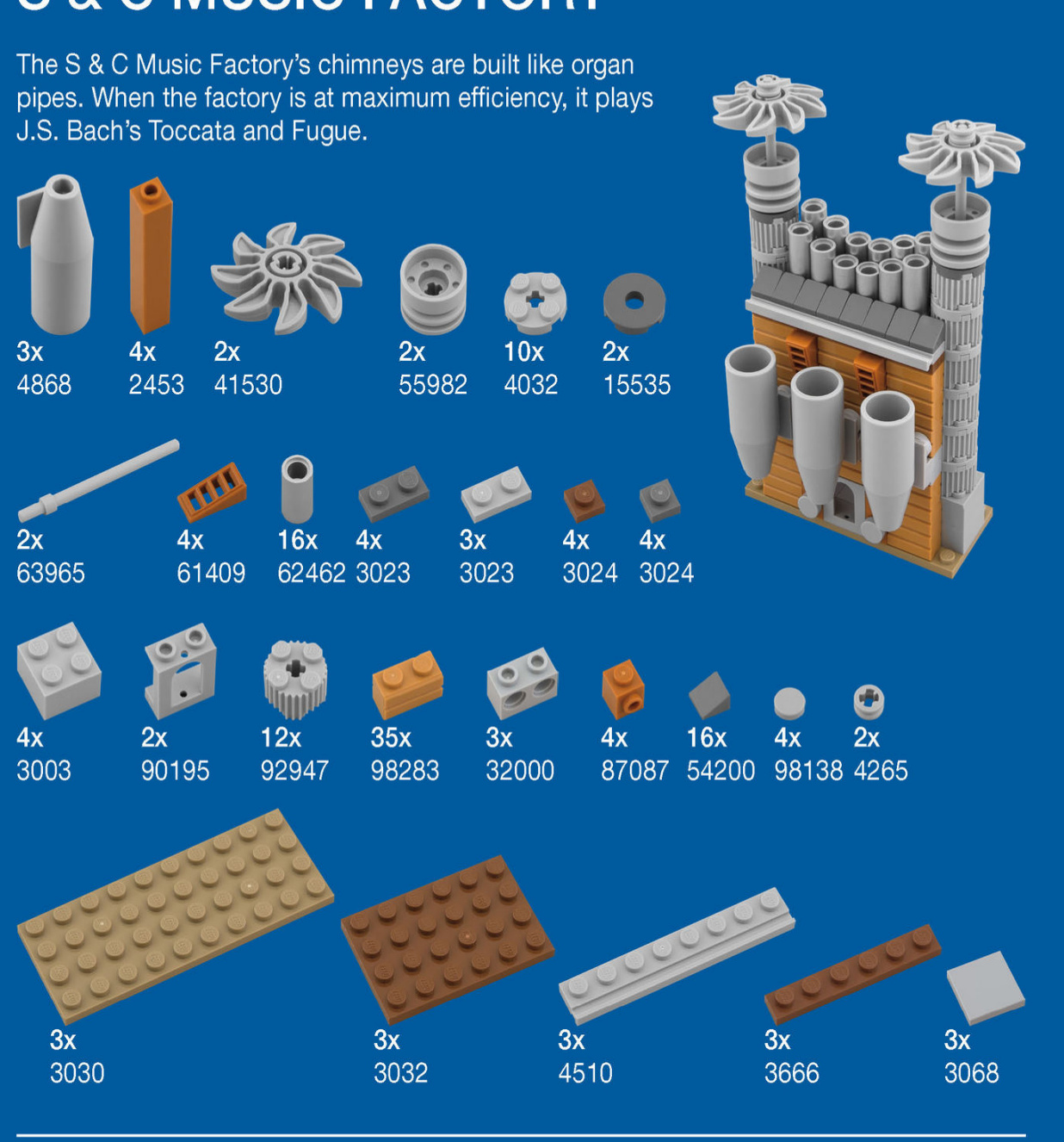
S&C MUSIC FACTORY
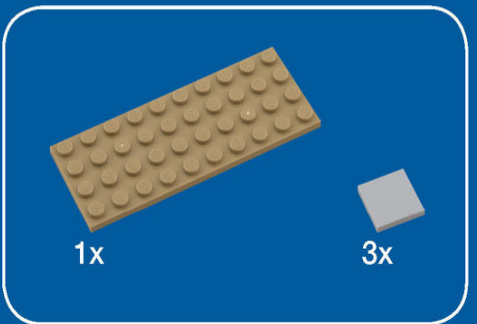
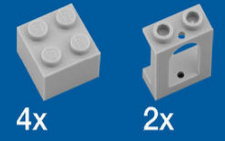
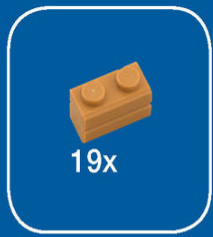
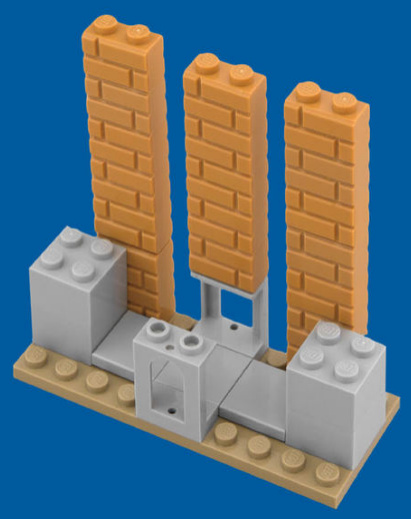
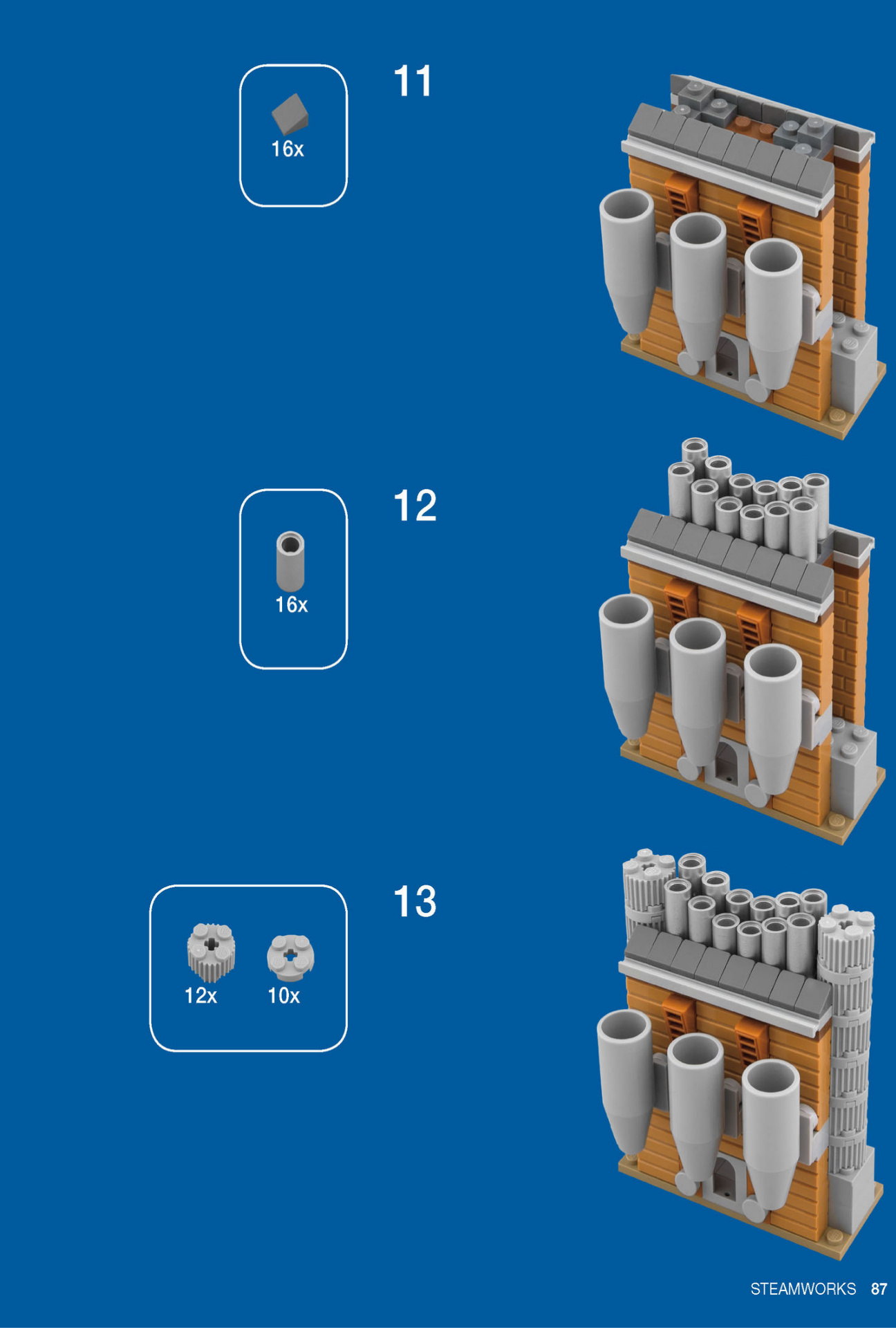
3 Notethatthe middlestack isfivebricks tallwhilethe sidestacksare sevenbrickstall.
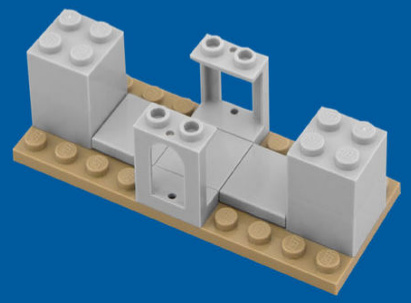
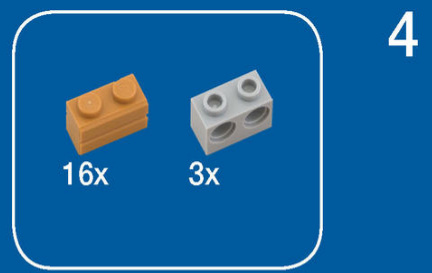
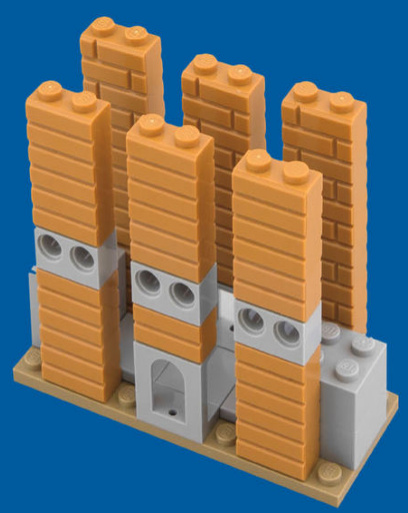
You’ll need to build four of these columns.
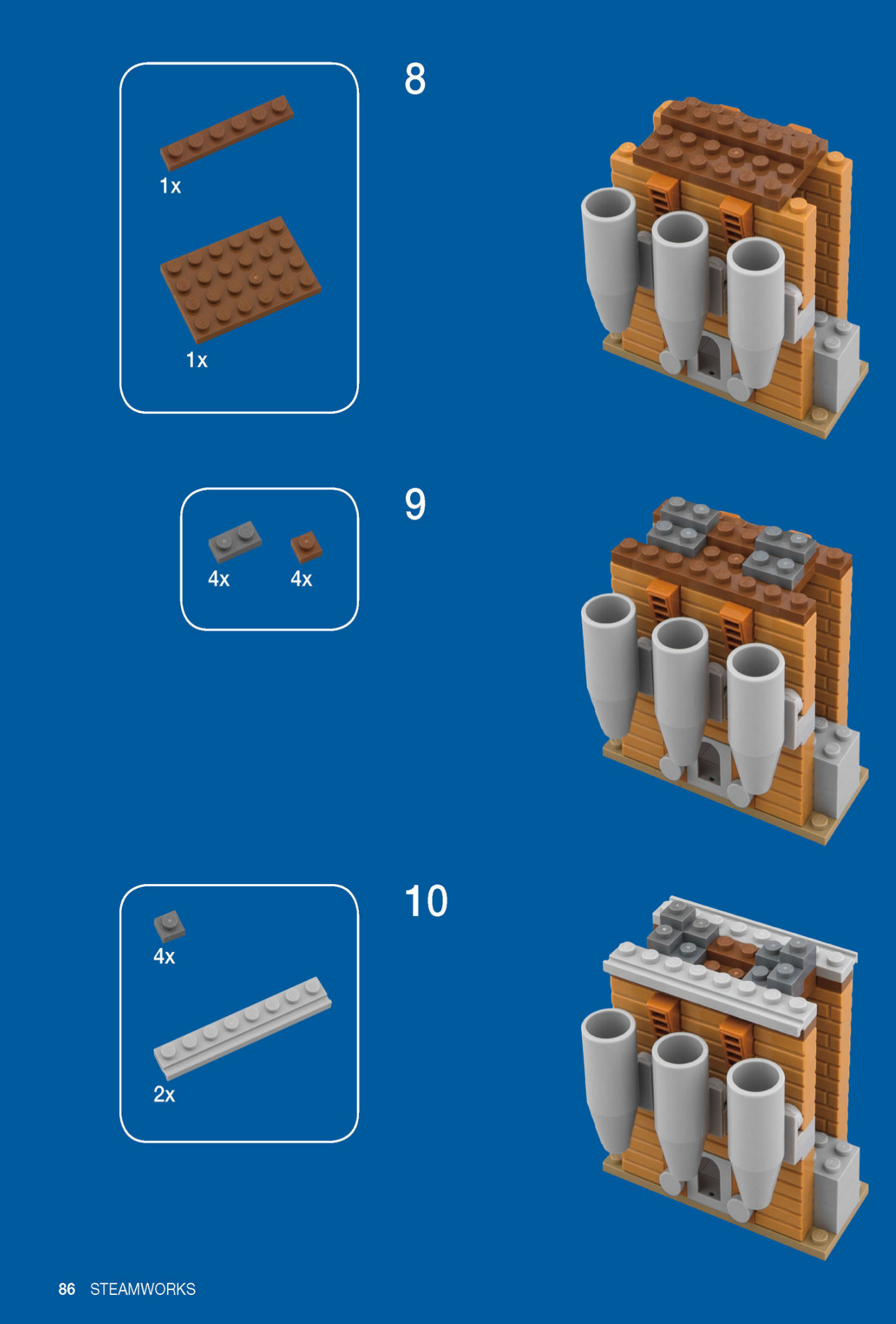
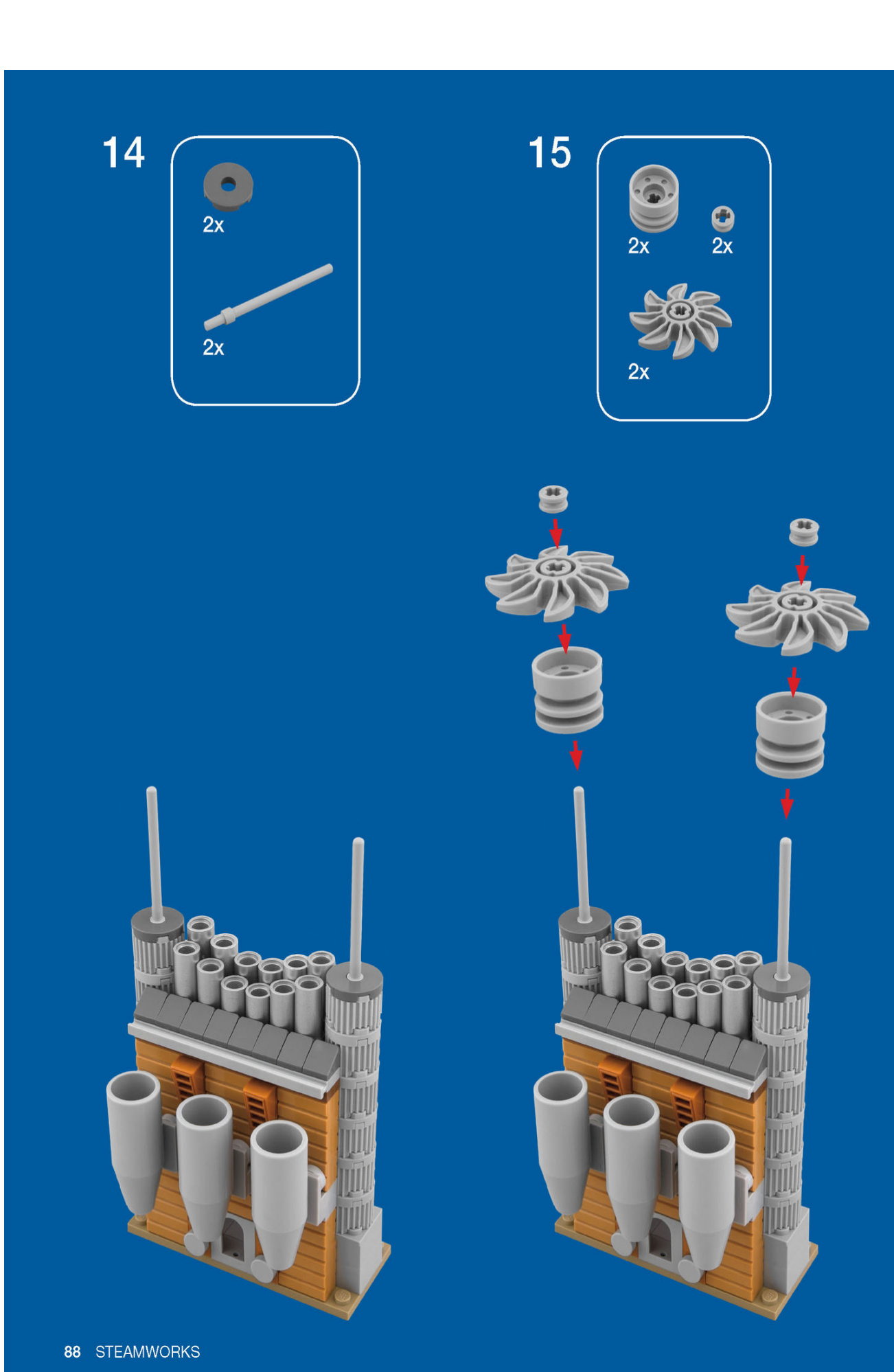
Attachtworound tilestoeach aircraftengine.
MAKE IT YOUR OWN
The S& C Music Factory has aircraft engine silos on just one side to fit on a 20x20-stud city.But if you have enough space in your city, you can have silos onboth sides. Just omit step 3 andrepeatsteps4 through 7 forbothsidesofthebuilding.
FINDING IN SPIRATION
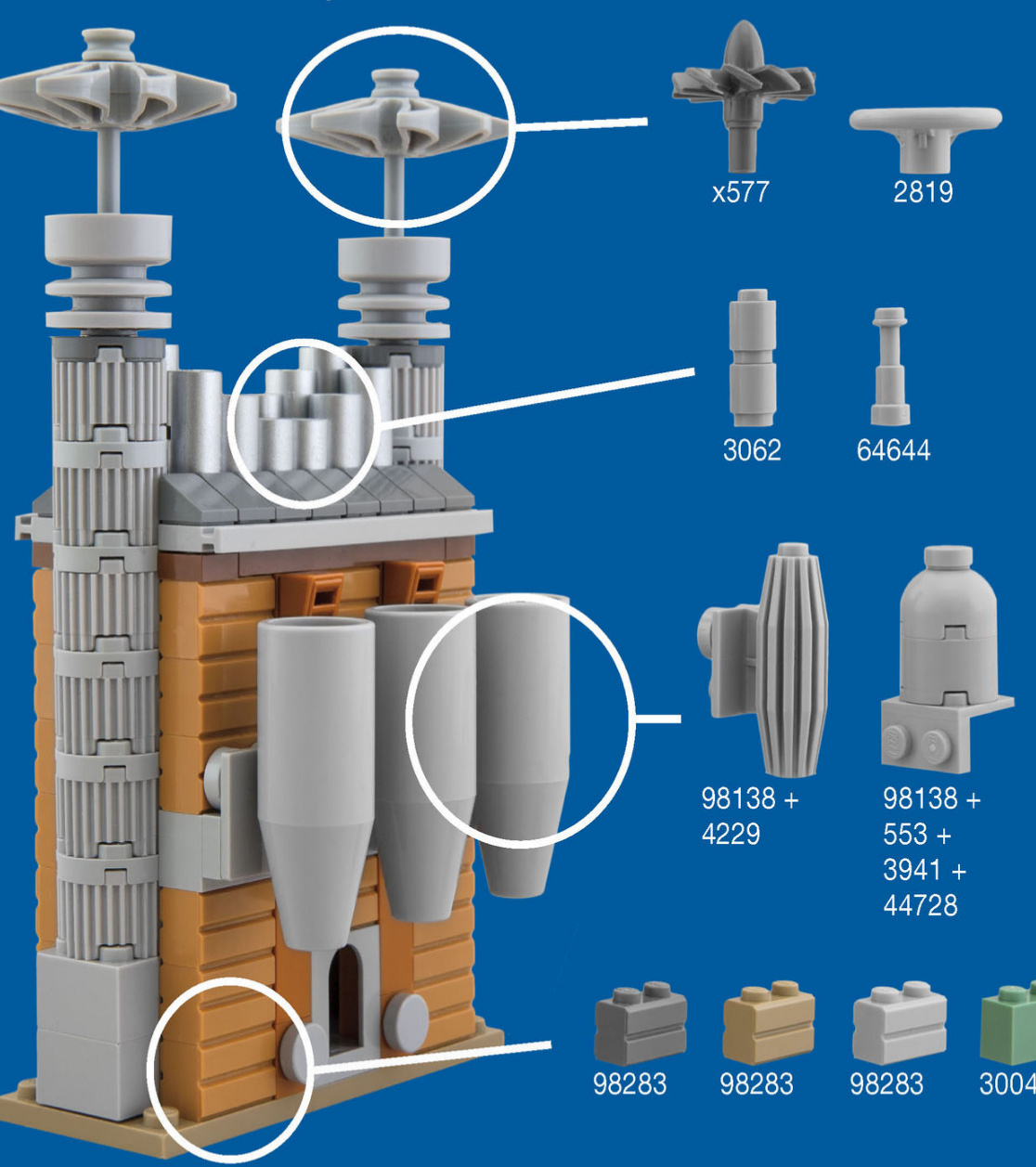
TheS& CMusicFactory doesn’t conformto any architectural style, and that’swhat makes it interesting! Itsdesign is inspiredby a pipe organ. Seek inspiration in unexpected places.
THE LIGHTNING FOUNDRY
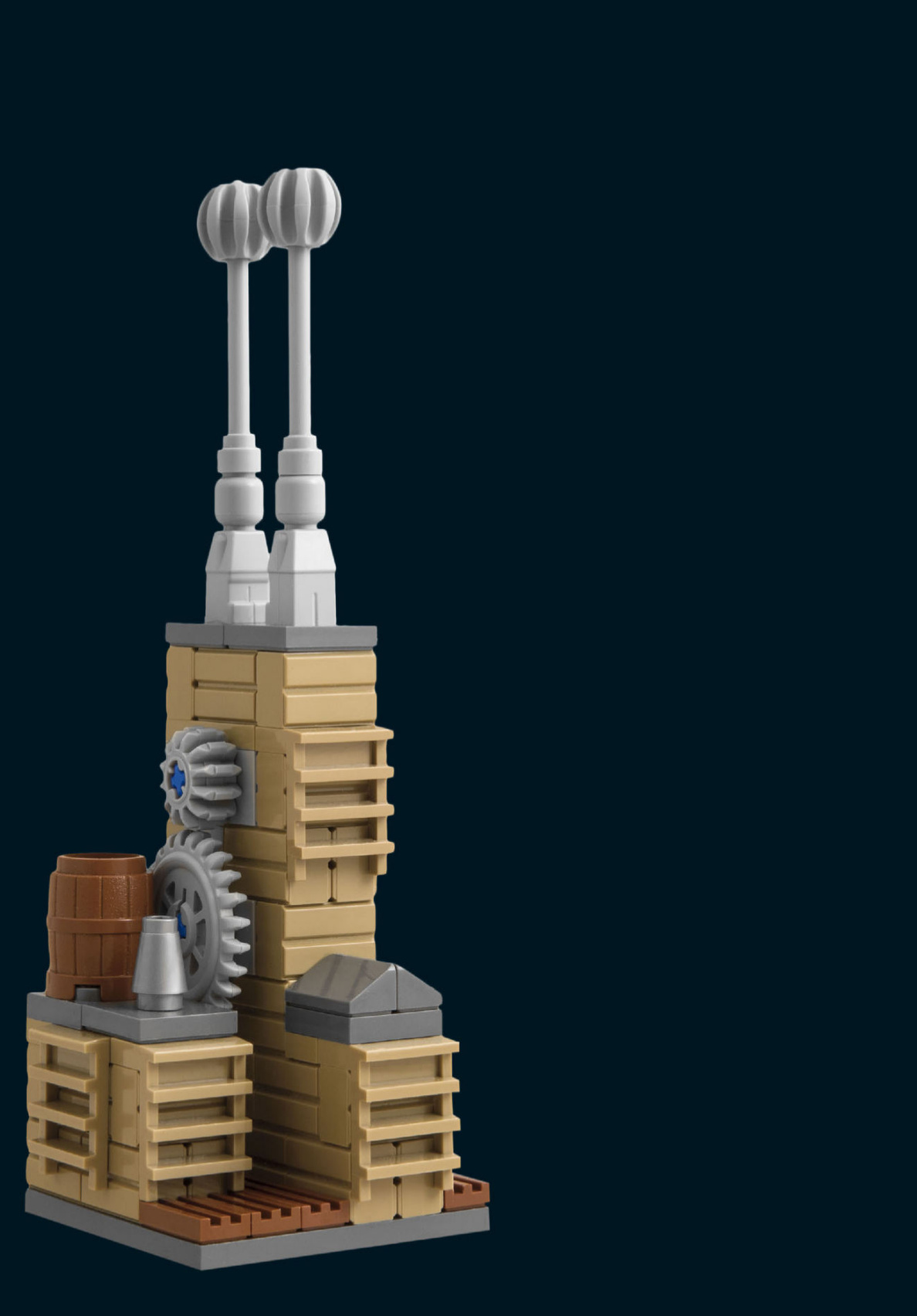
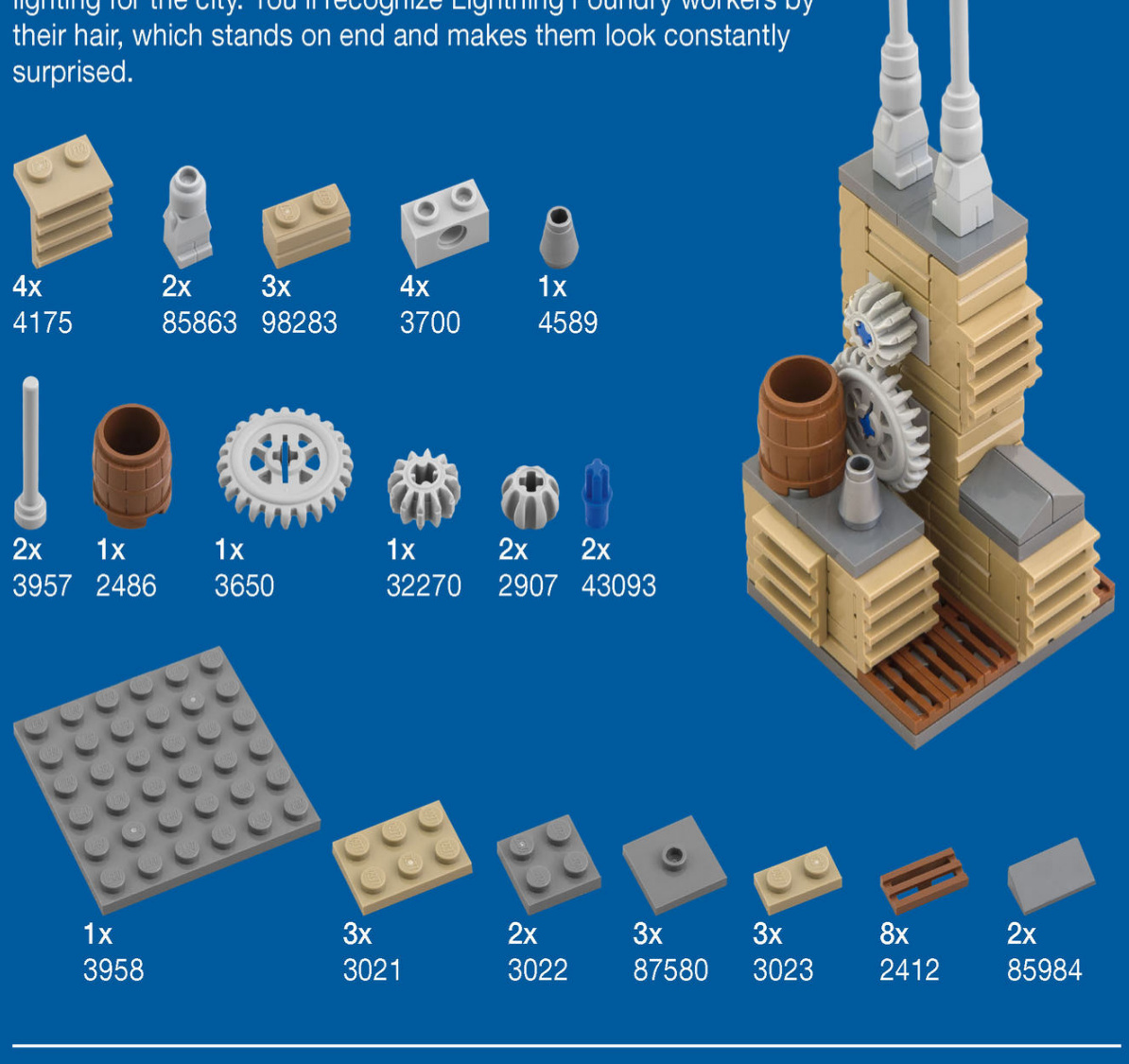
Electricity cracklesbetweenthe Lightning Foundry’stwopositively chargedspheres, in an ill-advisedschemeto createnighttime lighting for the city. You’ll recognize Lightning Foundry workers by
FORM FOLLOW SFUNCTION?
“Form folows function” is a maxim of modernist architects, who view ornamentationasgratuitousexcess.Butformdoesn’talwaysfollow function, and surprisingly decorative elementscanbefound onthe most seriousindustrialbuildings.For example, London’s BatterseaPower Station, aformercoal-firedpowerplantandoneofthelargestbrick buildingsintheworld,haschimneysthatweremadetoresemblefluted Romancolumns.
96STEAMWORKS
MAKE IT YOUR OWN
Transform your city into a complete industrial complex byconnectingbuildingswithTechnicgears.Youcan fine-tunethe placement of gears using platesto alter theirheight.
GEARING UP
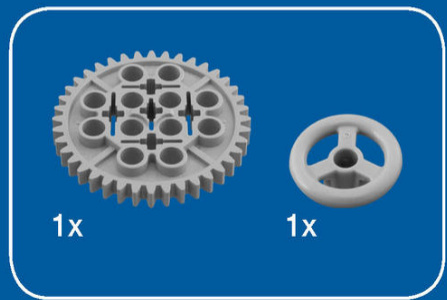
Technic gears often make upahumblecomponentin aLEGOTechnicvehicle’s transmissionorengine.But inmicroscale,thesegears becomemassivewheelsof industrythattoweroverhead and roar like thunder.
Mix and match any gears inyourcollectionandplace themonyourindustrial buildings to keepproduction rolling.
MAKE IT YOUR OWN
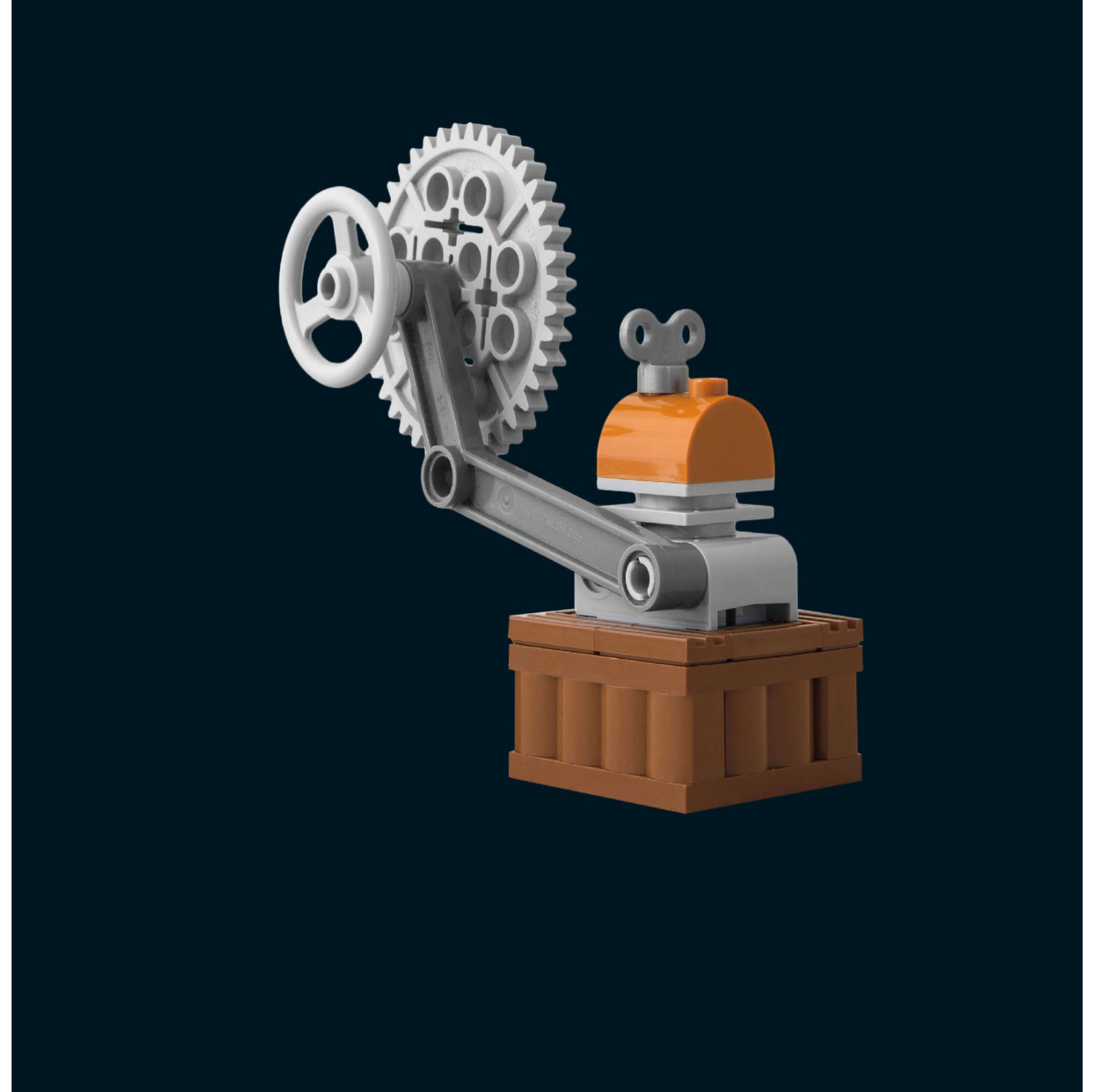
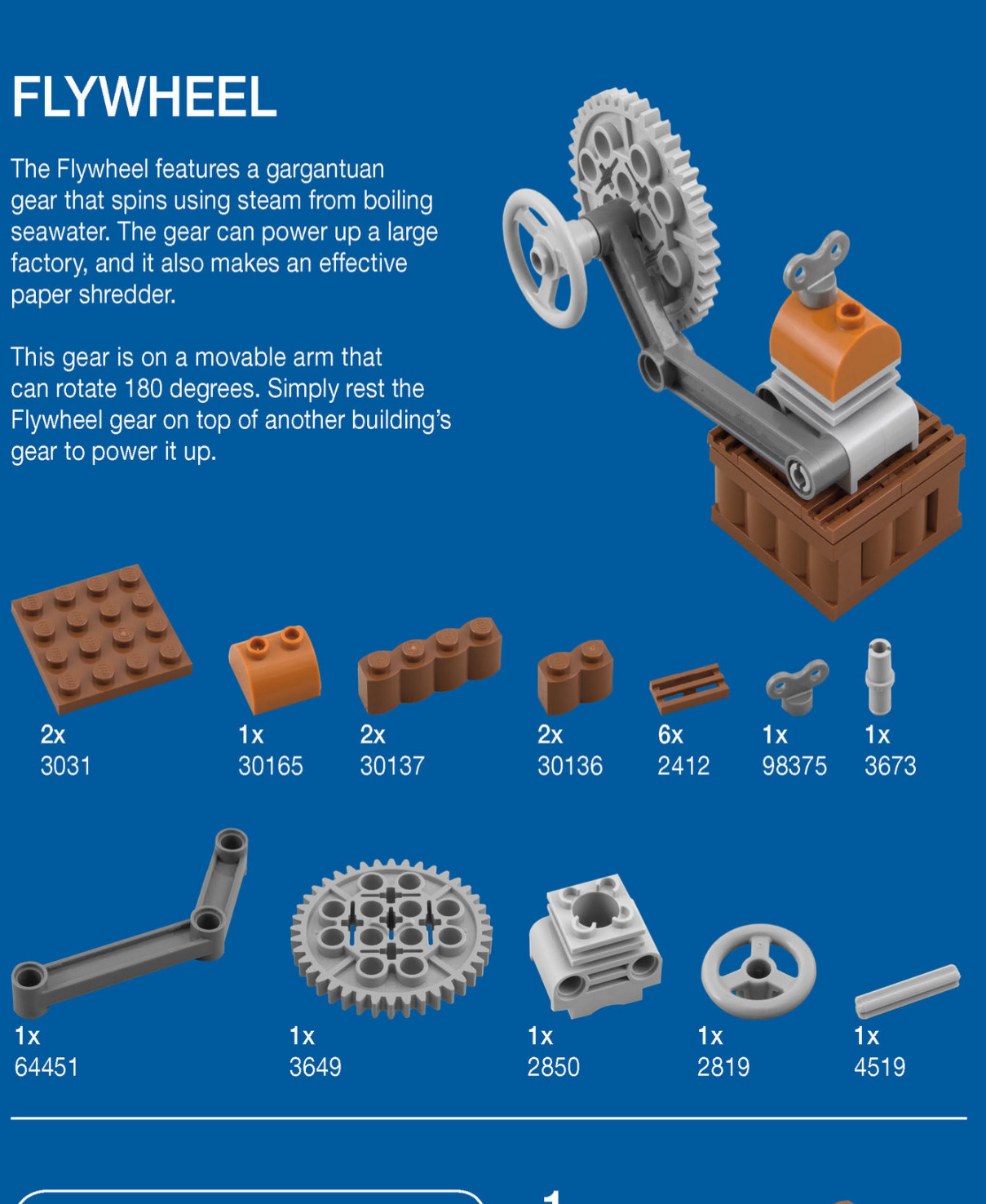
Use any1x1 roundbrick to add a custom chimney totheFlywheel’sdomedroof.
The only thing more enjoyablethan one giant gearonamovablearmistwogiantgearson twomovablearms!Youcanaddevenmore armssincethereareattachmentsforfour gearsintotal.
HYPERLOOP CITY
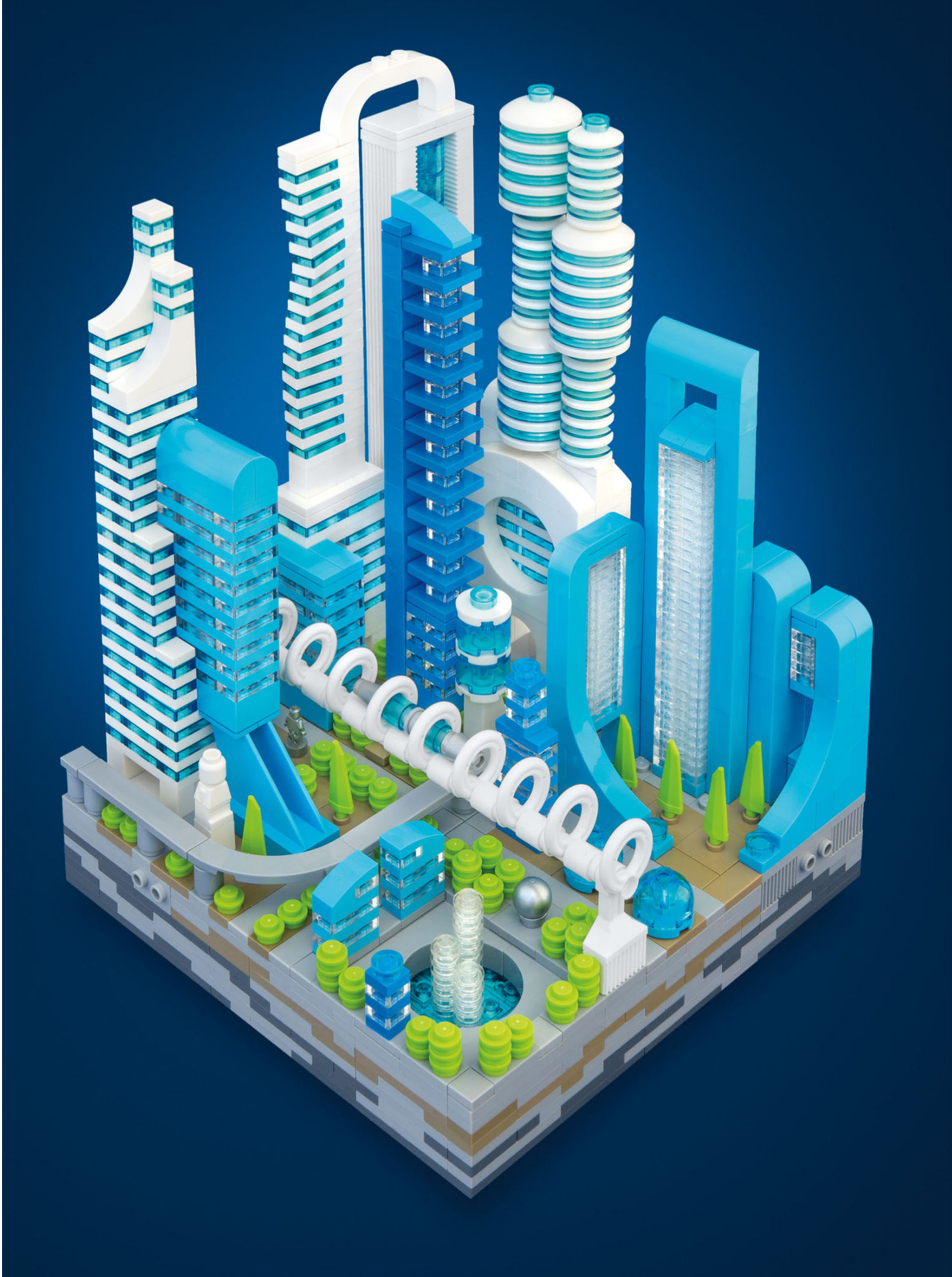
The main atraction of this sleek LEGO city is its next-generation Hyperloop technology, which uses electromagnetic rings to propel glass-walled passenger pods. It can transport passengers at speeds exceeding 6oo miles per hour. Best of all the open-air Hyperloop alleviates the claustrophobia of traveling in a closed tube.When you’ve built a beautiful LEGO city, why not give your citizens a clear view of its wonders?
Your LEGO micro city’s mode of public transportation says a lot about the city. For example, steam-driven trams, electric subways, or gleaming monorails clearly reveal the era you’ve placed your city in.A Hyperloop shows the world that your city is run by a visionary who embraces cutting-edge technology.
Public transportation and technological innovation are crucial to a thriving city. Will you embrace the future or get left behind?
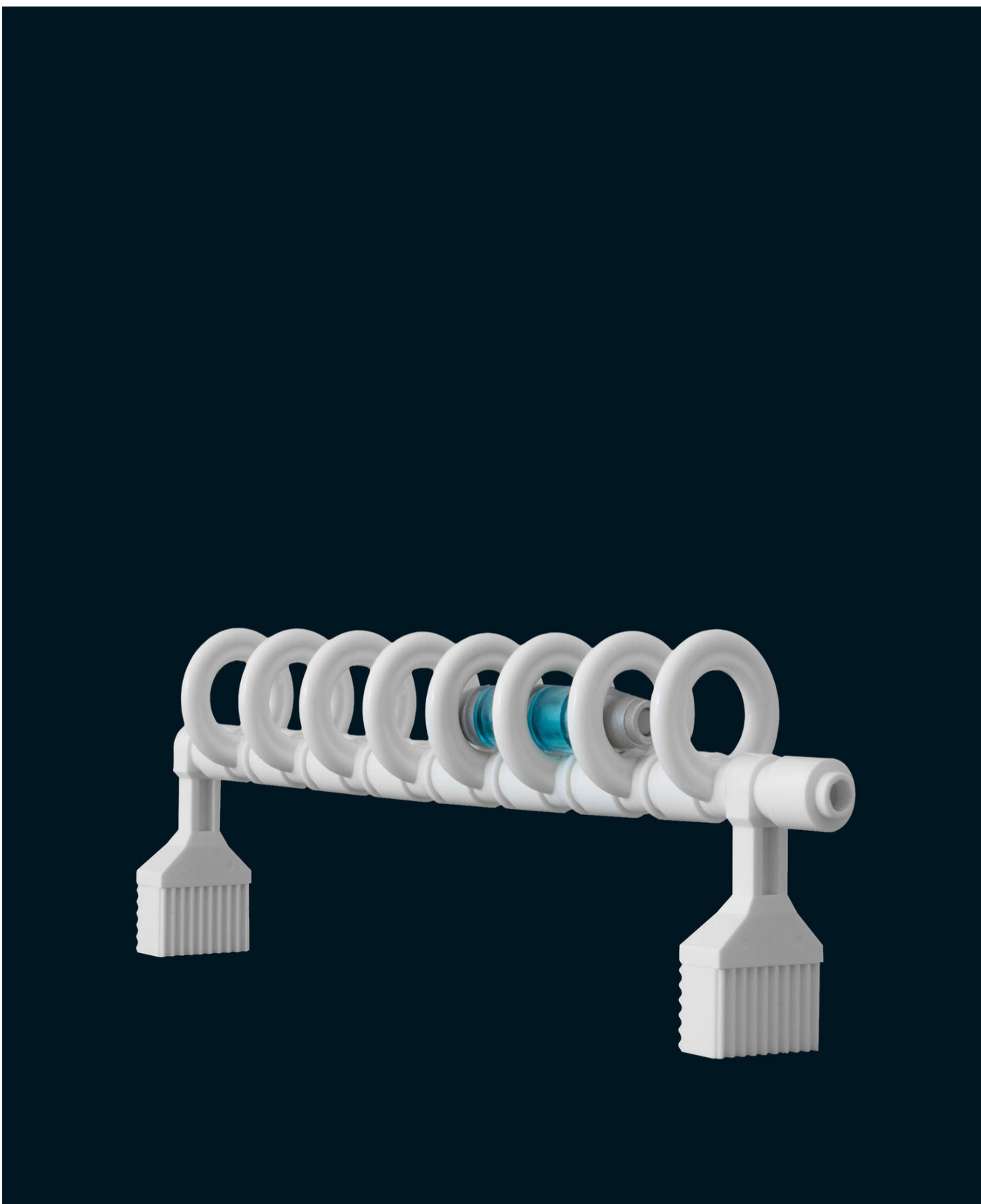
THE HYPERLOOP
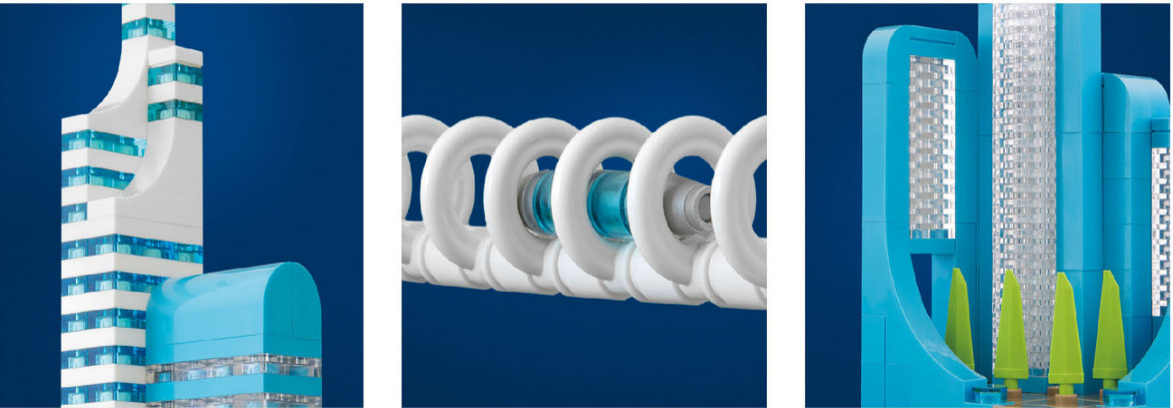
This Hyperloop transports your citizens in style and shows off your city’s technicalprowess.
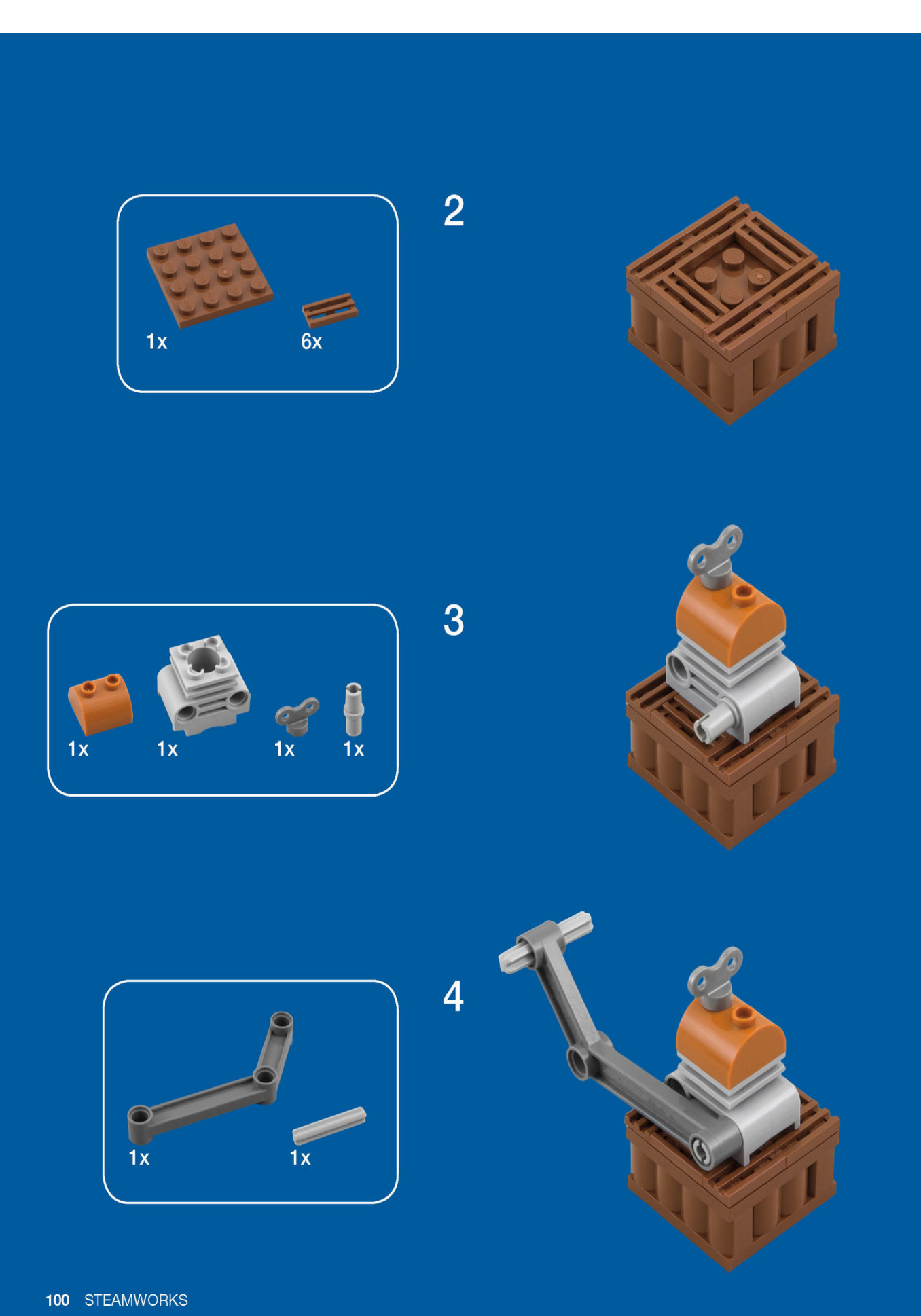
You’lluse minifigurelife preservers to re-create these microscale loops. Then, use R2-D2’s legs to holdthe Hyperloop up. (Don’t worry-R2-D2
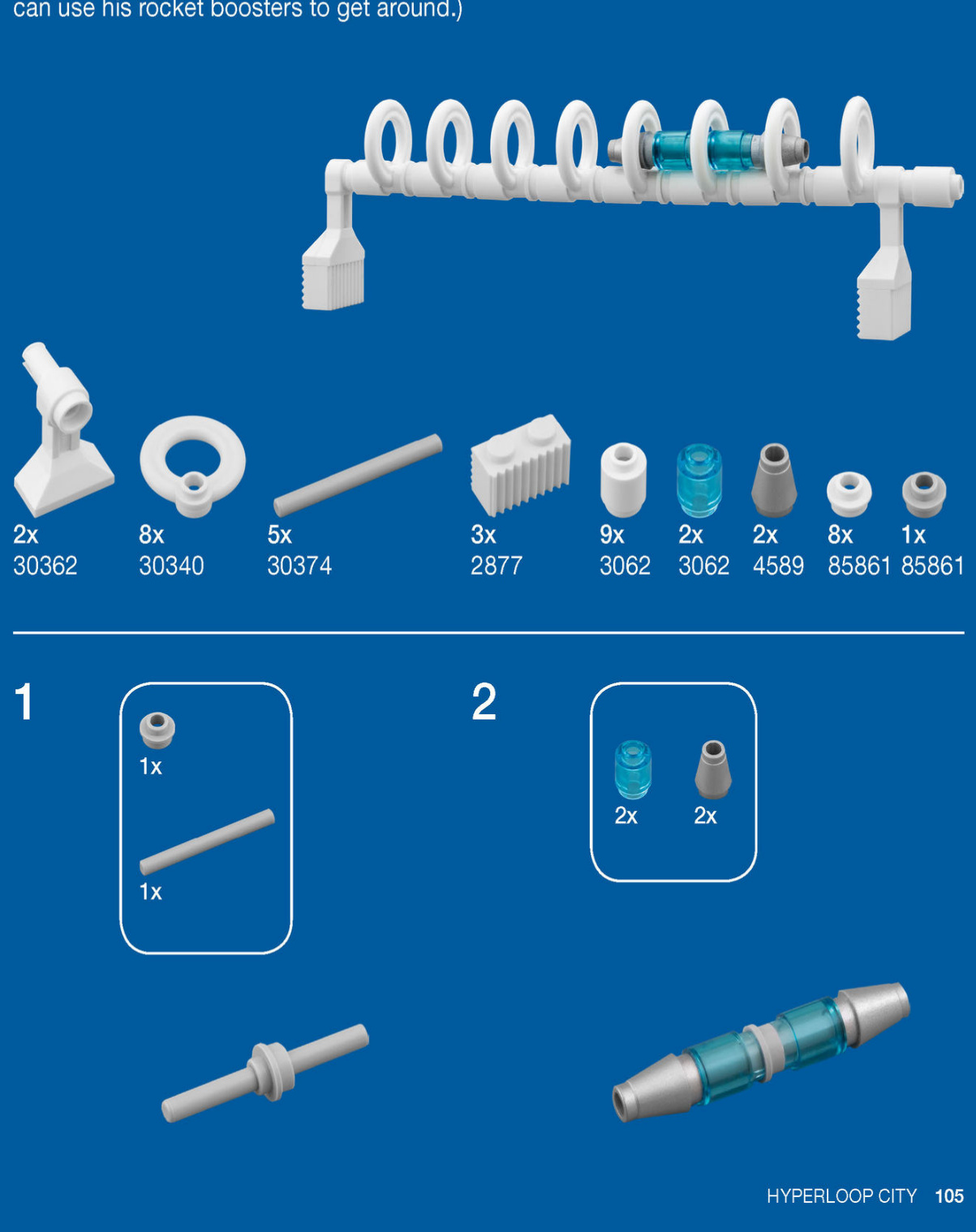
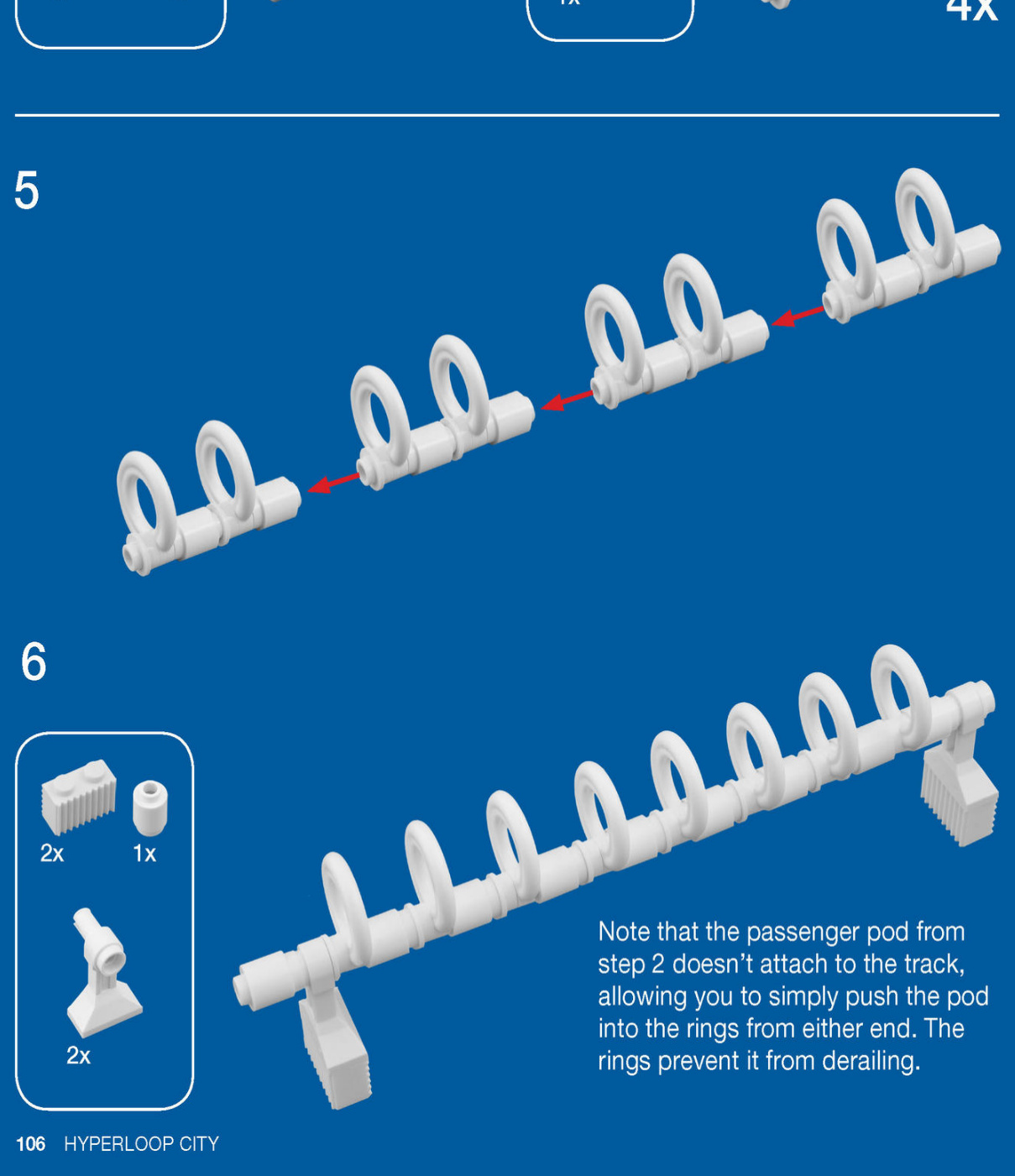
MAKE IT YOUR OWN
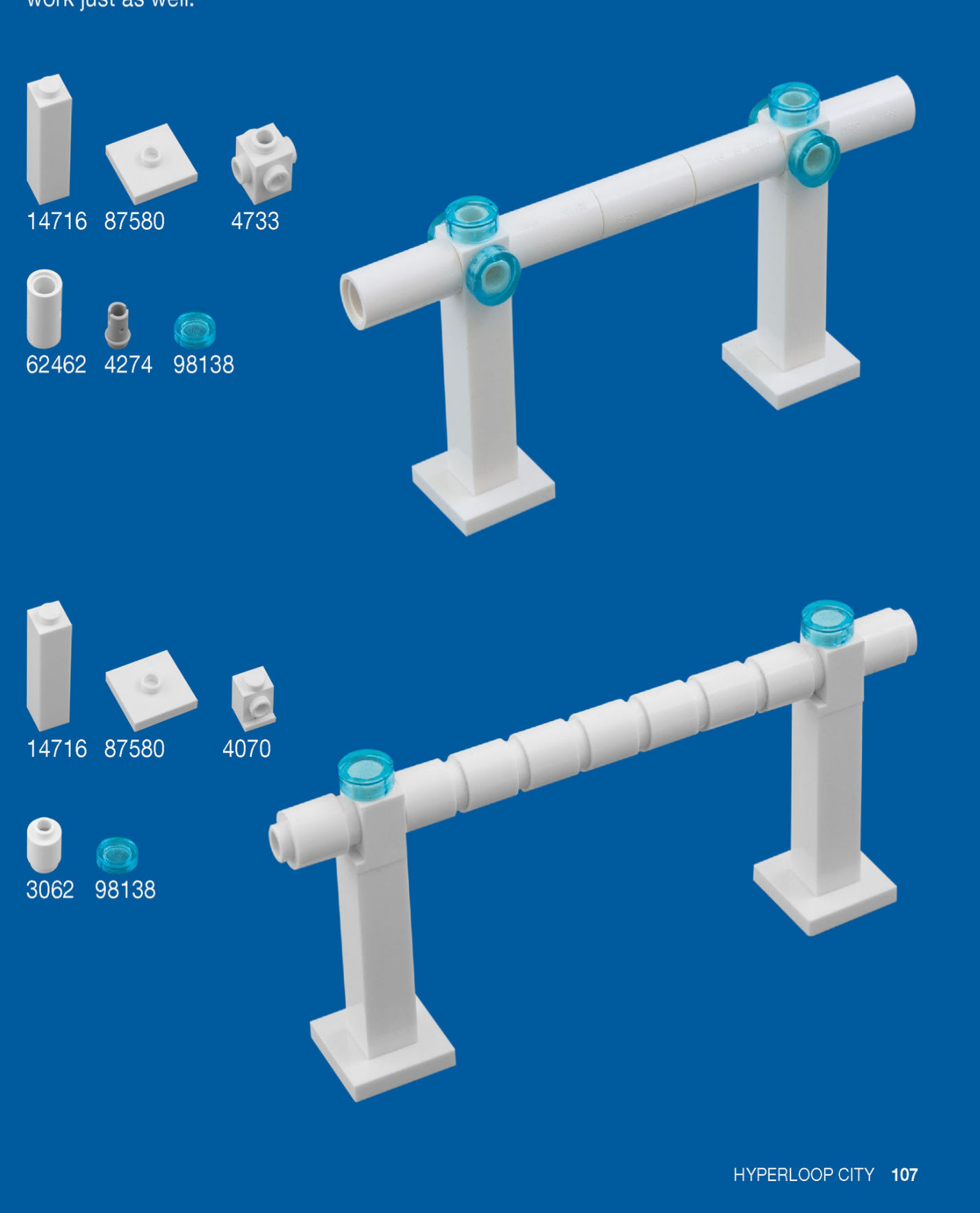
Make a totally enclosed Hyperloopwith basicbricks in place of minifigure lifepreservers.YoucanalsogiveR2-D2hislegsbackanduse1x1x3bricks instead.If youdon’t haveany1x1x3bricks,stackingthree1x1brickswill work justaswell.
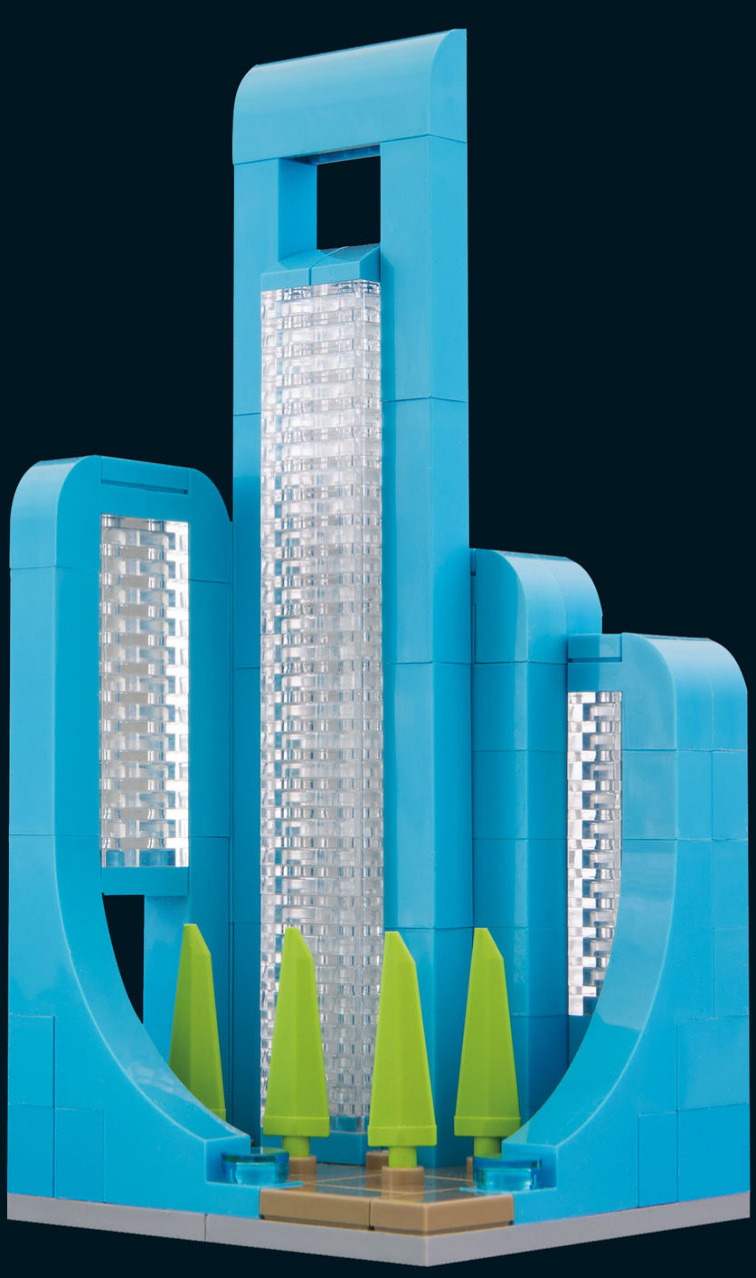
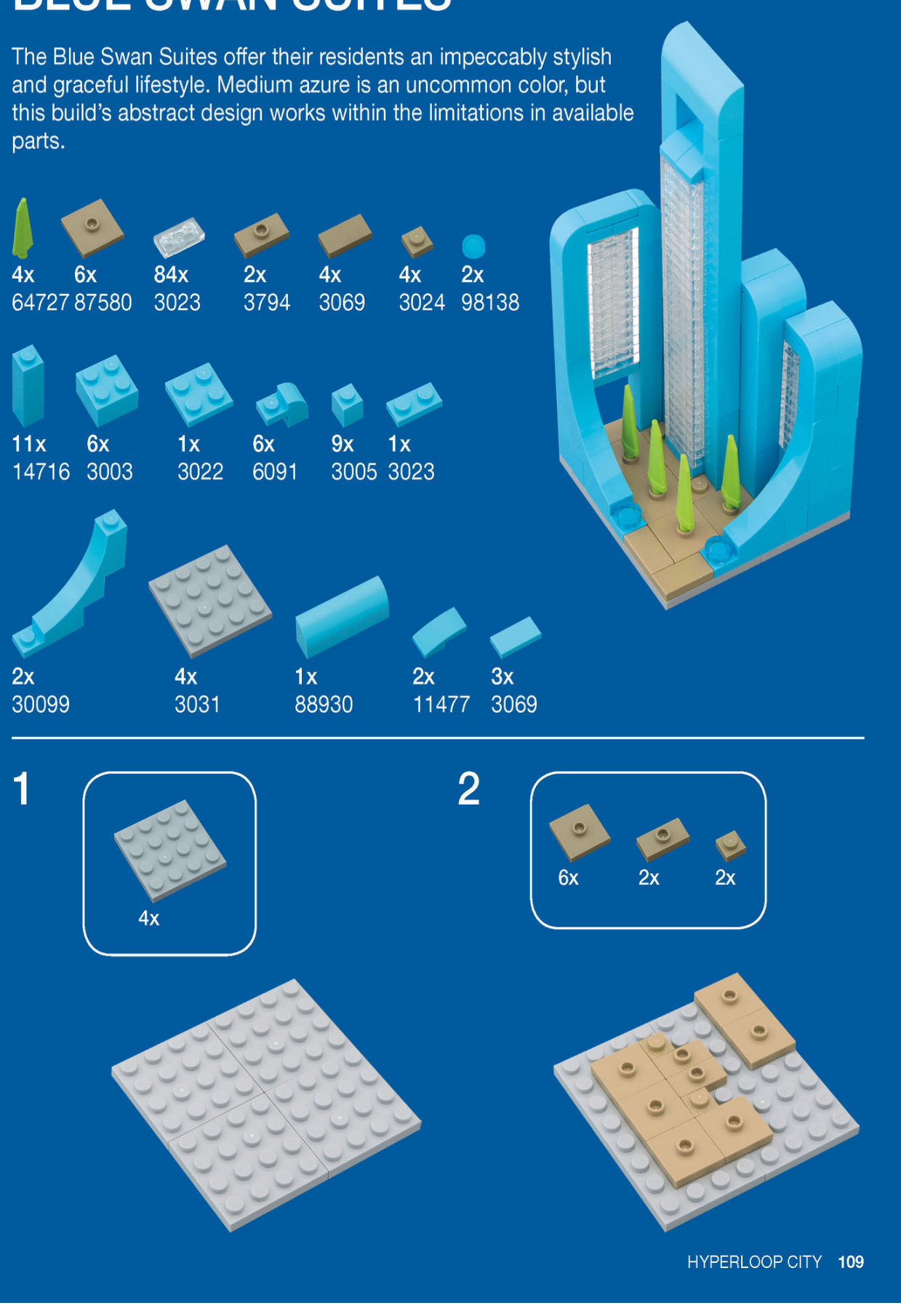
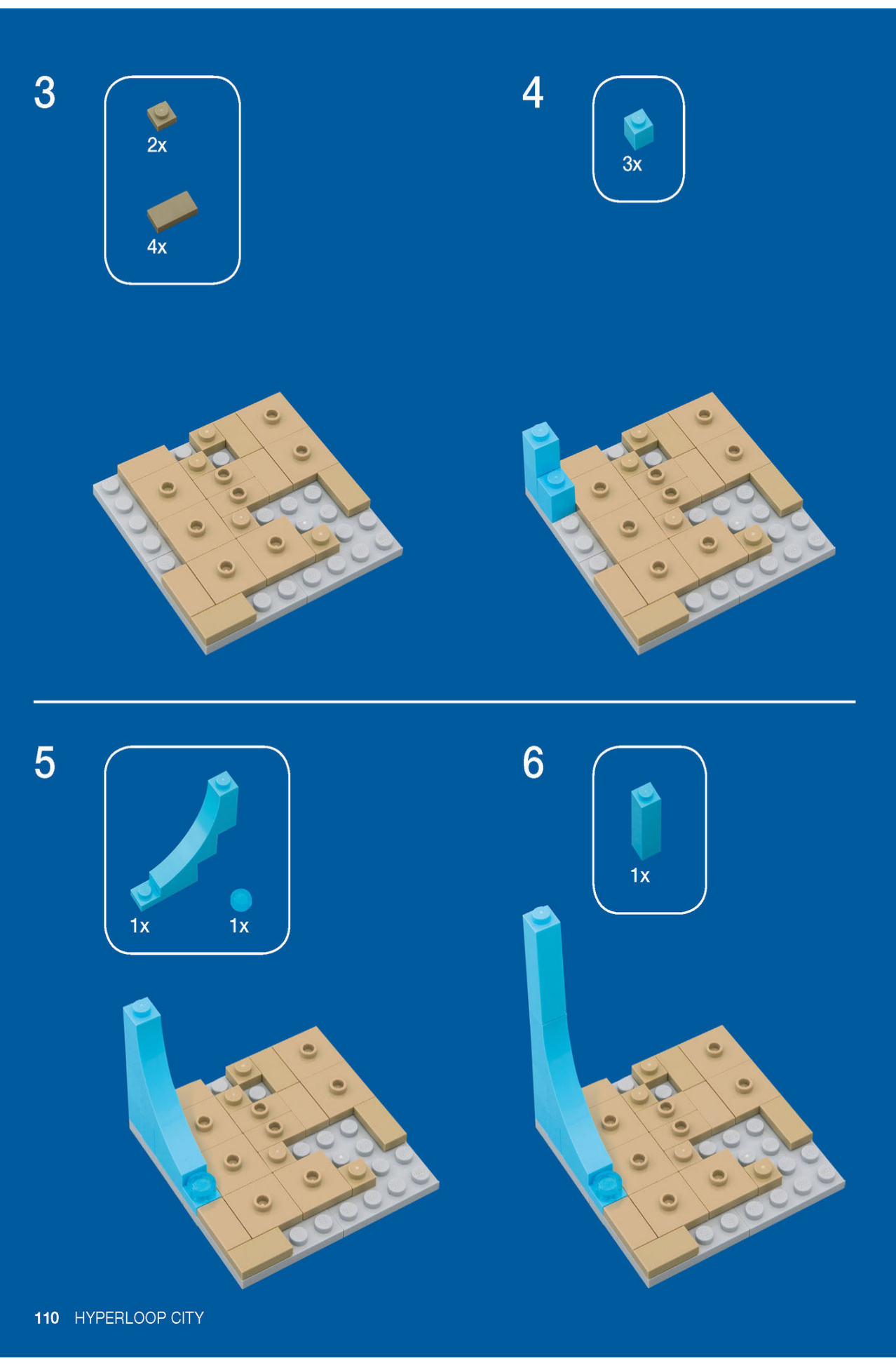
BLUE SWANSUITES
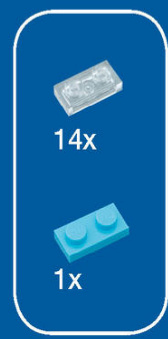
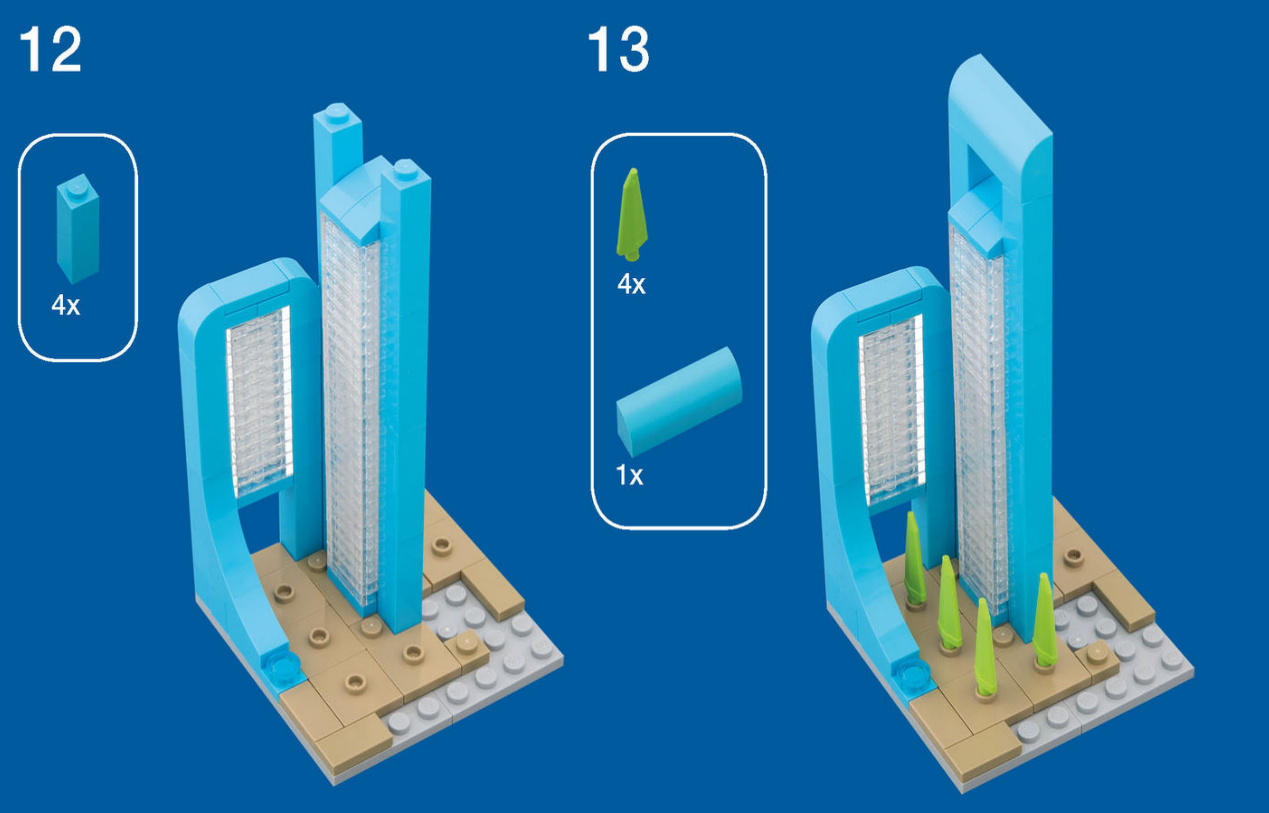
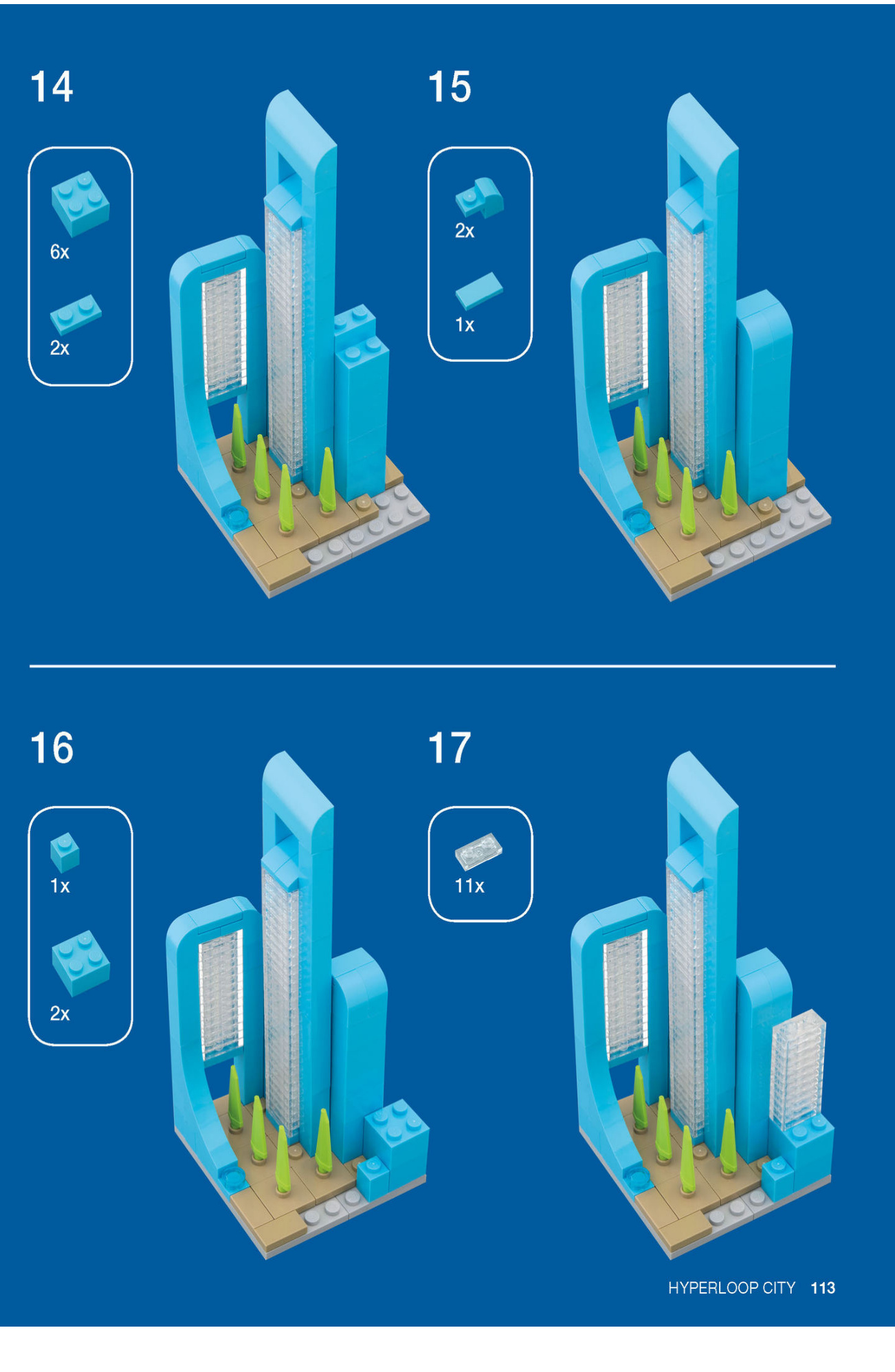
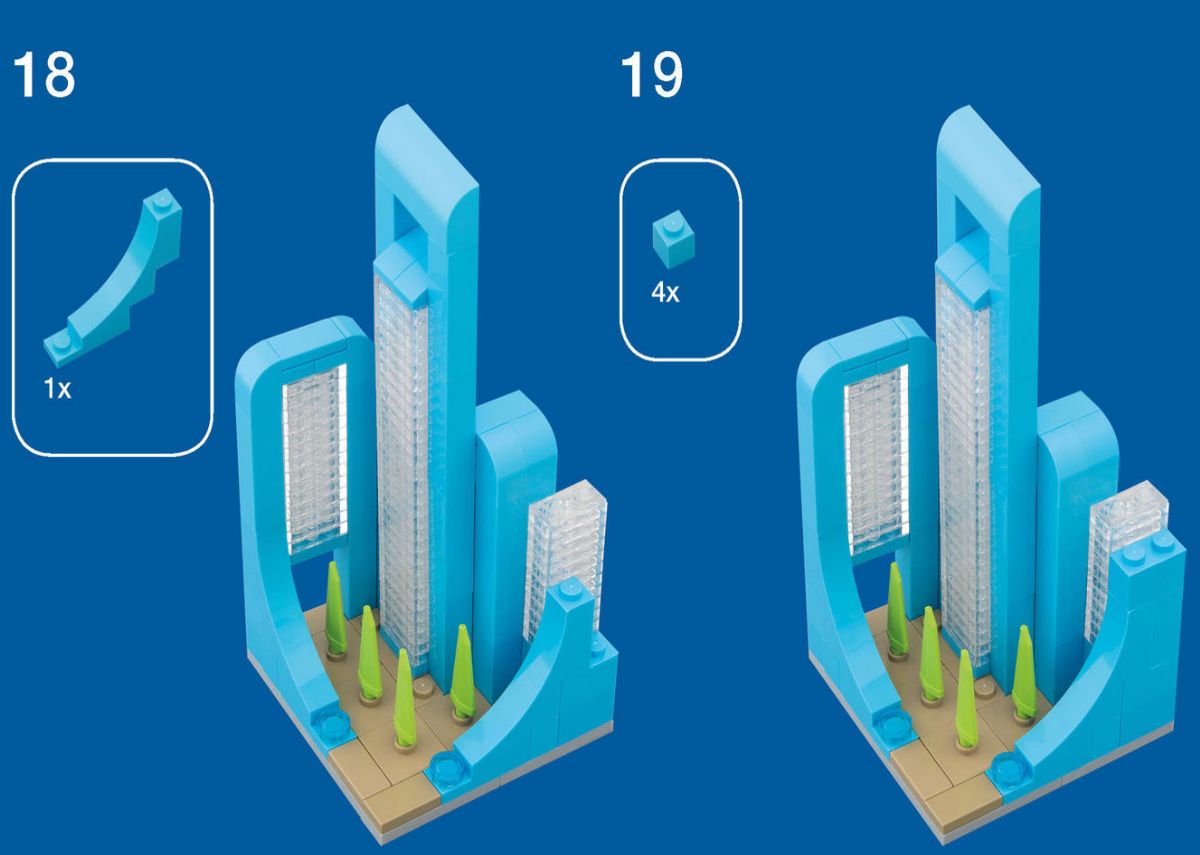
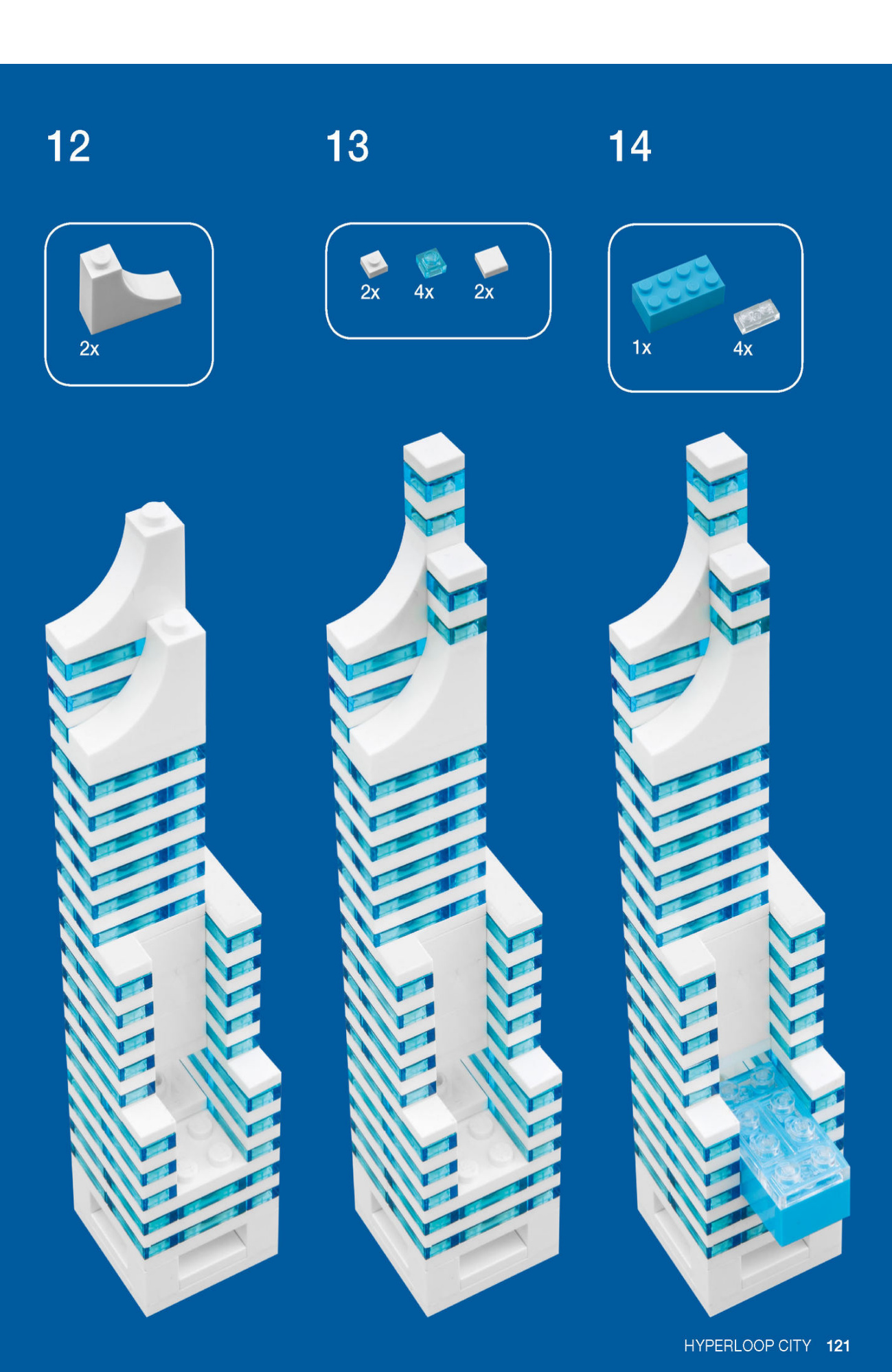
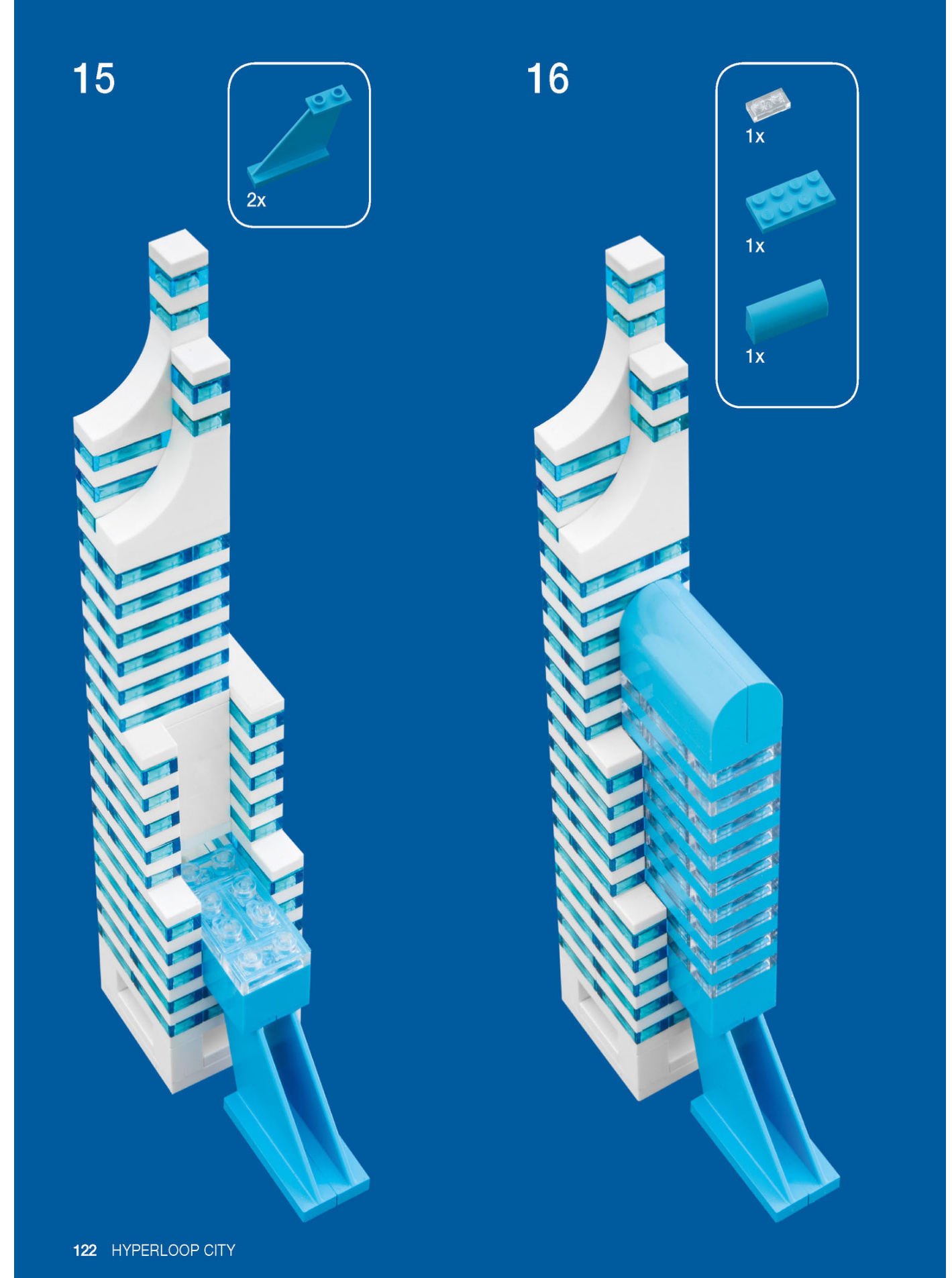
Stackthe 14 transparentplates ontop of theazure one, and then attach the entirestacktotheundersideofthearch.
Theconnectionshould besturdy enough,butit’snotsupportedfrom below.Foraddedsupport, usemore platestobuildallthewaytotheground floor,removingthe1x2tileonthebase plate.
BRICKS KETCHING
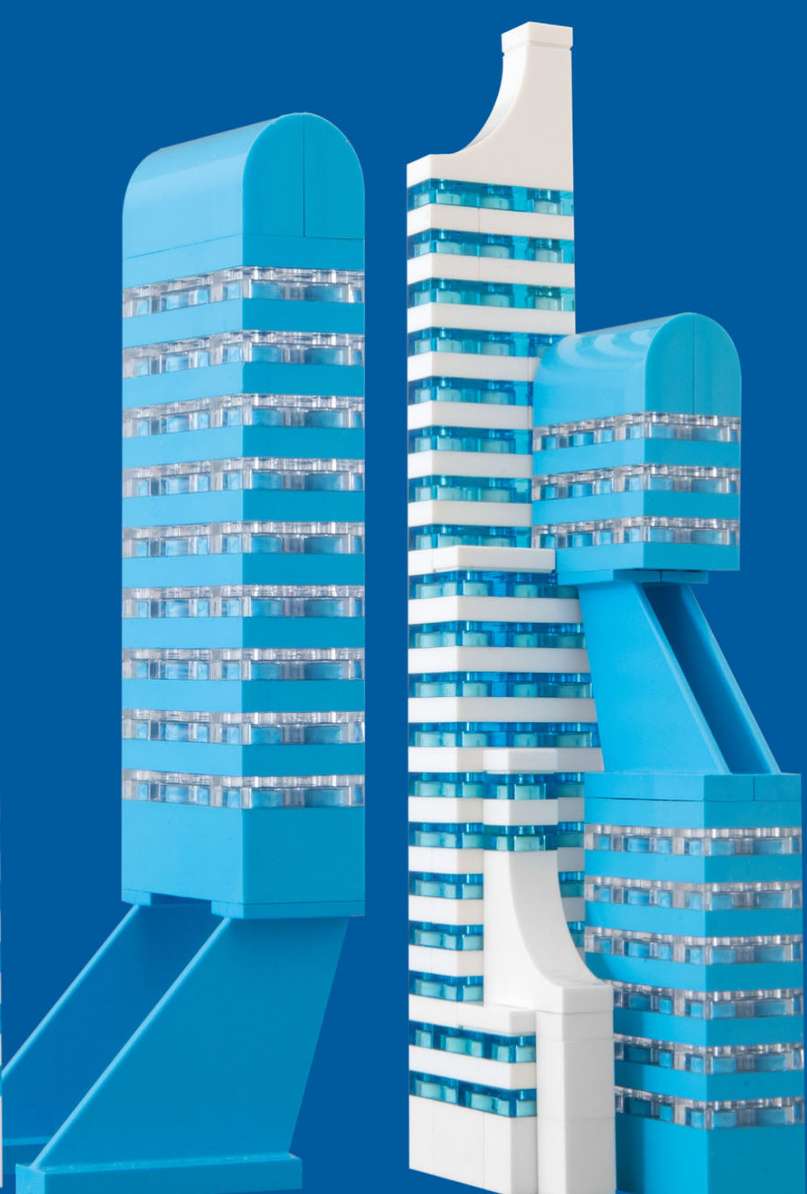
Limitations are good for creativity. For example,theBlueSwanSuites designresultedfromtryingtowork aroundthelimitedassortmentofparts availableinmediumazure
An effective method for designing newbuildingsistogatheralimited selection of bricksfor bricksketching, orattachingbrickstogetherindifferent configurationswithnoparticularplan inmind.Youneverknowwhatbeautiful shapesmightemerge from a freeform build.
MAKE IT YOUR OWN
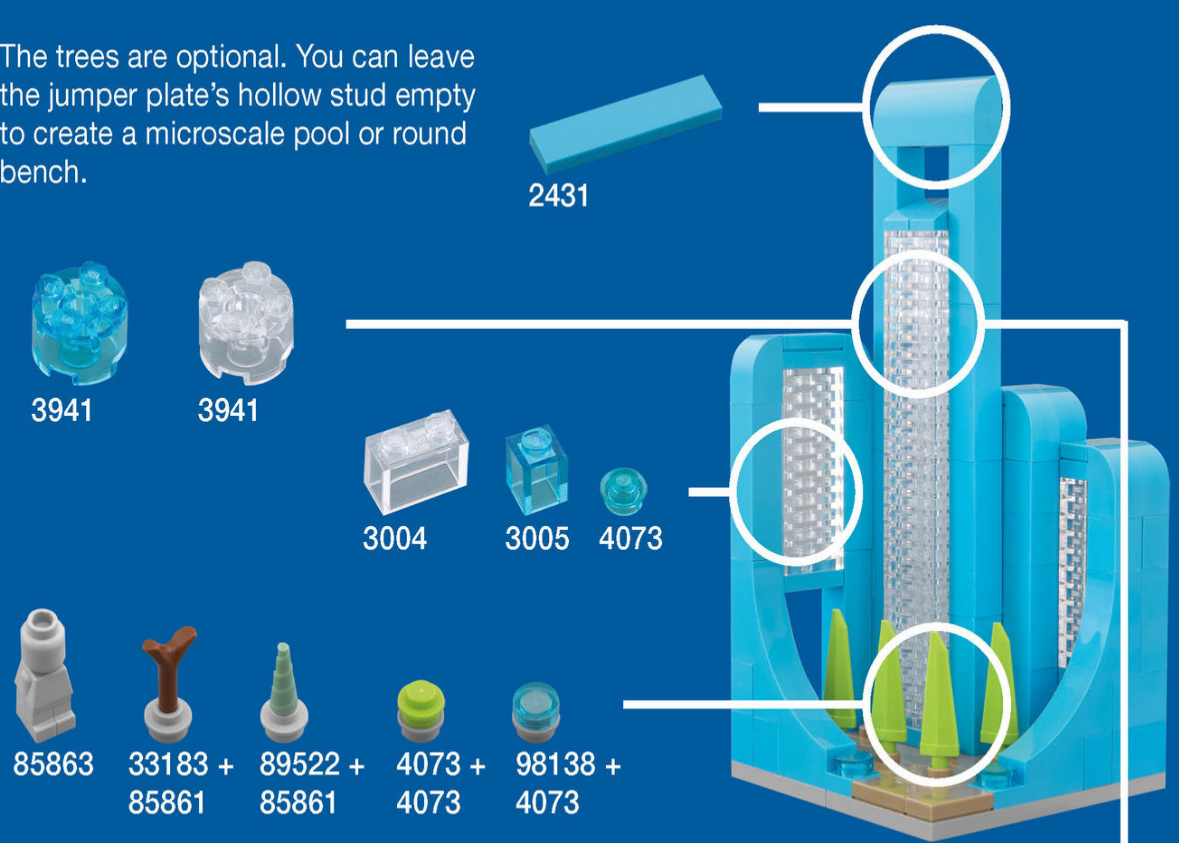
If you can’t find enough parts in medium azure, useanothercolor.
Youcanalsoreplacethe591x2plates inthe central tower with112x2roundbricks.Also, you canreplacethewindows onthesidewings with1x1roundplatestocontinuethecircular windowlook.
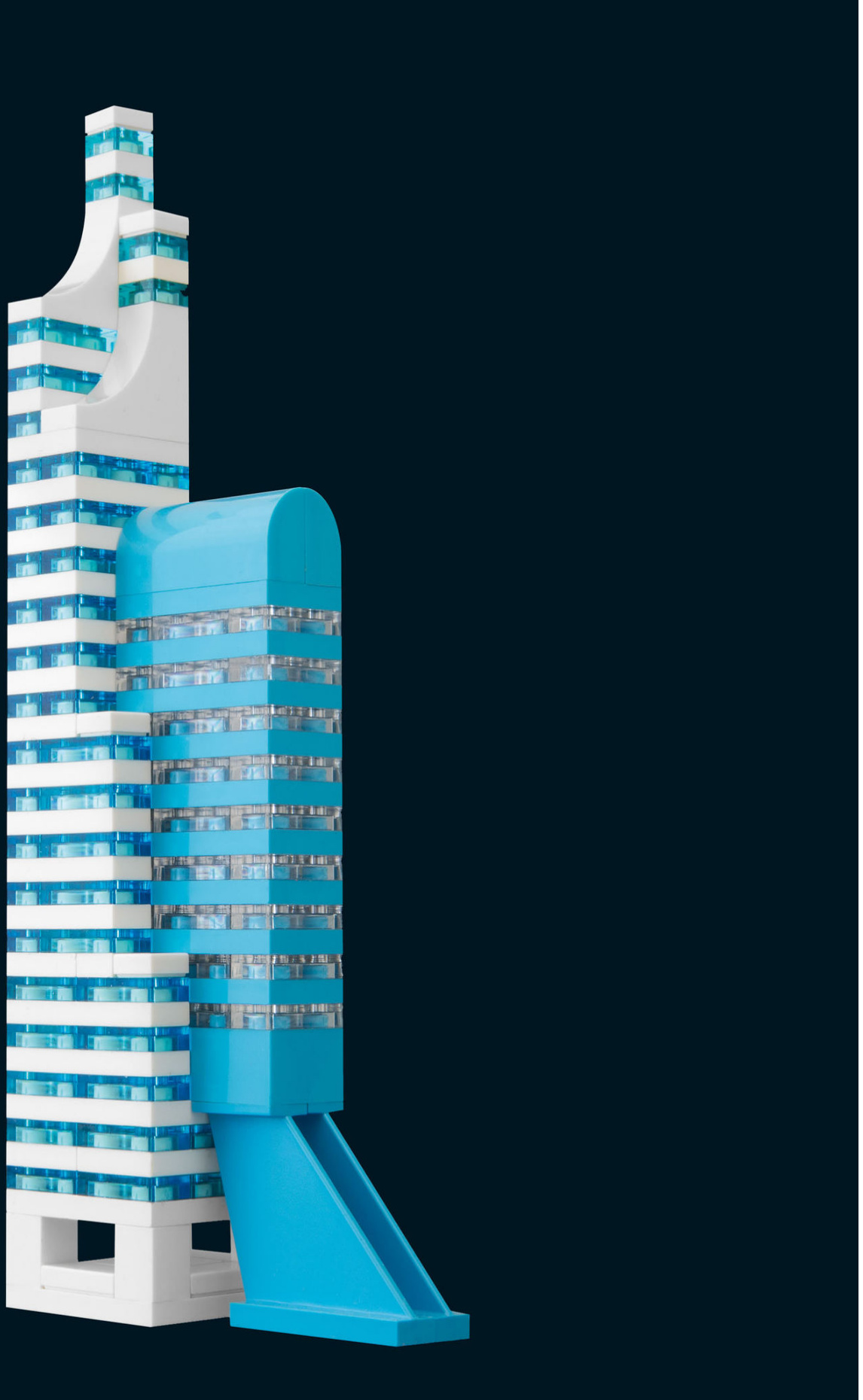
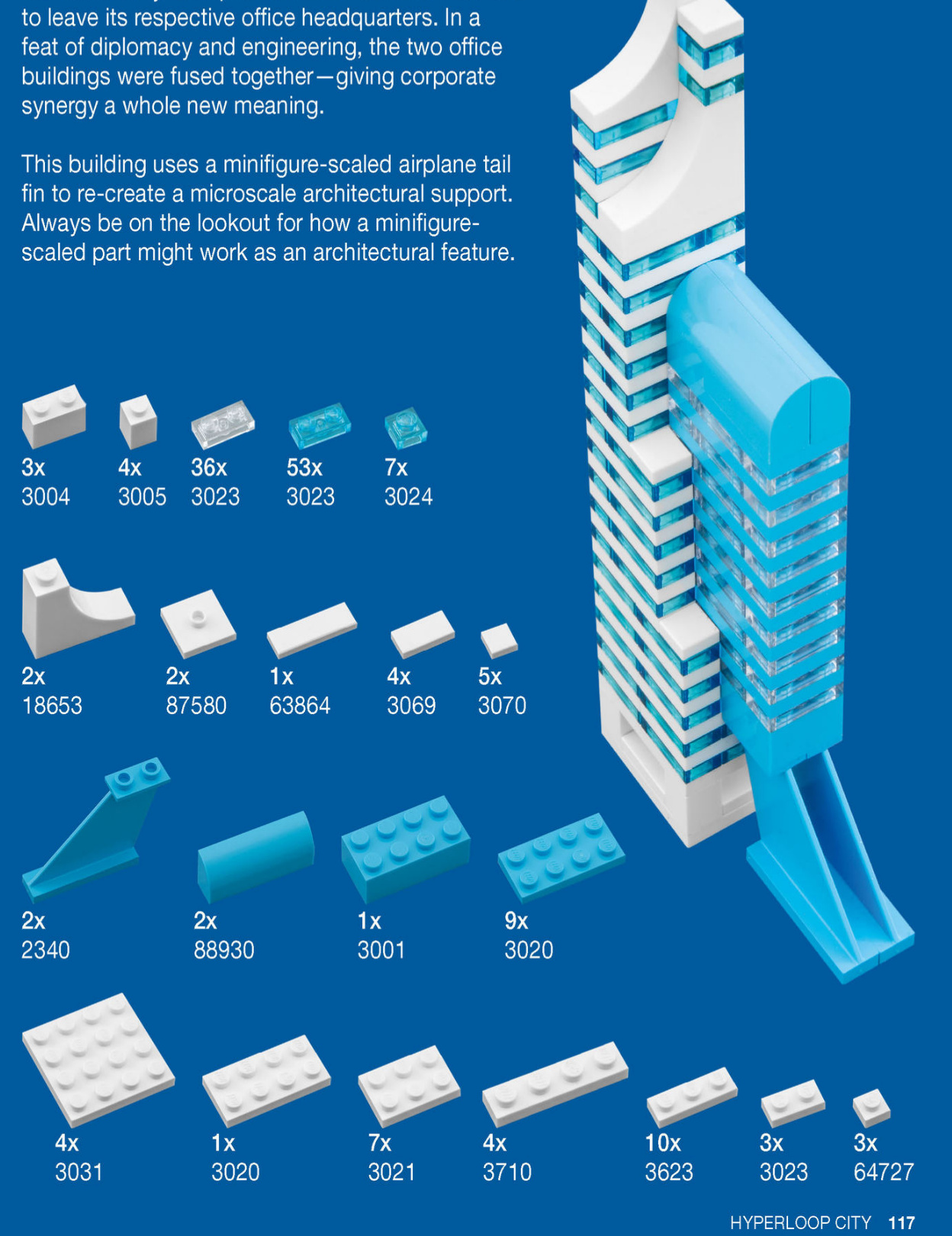
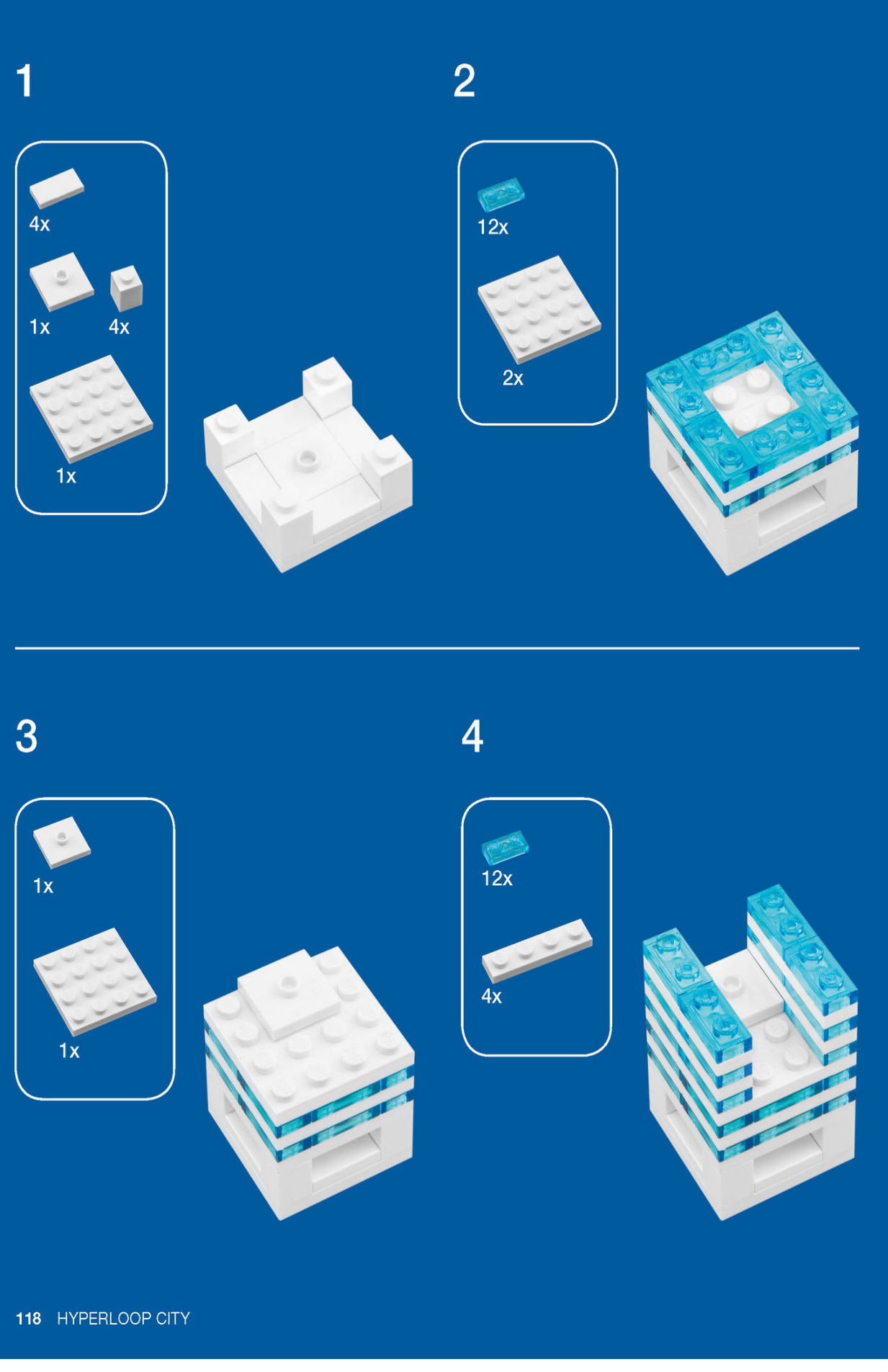
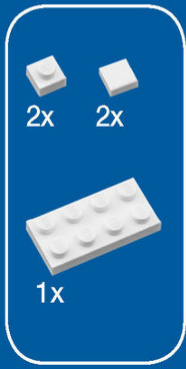
CORPORATE MERGER
The merger ofMaglev Motorsand PickledPretzels wentsmoothly,exceptthatneitherbusinesswanted
MAKE IT YOUR OWN
Don’tbeafraidtobecomeaLEGODJandremixthese piecestocomeupwithnew,unexpectedvariations.
Theformula to generate a LEGO DJ name is asfollows: MC+(your favorite LEGO color)+ (the last LEGO piece yousteppedon).
TOMORROW LAND
Why wait for the future? You can use LEGO to build tomorrow’s cities today.
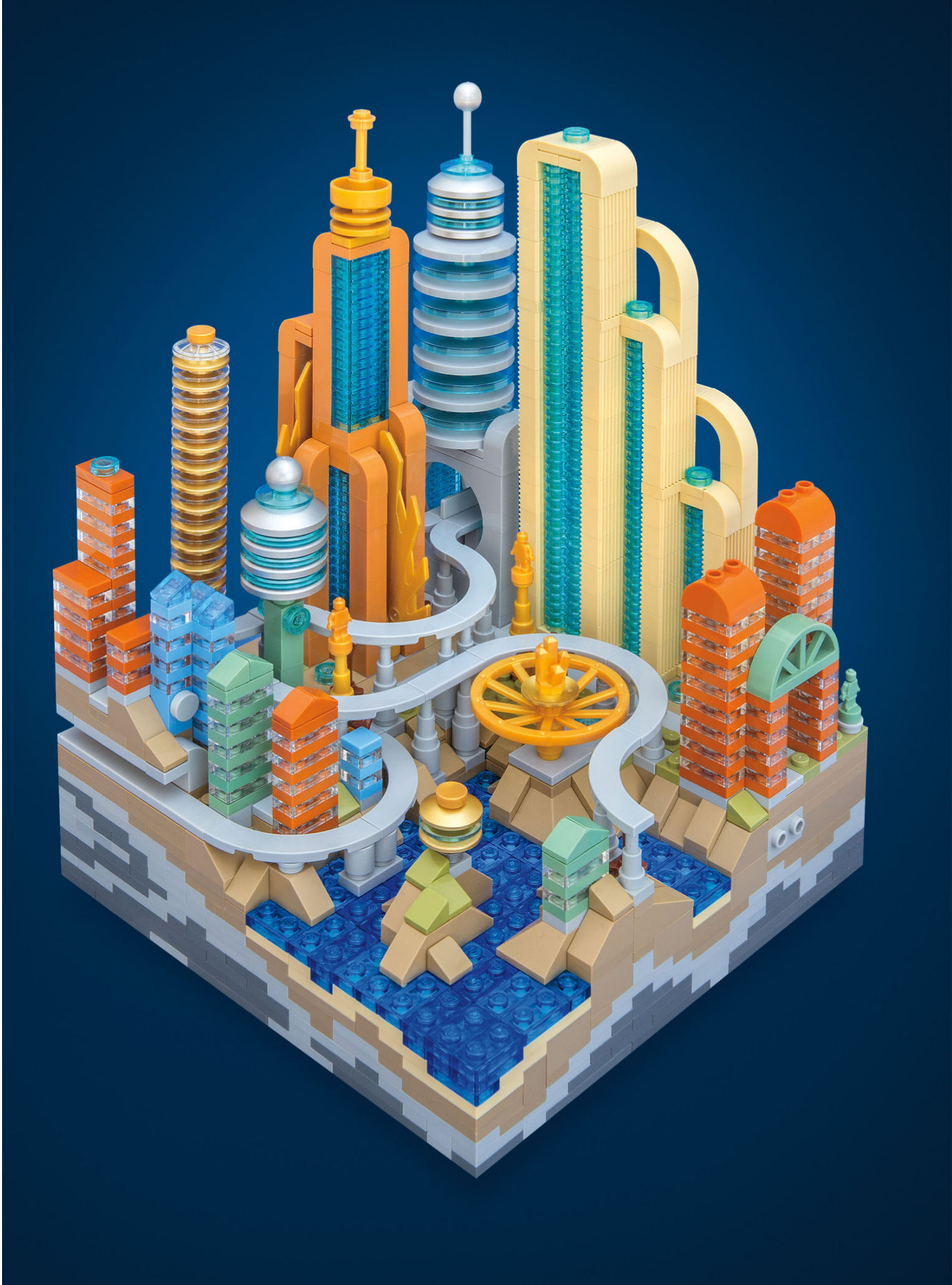
Tomorrowland is inspired by a retrofuturist style known as Googie architecture, reflecting the heady optimism spurred on by the Space Age into the 1960s.With its rounded corners, large windows, and geometric shapes that appear to be in motion, Googie architecture puts a friendly face on the future. If a building looks like it could blast off into space, it’s probably Googie. The Theme Building at Los Angeles International Airport is a perfect real-world example.
Tomorrowland features elevated roadways made with LEGO’s new curved tiles and minifigure telescopes.Its traffic plan is based more on aesthetics than logic,as everything Googie should be. Generous use of rounded elements, such as dishes and curves, makes for streamlined shapes, and windows built with transparent bricks give Tomorrowland’s citizens a great view of the city.